
Home Sellers Can Get Carried Away When It Comes to Greenery
For some real-estate agents, showings are ‘Little Shop of Horrors’ Meets ‘Jumanji’.

By AMY GAMERMAN
Tue, May 11, 2021 4:38pm 3 min
3 min
3 min


For some real-estate agents, showings are ‘Little Shop of Horrors’ Meets ‘Jumanji’.
3 min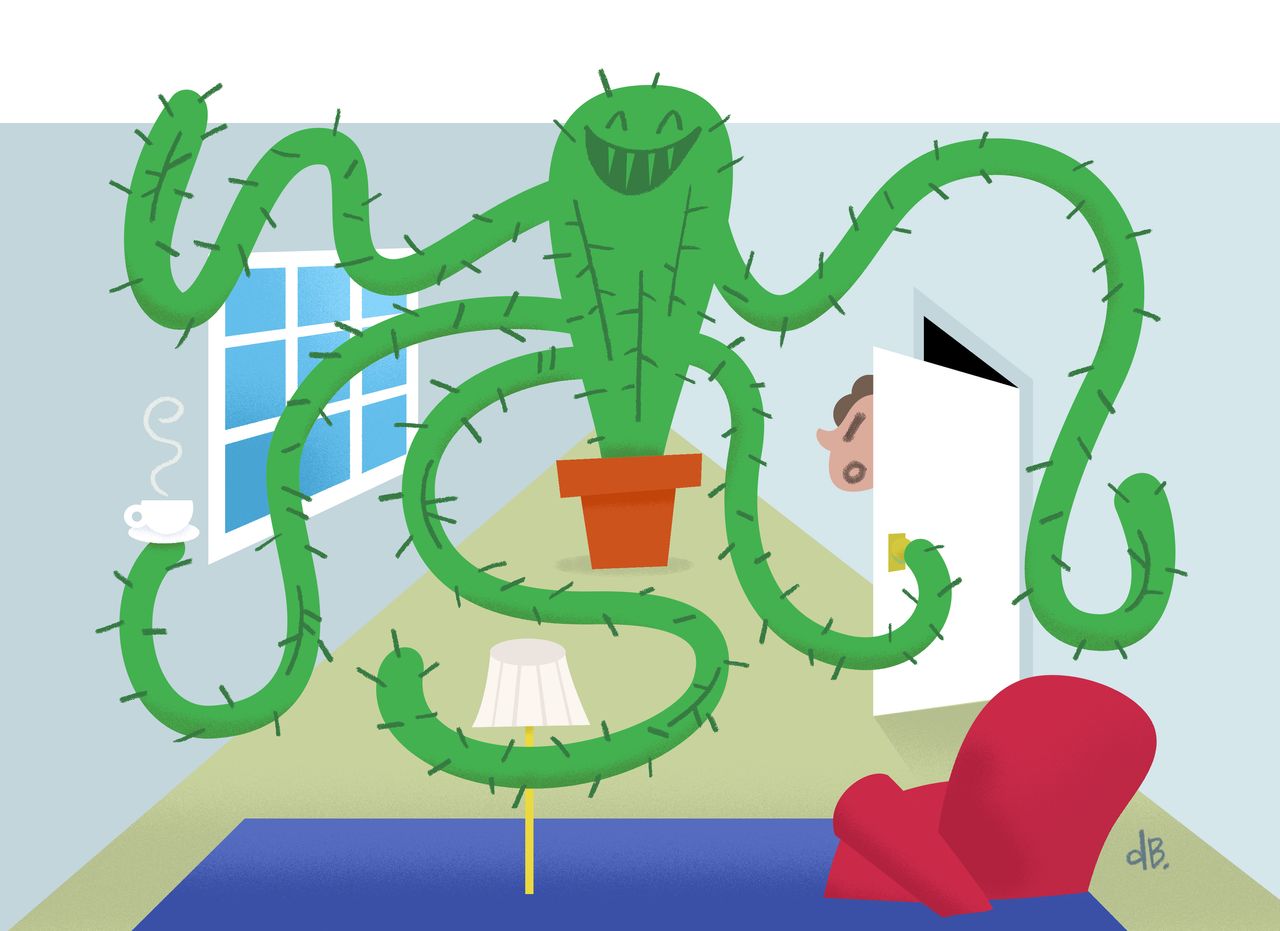
Senior global real-estate adviser and associate broker
Sotheby’s International Realty, NYC
It was an estate sale, a duplex apartment in a prewar building on the Upper East Side. There was a humongous cactus in the living room, the kind you see in the desert in California. It was like a gigantic Christmas tree, at least 10 feet tall, with tentacles coming out and big, big spines all over the place. When you walked in, the only thing you saw was that monstrosity. There isn’t a word to describe this thing. It was like “Little Shop of Horrors.”
I got pricked the first day I went to see the apartment. It was the summer and I was wearing linen pants and a Tory Burch tunic shirt. I went too close to the thing while I was talking to someone and got caught in one of the branches. It ruined my blouse.
The owners had died, and their children didn’t want to stage the apartment. The first week I said, “We at least have to move the cactus,” and they were like, “Oh no, we don’t want to pay for it.”
So I volunteered to move the cactus. I really wanted to sell this apartment.
It took three guys in protective gear with a chain saw. They started cutting the branches, cutting the branches. It took three hours. They filled 30 or 40 bags—big industrial ones. It cost like $600. I gave the super $100 in cash and he called someone to remove the bags.
We sold the duplex for US$3.5 million. Of course, the children weren’t happy with the price.
David Mazujian
Real-estate agent
The Corcoran Group, East Hampton, N.Y.
The listing in the Hamptons was very pastoral, very private, priced $1 million to $2 million. I would say the owner was a bit of a horticulturalist. There were huge plants that in the summertime would go outside but which came inside in October. I was showing the house in the fall. When I came into the house, I was overwhelmed. There were huge pots on the floor. They were beautiful plants, but it just blocked the view.

It was a huge challenge navigating the living space during showings. I was concerned with liability. You don’t want anybody tripping over the plants.
One potential buyer couldn’t get through the door, literally. It was a back door, and there was a very large terra-cotta pot with these large banana leaves coming out.
Apparently, one time a buyer did move the pot and one of the big leaves was damaged. That became an issue with the owner.
So I learned early on that we have to do our best to walk around the plants and not move them and not touch them. I would say, “Oh, I’m really sorry, the owner is a horticulturalist and let’s just be careful as we walk around this plant and slightly move the leaves.”
I love plants, but if I were trying to sell a house, those things would be gone yesterday.
Alexandria Ludlow
Sales associate
Summit Sotheby’s International Realty, Southern Utah
The house was 11,000 square feet and very old-fashioned. It would be a great place to host a murder mystery situation—marble floors, candelabras everywhere, a knight in shining armor. And on every surface and in every corner, there was a fake plant of some kind. There was fake ivy everywhere—over the tops of the windows, on top of the cabinets in the kitchen. In the master bathroom, they had a 4-foot vase with another 4 feet of fake pink lilies. In the kitchen, there were lots of gerbera daisy-type silk flowers and a wreath that was 4 or 5 feet in diameter. It took two of us to move it for the photos. They could have filmed “Jumanji” in that house.
I gave the owners my feedback for how to spruce up the place for staging. They did everything I asked them to. They had to hire a junk-removal service. They said they filled two dumpsters full of the fake plants—the ones they were willing to get rid of. They filled all the walk-in closets with all the other ones. They were so attached to some of these floral arrangements.
The weirder part is that the house was being sold fully furnished, except for the fake plants. When we were in negotiations, I’d say, “Everything except the family heirloom piano and the fake greenery are included.” The buyer was like, “Are you joking?”
Reprinted by permission of The Wall Street Journal, Copyright 2021 Dow Jones & Company. Inc. All Rights Reserved Worldwide. Original date of publication: May 10, 2021.
 Copyright 2020, Dow Jones & Company, Inc. All Rights Reserved Worldwide. LEARN MORE




BNW Developments has established a Sydney presence, joining Arada and Sobha Realty among the growing number of UAE developers pursuing Australian buyers and development opportunities.
The Australian leather house has opened an immersive four-day pop-up in Manhattan, unveiling its Bloom Collection and redefining what a product launch can look like.
A vibrant 1954 Palm Springs home featuring eight colorful murals by late artist Shawn Savage is on the market for $2.295 million. The 2,237-square-foot property features bold hot-pink doors, three bedrooms, a pool, mountain views and playful interiors blending modern glamour with classic Palm Springs style.
3 min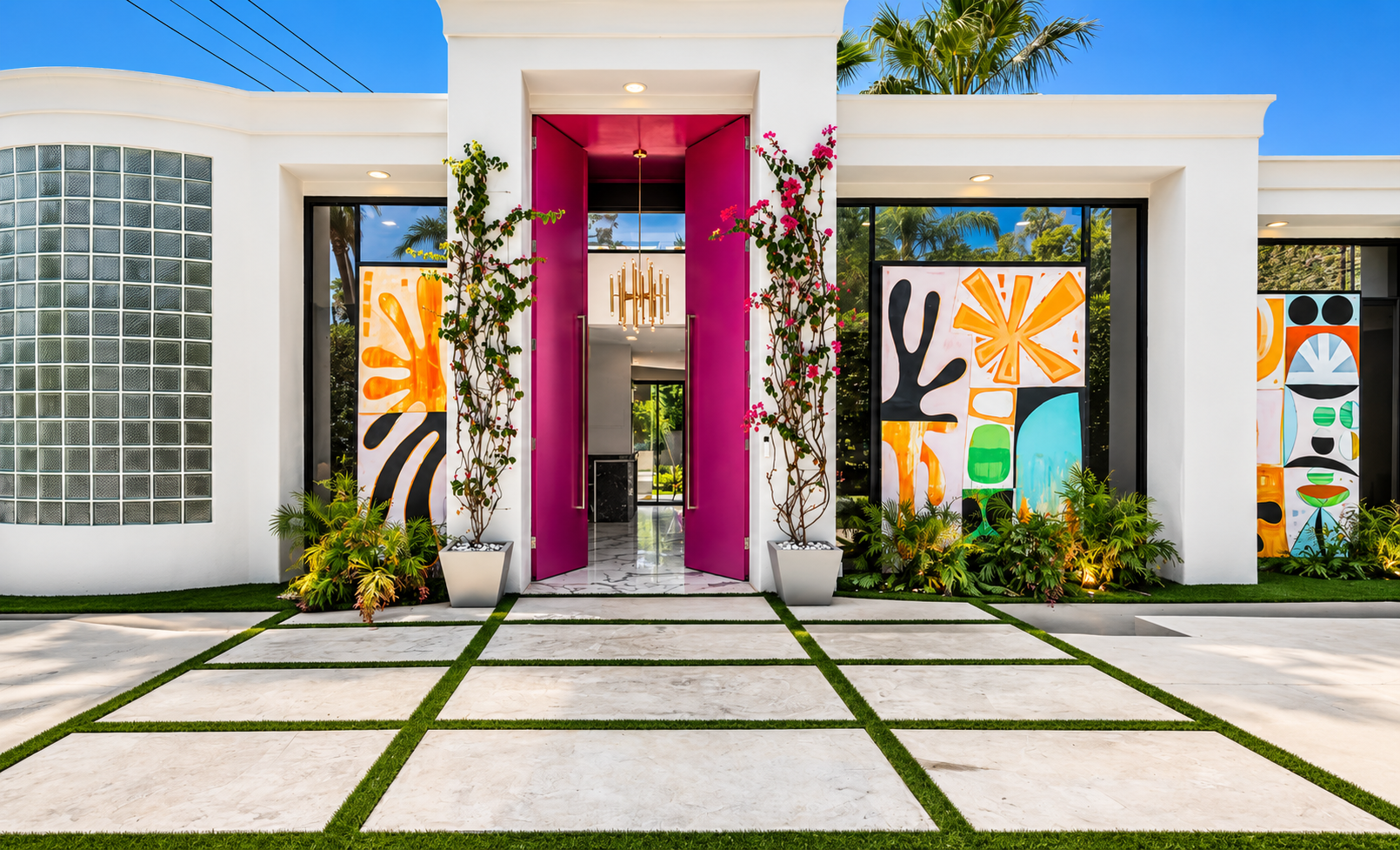
A bold 1950s home in Palm Springs, California, adorned with eight colorful murals by the late artist Shawn Savage, is coming to market ahead of the city’s annual Modernism Week.
The white stucco home on El Camino Way, built in 1954 and recently renovated, has an asking price of $2.295 million. Its staggered facade features three playfully abstract murals on either side of double-height hot pink doors.
MORE: Megamansion Outside Princeton, N.J., With a Pub and Two-Story Library Heads to Auction
The sellers are Los Angeles-based partners John Freeman and Mathieu Faure, who knew it was “the one” when they saw it after several months of searching in the winter of 2023. “It’s a happy house,” Freeman said. “We really liked the feel of the house: the uniqueness, the openness, the brightness—and the art.”
Located in the Mesa neighborhood of Palm Springs, which backs up to the San Jacinto Mountains, the 2,237-square-foot house features three bedrooms, an angled bonus room and a yard with a pool, desert mountain views and another colorful mural running alongside the pool.
“I never thought in my life I would have a house with pink doors,” said Faure, a producer at Apple TV who is originally from Paris. “It’s so colorful, it’s so different. And so Palm Springs.”
The layout of the home creates a smooth flow from the front doors through the open-plan common area—a foyer, bar, and living and dining room—into the kitchen around a fireplace wall and out to the yard. A corridor leads to a private bedroom wing, where the primary suite has floor-to-ceiling windows and the primary bath is only a tad smaller than the bedroom.
Faure has filled the home with Jonathan Adler furniture, rugs and accessories, riffing on the energetic California vibes of the house to create an aesthetic of “modern American glamour,” he said.
“It was enjoyable for me to play with different types of furniture and make this house ‘happy chic,’ as I describe it,” he said.
MORE: Beverly Hills Villa of Late Philanthropist Glorya Kaufman Sells for $19.25 Million
“He did a fantastic job,” said Freeman, who is an attorney and consultant. “It does kind of bring a smile to my face whenever I walk into the house.”
Since the furniture and decor were chosen for the particularities of the space, the couple is open to selling them with the home. Their West Hollywood house is already furnished; the collection doesn’t match the vibes of a Houston loft they bought near family; and Faure can’t imagine these pieces in New York—where he’s lived in the past—he said.
The duo bought the Palm Springs house for $1.925 million in 2024, according to property records, and will list the home Monday. They are represented by Stewart Smith, Patrick Jordan and Kevin Stanley of Bennion Deville Homes/Luxury Portfolio International.
The previous owners had purchased the home in 2021 for $975,000 and then spent more than two years and $700,000 on the renovation, according to Realtor.com. They commissioned Savage, a local Palm Springs artist and painter known for his joyful abstract work, to decorate the home.
MORE: Alpine Villa From Lady Gaga Movie ‘House of Gucci’ Lists for €2.9 Million
Savage, who died in 2024, lived in the Coachella Valley from 2003, and his work can be found in various local institutions and is on exhibit at the Illumine Gallery in Palm Springs. “Some artists pass through a place. Shawn Savage became a part of it,” the gallery’s description states.
Unsurprisingly, the murals invite lots of friendly conversations, as well as guided tours and interested lookers, but never to a degree that it disturbed the peacefulness of their home or the neighborhood, the sellers said. “It felt like living in an art gallery, and you have the exterior that you would share with the world,” Faure explained.
The neighborhood also played a role in their decision to buy, because of its access to the hiking trails of the San Jacinto Mountains, the lack of through-roads and the neighborly environment.
“It’s a very friendly place,” Faure said.

