
Tesla’s China Numbers Might Be Worse Than First Blush
After a day of confusion saw the company’s stock fall.

By Al Root
Wed, May 12, 2021 12:20pm 3 min
3 min
3 min


After a day of confusion saw the company’s stock fall.
3 minConfusion has reigned in recent Tesla trading. There has been confusion about Tesla driving features and a fatal Texas crash; the true impact of zero-emission credit sales; and now over Tesla’s April sales figures in China. One thing is certain: Investors hate confusion.
Tesla stock fell 1.9% Tuesday, but started out the day significantly lower, making the drop actually a small win for Tesla investors. The S&P 500 and Dow Jones Industrial Average fell 0.9% and 1.4%, respectively.
Even though the stock rallied through the day, Tesla’s China sales numbers might be worse than investors initially assumed. Chinese auto industry data show Tesla sold roughly 26,000 EVs in April, down from about 35,000 in March. It’s a decline amid growth for Tesla’s Chinese EV competitors.
The confusion is over exports. Tesla also exported about 14,000 cars from China in April, according to the same industry association. So the question investors started asking analysts is: Did Tesla produce 40,000 cars in China in April, meaning the company sold 26,000 in China and exported an additional 14,000? Or did Tesla make 26,000 cars overall in China, selling 12,000 of those in China and exporting the rest?
Tesla isn’t helping untangle the numbers. The company didn’t respond to a request for comment.
“We’ve been exchanging emails with confused clients all morning,” wrote Piper Sandler Alex Potter in a Tuesday report. His original interpretation of the numbers was that Tesla sold about 26,000 vehicles in China and exported an additional 14,000, but acknowledged the possibility that Tesla only sold about 12,000 in the country and exported the rest of the 26,000.
That would mean Tesla sales declined by nearly two-thirds month to month. But even if the answer is only 12,000 Chinese sales in April, Potter isn’t worried.
“Don’t stare too closely at these monthly numbers,” wrote the analyst. “We prefer to examine Tesla’s market share on a trailing [three-]month basis.”
He also points out that the Tesla plant in Shanghai was closed for two weeks in the first quarter, which might have sacrificed 10,000 or so vehicles. What’s more, Tesla tends to ship most of its units in the final month of the quarter.
GLJ analyst Gordon Johnson isn’t as sanguine and believes the 14,000 deliveries are part of the 26,000 figure. For him, that means Tesla has a market share problem in the world’s largest market for EVs.
Potter and Johnson’s take on the April data aligns with their ratings. Potter rates shares Buy and has $1,200 price target for the stock, the highest on Wall Street. His target price values the company at more than $1 trillion. Johnson rates shares Sell and has the lowest target price on the Street at $67 a share. His target values the company at about $80 billion, or roughly what General Motors (GM) stock is worth.
The entire April report is, frankly, confusing, adding to existing uncertainty surrounding Tesla stock.
Tesla’s driver-assistance function was initially implicated in a deadly Texas crash in April, but it looks as if the system wasn’t turned on, according to preliminary findings by the National Transportation Safety Board. In other words, that would mean the human driver crashed the car, although investors will have to wait to see the NTSB’s final report.
Tesla also reported better-than-expected first-quarter numbers in late April. The numbers, however, were boosted by Bitcoin trading profits and bigger-than-expected zero-emission credit sales—which Tesla earns for producing more than its fair share of no-emission cars and then sells to other auto makers that don’t meet zero-emission quotas.
All the confusion has weighed on shares. Tesla stock is down about 9% over the past month. The Nasdaq Composite is off 4% over the same span.
Regardless of the final interpretation, Tesla’s April sales in China dropped sequentially, while other EV makers’ deliveries rose. That isn’t what Tesla bulls want to see, and it’s another thing to worry about in coming months.
Reprinted by permission of Barron’s. Copyright 2021 Dow Jones & Company. Inc. All Rights Reserved Worldwide. Original date of publication: May 11, 2021.
 Copyright 2020, Dow Jones & Company, Inc. All Rights Reserved Worldwide. LEARN MORE




The Australian leather house has opened an immersive four-day pop-up in Manhattan, unveiling its Bloom Collection and redefining what a product launch can look like.
Following the successful launch of its Palais Collection, MAISON de SABRÉ has unveiled a new modular handbag system offering more than 720 styling combinations.
Nvidia’s earnings will test Wall Street’s confidence in the AI boom.
3 min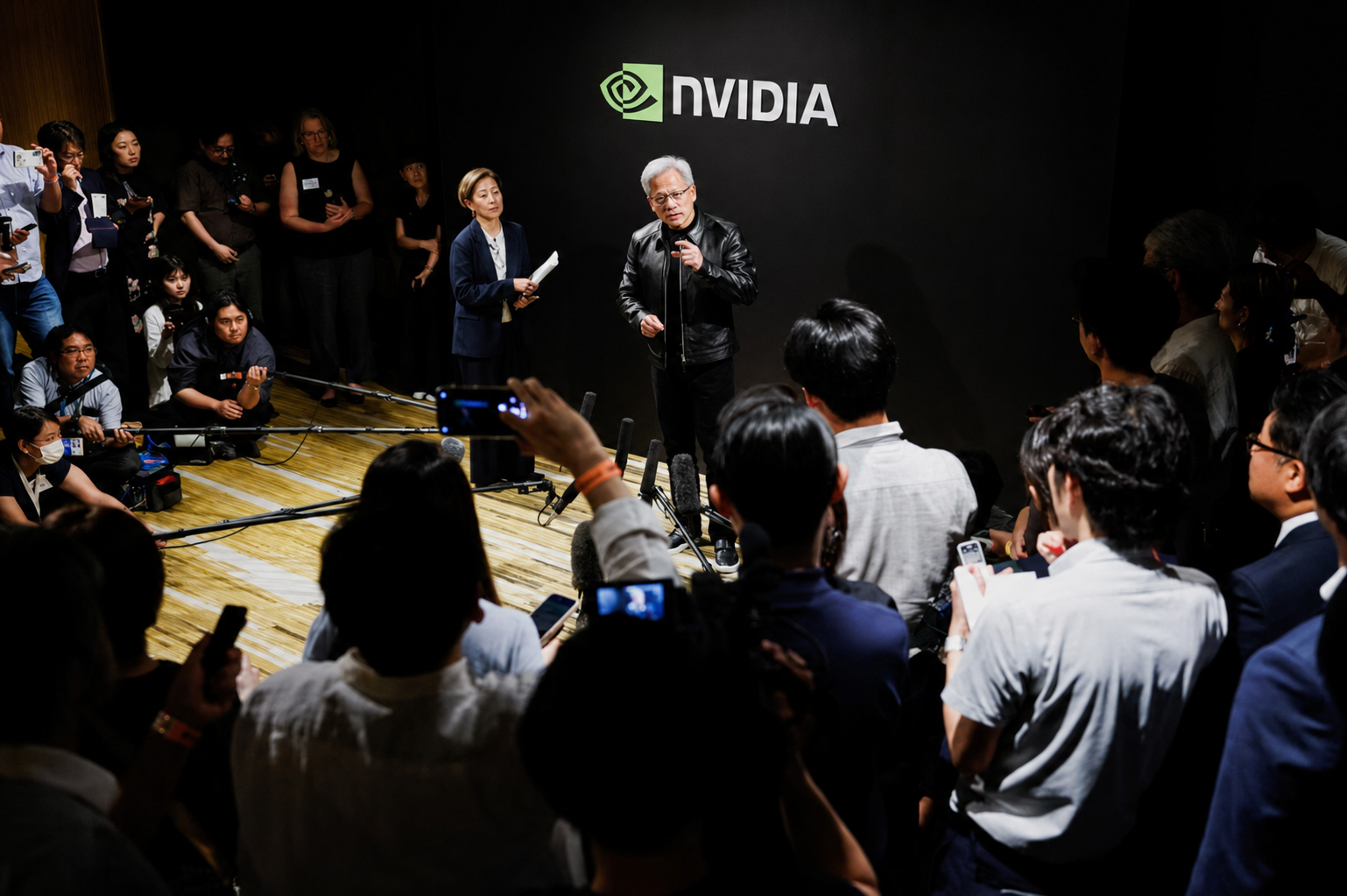
Chip makers are fighting to assure investors that the artificial-intelligence boom is racing forward. Wall Street might not believe it until Nvidia’s NVDA -0.98%decrease; down pointing triangle Jensen Huang says so.
When Huang steps up to the mic for his company’s earnings call Wednesday, he will have the world’s attention. What he says about Nvidia’s present will preview the future of AI, dictate the path forward for a tech-crazed stock market and influence an American economy increasingly tethered to hopes that the boom won’t go bust.
The $5 trillion chip maker has provided the key building blocks for AI since the launch of ChatGPT in 2022 set off a race for dominance among OpenAI, Anthropic and established Silicon Valley giants. Now, as Nvidia backstops sprawling data-center projects and an exotic money pipeline to boost chip demand, the company’s influence is arguably bigger than ever.
But there are signs of trouble ahead. Political pushback to AI is growing. A bond selloff propelled borrowing costs to their highest levels in years. The hyperscalers that include some of Nvidia’s key customers—once cash-printing machines—are relying more on debt. OpenAI recently told investors its revenue rose by a tepid 18% in the second quarter while its losses deepened.
Nvidia is increasingly stepping in to shore up potential weak points across the market. Earlier this month, the company teamed up with six of Wall Street’s biggest firms on a $500 billion AI-financing plan, pledging to backstop lending to customers that can’t afford its chips otherwise. The chip maker last week also took a stake in Cloverleaf Infrastructure, which arranges power for data centers, and struck a $6 billion deal with startup Poolside aimed at developing a powerful open-weight AI model.
After watching shares in other chip makers and the so-called Magnificent Seven tech companies swing wildly in recent months, Wall Street is hoping Nvidia can beat expectations—again. The countdown is on.
“It’s kind of becoming more and more like the World Cup final than the Super Bowl at this point,” said Brian Mulberry, chief market strategist at Zacks Investment Management. “It’s just gotten to be that big.”
The company has smashed analysts’ earnings estimates for each of the 14 quarters since the AI boom kicked into high gear. Nvidia posted 210% annual growth in net income in its last three-month period, according to FactSet, making Wall Street’s 126% projection look pedestrian.
Expectations for a blowout second quarter have risen rapidly over the course of this year. All Nvidia will have to do to beat this target: outrun 95% annual earnings growth to more than $51.5 billion. Analysts project the chip maker will report record sales of $92 billion for the period, up from a forecast of $78 billion at the start of this year.
In July, big-tech earnings sparked volatility. Concerns about runaway capital spending spread across the sector after Alphabet’s and Tesla’s results, driving a $890 billion wipeout that contributed to the unwind of hedge fund Situational Awareness. Microsoft posted the largest one-day gain in market capitalization by any company, ever, after a quarter proving that it could still show investors the money. SpaceX rocketed higher after a record-breaking initial public offering, only to see $1 trillion in value evaporate.
Surging memory prices and borrowing costs have fueled fears that those and other companies will be unable to keep plowing more money into supplies including Nvidia chips. Shaia Hosseinzadeh, founder of OnyxPoint Global Management, has recently bought dips in AI-infrastructure stocks when Wall Street has strained to absorb massive debt issued by Silicon Valley.
“The macro data is really quite robust,” he said. “Of course, there’s a level at which everything breaks.”
Investors have kept pumping money into the AI trade despite concerns around chip consumers—and to the benefit of chip producers. That is why Nvidia’s outlook for semiconductor demand could send ripples through counterparts such as Micron Technology and Sandisk, developers of the data centers in which their chips reside, and a supply chain of power producers, contractors and other specialists that underpin the globe-spanning AI build-out.
“We joke internally that we’re all Nvidia analysts now,” said David Lefkowitz, head of U.S. equities at UBS Global Wealth Management.
The irony is that investors have tended to sell Nvidia stock immediately after blockbuster earnings, with shares falling each trading session after its four past quarterly reports. Some are betting that will be the case this time around, too.
The options market is pricing in a 5.3% swing, higher or lower, in Nvidia shares during the session following earnings, according to Option Research & Technology Services. That is higher than the 4.8% average move in Nvidia’s stock over the last 12 months after the company reports quarterly results.
In recent days, some of the most actively traded Nvidia options have been put contracts tied to the stock falling from its Friday value of $214.75 to $205 and $210 apiece, according to Cboe Global Markets data. Put options give the right to sell a stock by a set price and typically represent a bearish wager.
Many analysts remain optimistic. Frank Lee, global head of tech hardware and semiconductor research at HSBC Global Investment Research, recently raised his price target for Nvidia shares to $360 from $325, citing, among other things, Nvidia’s strategic partnerships with suppliers and its role as a top contributor to open-source AI.
