THE ONLINE BANK THAT WANTS TO RESHAPE WORK AND MONEY - Kanebridge News
Share Button

THE ONLINE BANK THAT WANTS TO RESHAPE WORK AND MONEY

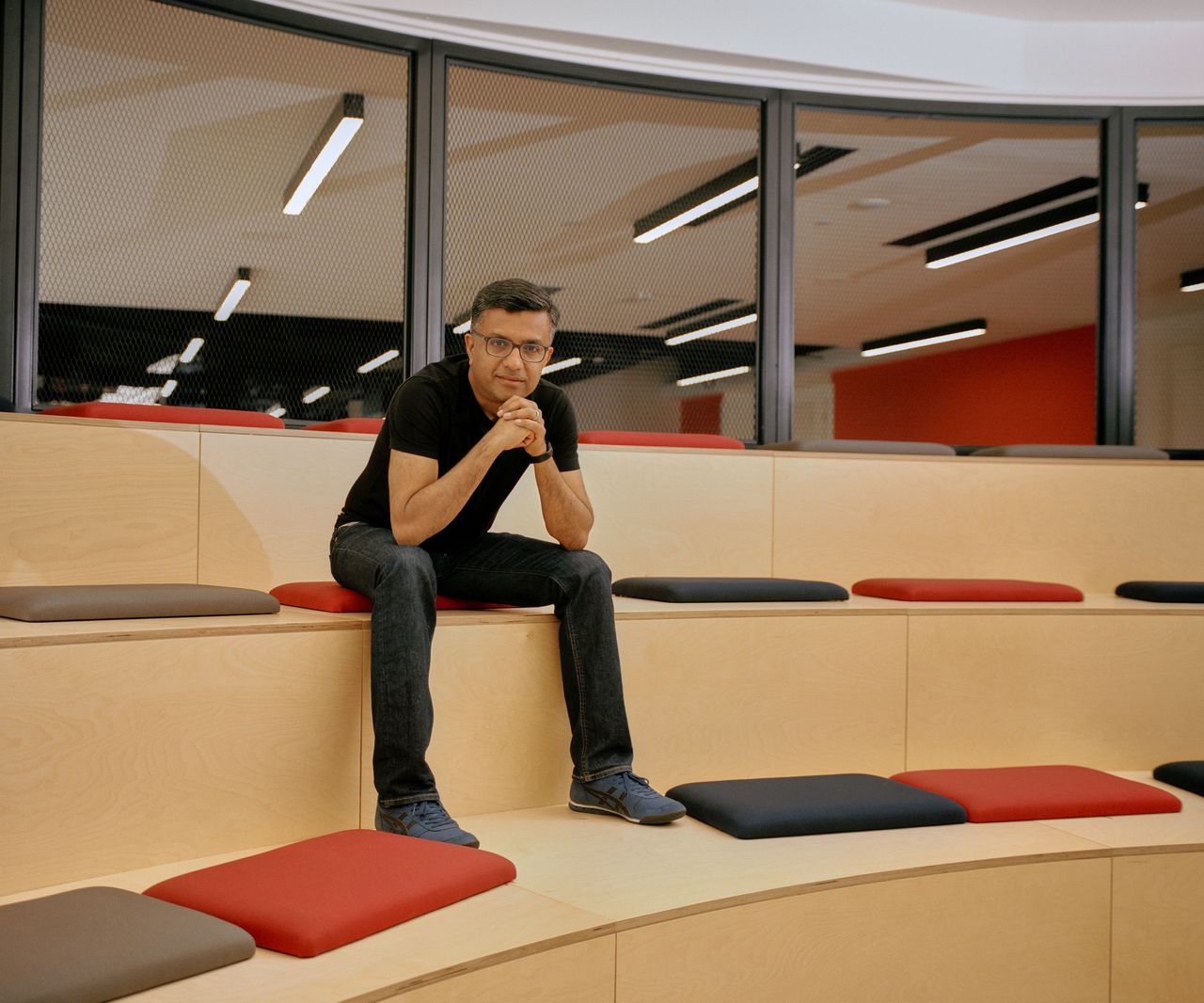
Shifts in benefits and investing are here to stay, says TS Anil, global chief executive of Monzo Bank.

By Chip Cutter
Tue, Jun 7, 2022 11:47amGrey Clock 5 min

If the pandemic changed the way people view their jobs, it may have also ushered in a new challenge for managers: how to keep reshaping work for years to come.

The desire for flexibility and a rethinking of workers’ relationships with their employers are likely to remain well into the future, putting pressure on employers to respond, says TS Anil, global chief executive of Monzo Bank. The online bank based in London officially launched U.S. operations earlier this year; it employs more than 2,500 people globally. Monzo doesn’t have physical banks but instead is based on a digital app that consolidates a user’s financial information and has tools like bots that can direct money into certain categories–say, saving for a future home.

Born in India, Mr. Anil has worked around the world at companies including Standard Chartered, Citigroup and Capital One. He was global head of payment products and platforms at Visa before joining Monzo in 2020.

He says he has spent much time in recent months considering where work is headed and how the financial-technology company’s own workplace policies should evolve. Monzo this year rolled out a three-month paid-sabbatical program for staffers who have been at the company four years or more. Such efforts reflect a desire to find ways to better support employees, Mr. Anil says.

The company is also aiming to stay ahead of changes in the ways consumers manage their finances while competing with its larger bank rivals. Mr. Anil spoke with The Wall Street Journal about what he’s focused on next.

The job market right now is tight–workers have more leverage, and employers have responded. Five years from now, will employees have as much power as they do today?

What has continued to change slowly over the last several years—but then Covid quite possibly accelerated—is the shift in mindset about what it means to work. People, increasingly, don’t want their jobs to just be about, “I go do this, and I get a paycheck.” People want meaning from their work, people want the ability to work in ways that work around their lives effectively. That shift creates opportunity for companies like us who are leading the way in terms of understanding what employees want and are willing to not be anchored to a historical way of doing things. So, yeah, I don’t think things go back in five years; this is an important cultural shift, and it’s a welcome cultural shift.

What are the new benefits companies will need to offer in the future to get employees to stay?

It’s hard to speculate on specific benefits. At Monzo, we’ve always been about our values. One is this idea that you help everyone belong. And it means we come up with ways that we can institutionalize policy to make everyone get that sense of what works best for them. We announced additional paid leave for colleagues of ours who suffer pregnancy loss, or who are undergoing fertility treatments.This is one of those where it feels like this should have always been offered by companies around the world.

What was it that prompted you to start offering paid sabbaticals?

We’re now going on seven years old, and building a bank—or really any kind of tech company—and scaling it is a marathon not a sprint. And we’re at the stage where enough of our employees have put in a few years of incredibly hard work. As we built it out, it felt like a good time to give people the ability to take a break, recharge, come back with even more energy to continue this marathon that we’re all excited to be on.

What has the response been like—how many people have signed up for a sabbatical?

I don’t have the numbers that add up how many we’ve already done since we’ve announced it, but lots of people have queued it up in terms of what they want to do in a few months, at the end of the year, early next year, and so on. So the response has been amazing.

When you look at banking, what’s the biggest change you expect to see in the industry in the next 10 years?

The biggest thing that I hope we see is making money work for everyone, which means really giving people the tools to make great decisions for themselves, to help them understand and make sense of their money. It’s still amazing and sad how little customers around the world are supported in all decisions related to their money. It’s such a source of anxiety for customers, that I’m hoping that, in the next decade, as an industry, we’ve solved that problem.

Is there a specific shift you foresee in how people will manage their money?

What I aspire to for us is that across all of your financial needs—whether it’s spending, paying, transacting borrowing, saving, investing—all of that happens in a single place. So as an individual trying to make sense of my money, I can see it all in one place; I can visualize it, I can analyze it.

What are the challenges you feel the company will need to overcome to fulfil this vision?

It’s important for us that we continue to evolve our culture for the scale that we’re growing into. That’s probably the single biggest one, to make sure that you preserve the best aspects of your culture—what we internally describe as the golden threads. Keep the golden threads, let go of the stuff that’s not working and keep evolving it. If you can get that right, then you can continue to scale and continue to have impact.

What will your job or industry look like in 2030?

It is making money work: taking the anxiety out of it for [customers] and replacing it with a sense of control and the sense that their money is working. It’s this idea of a single financial control centre—it’s in one place, they get in there, and they understand across the financial needs what the best choices are and they’re able to make them. The fundamental job of CEO is to enable the team to do the best work of their lives, and do it in a context of creating better and better outcomes for customers and for the company as a whole. So the fundamentals don’t change; that will remain the job of the CEO.

OK, five years from now, will people be working in offices more or less than today?

We joke inside the company that, what people talk about as the future of work, we talk about the now of work. Even before Covid-19, we were remote enabled; hybrid work was a reality for us anyway. Technology enables remoteness, but the human need for connection is just as real. The interplay between these two forces, I think, is what the future will be informed by. I’ve never thought of the future as being sort of homogenous, just like the present is not homogenous, right? Even in the same country, in the same company, people have different realities. The future will not be different.

Reprinted by permission of The Wall Street Journal, Copyright 2021 Dow Jones & Company. Inc. All Rights Reserved Worldwide. Original date of publication: May 6, 2022.



MOST POPULAR

Rugged coastal drives and fireside drams define a slow, indulgent journey through Scotland’s far north.

A haven for hedge-fund titans and Hollywood grandees, Greenwich is one of the world’s most expensive residential enclaves, where eye-watering prices meet unapologetic grandeur.

Related Stories
Money
What Is Artemis II? The NASA Mission to Fly Astronauts Around the Moon
By Micah Maidenberg 30/03/2026
Money
Saudi Arabia Sees a Spike to $180 Oil if Energy Shock Persists Past April
By SUMMER SAID, RYAN DEZEMBER AND DAVID UBERTI 20/03/2026
Money
Gen X Is Stuck in the Middle and Financially Squeezed. How One Financial Adviser Is Helping.
By Anne Field 18/03/2026

The lunar flyby would be the deepest humans have traveled in space in decades.

By Micah Maidenberg
Mon, Mar 30, 2026 4 min

It’s go time for the highest-stakes mission at NASA in more than 50 years.  

On April 1, the agency is set to launch four astronauts around the moon, the deepest human spaceflight since the final Apollo lunar landing in 1972.  

The launch window for Artemis II , as the mission is called, opens at 6:24 p.m. ET. 

National Aeronautics and Space Administration teams have been preparing the vehicles to depart from Florida’s Kennedy Space Center on the planned roughly 10-day trip. Crew members have trained for years for this moment. 

Reid Wiseman, the NASA astronaut serving as mission commander, said he doesn’t fear taking the voyage. A widower, he does worry at times about what he is putting his daughters through. 

“I could have a very comfortable life for them,” Wiseman said in an interview last September.  

“But I’m also a human, and I see the spirit in their eyes that is burning in my soul too. And so we’ve just got to never stop going.” 

Wiseman’s crewmates on Artemis II are NASA’s Victor Glover and Christina Koch, as well as Canadian Space Agency astronaut Jeremy Hansen. 

Photo: NASA’s Artemis II SLS rocket and Orion spacecraft being rolled out at night. Miguel J. Rodriguez Carrillo/Getty Images

What are the goals for Artemis II? 

The biggest one: Safely fly the crew on vehicles that have never carried astronauts before.  

The towering Space Launch System rocket has the job of lofting a vehicle called Orion into space and on its way to the moon.  

Orion is designed to carry the crew around the moon and back. Myriad systems on the ship—life support, communications, navigation—will be tested with the astronauts on board. 

SLS and Orion don’t have much flight experience. The vehicles last flew in 2022, when the agency completed its uncrewed Artemis I mission . 

How is the mission expected to unfold? 

Artemis II will begin when SLS takes off from a launchpad in Florida with Orion stacked on top of it.  

The so-called upper stage of SLS will later separate from the main part of the rocket with Orion attached, and use its engine to set up the latter vehicle for a push to the moon. 

After Orion separates from the upper stage, it will conduct what is called a translunar injection—the engine firing that commits Orion to soaring out to the moon. It will fly to the moon over the course of a few days and travel around its far side. 

Orion will face a tough return home after speeding through space. As it hits Earth’s atmosphere, Orion will be flying at 25,000 miles an hour and face temperatures of 5,000 degrees as it slows down. The capsule is designed to land under parachutes in the Pacific Ocean, not far from San Diego. 

Water photo: NASA’s Orion capsule after its splash-down in the Pacific Ocean in 2022 for the Artemis I mission. Mario Tama/Press Pool

Is it possible Artemis II will be delayed? 

Yes.  

For safety reasons, the agency won’t launch if certain tough weather conditions roll through the Cape Canaveral, Fla., area. Delays caused by technical problems are possible, too. NASA has other dates identified for the mission if it doesn’t begin April 1. 

Who are the astronauts flying on Artemis II? 

The crew will be led by Wiseman, a retired Navy pilot who completed military deployments before joining NASA’s astronaut corps. He traveled to the International Space Station in 2014. 

Two other astronauts will represent NASA during the mission: Glover, an experienced Navy pilot, and Koch, who began her career as an electrical engineer for the agency and once spent a year at a research station in the South Pole. Both have traveled to the space station before. 

Hansen is a military pilot who joined Canada’s astronaut corps in 2009. He will be making his first trip to space. 

Koch’s participation in Artemis II will mark the first time a woman has flown beyond orbits near Earth. Glover and Hansen will be the first African-American and non-American astronauts, respectively, to do the same. 

What will the astronauts do during the flight? 

The astronauts will evaluate how Orion flies, practice emergency procedures and capture images of the far side of the moon for scientific and exploration purposes (they may become the first humans to see parts of the far side of the lunar surface). Health-tracking projects of the astronauts are designed to inform future missions. 

Those efforts will play out in Orion’s crew module, which has about two minivans worth of living area.  

On board, the astronauts will spend about 30 minutes a day exercising, using a device that allows them to do dead lifts, rowing and more. Sleep will come in eight-hour stretches in hammocks. 

There is a custom-made warmer for meals, with beef brisket and veggie quiche on the menu.  

Each astronaut is permitted two flavored beverages a day, including coffee. The crew will hold one hourlong shared meal each day.  

The Universal Waste Management System—that’s the toilet—uses air flow to pull fluid and solid waste away into containers. 

What happens after Artemis II? 

Assuming it goes well, NASA will march on to Artemis III, scheduled for next year. During that operation, NASA plans to launch Orion with crew members on board and have the ship practice docking with lunar-lander vehicles that Elon Musk’s SpaceX and Jeff Bezos’ Blue Origin have been developing. The rendezvous operations will occur relatively close to Earth. 

NASA hopes that its contractors and the agency itself are ready to attempt one or more lunar landing missions in 2028. Many current and former spaceflight officials are skeptical that timeline is feasible.