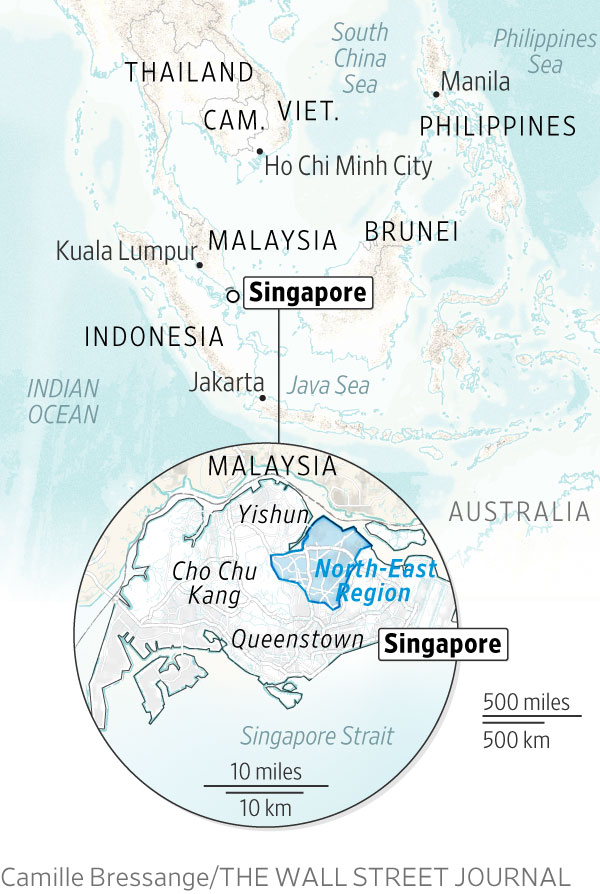
A single-family home is the exception to the rule in high-rise Singapore, where most of the city-state’s 5.5 million residents live in apartments. So when it came time for Mark Tan and Stella Gwee to trade in their starter bungalow for something larger and grander, they decided to stay put, tear down and begin again on their rare 1/10th-acre lot.
In 2009, Tan, now 48, and Gwee, 46, paid 2.2 million Singapore dollars, or about US$1.6 million, for their original 1,500-square-foot house, located in a single-family enclave in Singapore’s North-East region. The couple then spent $2.6 million to replace the three-bedroom, semidetached structure, built in a Balinese-fusion style, with a four-story, seven-bedroom brick house that combines Asian and Western elements across 7,400 square feet.
In all, Tan and Gwee have invested just over $4.2 million in their new home. Multibedroom Singapore homes of a similar size could sell now for twice that.
The couple—Gwee works with her husband, a local entrepreneur—began demolition in 2020, relocating with their two children, Xavier, now 17, and Andrea, 13, to a nearby rental for the two years of construction. The family, along with dogs Furry and Brownie, moved into the finished house in early 2022.
The new home’s standout feature is a landscaped vertical courtyard, rising nearly 40 feet. “A lot of Singaporeans won’t sacrifice the space to build a courtyard like this,” says Tan, a Singapore native, who grew up nearby.
Enclosed by a skylight, the space is outfitted at the top with a large industrial fan 8 feet in diameter that is powerful enough to ventilate a factory floor. Made by Southern California’s MacroAir, the fan helps the family keep cool in Singapore’s year-round tropical weather. It is part of a $74,000 climate-control system that allows every room individual air-conditioning units.
The flora-rich courtyard, featuring an indoor koi pond and fronted by an open-air outdoor swimming pool, opens to the street at its base between the pool and the pond. The house can be closed off and revert entirely to air conditioning on especially hot days.
The open-plan first floor includes living and dining areas, and has space enough for a Steinway piano for music student Andrea. The second floor is given over to a mahjong room that doubles as a guest bedroom and a study. The bedrooms are on the third floor. The fourth floor serves as a penthouse recreation room for the kids and their friends.
The elevator makes for easy transitions, but Tan says his health-conscious wife takes the stairs.
Windows and terraces orient the house around the courtyard. Designing an expansive vertical courtyard was a challenge, says the couple’s architect Han Loke Kwang, principal in Singapore’s HYLA Architects, which specialises in upscale single-family projects (or landed properties, as locals call them). Immense vertical spaces like this are seen in commercial structures but are unusual in a residential setting, says Han.
The goal in the Tan-Gwee home, he says, was “to make sure the scale of the courtyard wasn’t overwhelming.”
Foliage—chosen to flourish in the courtyard’s shaded conditions and kept fresh with an elaborate irrigation system—and the koi pond help ornament the space. The pond gives the first floor a waterfront feel.
The couple spent $148,000 on the pool and pond areas. Tan filled the pond with $59,000 worth of top-dwelling adult koi, mostly imported from Japan, and several bottom-dwelling freshwater stingrays, costing $22,000.
Singapore, which is smaller than Los Angeles County, is a blending of cultures, bringing together East Asian, South Asian and European influences. The Tan-Gwee home has a decidedly cosmopolitan flair, combining Italian designer furniture, British and Canadian lighting, kitchen appliances from Germany’s Miele, and bathroom details inspired by vacations in Dubai and the Maldives.
The fortresslike facade, which preserves the privacy of the home, is in keeping with Asian residential models, says Han.
Many of Han’s clients have two kitchens—an open area for Western-style cooking and a closed-off Asian-style cooking space with wok stations, requiring extra ventilation. While finishing the house, Tan and Gwee decided to forgo the planned Asian kitchen, converting it into a kitchen terrace equipped with an $11,000 barbecue.
Back inside, the kitchen was outfitted with a steam oven, two conventional ovens of different sizes and a built-in Miele coffee machine.
These are booming times in Singapore. The city-state now has a per capita GDP of more than $91,000, higher than anywhere else in Asia and one of the world’s strongest residential markets.
Overall residential real-estate prices rose 7.5% between the second quarters of 2022 and 2023, with those of landed residences increasing by 9.4% in the same period, says Nicholas Keong, senior director of Knight Frank’s Singapore affiliate. Also, Singapore came in first in Knight Frank’s Prime Global Rental Index—far exceeding London, New York, Monaco and Tokyo—with rent prices rising 28% in 2022.
The couple seem to have exhausted their wish list. When you have everything from three ovens to a stingray budget, there isn’t much left. What about a home spa? “No sauna here,” counters Tan, who relies on the primary bedroom’s three air conditioners to maintain comfort. “It’s already too hot in Singapore.”
OTHER COSTS
Foundation and framing: $589,400
Electrical work: $148,000
Designer Lighting: $74,000
Elevator: $88,400
Kitchen (including appliances): $222,000
Bathrooms (7): 148,000
Brickwork/masonry: $222,000
Glazing, including windows and sliding glass doors: $222,000
Landscaping, including indoor plants and irrigation: $73,700



 4 min
4 min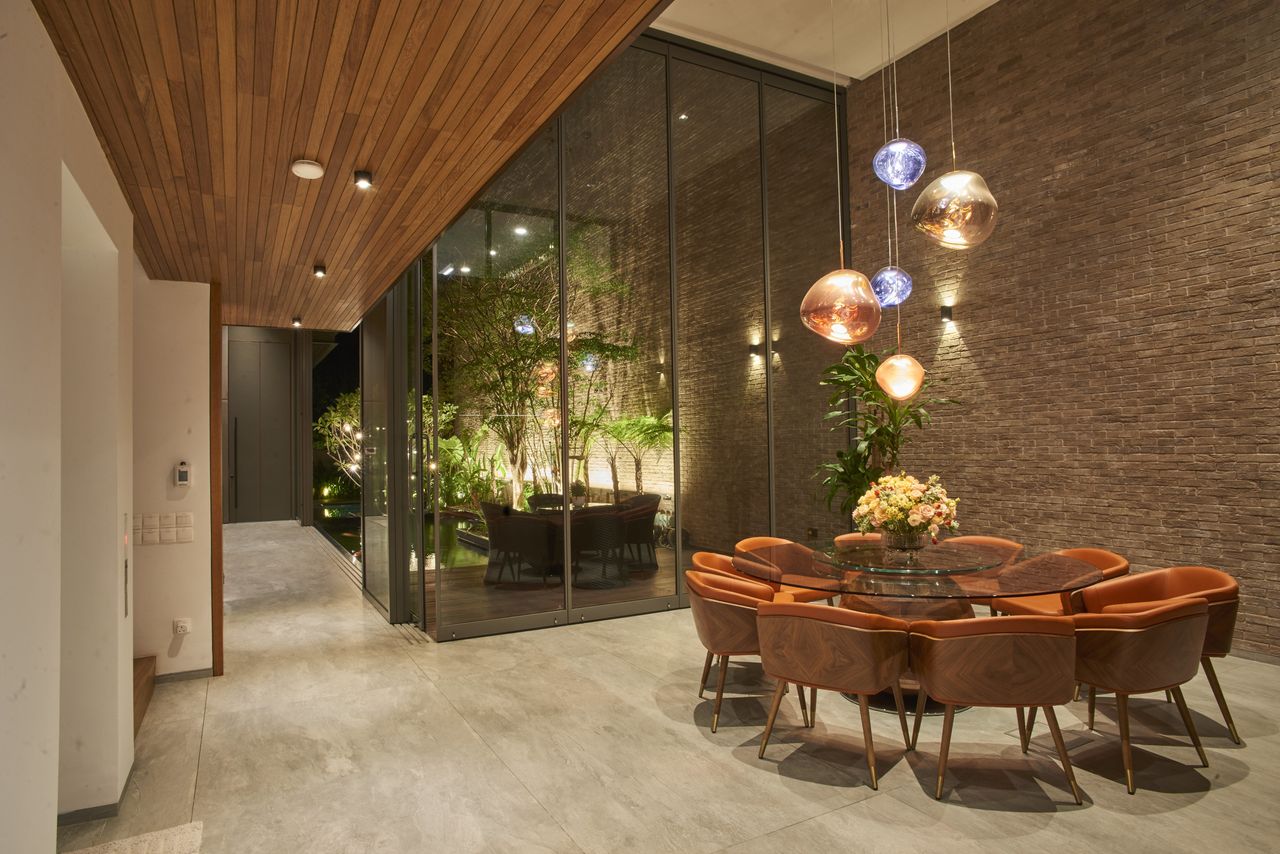
 Copyright 2020, Dow Jones & Company, Inc. All Rights Reserved Worldwide.