China Exports Fall for a Fourth Month as Once-Reliable Growth Engine Sputters - Kanebridge News
Share Button

China Exports Fall for a Fourth Month as Once-Reliable Growth Engine Sputters

Property sector’s downturn has pushed imports to their 11th month of declines in the past year

By STELLA YIFAN XIE
Fri, Sep 8, 2023 9:18amGrey Clock 4 min

HONG KONG—China’s exports to the rest of the world dropped for a fourth straight month in August, bringing little relief to the country from a deepening economic malaise and weighing on the global trade outlook.

China has struggled to sustain a wave of overseas demand for Chinese-made goods that carried it through much of the three years of the pandemic, particularly as Western consumers tilted their spending back toward services and away from smartphones, furniture and other goods. Higher borrowing rates in the U.S. and other developed countries also hit consumer appetite.

Meanwhile, Chinese imports continued to shrink in August, a reflection of lacklustre consumer demand even after the country loosened its longstanding Covid-related restrictions. A downturn in China’s property market has also sapped demand for raw materials used in construction.

Taken together, the sluggish trade data released Thursday by Beijing provides new evidence that the world’s second-largest economy is struggling to revive domestic demand.

That would ripple through the global economy as China’s slowdown weighs on oil prices and hurts commodity-exporting countries such as Australia, Brazil and Canada. Chinese manufacturers have been under pressure to cut prices to retain market share, potentially sending disinflationary currents around the world.

While Chinese policy makers have trimmed key interest rates and made new attempts to revive home-buying sentiment, economists have widely dismissed these efforts as too piecemeal to revive growth given the speed with which sentiment has soured.
“There’s still a steep hill to climb to get the all-clear on stabilisation for China,” said Frederic Neumann, chief Asia economist at HSBC.

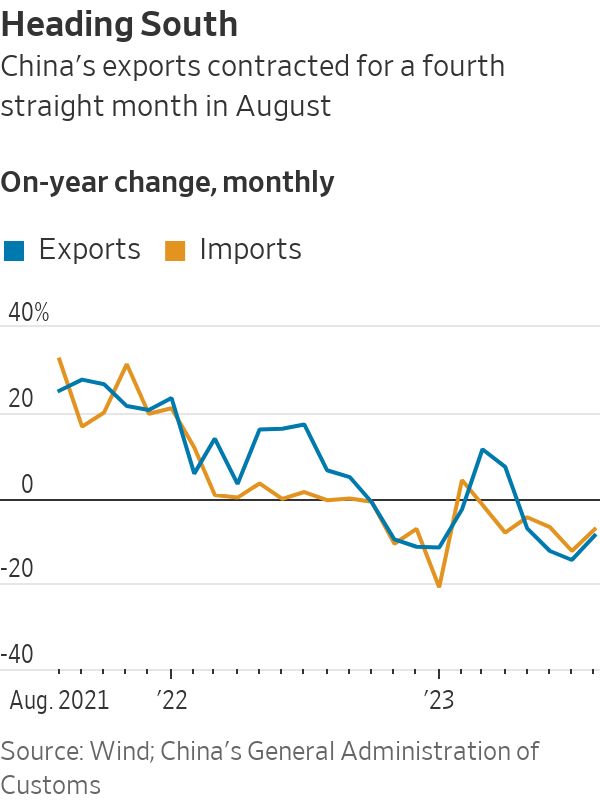
China’s outbound shipments declined 8.8% in August from a year earlier, China’s General Administration of Customs said Thursday. The reading narrowed from the 14.5% year-over-year drop in exports in July, which marked the worst such result since February 2020.

Imports to China, including intermediate components, commodities and consumer products, fell 7.3% in August from a year earlier, slower than July’s 12.4% drop.

Even with the better-than-feared trade data, economists generally agree that exports’ ability to provide support for China’s sputtering recovery remains a distant prospect, particularly given that global trade is expected to contract this year.

“We expect exports to decline over the coming months before bottoming out toward the end of the year,” research firm Capital Economics told clients in a note Thursday.

Apart from the general slowdown in trade, China is facing a raft of other economic headwinds. After a brief spurt of spending in traveling and dining out upon reopening early this year, consumers tightened their purse strings, dragging consumer prices into deflationary territory in July. China is set to report August inflation data on Saturday.

Factory activity, meantime, reported a fifth straight month of contraction in August, while a years long downturn in the housing market has only deepened in recent months. Private investment remains depressed, while the youth jobless rate climbed to a series of record highs in the summer before Beijing decided to discontinue releasing the data to the public.

More broadly, the run of downbeat data during the summer months has sparked growing concerns over China’s long-term growth trajectory and prompted several investment banks to trim their growth forecasts for gross domestic product to below 5% for the year, compared with the official government target of around 5%, which was set in March.

Meeting with Southeast Asian leaders this week, Chinese Premier Li Qiang struck back against widespread pessimism about the country’s near-term economic outlook, saying the country is on track to hit its growth target for the year.

While Chinese policy makers have rolled out a batch of stimulus measures in recent weeks, including trimming interest rates for businesses and home buyers and extending tax relief to households, many economists have questioned whether the policies will be enough to turn around weak consumer sentiment.

China’s reduced appetite for imports—which have fallen for 11 of the past 12 months—reflects in large part the knock-on effects of the country’s continuing property crisis. Both property investment and new construction starts have plunged in recent months amid a loss of confidence in home prices; that in turn has curbed China’s appetite for commodities such as iron ore.

The export data, meanwhile, offers more evidence of China’s shifting trade patterns.

As ties have soured between Beijing and Washington, many U.S. companies have begun to redirect supply chains away from China and toward other Asian countries such as India, leading to a sharp decline in America’s reliance on goods from China.

Rising operational uncertainty, made most clear during China’s pandemic-era lockdowns, which disrupted domestic and global production and logistics, heightened the urgency for many multinationals.

In the first half of the year, China accounted for 13.3% of U.S. goods imports, down from a high of 21.6% in 2017 and representing the lowest level since 2003.

Meanwhile, trade with the 10-member Association of Southeast Asian Nations has grown over the past year to become China’s largest export market, ahead of the U.S. and European Union, according to a recent report by HSBC.

China’s warmer trade relations with Asian countries will help buffer the impact of softening Chinese exports to advanced economies. But economists say Beijing won’t be immune if the U.S. and other advanced economies tip into recession.

Global goods trade is expected to drop by 1.5% this year in part due to tightening global monetary and credit conditions before staging a modest recovery of 2.3% growth in 2024, according to estimates by Adam Slater, lead economist at Oxford Economics.

China’s weakening trade activities, meanwhile, is likely to ripple across Asia, slowing industrial expansion and hitting commodity prices, he added.

—Xiao Xiao in Beijing contributed to this article.


MOST POPULAR

Rugged coastal drives and fireside drams define a slow, indulgent journey through Scotland’s far north.

A haven for hedge-fund titans and Hollywood grandees, Greenwich is one of the world’s most expensive residential enclaves, where eye-watering prices meet unapologetic grandeur.

Related Stories
Money
What Is Artemis II? The NASA Mission to Fly Astronauts Around the Moon
By Micah Maidenberg 30/03/2026
Money
Saudi Arabia Sees a Spike to $180 Oil if Energy Shock Persists Past April
By SUMMER SAID, RYAN DEZEMBER AND DAVID UBERTI 20/03/2026
Money
Gen X Is Stuck in the Middle and Financially Squeezed. How One Financial Adviser Is Helping.
By Anne Field 18/03/2026

The lunar flyby would be the deepest humans have traveled in space in decades.

By Micah Maidenberg
Mon, Mar 30, 2026 4 min

It’s go time for the highest-stakes mission at NASA in more than 50 years.  

On April 1, the agency is set to launch four astronauts around the moon, the deepest human spaceflight since the final Apollo lunar landing in 1972.  

The launch window for Artemis II , as the mission is called, opens at 6:24 p.m. ET. 

National Aeronautics and Space Administration teams have been preparing the vehicles to depart from Florida’s Kennedy Space Center on the planned roughly 10-day trip. Crew members have trained for years for this moment. 

Reid Wiseman, the NASA astronaut serving as mission commander, said he doesn’t fear taking the voyage. A widower, he does worry at times about what he is putting his daughters through. 

“I could have a very comfortable life for them,” Wiseman said in an interview last September.  

“But I’m also a human, and I see the spirit in their eyes that is burning in my soul too. And so we’ve just got to never stop going.” 

Wiseman’s crewmates on Artemis II are NASA’s Victor Glover and Christina Koch, as well as Canadian Space Agency astronaut Jeremy Hansen. 

Photo: NASA’s Artemis II SLS rocket and Orion spacecraft being rolled out at night. Miguel J. Rodriguez Carrillo/Getty Images

What are the goals for Artemis II? 

The biggest one: Safely fly the crew on vehicles that have never carried astronauts before.  

The towering Space Launch System rocket has the job of lofting a vehicle called Orion into space and on its way to the moon.  

Orion is designed to carry the crew around the moon and back. Myriad systems on the ship—life support, communications, navigation—will be tested with the astronauts on board. 

SLS and Orion don’t have much flight experience. The vehicles last flew in 2022, when the agency completed its uncrewed Artemis I mission . 

How is the mission expected to unfold? 

Artemis II will begin when SLS takes off from a launchpad in Florida with Orion stacked on top of it.  

The so-called upper stage of SLS will later separate from the main part of the rocket with Orion attached, and use its engine to set up the latter vehicle for a push to the moon. 

After Orion separates from the upper stage, it will conduct what is called a translunar injection—the engine firing that commits Orion to soaring out to the moon. It will fly to the moon over the course of a few days and travel around its far side. 

Orion will face a tough return home after speeding through space. As it hits Earth’s atmosphere, Orion will be flying at 25,000 miles an hour and face temperatures of 5,000 degrees as it slows down. The capsule is designed to land under parachutes in the Pacific Ocean, not far from San Diego. 

Water photo: NASA’s Orion capsule after its splash-down in the Pacific Ocean in 2022 for the Artemis I mission. Mario Tama/Press Pool

Is it possible Artemis II will be delayed? 

Yes.  

For safety reasons, the agency won’t launch if certain tough weather conditions roll through the Cape Canaveral, Fla., area. Delays caused by technical problems are possible, too. NASA has other dates identified for the mission if it doesn’t begin April 1. 

Who are the astronauts flying on Artemis II? 

The crew will be led by Wiseman, a retired Navy pilot who completed military deployments before joining NASA’s astronaut corps. He traveled to the International Space Station in 2014. 

Two other astronauts will represent NASA during the mission: Glover, an experienced Navy pilot, and Koch, who began her career as an electrical engineer for the agency and once spent a year at a research station in the South Pole. Both have traveled to the space station before. 

Hansen is a military pilot who joined Canada’s astronaut corps in 2009. He will be making his first trip to space. 

Koch’s participation in Artemis II will mark the first time a woman has flown beyond orbits near Earth. Glover and Hansen will be the first African-American and non-American astronauts, respectively, to do the same. 

What will the astronauts do during the flight? 

The astronauts will evaluate how Orion flies, practice emergency procedures and capture images of the far side of the moon for scientific and exploration purposes (they may become the first humans to see parts of the far side of the lunar surface). Health-tracking projects of the astronauts are designed to inform future missions. 

Those efforts will play out in Orion’s crew module, which has about two minivans worth of living area.  

On board, the astronauts will spend about 30 minutes a day exercising, using a device that allows them to do dead lifts, rowing and more. Sleep will come in eight-hour stretches in hammocks. 

There is a custom-made warmer for meals, with beef brisket and veggie quiche on the menu.  

Each astronaut is permitted two flavored beverages a day, including coffee. The crew will hold one hourlong shared meal each day.  

The Universal Waste Management System—that’s the toilet—uses air flow to pull fluid and solid waste away into containers. 

What happens after Artemis II? 

Assuming it goes well, NASA will march on to Artemis III, scheduled for next year. During that operation, NASA plans to launch Orion with crew members on board and have the ship practice docking with lunar-lander vehicles that Elon Musk’s SpaceX and Jeff Bezos’ Blue Origin have been developing. The rendezvous operations will occur relatively close to Earth. 

NASA hopes that its contractors and the agency itself are ready to attempt one or more lunar landing missions in 2028. Many current and former spaceflight officials are skeptical that timeline is feasible.