Carbon Trading Opens Loophole in Paris Climate Accord
Credits issued under the landmark Paris accord come with limited oversight as international trading ramps up
When the South American nation of Guyana wanted to sell millions of carbon-offset credits to preserve its rainforests, government officials knew they had a problem: The country’s lush Amazonian forests were actually in good shape.
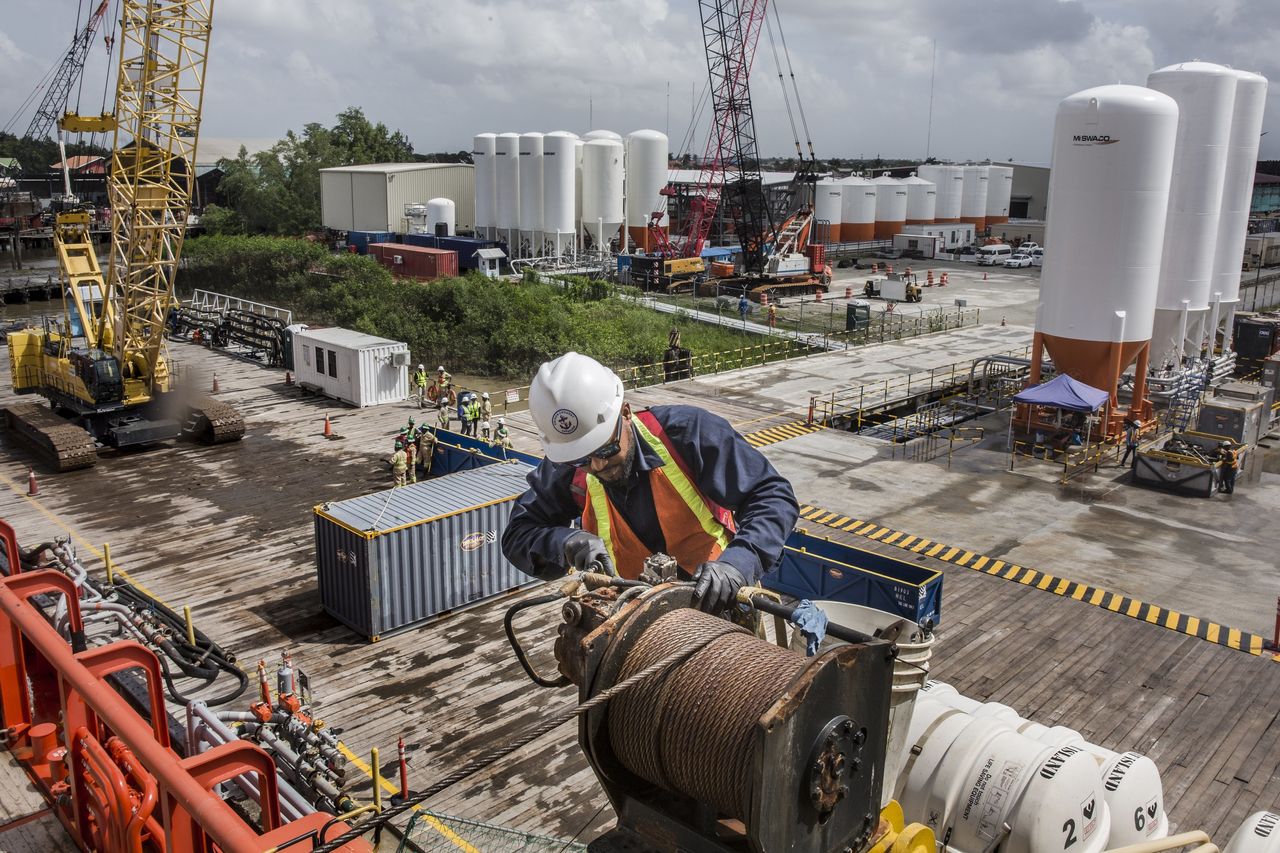
Guyana’s rate of deforestation was already low, meaning its forests wouldn’t yield much under standard methodologies for calculating carbon credits. So its government chose a new method that allows a large adjustment for countries with healthy forests. The change raised the credits that Guyana could issue sixfold. Guyana sold 37.5 million of them last year to U.S. oil giant Hess for at least $750 million, and is now shopping the remaining two thirds to countries facing pressure to comply with the landmark Paris climate accord, officials say.
That agreement calls for governments to adopt national plans to limit greenhouse-gas emissions and allows them to pay for emission-reduction projects elsewhere in the world to offset their own pollution. Credits for each ton of emissions cut can then be traded between countries. It is as if the emission reduction happened in the country buying the credit, not the one selling it.
Guyana is among the first in a long line of developing-world countries expected to cash in on credits compliant with United Nations agreements. Some officials worry the U.N. risks giving its seal of approval to credits for forests that aren’t under threat. At the COP28 climate summit under way in Dubai, negotiators are debating how much scrutiny carbon trading should face from U.N. experts and the public to prevent the mechanism from becoming a loophole in the Paris accord.
“If we play that game—every country gets to come in and pull an arbitrary methodology out of the ether, apply it to their forest areas and say give me credits—we’re never going to get anywhere,” said Kevin Conrad, the climate envoy of Papua New Guinea.
For now, the Paris accord imposes relatively little oversight on the market. Credits are required to undergo review by a panel of experts. But at last year’s COP in Egypt, governments decided that the experts wouldn’t be allowed to review the “appropriateness” or “adequacy” of projects.
That is fuelling fears the accord opens the door for polluting countries to buy lower-quality credits from poorer nations to meet their own emissions targets, undermining the Paris accord ambition of limiting global warming to 1.5 degrees Celsius above preindustrial era temperatures. Some developing countries are pushing for the right to keep much of the information around offset projects confidential. Companies would end up buying the credits, critics say, that would support spurious greenhouse-gas reduction claims. Hess said it would apply Guyana’s credits to its goal of completely offsetting its emissions by 2050.
“There is very little oversight of the process,” said Jonathan Crook of Carbon Market Watch, a Brussels-based nonprofit. “Some countries could set a higher bar, but there’s a risk that others do not.”
Guyana is in talks to sell credits to Singapore, which is evaluating whether it will accept the adjustment for low deforestation countries, an official involved in the talks said. The U.N.’s civil aviation agency last year said it would accept Guyana’s methodology under new regulations it set to limit emissions from international flights, making Guyana’s offsets the first eligible under the rules.
Switzerland is moving to purchase the first credits under the Paris accord, for non-forest projects in Ghana, Thailand and Vanuatu. The credits will then be used by Swiss companies to comply with the country’s greenhouse-gas limits under the Paris accord.
The Swiss government is refusing to invest in forestry projects because of uncertainties around the baseline against which the lack of deforestation is measured. Switzerland also has concerns around whether protections for forests are long term—a tree cut down or destroyed in the future would release the planet-warming carbon dioxide it has absorbed over its lifetime.
Corporations over the past decade have invested billions of dollars in greenhouse-gas offset projects in the developing world. Those projects yield so-called voluntary carbon credits: The companies are under no legal obligation to buy them but do so because of public commitments they have made to offset their carbon emissions.
Academic research and media reports have cast doubt on the impact of many of the projects underlying these credits. The problems were particularly acute in projects to prevent deforestation. Because such programs typically cover relatively small areas within a larger forest, they risk pushing logging and clear-cutting for agriculture into other sections that aren’t protected by a project.
Guyana’s project is designed to address some of these problems. It is one of the first to cover an entire nation, eliminating the possibility that deforestation could be displaced within the country. Covering around 45 million acres, it is one of the world’s largest forest-protection projects, according to Trove Research.
Guyana has some of the most pristine forests on the planet. They have been mostly spared the rampant logging and clear-cutting seen in neighbouring Brazil. Guyana lacks rich soil suitable for large-scale agriculture, a major driver of deforestation, scientists say.
“These are among the poorest soils on the planet,” said Janette Bulkan, a Guyanese forestry expert at the University of British Columbia.
Critics say issuing credits for protecting such forests violates a core principle of carbon crediting: They should only be issued for emissions that would have happened without the project.
Guyanese officials say its forests are nevertheless at risk in the near future without intervention. The country’s economy is growing quickly, as is global demand for the commodities that could be extracted from its rainforests. Guyana is also reaping a windfall from oil discoveries off its coast that are now being pumped by Exxon Mobil and Hess.
“Guyana’s forests offer opportunities for a wide range of goods and services, and development opportunities for opening up areas for industry and manufacturing,” said Pradeepa Bholanath, who oversees climate policy at Guyana’s Ministry of Natural Resources.
Guyana’s credits have been calculated by Architecture for REDD+ Transactions, a program run by the U.S. nonprofit Winrock International. The program’s methodology allows countries like Guyana that have had little deforestation in the past to issue credits against apredicted future level of deforestation under a formula devised by Winrock.
Winrock and other advocates of the methodology say the money allows much-needed climate finance to flow to rain-forested countries, even if they haven’t experienced past deforestation. Guyana has already received more than $100 million in its deal with Hess. Officials say that money is reaching tribes that live in the rainforests and being used nationally for forest preservation and renewable energy projects.
Rugged coastal drives and fireside drams define a slow, indulgent journey through Scotland’s far north.
A haven for hedge-fund titans and Hollywood grandees, Greenwich is one of the world’s most expensive residential enclaves, where eye-watering prices meet unapologetic grandeur.
The lunar flyby would be the deepest humans have traveled in space in decades.
It’s go time for the highest-stakes mission at NASA in more than 50 years.
On April 1, the agency is set to launch four astronauts around the moon, the deepest human spaceflight since the final Apollo lunar landing in 1972.
The launch window for Artemis II , as the mission is called, opens at 6:24 p.m. ET.
National Aeronautics and Space Administration teams have been preparing the vehicles to depart from Florida’s Kennedy Space Center on the planned roughly 10-day trip. Crew members have trained for years for this moment.
Reid Wiseman, the NASA astronaut serving as mission commander, said he doesn’t fear taking the voyage. A widower, he does worry at times about what he is putting his daughters through.
“I could have a very comfortable life for them,” Wiseman said in an interview last September.
“But I’m also a human, and I see the spirit in their eyes that is burning in my soul too. And so we’ve just got to never stop going.”
Wiseman’s crewmates on Artemis II are NASA’s Victor Glover and Christina Koch, as well as Canadian Space Agency astronaut Jeremy Hansen.

What are the goals for Artemis II?
The biggest one: Safely fly the crew on vehicles that have never carried astronauts before.
The towering Space Launch System rocket has the job of lofting a vehicle called Orion into space and on its way to the moon.
Orion is designed to carry the crew around the moon and back. Myriad systems on the ship—life support, communications, navigation—will be tested with the astronauts on board.
SLS and Orion don’t have much flight experience. The vehicles last flew in 2022, when the agency completed its uncrewed Artemis I mission .
How is the mission expected to unfold?
Artemis II will begin when SLS takes off from a launchpad in Florida with Orion stacked on top of it.
The so-called upper stage of SLS will later separate from the main part of the rocket with Orion attached, and use its engine to set up the latter vehicle for a push to the moon.
After Orion separates from the upper stage, it will conduct what is called a translunar injection—the engine firing that commits Orion to soaring out to the moon. It will fly to the moon over the course of a few days and travel around its far side.
Orion will face a tough return home after speeding through space. As it hits Earth’s atmosphere, Orion will be flying at 25,000 miles an hour and face temperatures of 5,000 degrees as it slows down. The capsule is designed to land under parachutes in the Pacific Ocean, not far from San Diego.

Is it possible Artemis II will be delayed?
Yes.
For safety reasons, the agency won’t launch if certain tough weather conditions roll through the Cape Canaveral, Fla., area. Delays caused by technical problems are possible, too. NASA has other dates identified for the mission if it doesn’t begin April 1.
Who are the astronauts flying on Artemis II?
The crew will be led by Wiseman, a retired Navy pilot who completed military deployments before joining NASA’s astronaut corps. He traveled to the International Space Station in 2014.
Two other astronauts will represent NASA during the mission: Glover, an experienced Navy pilot, and Koch, who began her career as an electrical engineer for the agency and once spent a year at a research station in the South Pole. Both have traveled to the space station before.
Hansen is a military pilot who joined Canada’s astronaut corps in 2009. He will be making his first trip to space.
Koch’s participation in Artemis II will mark the first time a woman has flown beyond orbits near Earth. Glover and Hansen will be the first African-American and non-American astronauts, respectively, to do the same.
What will the astronauts do during the flight?
The astronauts will evaluate how Orion flies, practice emergency procedures and capture images of the far side of the moon for scientific and exploration purposes (they may become the first humans to see parts of the far side of the lunar surface). Health-tracking projects of the astronauts are designed to inform future missions.
Those efforts will play out in Orion’s crew module, which has about two minivans worth of living area.
On board, the astronauts will spend about 30 minutes a day exercising, using a device that allows them to do dead lifts, rowing and more. Sleep will come in eight-hour stretches in hammocks.
There is a custom-made warmer for meals, with beef brisket and veggie quiche on the menu.
Each astronaut is permitted two flavored beverages a day, including coffee. The crew will hold one hourlong shared meal each day.
The Universal Waste Management System—that’s the toilet—uses air flow to pull fluid and solid waste away into containers.
What happens after Artemis II?
Assuming it goes well, NASA will march on to Artemis III, scheduled for next year. During that operation, NASA plans to launch Orion with crew members on board and have the ship practice docking with lunar-lander vehicles that Elon Musk’s SpaceX and Jeff Bezos’ Blue Origin have been developing. The rendezvous operations will occur relatively close to Earth.
NASA hopes that its contractors and the agency itself are ready to attempt one or more lunar landing missions in 2028. Many current and former spaceflight officials are skeptical that timeline is feasible.