
Why London’s Wealthy Are Renting Instead of Buying

By RUTH BLOOMFIELD
Wed, Feb 7, 2024 9:28am 5 min
5 min
5 min

 5 min
5 min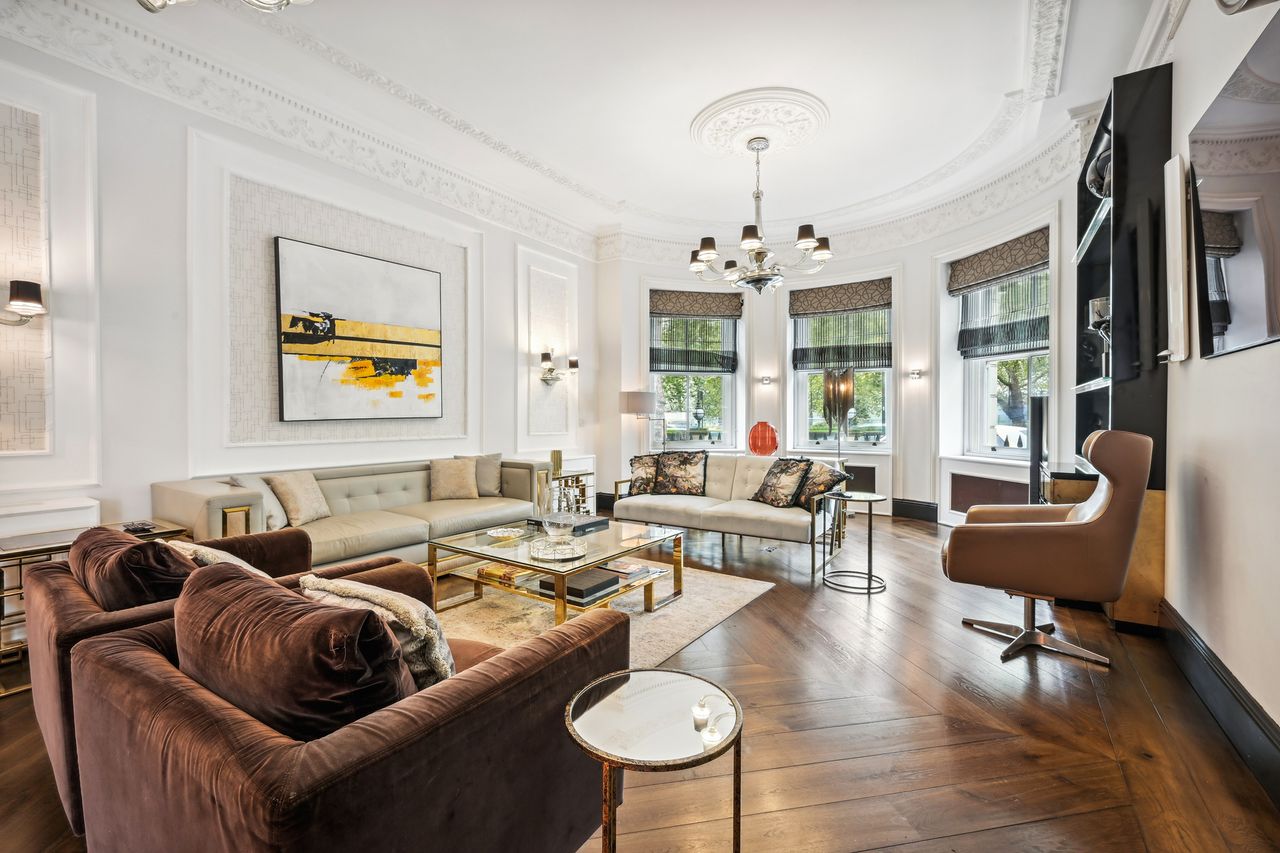
With London luxury real-estate prices on the slide and a collapse in high-end deal volume, it has been a tough year for prime central London real estate. But the prime rental market is thriving. People in need of a London base are increasingly opting to take the flexible, minimal-commitment housing option rather than buying, and paying Britain’s high taxes, in a stalled market. As a result, prime rents are escalating.
House price analyst LonRes found that average prime rents in London increased 3.5% between December 2022 and December 2023. Average prime rents are now 29% above pre pandemic levels notched during the period of 2017 to 2019. Separate research from estate agent Beauchamp Estates found that 63 London homes were rented out for $6,370 or more per week—about $330,000 per year—between January and June 2023.
Buying agent Liam Monaghan, managing director of London Central Portfolio, said many of his prime tenants live a global, itinerant lifestyle. They include soccer players, actors and film producers and tech entrepreneurs.
“They can obviously afford to buy these properties, but perhaps they are on a short-term contract or are growing a business and have got a lot of wealth quite quickly and are jumping between lots of different countries and are still working out where they want to live,” said Monaghan.
Nina McDowall, head of lettings at estate agent Strutt & Parker’s office in Knightsbridge, one of London’s most expensive neighbourhoods, said many of her renters are considering buying a London property but only when they find the perfect home at a great price.
“There are a lot of people who are weighing up their options,” she said. “They might also be sitting tight to see if prices slide further.”
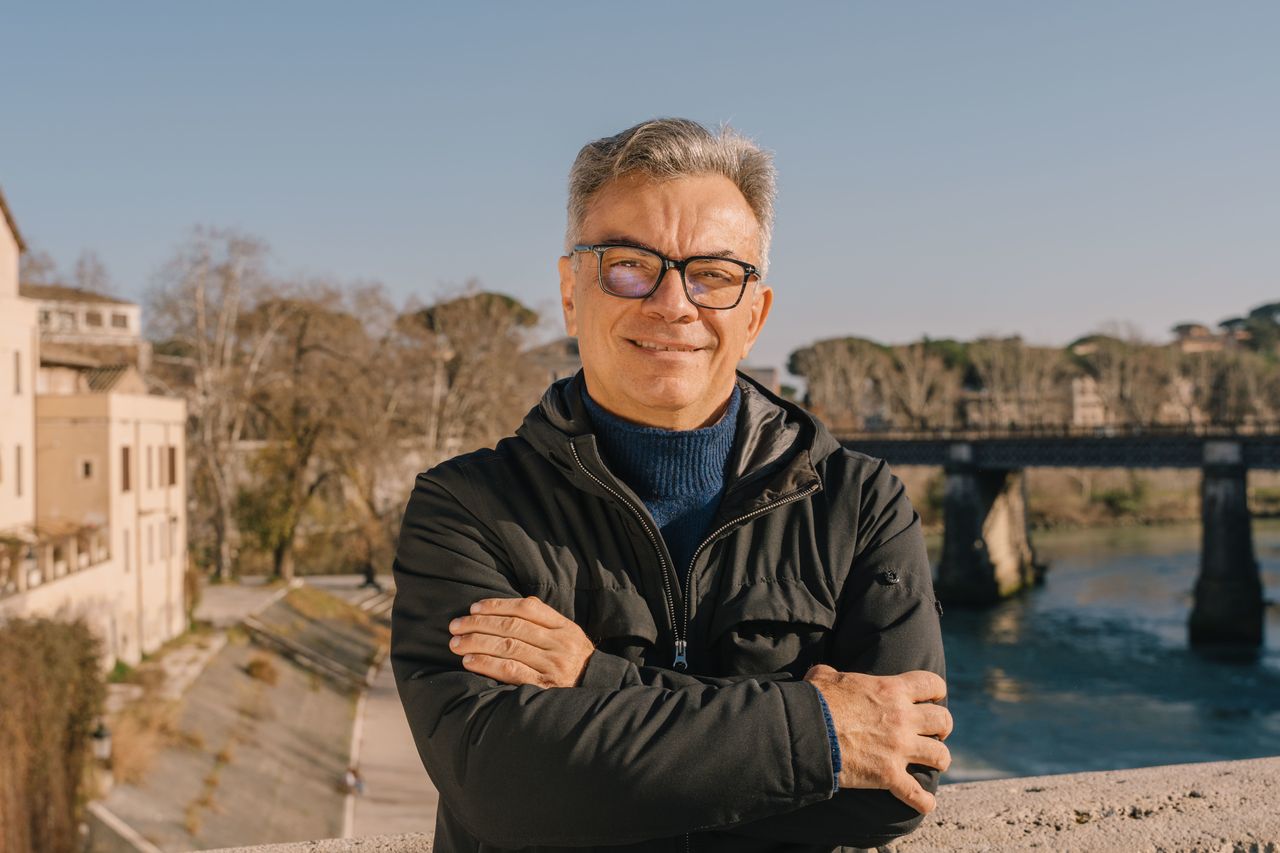
Others, such as Antonio Volpin, simply don’t see London property as a great investment opportunity. Volpin, who is Italian, moved to London for work in 2011, initially living out of hotels. When his wife and two sons joined him in London in 2012, the family started renting.
“We mulled the idea of buying a property, because the market was very strong, but I thought it could not grow forever, and with my work I am not sure where I will be next year,” said Volpin, 61, a consultant for asset and fund management firms.
The family’s decision to continue renting proved prescient, because prime central London’s house prices have stagnated for almost a decade. According to LonRes, average sale prices in prime central London increased by just 2.3% between 2013 and 2023 (from $2,130 per square foot to $2,180 per square foot). In 2016, Volpin’s job took him to Singapore, and now he and his university professor wife are based in Rome. Their two sons, aged 26 and 22, opted to remain in London so their parents, who visit regularly, have continued to rent a three-bedroom, three-level, apartment in the affluent, historic neighbourhood of South Kensington, 2 miles west of the city centre.
Volpin has signed a nondisclosure agreement prohibiting him from revealing his monthly rental costs, but a spokeswoman for his estate agent, Winkworth, said that a similar property would cost up to $191,000 per year.
“Certainly with that money I could buy, but the point is that at the moment it is more of a kind of holiday home,” Volpin said. “When I come, I want to be close to downtown and to the friends I made while living in London.”
McDowell believes that the reason top-end rental prices have accelerated while home sale prices are falling is simple: Demand for these types of rentals is high and there is a serious undersupply of high-specification, turnkey properties.
“They are as rare as hen’s teeth,” she said. “Super-prime tenants will not sacrifice or compromise on many things. The condition and functionality of the property has to be slick and beautiful, and they will pay big prices, or pay one or two years in advance, to secure the right property.”
But while rents are rising, prime-central London landlords still have to work hard to attract high-paying tenants who expect five-star standards.
“I have had people who want walls to be ripped out or massive extension work,” said Sinead Conlon, head of corporate and relocation services at John D Wood & Co. estate agents. “Some of them want interior-design furniture packages costing about $32,000 to $127,000 per month. They are all looking for an add-on.”
In one memorable case, Conlon was able to rent a substantial house in the north London suburb of Primrose Hill to a tenant who wanted the toilets in the bathrooms, 17 of them, to be replaced with Japanese models with built-in bidets. The tenant, who paid around $70,000 per month to rent the house for a year starting in 2021, eventually settled for just 10 new toilets to be fitted.
“But they are around £25,000 [$32,000] a pop, so it was not exactly cheap,” said Conlon.
Another problem facing landlords is dwindling profit margins. Interest rates have jumped and, since 2020, landlords cannot deduct mortgage interest from their tax bills, said Becky Fatemi, executive partner of Sotheby’s Realty UK. The administration of renting a property is also not cheap. Fatemi said landlords should expect to pay their estate agent between 8% and 15% of the annual rent to find and install a tenant. Management fees, if required, add another 5% to the cost.
Vickram Mirchandani currently owns and rents out two prime London properties. He is painfully aware how hard it is to turn a decent profit even in a hot rental market. Mirchandani, 46, who is British, bought a five-bedroom family home in the upscale neighbourhood of Belgravia, about 10 years ago. They lived in the home full time, but he and his wife became increasingly disillusioned with life in Britain and left London in October, then moved to Dubai with their young family in January—they have one child and are expecting a second.

Mirchandani has decided against trying to sell the property until London’s property market has revived. In October 2023, tenants moved into the 4,200-square-foot townhouse, paying just under $8,900 per month in rent.
“It was gone within a week, on the second viewing, for the asking price,” said Mirchandani, a renewable-energy developer. “In hindsight, I could probably have got a little bit more.”
Mirchandani also owns a second property, a three-bedroom penthouse in Belgravia, which he had originally hoped to flip. “The plan was to purchase it, develop it, and sell it at a handsome margin,” he said. “But after Brexit that handsome margin never materialised.”
The apartment is also rented out, fetching $11,500 per month. “I actually got over asking price for that one because the tenant has a dog and I said, ‘Fine, but that will be an extra 10%,’ ” said Mirchandani. “I am very happy with the prices achieved.”
He is less happy with the yields his capital is earning. He estimates that after costs, including income tax, he is earning around 1.5% to 2%. England’s major banks are currently offering interest rates of around 4% to 5%. Longer term, Mirchandani is still weighing his options. “I could keep them in the hope that someday some miracle will happen and they will go up, but if we like it in Dubai we will probably sell the properties,” he said.
 Copyright 2020, Dow Jones & Company, Inc. All Rights Reserved Worldwide. LEARN MORE




BNW Developments has established a Sydney presence, joining Arada and Sobha Realty among the growing number of UAE developers pursuing Australian buyers and development opportunities.
The Australian leather house has opened an immersive four-day pop-up in Manhattan, unveiling its Bloom Collection and redefining what a product launch can look like.
A vibrant 1954 Palm Springs home featuring eight colorful murals by late artist Shawn Savage is on the market for $2.295 million. The 2,237-square-foot property features bold hot-pink doors, three bedrooms, a pool, mountain views and playful interiors blending modern glamour with classic Palm Springs style.
3 min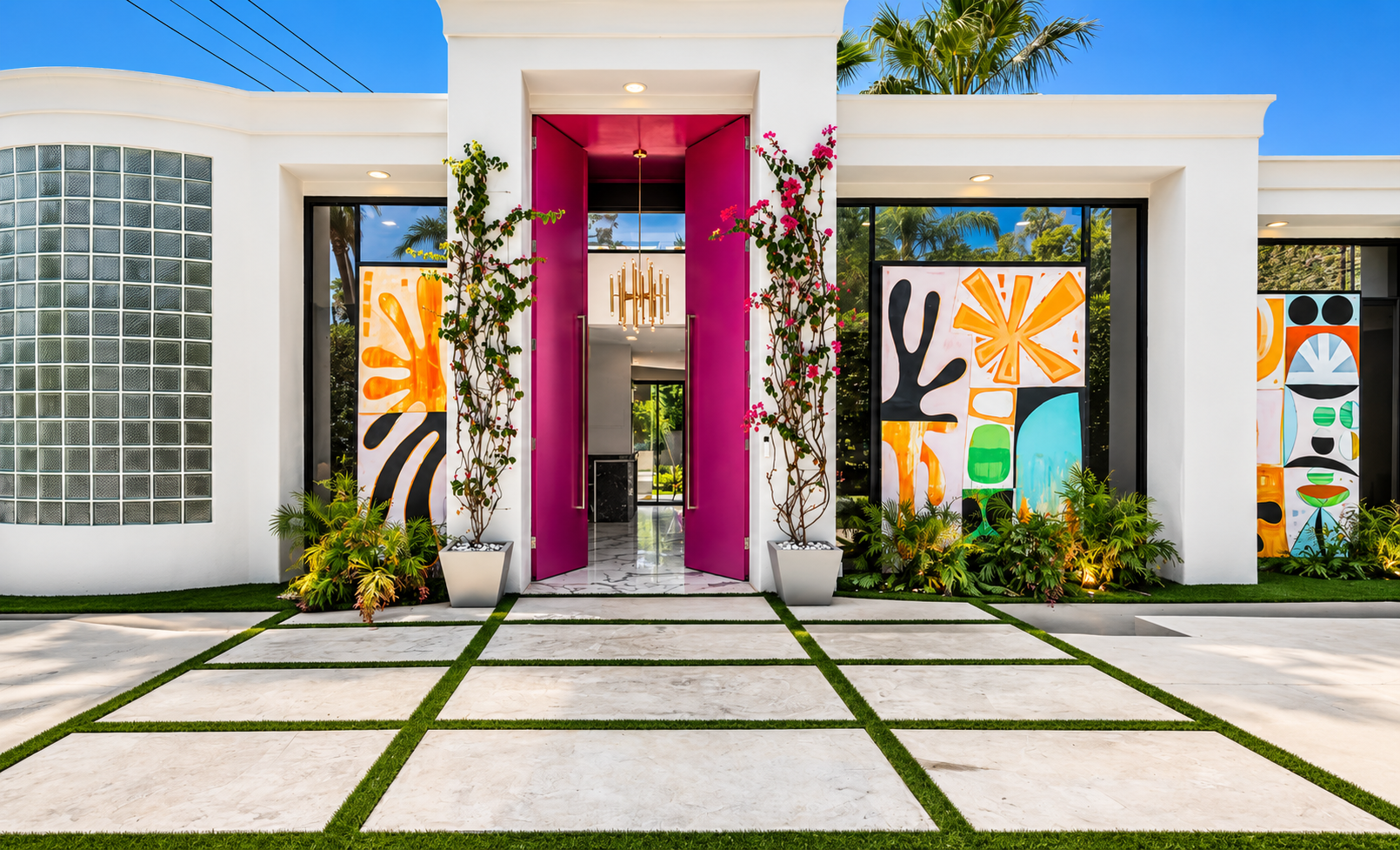
A bold 1950s home in Palm Springs, California, adorned with eight colorful murals by the late artist Shawn Savage, is coming to market ahead of the city’s annual Modernism Week.
The white stucco home on El Camino Way, built in 1954 and recently renovated, has an asking price of $2.295 million. Its staggered facade features three playfully abstract murals on either side of double-height hot pink doors.
MORE: Megamansion Outside Princeton, N.J., With a Pub and Two-Story Library Heads to Auction
The sellers are Los Angeles-based partners John Freeman and Mathieu Faure, who knew it was “the one” when they saw it after several months of searching in the winter of 2023. “It’s a happy house,” Freeman said. “We really liked the feel of the house: the uniqueness, the openness, the brightness—and the art.”
Located in the Mesa neighborhood of Palm Springs, which backs up to the San Jacinto Mountains, the 2,237-square-foot house features three bedrooms, an angled bonus room and a yard with a pool, desert mountain views and another colorful mural running alongside the pool.
“I never thought in my life I would have a house with pink doors,” said Faure, a producer at Apple TV who is originally from Paris. “It’s so colorful, it’s so different. And so Palm Springs.”
The layout of the home creates a smooth flow from the front doors through the open-plan common area—a foyer, bar, and living and dining room—into the kitchen around a fireplace wall and out to the yard. A corridor leads to a private bedroom wing, where the primary suite has floor-to-ceiling windows and the primary bath is only a tad smaller than the bedroom.
Faure has filled the home with Jonathan Adler furniture, rugs and accessories, riffing on the energetic California vibes of the house to create an aesthetic of “modern American glamour,” he said.
“It was enjoyable for me to play with different types of furniture and make this house ‘happy chic,’ as I describe it,” he said.
MORE: Beverly Hills Villa of Late Philanthropist Glorya Kaufman Sells for $19.25 Million
“He did a fantastic job,” said Freeman, who is an attorney and consultant. “It does kind of bring a smile to my face whenever I walk into the house.”
Since the furniture and decor were chosen for the particularities of the space, the couple is open to selling them with the home. Their West Hollywood house is already furnished; the collection doesn’t match the vibes of a Houston loft they bought near family; and Faure can’t imagine these pieces in New York—where he’s lived in the past—he said.
The duo bought the Palm Springs house for $1.925 million in 2024, according to property records, and will list the home Monday. They are represented by Stewart Smith, Patrick Jordan and Kevin Stanley of Bennion Deville Homes/Luxury Portfolio International.
The previous owners had purchased the home in 2021 for $975,000 and then spent more than two years and $700,000 on the renovation, according to Realtor.com. They commissioned Savage, a local Palm Springs artist and painter known for his joyful abstract work, to decorate the home.
MORE: Alpine Villa From Lady Gaga Movie ‘House of Gucci’ Lists for €2.9 Million
Savage, who died in 2024, lived in the Coachella Valley from 2003, and his work can be found in various local institutions and is on exhibit at the Illumine Gallery in Palm Springs. “Some artists pass through a place. Shawn Savage became a part of it,” the gallery’s description states.
Unsurprisingly, the murals invite lots of friendly conversations, as well as guided tours and interested lookers, but never to a degree that it disturbed the peacefulness of their home or the neighborhood, the sellers said. “It felt like living in an art gallery, and you have the exterior that you would share with the world,” Faure explained.
The neighborhood also played a role in their decision to buy, because of its access to the hiking trails of the San Jacinto Mountains, the lack of through-roads and the neighborly environment.
“It’s a very friendly place,” Faure said.

