Futuristic Sydney-Area Home of Late Australian Businessman Lists for A$9 million
The concrete-and-steel house, last owned by Peter Woodland of Barbeques Galore, has Pacific Ocean views and a helicopter hanger
The home of an Australian businessman who died tragically in a helicopter crash in 2022 is on the market with a A$9 million (US$5.9 million) price guide.
Peter Woodland, the late director of Barbeques Galore who purchased the expansive family estate just north of Sydney in 2017, was killed in April 2022, when his helicopter crashed in the Snowy Mountains in New South Wales. He was 75.
Woodland, who was a keen pilot and even installed a helicopter hanger and helipad at the residence, bought the home from acclaimed landscape photographer Richard Green, who built the unique property in Terrey Hills in the 1990s. He also died in a helicopter crash in 2015 .
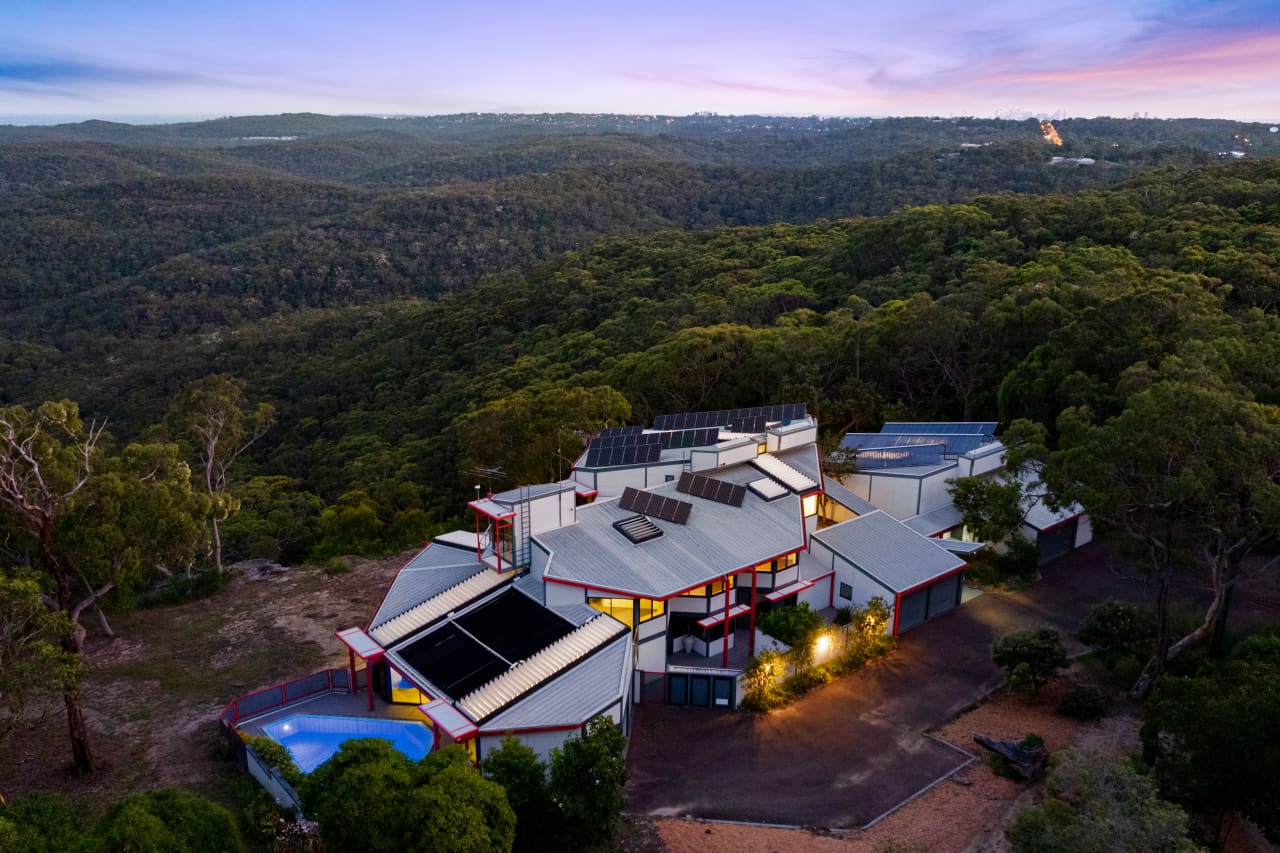
The vast five-bedroom house is located in a lush native bushland setting off Mona Vale Road.

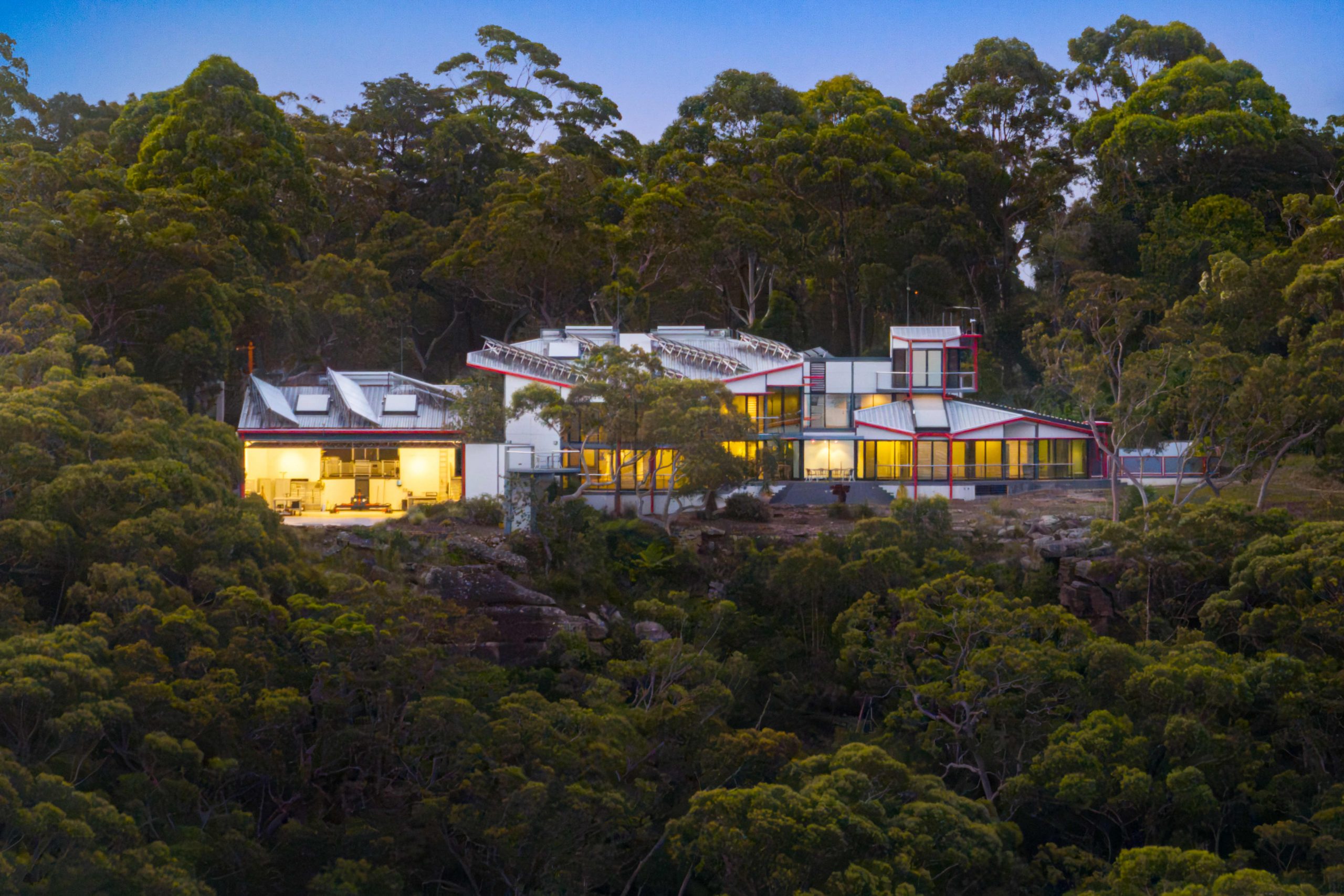
“Sitting right on the cliff’s edge, it looks right out over the bush to the water, and its proximity to the beach and even the city means it’s pretty special,” said listing agent Shayne Hutton of Sydney Country Living, which listed the home earlier this month.
Walls of fireproof glass and dozens of skylights with electronically operated Vergolas mean the natural landscape acts as a dramatic backdrop to every room. The neighbouring national park and 5 acres of landscaped gardens are met with panoramic views stretching to the Pacific Ocean.
“It’s really country living in the city. That’s the only way to describe it. This place is perfect for anyone who is just sick of crowds and wants to get away, even if it’s as a secondary property they’ll use as a weekender,” he added.
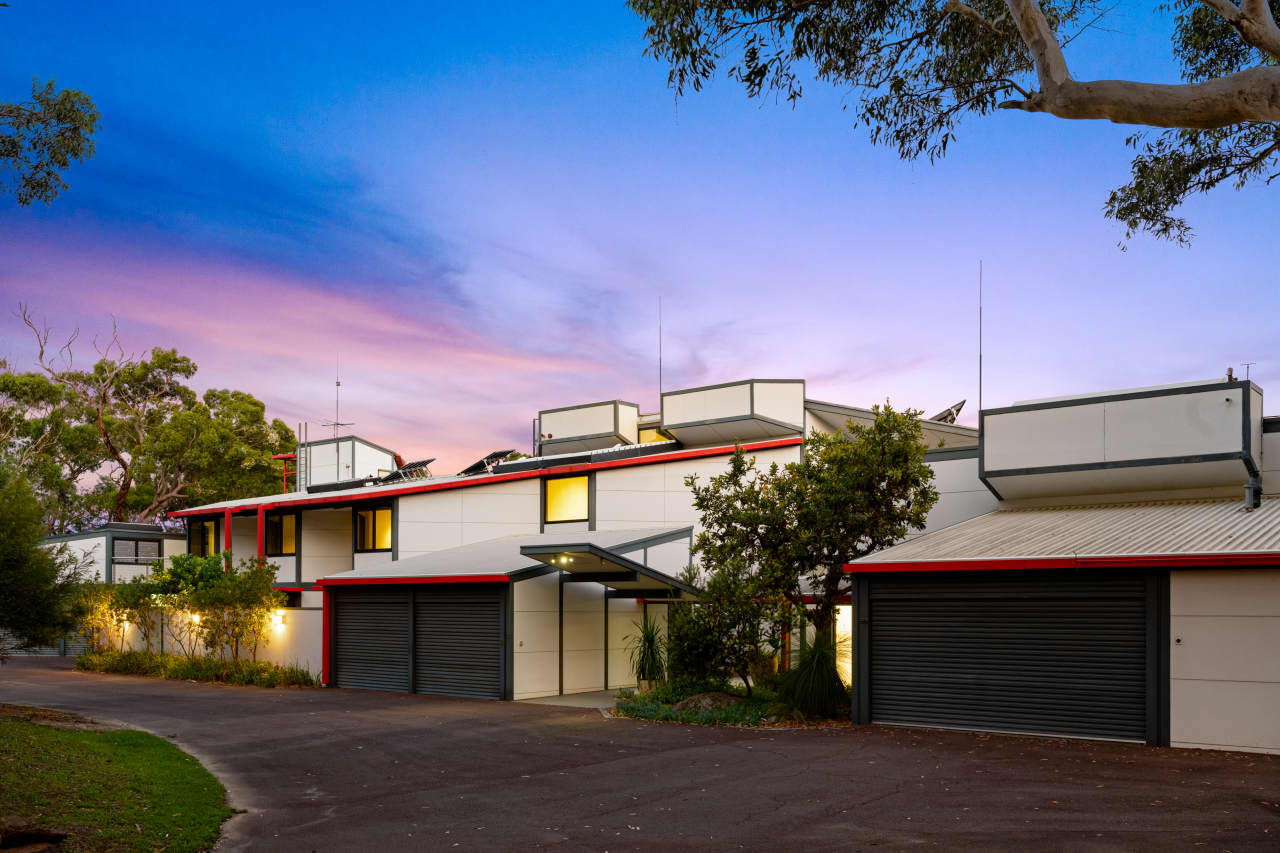
The concrete-and-steel trophy home has a Travertine-tiled entrance foyer with 20ft ceilings which leads through to two separate wings; one for living and another for sleeping. With a choice of everyday spaces, each living zone has sweeping district views and doors to the wraparound veranda.
In addition to casual living and dining rooms, there are formal entertaining areas, a library, a home office or extra family room, a professional photographer’s darkroom plus a large artist’s studio that could also be used as a poolside cabana with wet bar.

The granite kitchen has Gaggenau appliances, a grand island bench, a walk-in pantry, and an adjoining central courtyard with water features, perfect for a chef’s herb and vegetable garden.
While two bedrooms sit on the ground floor, four more occupy the upstairs accommodation level including a palatial primary suite. This parents’ retreat has a balcony, a vast dressing room plus walk-in wardrobe and a deluxe ensuite with freestanding bathtub, a double shower and twin vanities. One other bedroom features an ensuite and two more share a full family bathroom and powder room.
Outside, there are multiple entertaining terraces and courtyards, but the icing on the cake is the solar-heated pool and sun deck. Then the property’s standout feature is its state-of-the-art helipad with a fully incorporated turntable and a full-size helicopter hangar. Above the helipad, there is also a treetop viewing platform.
“A lot of people who might live on a farm have helicopters or just want the convenience to get in from the airport. It’s a great feature of the home and could be used for a variety of uses. For buyers without a helicopter, it could be an ideal car showroom,” Hutton said.
Additional features of the Terrey Hills residence include remote-controlled lock-up garages for up to five cars, storerooms, a wine cellar, ducted air conditioning, a security alarm and video intercom.
The Sydney sanctuary is surrounded by walking and biking trails, is a short drive to the transport and shopping hub of Chatswood and is an approximate 15-minute drive to local beaches.
Rugged coastal drives and fireside drams define a slow, indulgent journey through Scotland’s far north.
A haven for hedge-fund titans and Hollywood grandees, Greenwich is one of the world’s most expensive residential enclaves, where eye-watering prices meet unapologetic grandeur.
Australia’s wealthy class is expanding fast, and Knight Frank says that a surge in billionaires is reshaping the nation’s luxury property market.
Australia’s luxury property market is being quietly reshaped by one of the most significant wealth expansions in the world.
According to Knight Frank’s latest Wealth Report, the country’s billionaire population is set to grow by 77 per cent over the next five years, rising from 48 to 85 individuals.
That surge sits within a broader wave of wealth creation. Ultra-high-net-worth individuals, those with more than US$30 million, are forecast to increase by nearly 60 per cent to over 26,000 Australians by 2031.
Globally, the pace is accelerating. The report reveals that 89 new ultra-wealthy individuals are created every day, a figure that underscores a structural shift in capital formation rather than a cyclical upswing.
For luxury property markets, this is not just a headline number. It is a demand driver.
Australia’s wealth story is increasingly underpinned by diversification across resources, finance, technology and services, creating a depth of private capital that is both mobile and strategic.
And mobility is key. The ultra-wealthy are no longer tied to a single market. Instead, they are operating across multiple global hubs, maintaining footholds in cities like London, New York and Singapore, while using Australia as a stable base.
In this environment, real estate becomes less about shelter and more about positioning. Trophy assets remain desirable, but capital is increasingly being deployed across the full risk spectrum, from long-term holds to value-add opportunities. For Australia, the implications are clear. As wealth expands, so too does the expectation of product, and the locations that can attract it.
The billionaire effect
While property remains central to wealth preservation, the latest data shows that capital is increasingly spreading across luxury asset classes, albeit with a more disciplined approach.
Knight Frank’s Luxury Investment Index recorded a modest 0.4 per cent decline in 2025, signalling a stabilisation phase after several years of correction.
But beneath that headline number is a more telling shift. Collectors are moving away from speculative buying and toward assets defined by rarity, provenance and cultural significance.
Impressionist art led the market, rising 13.6 per cent, buoyed by landmark sales including a US$236 million Klimt painting. Watches also performed strongly, up 5.1 per cent, driven by continued demand for brands like Patek Philippe and Rolex.
At the same time, more volatile categories have corrected. Whisky values fell 10.9 per cent, while parts of the fine wine market have softened following pandemic-era highs.
Perhaps the most notable trend is behavioural. Younger investors are entering the market through fractional ownership platforms, gaining exposure to high-value assets that were once out of reach.
For property, the parallels are clear. The same focus on scarcity, narrative and long-term value is increasingly shaping buying decisions at the top end of the residential market.
Global wealth
The growth in billionaires is not just increasing demand, it is changing where that demand is directed.
In Australia, Brisbane has emerged as one of a handful of global cities experiencing rapid change in its luxury positioning. The city’s transformation is being driven by infrastructure investment and the 2032 Olympics, with top-end apartment prices rising from around US$6 million to more than US$10 million in just 12 months.
Luxury price growth has remained steady, with Brisbane rising 2.1 per cent in 2025, while the Gold Coast recorded 2.8 per cent.
At the same time, buying power is tightening. US$1 million now buys 5 per cent less in Brisbane than it did five years ago, reflecting the upward pressure on prime markets.
The trend is not confined to capital cities. Regional lifestyle markets are also capturing attention. Geelong’s waterfront has been identified as one of the world’s hottest luxury residential markets, driven by a combination of coastal amenity, infrastructure and relative value.
In these markets, pricing is no longer the sole driver. Lifestyle, accessibility and long-term growth are increasingly shaping buyer decisions, particularly among globally mobile wealth.
Alternative luxury assets
Beyond residential property, high-net-worth individuals are continuing to diversify into alternative assets that combine lifestyle and investment potential.
One of the most compelling examples is vineyard investment. Knight Frank’s Global Vineyard Index highlights the Barossa Valley as one of the best-value wine regions globally, where US$1 million can secure more than 18 hectares of land.
Despite a 10 per cent decline in land values over the past year, the broader outlook remains positive, particularly as the global wine industry shifts toward premiumisation.
This “trading up” trend is seeing consumers favour higher-quality, provenance-driven wines over mass-market products, reinforcing the long-term appeal of established regions like the Barossa and Eden Valleys.
For investors, the appeal lies in the intersection of lifestyle and capital preservation. Vineyard assets offer not only production potential, but also a narrative — something increasingly valued in a market where experience and authenticity carry weight.