Concrete Is One of the World’s Worst Pollutants. Making It Green Is a Booming Business.
The material accounts for more than 7% of global carbon emissions, according to some estimates
By KONRAD PUTZIER
Wed, Mar 13, 2024 8:53am 3min
Concrete is popular because it is cheap, relatively easy to produce, fire-resistant and extremely strong. KENT NISHIMURA FOR THE WALL STREET JOURNAL
Bill Gates , Jeff Bezos and former Los Angeles Laker Rick Fox are part of a new wave of investors and entrepreneurs looking to make one of the world’s worst pollutants greener.
Concrete accounts for more than 7% of global carbon emissions, according to some estimates. That is roughly the same as the CO undefined produced by all of India and more than double the amount produced by the global aviation industry.
Most of those emissions are caused by cement, the glue that binds together sand and gravel to make the concrete used to build roads, bridges and tall buildings.
Concrete, the second-most-used material in the world after water, is popular because it is cheap, relatively easy to produce, fire-resistant and extremely strong.
“It’s the most democratic material,” said Admir Masic , an associate professor of civil and environmental engineering at the Massachusetts Institute of Technology.
It is also very, very dirty. Cement is made by heating limestone and clay at around 2,700 degrees Fahrenheit in giant kilns and turning them into marble-sized granules called clinker, which are then turned into a powder and mixed with other materials. As it heats up, the limestone releases a lot of CO undefined , and the whole process is often powered by fossil fuels such as coal or gas.
Big cement producers and startups including Brimstone and Partanna, a startup based in the Bahamas and headed by three-time NBA champion Fox, are developing new technologies to produce cement while producing less CO undefined . Breakthrough Energy Ventures, which was founded by Gates and is backed by Bezos, Jack Ma and Michael Bloomberg among others, Fifth Wall and other venture firms have poured tens of millions of dollars into these companies.
These companies are being motivated in part by the federal government, which is dishing out grants and setting aside billions to decarbonise materials such as cement. Local regulators are also encouraging these new technologies. California in 2021 passed a law to cut emissions from cement and New York in 2023 issued rules that limit emissions on concrete used in state-funded construction projects.
Some companies are trying to make cement from different materials that are less polluting. Brimstone said it developed a way to make cement from rocks that contain no carbon. The company said it has raised around $60 million in venture funding to date.
Others are selling substitutes for cement so that concrete mixers need less of it. Eco Material Technologies, for example, harvests coal ash from landfills and volcanic ash from mines and sells it to concrete mixers. These substitutes aren’t new, but the company says it has worked out ways to increase its share in concrete.
“Our goal is to be able to use the last several generations of trash as the next several generations of greener concrete,” said CEO Grant Quasha .
Still others are removing pollutants from the air. The Halifax, Nova Scotia-based startup CarbonCure came up with a process to pump CO undefined into concrete as it is being made and raised $80 million in venture funding this past year.
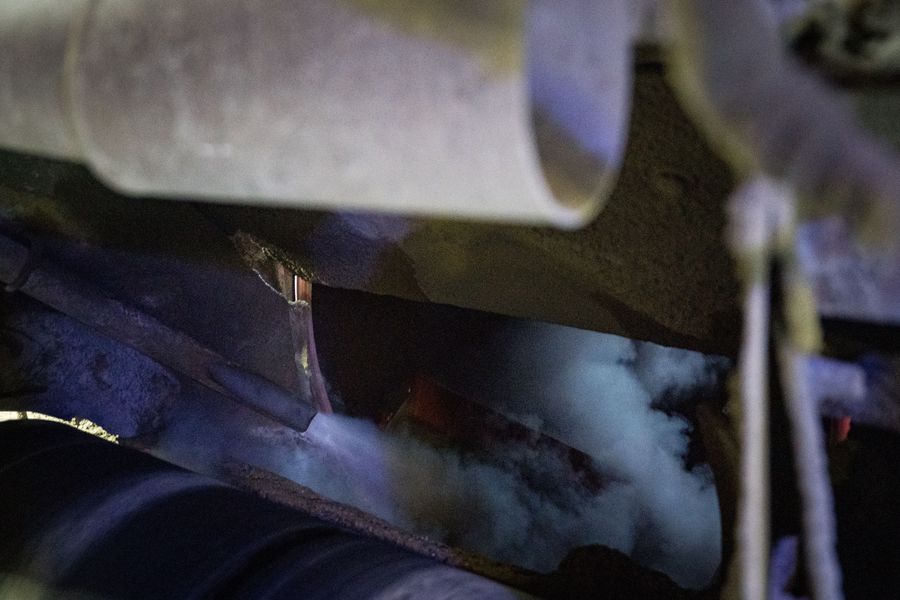
CarbonCure pumps CO2 into concrete as it is being made. PHOTO: KENT NISHIMURA FOR THE WALL STREET JOURNAL
Partanna, which uses brine from saltwater desalination to make concrete, said homes made from its material suck carbon out of the air.
It is unclear if the greener concrete alternatives will ever catch on broadly. Building codes have rigid rules on what concrete must contain, and many builders don’t like to try out new materials, Masic said.
Cost is another issue. Eco Material’s most environmentally friendly cement alternative, for example, costs around twice as much as standard cement, according to Quasha. CEO Cody Finke said Brimstone’s cement will be as cheap or cheaper than the common sort, but the company has yet to build a factory.
“If I go to the developing world and tell them you’re going to have to pay 20% more for your cement, they won’t do it,” said Eric Toone , a managing partner at Breakthrough Energy Ventures.
Even if some of these new technologies succeed, the startups have yet to prove that they can produce green cement at the vast quantities needed to make a dent in global warming.
Still, Toone said cement makers have no choice but to find cheap ways to cut emissions because ditching the material isn’t an option.
“Cement is sort of this wonder material,” he said. “It’s so cheap, it’s so valuable, it’s so good for what we need that it’s really hard to think of ways around it.”
Copyright 2020, Dow Jones & Company, Inc. All Rights Reserved Worldwide. LEARN MORE
The Australian leather house has opened an immersive four-day pop-up in Manhattan, unveiling its Bloom Collection and redefining what a product launch can look like.
Following the successful launch of its Palais Collection, MAISON de SABRÉ has unveiled a new modular handbag system offering more than 720 styling combinations.
Related Stories
Property
A Modern Home in Silicon Valley Lists for $44 Million
By E.B. Solomont 24/09/2026
Property
$8.1 billion, 10,000-home community set for Dubai neighbour Sharjah
By Ruba Jaajaa 21/09/2026
Property
The 60-Year-Old Real-Estate Agent Giving History Lessons on Instagram
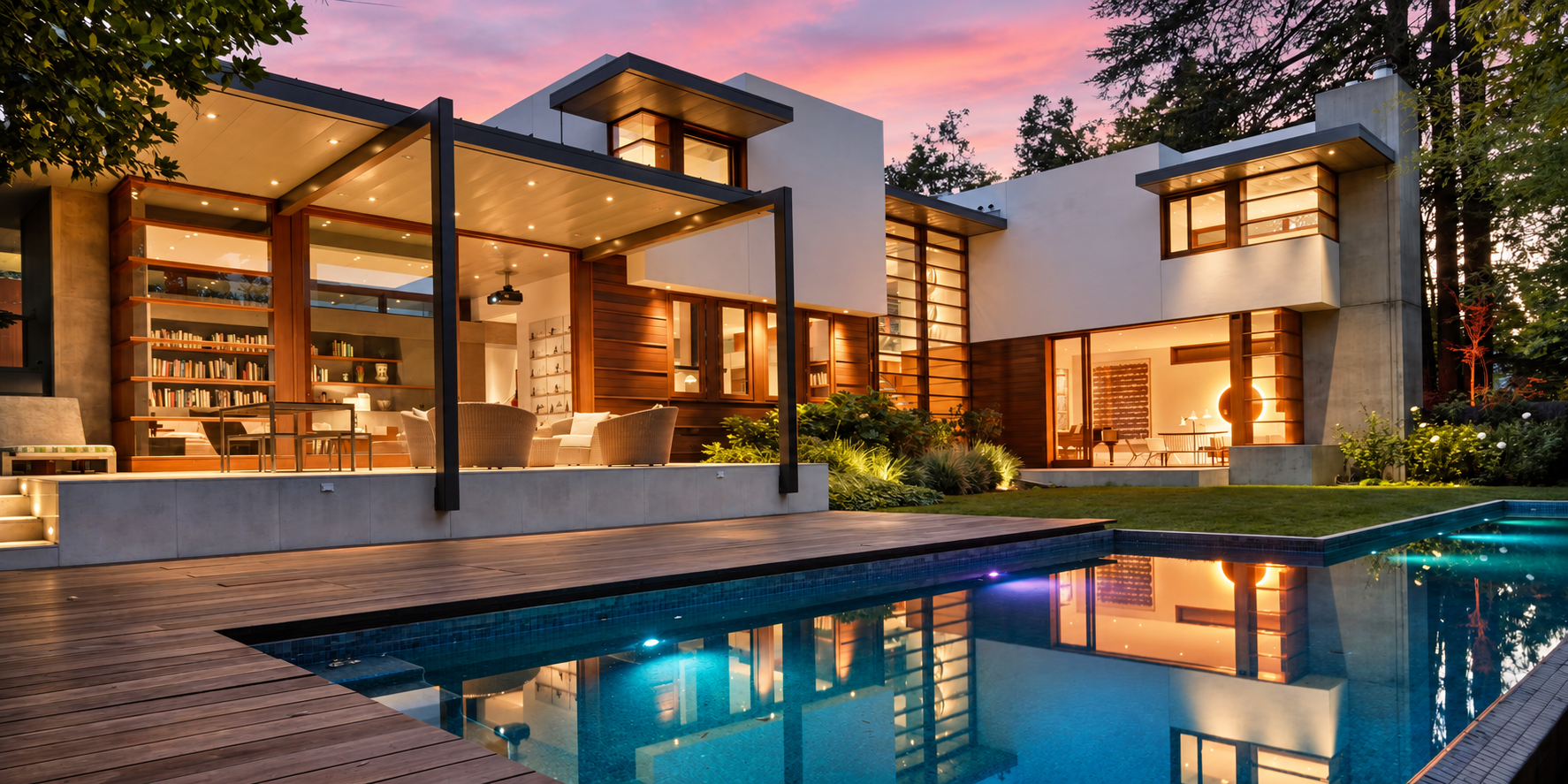
A five-bedroom Palo Alto home designed by Steven Ehrlich is listed for $44 million, making it the city’s most expensive listing. Built around a dramatic concrete spine, the home features four courtyards and a pool.
By E.B. Solomont
Thu, Sep 24, 2026 3min
For years, tech entrepreneur Asher Waldfogel and his wife, Helyn MacLean, dreamed of building a modern house in Palo Alto, Calif.
The couple, however, worried about clashing with the Mediterranean-style architecture typically associated with their neighborhood of Old Palo Alto.
So they tapped architect Steven Ehrlich to create a design that paid homage to its surroundings with stucco, mahogany and titanium zinc cladding. They spent $20 million over several years building the house, completed in 2005.
Designed for indoor-outdoor living, the house has matching mahogany paneling and limestone both inside and out. Arthur Sharif/Sotheby’s International Realty
The dining room is between an outdoor garden and the staircase. Arthur Sharif/Sotheby’s International Realty
Now looking to be closer to their adult daughter on the East Coast, they are putting the five-bedroom home on the market for $44 million—the most expensive listing in Palo Alto.
Waldfogel is an angel investor who co-founded Redback Networks, a telecommunications-equipment company. MacLean previously had a career in fundraising.
The kitchen and family room open to the garden and pool. Arthur Sharif/Sotheby’s International Realty
Cast alcoves and mahogany shelves house the couple’s books and ceramics. Arthur Sharif/Sotheby’s International Realty
The couple purchased the roughly 0.4-acre site for $7.1 million in 2000 and demolished a circa-1930s Spanish Colonial home. The house they built pinwheels around a central staircase. It has 7,900 square feet of livable space, with four distinct courtyards and a pool.
A key feature of the home is a cast-in-place concrete wall, or spine, that is two stories high and about 80 feet long. “There’s a little bit of controlled chaos in what comes out of the form,” unlike a perfectly uniform surface, Waldfogel said. “If you want that, you do it in plastic.”
Ehrlich said it took a few tries to get the concrete wall right. Arthur Sharif/Sotheby’s International Realty
‘It’s a really hard material to tame,’ Ehrlich said of concrete. Workers learned as they went, and Waldfogel and Helyn grew to appreciate the imperfect material. Arthur Sharif/Sotheby’s International Realty
A central staircase is housed in a glass tower. Arthur Sharif/Sotheby’s International Realty
Waldfogel said he and his wife are thinking about the next phase of life now that their daughter is grown, although they have not decided where they will move. They also have a home in Sun Valley, Idaho.
“Right now we’re just trying to emotionally let go and decide what to do next,” he said.
Arthur Sharif/Sotheby’s International Realty
Two wings of the house are connected by horizontal planes. Arthur Sharif/Sotheby’s International Realty
Palo Alto, an epicenter of venture capital and tech startups in Silicon Valley, is home to some of the country’s biggest tech titans. Sales volume and prices are rising, with a median sale price of $3.5 million for the three months ending in August, up 5.8% year-over-year, according to real-estate brokerage Redfin.
Arthur Sharif of Sotheby’s International Realty—San Francisco Brokerage has the listing.



 3 min
3 min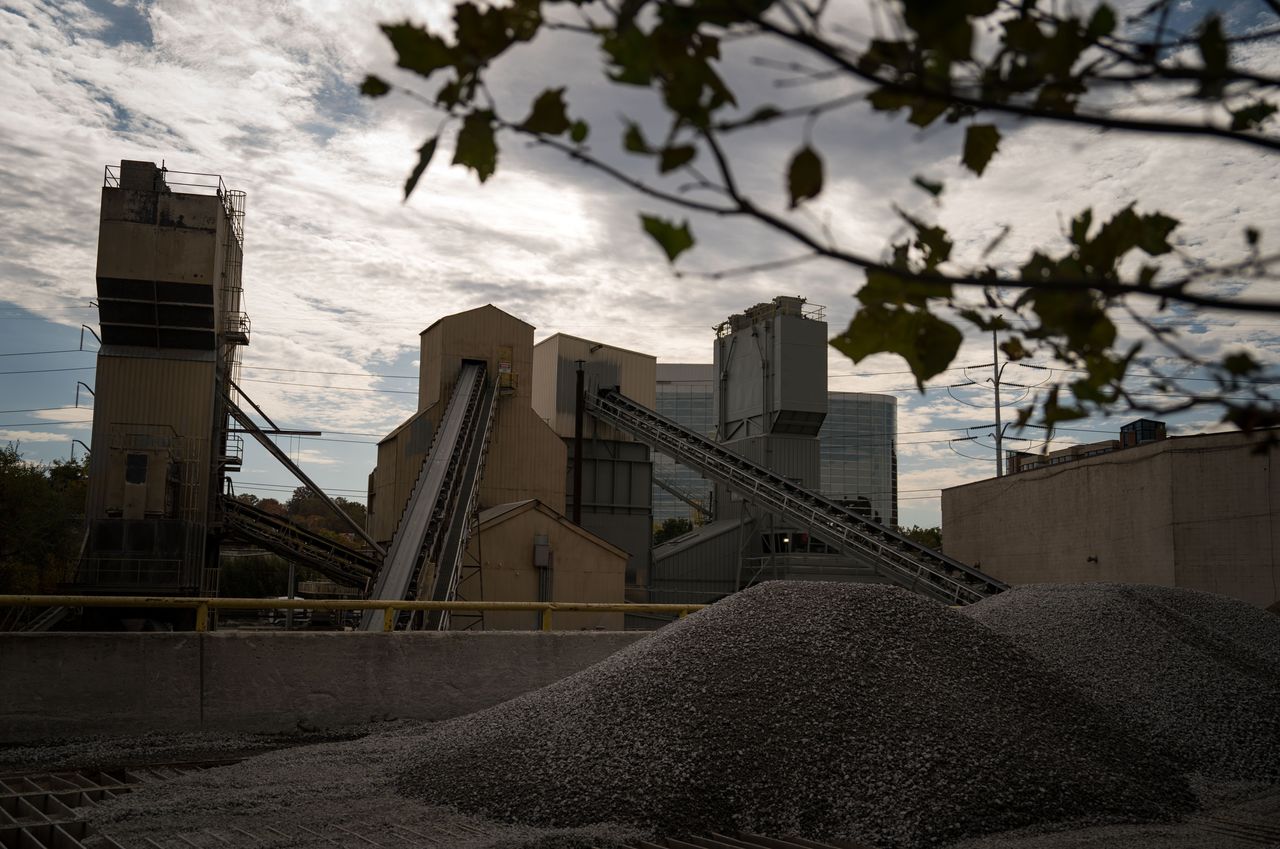
 Copyright 2020, Dow Jones & Company, Inc. All Rights Reserved Worldwide.