
Dumpster Driving: Inside the Treasures From the Los Angeles ‘Junkyard’ Car Collection

By Jim Motavalli
Fri, Aug 23, 2024 8:32am 3 min
3 min
3 min

 3 min
3 minClassic car enthusiast Rudi Klein was, by all accounts, a unique character.
The German émigré lived in Los Angeles, where he opened a junkyard called Porche Foreign Auto Dismantling (with the automaker’s name misspelled to avoid litigation). Klein, who passed away in 2001, took in only high-end foreign cars, mostly Mercedes and Porsche, but also BMWs and every brand of supercar, including many very rare examples. The junkyard’s trophies included famous Grand Prix driver Rudolf Caracciola’s 1935 Mercedes 500 K Special Coupe, a rare 1955 Mercedes-Benz 300 SL “Gullwing” (one of 29 with alloy bodywork), and many more.
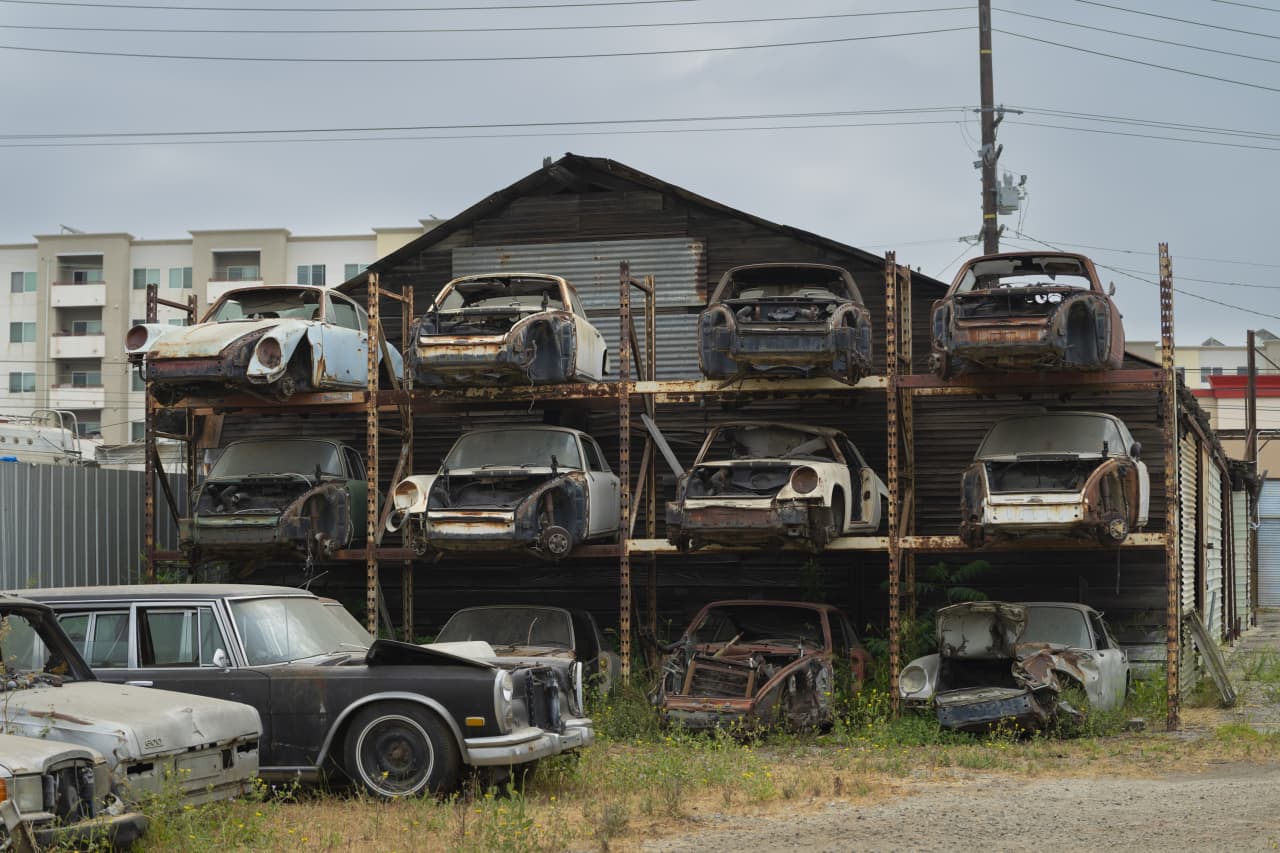
Most, but certainly not all, of the cars that Klein bought were crashed, burned, or otherwise derelict. A German crew managed to get into Klein’s closely guarded sanctuary, subsequently producing the unauthorised 2017 photo book Junkyard . Many other people were turned away from the gates, and Klein charged such high prices for salvaged parts that purchases were fraught. The doors remained closed after Klein’s sons, Ben and Jason, took over. But now, everything is coming into the light as RM Sotheby’s prepares to auction cars from the Klein collection on Oct. 26 in its current South Los Angeles location, including those two notable Mercedes-Benzes.
Andrew Olson, car specialist at RM Sotheby’s, said Klein’s premises have “an interesting and special atmosphere—if we moved the cars, some of that would be lost. There’s still a rack of Porsche 356s. We took them out to photograph them, but then they went back to where they were.” In Monterey last year, the auction house staged a horde of storm-damaged Ferraris as if they were still in a collapsing warehouse. Klein’s yard provides natural staging.
There’s a total of 180 cars in the sale, Olson says. Most of what was in the yard will be sold, minus some extensively burned cars and those with a current value that would not justify restoration.
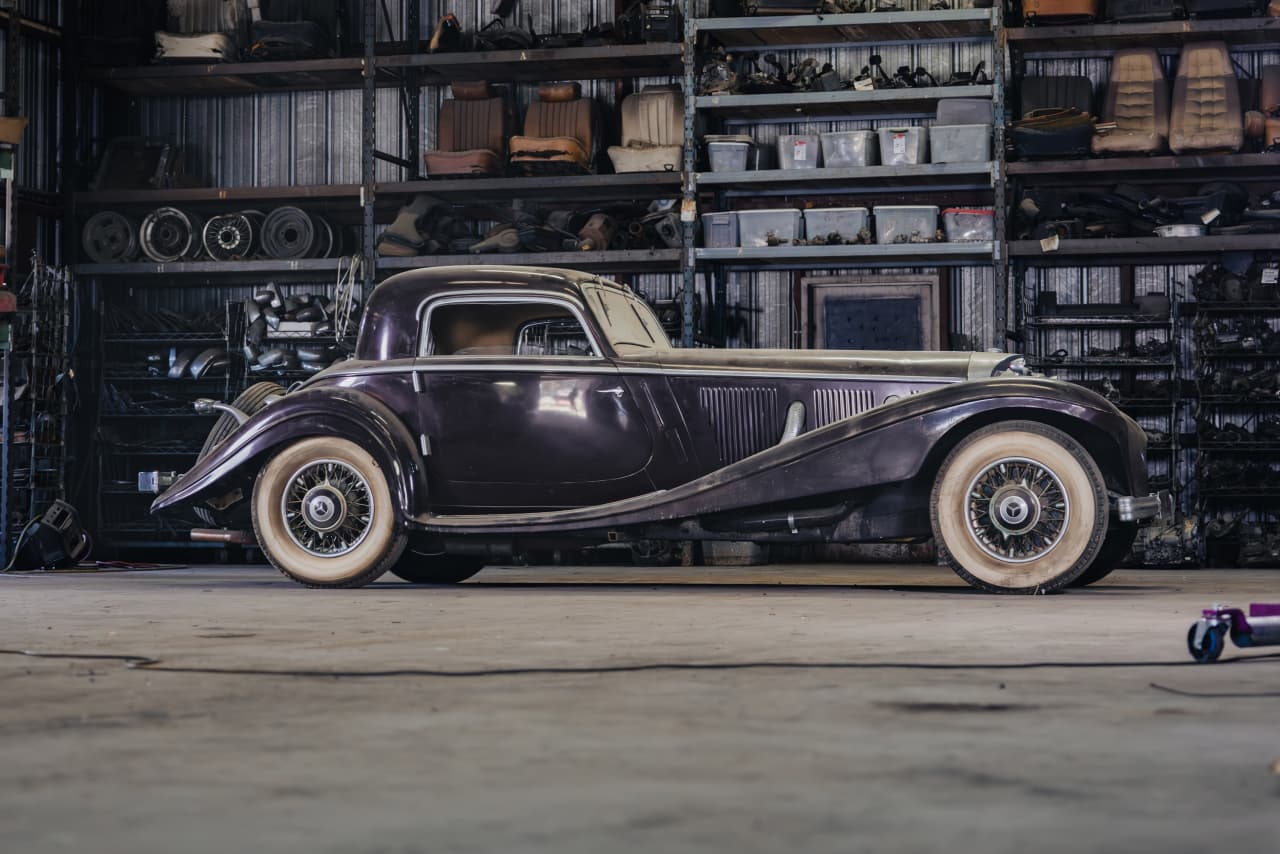
The 500 K Mercedes coupe has bodywork by Sindelfingen. It is a one-of-one vehicle, still wearing its original body. The car was restored and caused a stir at the famed Pebble Beach car show in 1966 and then again in 1978. But it was parked under Klein’s ownership in 1980, fortunately under cover. “The condition is surprisingly good,” Olson says. “It’s very solid and should be a straightforward restoration.”
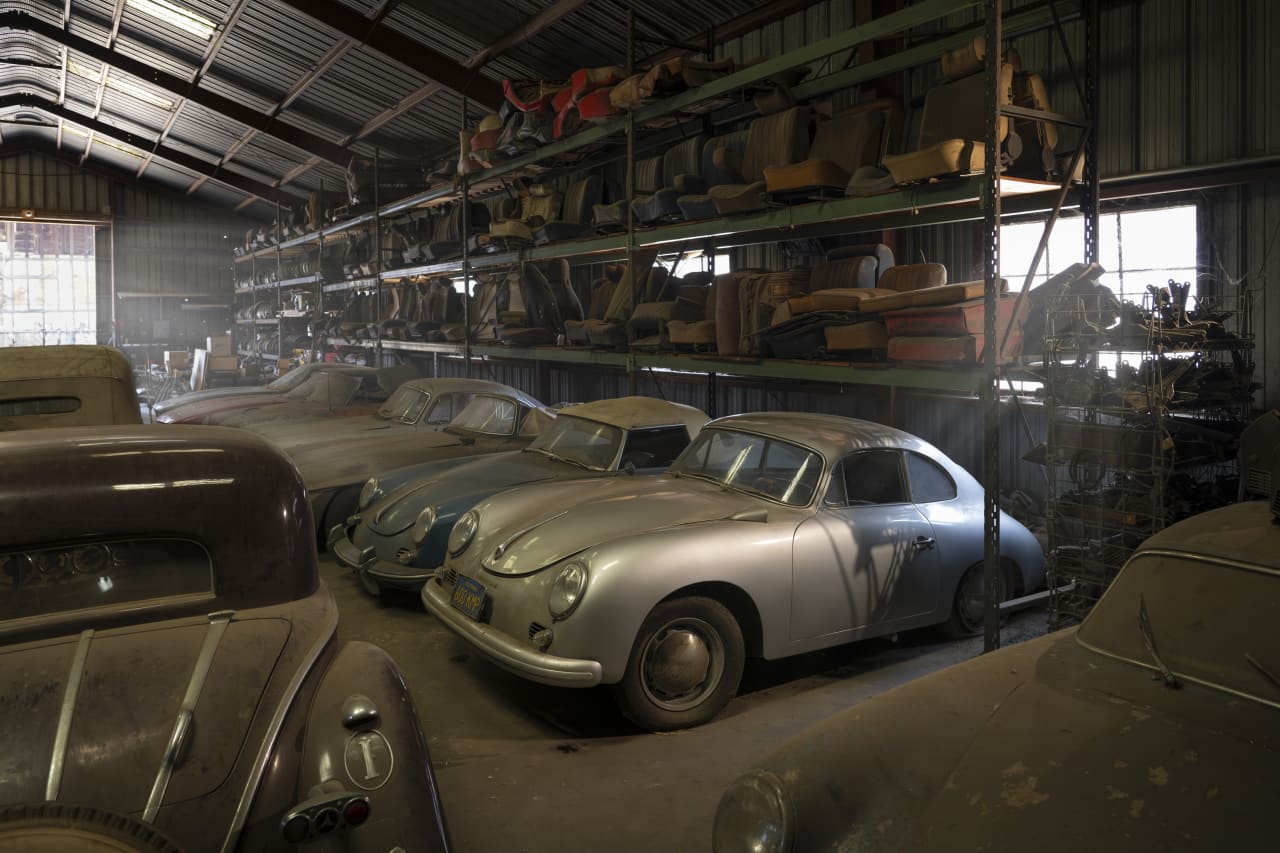
The alloy-bodied 1955 Mercedes 300 SL was the only one delivered in black, and had once been owned by Ferrari importer Luigi Chinetti. The auction house describes it as “a unique example of the most sought-after of all 300 SLs, virtually unseen for decades.” Complementing it is a 1957 300 SL Roadster that was painted Fire Engine Red from the factory, with a cream interior, and coveted Rudge wheels.
The 1967 Iso Grifo A3/L Spider is a prototype built by the Italian coachmaker Bertone, and is the only factory-built Grifo convertible. Klein acquired the car, with Chevrolet V8 power, reportedly from auto enthusiast and Hollywood producer Greg Garrison. According to Junkyard : “It was one of Rudi Klein’s all-time favourites, and he hoped one day to rebuild it and take part in a classic-car rally in Bavaria.”
 Copyright 2020, Dow Jones & Company, Inc. All Rights Reserved Worldwide. LEARN MORE




BNW Developments has established a Sydney presence, joining Arada and Sobha Realty among the growing number of UAE developers pursuing Australian buyers and development opportunities.
The Australian leather house has opened an immersive four-day pop-up in Manhattan, unveiling its Bloom Collection and redefining what a product launch can look like.
Apple closed above a $5 trillion market valuation for the first time, capping Tim Cook’s 15-year tenure and setting a high bar for incoming CEO John Ternus, as the company faces growing pressure to strengthen its AI capabilities and sustain growth.
3 min
Apple AAPL 0.50%increase; became the second company to close above the $5 trillion mark on Wednesday, capping the Tim Cook era, and posing an implicit challenge to new Chief Executive John Ternus.
The iPhone-maker’s shares closed at a record, just enough to push the company’s market capitalization into territory that only chip colossus Nvidia occupies. Apple’s market value has surpassed $5 trillion six times previously during intraday trading, but it had never closed above that level, which it squeaked past on Wednesday, ending the day at $5.005 trillion according to Dow Jones Market Data.
Cook’s act will be tough to follow. During his 15-year tenure as CEO, which ended Aug. 31, Apple’s market capitalization multiplied by a factor of 13. He nearly quadrupled the number of iPhones sold annually. He grew its highly profitable services business from $10 billion annually to more than $100 billion. He launched the Apple Watch and AirPods, which together generate more than $30 billion a year. He poured Apple’s cash into more than $1 trillion worth of share buybacks and dividends.
Today, Apple shares trade at a premium compared with the overall S&P 500 even though the company’s revenue growth rate is slower than the index’s average. That is because the company’s shares are viewed as safe, and its business predictable, say analysts.
A key to Apple’s success under Cook is how it has limited capital spending, juicing the company’s returns for investors and greatly reducing the risks of its business. That has never been more apparent than during the AI build-out, when big tech rivals have rushed to spend gargantuan sums on data centers while Apple has focused on its core businesses making devices and selling high-margin services for them.
Apple investors are so confident in its business that they have driven up its shares despite big cost increases that threaten profit margins. The cost of memory and storage chips inside iPhones, Macs and iPads has skyrocketed as demand for those chips from data centers has led to shortages. Apple has responded by raising prices across its device lineup, including for older model iPhones that would typically get a price cut.
In theory, such a move could hurt Apple since iPhone buyers might wait longer to upgrade their devices. Yet since the first wave of price increases Apple shares have jumped 25%.
In part, that is because investors think Apple device buyers will pay the higher prices, enabling Apple to generate as much or more in total profits even if margins are down, said Bank of America analyst Wamsi Mohan. He added that Apple’s new foldable iPhone Duo is likely to be popular and that the new Siri AI will prompt iPhone upgrades.
AI has long been viewed as Apple’s Achilles’ heel. The company failed in its efforts to build its own frontier model, and it also allowed its Siri assistant to fall far behind rivals. ChatGPT revolutionized what smartphone users expect from chatbots.
Apple hopes to turn a corner with the new Siri AI. Built with Google’s help, Apple’s redesigned chatbot was released this fall. It still lags behind rival AI systems in key respects, though it has the advantage of being built directly into the device that many people already use, their iPhone. Apple also has access to more personal data, which could theoretically be used for compelling AI features, though new AI agents show the technology is advancing faster than Apple’s ability to keep up.
Tech rivals know how important it is to control the devices that people use to deliver their services. Perhaps most threatening to Apple, OpenAI is planning a family of AI-powered devices. It has poached hundreds of Apple employees to drive its device strategy. Apple responded in July by suing OpenAI, alleging it stole Apple trade secrets.
OpenAI has said it is “not aware of any evidence that this complaint has merit” and alleged in a new legal filing Wednesday that Apple poached one of its own employees who took confidential files with him. Apple said in response that it had found no evidence supporting the new allegation.
AI could be the battleground where Ternus makes his mark, either ushering in a new era of innovation and growth for Apple or finally losing its status as the company that has defined how people interact with computers.
