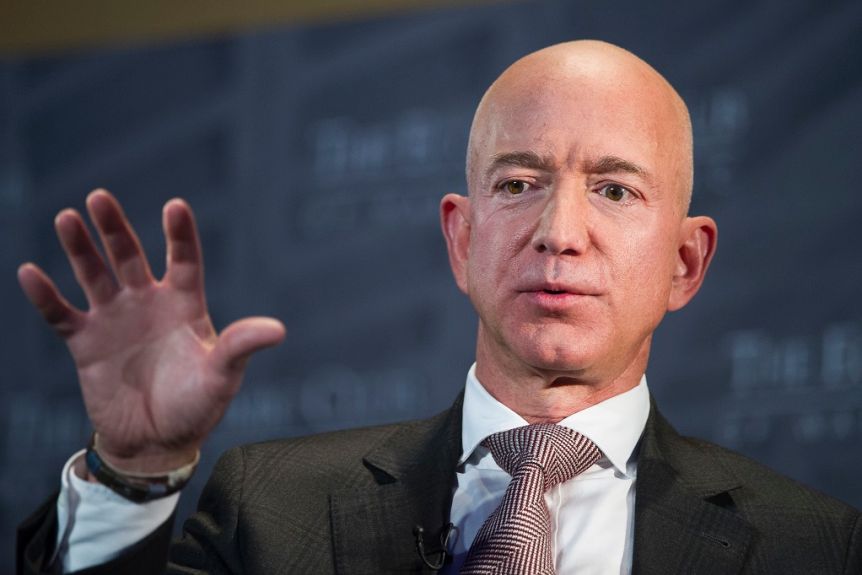
Jeff Bezos To Step Down As Amazon CEO; Andy Jassy To Take Over
The company announced changing roles as it reported that revenue in the fourth quarter soared 44% to US$125.56 billion.
Jeff Bezos is stepping down as chief executive of Amazon.com Inc. to become executive chairman, marking the biggest change in leadership of the tech giant since he started it in a Washington state garage more than 26 years ago.
Amazon said on Tuesday that he will be succeeded as CEO in the third quarter by Andy Jassy, Mr Bezos’s closest lieutenant and the longtime head of the company’s booming cloud-computing business.
Mr Bezos, 57 years old, is handing over the day-to-day reins, as Amazon’s core businesses of online retail and business-computing services are booming during the Covid-19 pandemic, which has shifted work and life to the internet more than ever. The company announced his changing role as it reported that revenue in the fourth quarter soared 44% to US$125.56 billion—surpassing US$100 billion for the first time in a three-month span—and profit more than doubled.
But Amazon also faces the biggest regulatory challenges in its history, with multiple federal investigations into its competitive practices and lawmakers drafting legislation that could force Amazon to restructure its business. Tension with regulators and lawmakers has directly embroiled Mr Bezos, who was called to testify in front of Congress last summer for the first time.
Mr Bezos’s leadership of Amazon has made him one of the most respected, and feared, leaders in business, as well as fantastically wealthy. He is currently neck-and-neck with his rival rocket entrepreneur, Tesla Inc. CEO Elon Musk, as the world’s wealthiest person. Forbes lists Mr Bezos’s wealth at more than $196 billion.
In an email to employees made public Tuesday, Mr Bezos said he plans to focus his energy now on new products and early initiatives as well as his outside interests. “Being the CEO of Amazon is a deep responsibility, and it’s consuming,” Mr Bezos wrote. “When you have a responsibility like that, it’s hard to put attention on anything else.”
Mr Bezos’s move makes Amazon the latest of today’s tech giants to transition leadership away from the people who started them. The co-founders of Google stepped back from their management roles at its parent Alphabet Inc. in 2019, and both Apple Inc. and Microsoft Corp. have long been run by successors to their founders.
Mr Bezos left a career on Wall Street to start Amazon.com in 1994 as a scrappy online bookseller during a time when most Americans didn’t own computers. Amazon became an against-all-odds success story that would go on to completely disrupt the bookselling industry along with nearly every other industry in its path, from logistics to advertising. The company today is America’s largest online retailer, the leading provider of cloud-computing services, a significant player in Hollywood, a competitor in bricks-and-mortar groceries through its Whole Foods subsidiary, and a growing rival to United Parcel Service Inc. and FedEx Corp. in logistics. Amazon employs nearly 1.3 million people.
The executive imbued the Seattle-based company with a “Day 1” philosophy of always maintaining an underdog startup ethos. However, in recent years, Mr Bezos has stepped back from day-to-day management of the tech giant—with a brief pause when he became more actively involved in the early days of the pandemic. Many in his inner circle describe Mr Bezos’s role over the past few years as akin to that of an executive chairman. The executive famously tries to not schedule meetings before 10 a.m. and to make all of his tough decisions before 5 p.m. Amazon employees say the billionaire is elusive, with many saying they have never spotted him on the company’s sprawling downtown Seattle campus.
In 2016, he appointed two of his top deputies to oversee management of daily operations. Jeff Wilke was named CEO of world-wide consumer at Amazon, overseeing everything from Amazon’s retail arm and warehouses to its advertising and devices business. Mr Jassy was CEO of the cloud business, called Amazon Web Services.
The appointments freed up Mr Bezos to devote time to innovations and moonshots. He took on pet projects such as Amazon’s voice assistant product, the Echo, and spent time with Amazon’s studio executives on what movies and television programs it had in the pipeline.
Mr Bezos’s tightknit group of top lieutenants at Amazon has seen its ranks thin out in the past few years. In addition to Mr Wilke’s departure at the beginning of the year, Jeff Blackburn, a 20-year veteran and member of Mr Bezos’s team of top executives, took a sabbatical in 2020. Steve Kessel, another member of Mr. Bezos’s top executives, retired from the company last year.
Beyond Amazon, Mr Bezos bought the Washington Post in 2013 and has spent a sizable chunk of his time at Blue Origin LLC, the space company he founded. While the coronavirus pandemic re-engaged Mr Bezos, as the company had to deal with unprecedented demand, he remained involved with Blue Origin’s mission. Just last week Mr Bezos posted a photo on Instagram of a “hotfire test” of a Blue Origin engine.
Mr Bezos, a father of four children, also has experienced a major transition in his personal life recently. In 2019, Mr Bezos and his wife divorced and the National Enquirer tabloid reported his affair with a former television reporter who was the wife of a Hollywood executive.
The leadership transition at Amazon will take place as it grapples with unprecedented scrutiny.
The company is currently the subject of probes from the Justice Department, the Federal Trade Commission, the European Union and other governing agencies about whether it participates in anticompetitive practices.
In October, the House Judiciary Committee’s Antitrust Subcommittee—before which Mr Bezos testified in July—concluded its 16-month investigation into the biggest U.S. tech companies. Its report accused Amazon of exerting “monopoly power” over sellers on its website and suggested legislation that could cause Amazon to exit business lines—like its private-label or devices businesses—that compete with sellers on its platform.
In response to the Congressional report, Amazon said: “All large organisations attract the attention of regulators, and we welcome that scrutiny. But large companies are not dominant by definition, and the presumption that success can only be the result of anticompetitive behaviour is simply wrong.”
On Tuesday, a member of the committee, Ken Buck (R., Colo.), tweeted Amazon’s announcement saying: “I have some questions for Mr Jassy,” indicating that the new CEO will inherit much of the regulatory scrutiny from his predecessor.
Rugged coastal drives and fireside drams define a slow, indulgent journey through Scotland’s far north.
A haven for hedge-fund titans and Hollywood grandees, Greenwich is one of the world’s most expensive residential enclaves, where eye-watering prices meet unapologetic grandeur.
The lunar flyby would be the deepest humans have traveled in space in decades.
It’s go time for the highest-stakes mission at NASA in more than 50 years.
On April 1, the agency is set to launch four astronauts around the moon, the deepest human spaceflight since the final Apollo lunar landing in 1972.
The launch window for Artemis II , as the mission is called, opens at 6:24 p.m. ET.
National Aeronautics and Space Administration teams have been preparing the vehicles to depart from Florida’s Kennedy Space Center on the planned roughly 10-day trip. Crew members have trained for years for this moment.
Reid Wiseman, the NASA astronaut serving as mission commander, said he doesn’t fear taking the voyage. A widower, he does worry at times about what he is putting his daughters through.
“I could have a very comfortable life for them,” Wiseman said in an interview last September.
“But I’m also a human, and I see the spirit in their eyes that is burning in my soul too. And so we’ve just got to never stop going.”
Wiseman’s crewmates on Artemis II are NASA’s Victor Glover and Christina Koch, as well as Canadian Space Agency astronaut Jeremy Hansen.

What are the goals for Artemis II?
The biggest one: Safely fly the crew on vehicles that have never carried astronauts before.
The towering Space Launch System rocket has the job of lofting a vehicle called Orion into space and on its way to the moon.
Orion is designed to carry the crew around the moon and back. Myriad systems on the ship—life support, communications, navigation—will be tested with the astronauts on board.
SLS and Orion don’t have much flight experience. The vehicles last flew in 2022, when the agency completed its uncrewed Artemis I mission .
How is the mission expected to unfold?
Artemis II will begin when SLS takes off from a launchpad in Florida with Orion stacked on top of it.
The so-called upper stage of SLS will later separate from the main part of the rocket with Orion attached, and use its engine to set up the latter vehicle for a push to the moon.
After Orion separates from the upper stage, it will conduct what is called a translunar injection—the engine firing that commits Orion to soaring out to the moon. It will fly to the moon over the course of a few days and travel around its far side.
Orion will face a tough return home after speeding through space. As it hits Earth’s atmosphere, Orion will be flying at 25,000 miles an hour and face temperatures of 5,000 degrees as it slows down. The capsule is designed to land under parachutes in the Pacific Ocean, not far from San Diego.

Is it possible Artemis II will be delayed?
Yes.
For safety reasons, the agency won’t launch if certain tough weather conditions roll through the Cape Canaveral, Fla., area. Delays caused by technical problems are possible, too. NASA has other dates identified for the mission if it doesn’t begin April 1.
Who are the astronauts flying on Artemis II?
The crew will be led by Wiseman, a retired Navy pilot who completed military deployments before joining NASA’s astronaut corps. He traveled to the International Space Station in 2014.
Two other astronauts will represent NASA during the mission: Glover, an experienced Navy pilot, and Koch, who began her career as an electrical engineer for the agency and once spent a year at a research station in the South Pole. Both have traveled to the space station before.
Hansen is a military pilot who joined Canada’s astronaut corps in 2009. He will be making his first trip to space.
Koch’s participation in Artemis II will mark the first time a woman has flown beyond orbits near Earth. Glover and Hansen will be the first African-American and non-American astronauts, respectively, to do the same.
What will the astronauts do during the flight?
The astronauts will evaluate how Orion flies, practice emergency procedures and capture images of the far side of the moon for scientific and exploration purposes (they may become the first humans to see parts of the far side of the lunar surface). Health-tracking projects of the astronauts are designed to inform future missions.
Those efforts will play out in Orion’s crew module, which has about two minivans worth of living area.
On board, the astronauts will spend about 30 minutes a day exercising, using a device that allows them to do dead lifts, rowing and more. Sleep will come in eight-hour stretches in hammocks.
There is a custom-made warmer for meals, with beef brisket and veggie quiche on the menu.
Each astronaut is permitted two flavored beverages a day, including coffee. The crew will hold one hourlong shared meal each day.
The Universal Waste Management System—that’s the toilet—uses air flow to pull fluid and solid waste away into containers.
What happens after Artemis II?
Assuming it goes well, NASA will march on to Artemis III, scheduled for next year. During that operation, NASA plans to launch Orion with crew members on board and have the ship practice docking with lunar-lander vehicles that Elon Musk’s SpaceX and Jeff Bezos’ Blue Origin have been developing. The rendezvous operations will occur relatively close to Earth.
NASA hopes that its contractors and the agency itself are ready to attempt one or more lunar landing missions in 2028. Many current and former spaceflight officials are skeptical that timeline is feasible.