Everyone’s Over ‘Quiet Luxury.’ Here’s What’s Next - Kanebridge News
Share Button

Everyone’s Over ‘Quiet Luxury.’ Here’s What’s Next

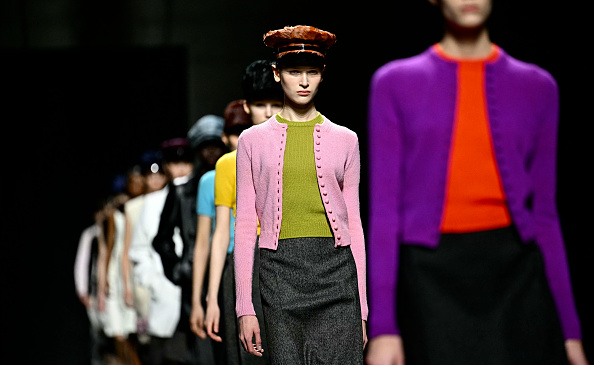
Cosy silhouettes and sumptuous fabrics were throughlines of the fashion collections shown last week in Milan

By RORY SATRAN
Tue, Feb 27, 2024 8:47amGrey Clock 3 min

“Quiet luxury” has become a bit of a dirty phrase in Milan. To some at the Italian brands that embody the term , it’s reductive—an overly TikTok-ified way of describing classic, refined clothing. Many fashion industry people roll their eyes when it comes up.

Brunello Cucinelli , one of the kings of natural textiles, prefers the term “gentle luxury.” At his fall presentation in Milan this past week, the (extremely expensive) clothing at which he excels looked especially touchable. Cashmere sweatsuits were layered with blanket-like scarves and silky suiting hung in loose pleats. Even an evening look, composed of a black sweater tucked into a feathered skirt, appeared comfy. Holding a pillowy bag, one Brunello disciple called it “accogliente”—Italian for “cozy.”

One step beyond coziness is protection, and there was plenty of that in Milan, too. Chalk it up to an uncertain luxury market , the roiling geopolitical climate or global warming, but using clothing as a sanctuary seemed to be on many designers’ minds. For some, like the excellent Brioni La Donna and Loro Piana collections, that means impeccable tailoring and forever-worthy double-breasted coats. Others, like Luke and Lucie Meier at Jil Sander, took the cocooning more literally, making succulent, quilted floor-length capes.

Not everyone is swaddling themselves in shearling. Architect Bianca Censori, who joined her companion, the rapper Ye, at the Marni show, wore a mere scrap of leather that failed to cover her buttocks among other body parts. No protection needed—except her bodyguard.

The Look of Love at Prada

Miuccia Prada and Raf Simons, the co-creative directors of Prada, are on quite a roll. If you were feeling hyperbolic, you might even say that they’re making fashion history. The duo’s fall collection started with thinking about love, explained Simons backstage, but “all the elements of love,” including loving your home, or even loving your sheets. There’s that theme of comfort again.

That manifested in a romance for different eras of fashion, remixed: A Jackie O. linen shift dress shot through with a streak of shearling. A leather bomber jacket embellished with “1913,” the year Prada was founded. A twin set in shocking red and ultraviolet. High-tech nylon jackets in midcentury couture shapes.

“There is no way to think about the future unless you have a good understanding of the past,” said Simons.

Everyday Allure at Bottega Veneta

In less than four years, Matthieu Blazy has completely renewed Bottega Veneta, making it a cult spot for creative types that want unique clothing and accessories with plenty of craftsmanship. Without succumbing to naked dresses and other revealing gimmicks, the brand appeals to a broad demographic, as shown by front-row neighbours Julianne Moore, 63, and A$AP Rocky, 35.

The fall collection, Blazy said backstage, was a “celebration of the everyday.” He found himself thinking about the allure of everyday clothing on his nightly dog walks. This meant recognizable pieces like peacoats, skirts and sweaters, reduced to their essential essence but rendered fabulous through textile innovation and fabrication. A simple yellow evening dress had a shirred-fabric fraying (not unlike recent work by Phoebe Philo ) and a long column skirt boasted leather plumes.

Blazy wanted to express resilience, he said, like flowers blooming in the desert. Fittingly, he designed giant Murano glass cactus flowers to decorate the show space.

Womblike Sumptuousness at Jil Sander

Real life crept into the fashion bubble on the day of Jil Sander’s show, when guests were confronted with a triple-whammy of rain, traffic and multiple public protests that closed the streets. Supermodel Mariacarla Boscono, like several models and editors, had a harrowing trip from Dolce & Gabbana to Jil Sander, and was swept right into hair and makeup and then onto the runway. Wearing the first look, a cocoon-like rounded red suit, Boscono was worth the wait.

Jil Sander put forward an extensive 68-look collection chock-full of satisfyingly sumptuous pieces. Chunky knitwear was sheathed in fine netting, tailored pieces were lined in silky quilting. Coats in deer leather and Himalayan goat fur looked like outerwear for an Icelandic wedding.

Androgynous Realism at Tod’s 

At conservative Italian stalwart Tod’s, Matteo Tamburini executed an impressive debut. Upon arriving from Bottega Veneta in December, the first thing Tamburini discussed with Tod’s group boss Diego Della Valle was the need to create “desirable objects.” “You don’t want to have a big fashion show and then find nothing in the store,” said Tamburini after the show.

So in just a few short months, Tamburini was able to create a tightly edited women’s collection full of androgynous separates and light, appealing accessories. Stylist Brian Molloy, who’s also worked with The Row and Hermès , worked magic with restraint. One supersoft foldable tote big enough for a laptop had a slit at the top so it could fit under your shoulder—easy stuff that merits a high price tag.


MOST POPULAR

BNW Developments has established a Sydney presence, joining Arada and Sobha Realty among the growing number of UAE developers pursuing Australian buyers and development opportunities.

The Australian leather house has opened an immersive four-day pop-up in Manhattan, unveiling its Bloom Collection and redefining what a product launch can look like.

Related Stories
Money
Anthropic Committed to Spend $900 Billion. Wall Street Expects Its Debt to Be Junk.
By Matt Wirz and Jack Pitcher 24/11/2026
Money
AI stocks roar back as Jensen Huang returns to Nvidia
By Ruba Jaajaa 24/11/2026
Lifestyle
Basketball Made Magic Johnson Famous. Mark Walter Made Him a Billionaire.
By Margot Patrick , Shane Shifflett and Justin Baer 23/11/2026

Anthropic’s $1.18 trillion valuation is facing a new test: the bond market. Despite raising more than $100 billion, the AI company faces questions over its ability to finance nearly $900 billion in future computing commitments. Investors are weighing whether its growth prospects justify the risks of lending to an unprofitable AI giant.

By Matt Wirz and Jack Pitcher
Tue, Nov 24, 2026 4 min

Anthropic’s ANT -1.43%decrease; stock market debut was rocky. There are even bigger questions about how it will fare in the bond market.

The hot artificial-intelligence company raised more than $100 billion last week and is worth around $1.18 trillion, above Walmart or JPMorgan Chase. But it has committed to spend some $900 billion in the coming years to pay for the gargantuan amount of computing power needed for its leading AI models.

Borrowing big in the corporate bond market won’t be easy. Anthropic is unprofitable, less than six years old and Wall Street isn’t confident it will meet its long-term obligations. The debt market expects credit-rating firms to rate its bonds as junk, or below investment grade.

“Any Anthropic debt deal is going to be viewed with a suspicious eye,” said Craig Manchuck, a bond-fund manager at San Francisco-based Osterweis Capital Management. “How do you gauge what the right price is for a company that has committed to spend $900 billion in the next couple of years?”

Anthropic’s credit rating has consequences for bond markets and the entire AI ecosystem.

An investment-grade rating would give Anthropic access to the $8.6 trillion high-grade corporate bond market, a relief for microchip manufacturers. Broadcom and Nvidia have guaranteed tens of billions of dollars of loans to buyers of its chips that are rented to AI “labs” like Anthropic and OpenAI. Analysts have grown increasingly worried about “circular” financing deals and the size of the loan guarantees, making chip makers eager for the labs to start borrowing on their own.

AI has upended the market convention that equity investors fund unproven technology upstarts, while bond investors, who get interest payments and no upside, steer clear. The cost of building digital infrastructure—$10 trillion by some measures—far exceeds what even the stock market can provide, forcing the industry to borrow money.

Rising borrowing costs and tightening lending markets have been among the forces battering stocks in recent weeks as trillions of dollars in market value have been wiped away. Anthropic lost much of its post-IPO bump last week, as a sweeping selloff caught up with big players like Nvidia, Meta Platforms, Oracle and others.

One prominent credit investor said he was worried credit-ratings firms would give Anthropic an investment-grade rating because of its sheer scale, potentially allowing its bonds into retirement funds meant to hold ultrasafe assets.

“Obviously, at some point in the future, we’re hoping to be investment grade,” Anthropic Chief Executive Dario Amodei said in an interview on CNBC on Thursday.

Spokespeople for Fitch Ratings and S&P Global Ratings declined to comment. A spokeswoman for Anthropic declined to comment.

Several large bond-fund managers said they expect Anthropic to land a rating in the BB range, a notch or two short of investment-grade, which would make it by far the most valuable U.S. high-yield company. Hilton Worldwide currently holds that distinction, according to Dow Jones Market Data, with a market value of around $80 billion.

Other large-cap AI companies—including cloud-computing firm CoreWeave—also have junk ratings, highlighting the growing gap between how stock and bond investors view the industry.

“Companies on the one hand have $40 billion, $60 billion market caps and are paying 16% to 18% for their debt,” Apollo Global Management Chief Executive Marc Rowan said in an interview with a Wall Street Journal podcast in October. “One of those things is wrong.”

AI labs like Anthropic remain unproven, but if their growth continues, they could become dominant players in tech, outstripping the greats of Silicon Valley. Bond markets were also skeptical of electric-car maker Tesla in 2018, just before the company—and its share price—took off.

The big ratings firms haven’t publicized their views on Anthropic and could deliver a split decision, with some granting the company investment grade. Investors might not get final word until after Anthropic decides to issue public debt for the first time.

The company is unlikely to issue many unsecured bonds because the junk-bond market is relatively small at $1.7 trillion and carries high borrowing costs, the fund managers said.

Instead, they are more likely to continue accessing capital via structured financing, chip financing and the like, “where there are ways to enhance their own credit quality,” said Brian Barnhurst, head of global credit research at PGIM.

Bond managers are already struggling to absorb the tidal wave of bonds from large AI companies, or “hyperscalers” this year, many of which have performed poorly. Some of the $25 billion of bonds SpaceX issued shortly after its IPO in June have since lost more than 10%.

“I talked to a lot of my peers…and they don’t really have the appetite to buy into hyperscalers right now,” said Neil Sun, a bond-fund manager at RBC Global Asset Management.

Established tech giants with investment-grade credit ratings like Meta and Oracle issued record amounts of bonds and guaranteed jumbo loans used to build data centers. Wall Street banks sold the deals to debt-fund managers by offering interest rates well above typical yields on investment-grade bonds, but the investments have since lost value amid market indigestion.

Anthropic might be where the buck stops. Anthropic reported $17 billion of revenue last quarter but still lost money because of its high spending on computing power, and it has no other business to give bond investors comfort.

Anthropic can use its $96 billion in cash on hand and the proceeds from its IPO and a concurrent private-share placement to fund spending commitments for a year or more, analysts say. The company also started buying its own computing hardware, assets that could ease the way to an investment-grade rating. SpaceX landed an investment-grade rating thanks to its lucrative satellite business.

Roughly half of the AI lab’s spending commitments don’t start until 2030. Without an investment-grade rating by then, Anthropic could struggle to pay its bills.

“They have about three years of runway to get investors particularly comfortable with the credit story and their plan, so that the capital markets remain open for them,” RBC’s Sun said.