The Art Market is Down. A Cyberattack at Christie’s May Make Things Worse. - Kanebridge News
Share Button

The Art Market is Down. A Cyberattack at Christie’s May Make Things Worse.

The auction house plans for sales to proceed, including for a Warhol ‘Flowers’ estimated at $20 million

By KELLY CROW
Wed, May 15, 2024 9:56amGrey Clock 3 min

Christie’s remained in the grip of an ongoing cyberattack on Tuesday, a crisis that has hobbled the auction house’s website and altered the way it can handle online bids. This could disrupt its sales of at least $578 million worth of art up for bid this week, starting tonight with a pair of contemporary art auctions amid New York’s major spring sales.

Christie’s said it has been grappling with the fallout of what it described as a technology security incident since Thursday morning—a breach or threat of some kind, though the auction house declined to discuss details because of its own security protocols. Christie’s also declined to say whether any of the private or financial data it collects on its well-heeled clientele had been breached or stolen, though it said it would inform customers if that proves to be the case.

“We’re still working on resolving the incident, but we want to make sure we’re continuing our sales and assuring our clients that it’s safe to bid,” said Chief Executive Guillaume Cerutti.

Sotheby’s and Phillips haven’t reported any similar attacks on their sites.

Christie’s crisis comes at a particularly fragile moment for the global art market. Heading into these benchmark spring auctions, market watchers were already wary, as broader economic fears about wars and inflation have chipped away at collectors’ confidence in art values. Christie’s sales fell to $6.2 billion last year, down 20% from the year before.

Doug Woodham, managing partner of Art Fiduciary Advisors and a former Christie’s president, said people don’t want to feel the spectre of scammers hovering over what’s intended to be an exciting pastime or serious investment: the act of buying art. “It’s supposed to be a pleasurable activity, so anything that creates an impediment to enjoying that experience is problematic because bidders have choices,” Woodham said.

Aware of this, Cerutti says the house has gone into overdrive to publicly show the world’s wealthiest collectors that they can shop without a glitch—even as privately the house has enlisted a team of internal and external technology experts to resolve the security situation. Currently, it’s sticking to its schedule for its New York slate of six auctions of impressionist, modern and contemporary art, plus two luxury sales, though one watch sale in Geneva scheduled for Monday was postponed to today.

The first big test for Christie’s comes tonight with the estimated $25 million estate sale of top Miami collector Rosa de la Cruz, who died in February and whose private foundation offerings include “Untitled” (America #3),” a string of lightbulbs by Félix González-Torres estimated to sell for at least $8 million.

Cerutti said no consignors to Christie’s have withdrawn their works from its sales this week as a result of the security incident. After the De la Cruz sale, Christie’s 21st Century sale on Tuesday will include a few pricier heavyweights, including a Brice Marden diptych, “Event,” and a Jean-Michel Basquiat from 1982, “The Italian Version of Popeye Has no Pork in his Diet,” each estimated to sell for at least $30 million.

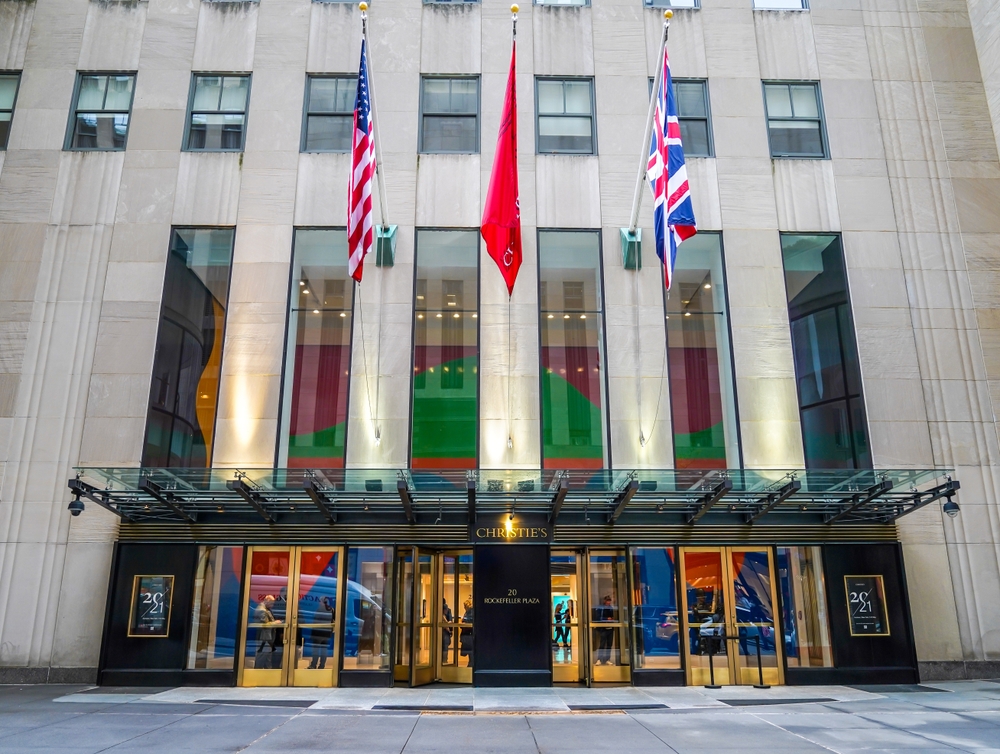
But the cyberattack has already altered the way some collectors might experience these bellwether auctions at Christie’s. Registered online bidders used to be able to log into the main website before clicking to bid in sales. This week, the house will email them a secure link redirecting them to a private Christie’s Live site where they can watch and bid in real time. Everyone else will be encouraged to call in or show up to bid at the house’s saleroom in Rockefeller Center in Midtown Manhattan.

If more bidders show up in person, the experience might prove to be a squeeze. During the pandemic, Christie’s reconfigured its main saleroom from a vast, well-lit space that could fit several hundred people into a spotlit set that more closely evokes a television studio, with far fewer seats and more roving cameras—all part of the auction industry’s broader effort to entice more collectors as well as everyday art lovers to tune in, online.

Once this smaller-capacity saleroom is filled, Christie’s said it will direct people into overflow rooms elsewhere in the building. Those who want to merely watch the sale can’t watch on Christie’s website like usual but can follow along via Christie’s YouTube channel.

Art adviser Anthony Grant said he typically shows up to bid on behalf of his clients in these major sales, though he said his collectors invariably watch the sales online as well so they can “read the room” in real time and text him updates. This week, Grant said a European collector who intends to vie for a work at Christie’s instead gave Grant a maximum amount to spend.

Grant said the cyberattack popped up in a lot of his conversations this past weekend. “There’s a lot of shenanigans going on, and people have grown so sensitive to their banks and hospitals getting hacked,” he said. “Now, their auction house is going through the same thing, and it’s irksome.”


MOST POPULAR

The Australian leather house has opened an immersive four-day pop-up in Manhattan, unveiling its Bloom Collection and redefining what a product launch can look like.

Following the successful launch of its Palais Collection, MAISON de SABRÉ has unveiled a new modular handbag system offering more than 720 styling combinations.

Related Stories
Lifestyle
Forget the AI Apocalypse—the Real Threats Are Already Here
By Christopher Mims 17/09/2026
Lifestyle
How to Give Host Gifts That People Will Want
By Misty White Sidell 15/09/2026
Lifestyle
At Restaurants, Phones Are Becoming the New Cigarettes
By Adam Chandler 14/09/2026

Investors are bracing for a bumpier fall stock market due to shifting odds of a Federal Reserve interest-rate increase and other macro challenges.

By Hannah Erin Lang
Tue, Sep 8, 2026 3 min

The stock market had a decent summer. Investors are bracing for a bumpier fall.

In the past couple of months, equity investors cheered soaring profits at big companies, shrugged off jitters in the bond market and nudged megacap tech shares back near records.

Now, as the post-Labor Day stretch begins, a number of new challenges lie ahead: ever-shifting odds of an interest-rate increase from the Federal Reserve. Sky-high expectations after a stunning earnings season. The persistent threat of higher consumer prices as fighting in the Middle East drags on.

“You’re moving from this earnings-driven market to this macro-driven market with the Fed, inflation and interest rates in focus,” said Keith Lerner, chief investment adviser for Truist Advisory Services. “It tends to be a choppier period.”

Historically, every major U.S. stock index experiences its worst average return in September. The Dow Jones Industrial Average has slid an average 1.1% in the ninth month of the year, in data that dates back to the 19th century. The S&P 500 has seen the same average decline—and for every September dating back to 1928, the benchmark ends the month lower more than half of the time.

Analysts caution against reading too much into those seasonal patterns. But in recent weeks, new reasons for investor caution have emerged. One of the largest: the looming threat of an interest-rate increase from the Fed, which announces its next policy decision on Sept. 16.

Chairman Kevin Warsh’s decision to ditch forward guidance and take more of his cues from markets has muddied the waters for investors when it comes to monetary policy. That has left traders scouring Fed governor speeches and economic-data reports for clues on the central bank’s next move.

“There’s going to be a lot of eyes on those numbers,” said John Luke Tyner, head of fixed income and portfolio manager at Aptus Capital Advisors.

The past couple of weeks offered just one example of how frequently those expectations can change. After Warsh struck a hawkish tone during remarks on Aug. 28, the odds of a hike at the Fed’s next meeting jumped from 35% before the speech to 58%, according to CME FedWatch data.

On Thursday, Fed governor Christopher Waller made a case for leaving rates where they are. Interest-rate futures showed coin-flip odds between a hike and a hold. Then Friday’s robust jobs report amped up rate-hike bets once more, back to a roughly 60% chance of higher rates after the meeting.

“Rates have really been driving the car for equities the last few weeks,” said Ross Mayfield, an investment strategist at Baird.

That uncertainty comes as an unruly bond market could put pressure on stocks. Treasury yields have marched higher for much of the summer, driven by concerns about rising oil prices, growing U.S. budget deficits and a deluge of tech-company bonds now competing for investors’ cash. Last week, the rout went global, pushing yields to multiyear highs in Japan, Germany and the U.K.

Higher bond yields can drag on stock prices and lift borrowing costs for companies and consumers across the economy.

Rising prices remain the top concern for bond traders, and continued fighting between the U.S. and Iran has done little to ease those worries. The national average price of diesel climbed to a record of $5.850 on Friday, according to AAA. That is up from $3.712 a year ago.

Investors will get more insight on the path of prices this week, with the much-awaited consumer-price index report due Friday and a reading on producer prices Thursday.

With another blockbuster earnings season in the books, some analysts have also warned that any boost from the third-quarter reports due in the coming months could be minimal. Back-to-back quarters of standout profits have raised expectations and made it especially difficult to impress traders. Custom-chip company Broadcom, for example, said Wednesday that it more than tripled its earnings and nearly doubled its revenue. Shares slipped 2.7% the next session.

Many analysts note there are plenty of reasons not to panic. The economy is in impressive shape, thanks to a healthy labor market and the rippling effects of the artificial-intelligence investment boom. Profits are booming at America’s biggest companies. The Cboe Volatility Index has dropped to its lowest levels of 2026. Credit spreads are tight, a sign bond investors aren’t concerned about economic conditions that could hurt companies.

But the mood has shifted from the euphoria that felt tangible when the Nasdaq was notching back-to-back records early this summer. The question, Mayfield said, is whether the fundamentals that have bolstered the bull market so far can stretch the rally into 2027.

“There are more anxieties or uncertainties about the backdrop,” he said. “It does feel like a transitional moment.”