
WHY COUTURE CLIENTS KEEP BUYING SIX-FIGURE GOWNS
How designers brought the antiquated craft of haute couture into the future at the shows in Paris

By RORY SATRAN
Mon, Jul 1, 2024 8:24pm 3 min
3 min
3 min


How designers brought the antiquated craft of haute couture into the future at the shows in Paris
3 min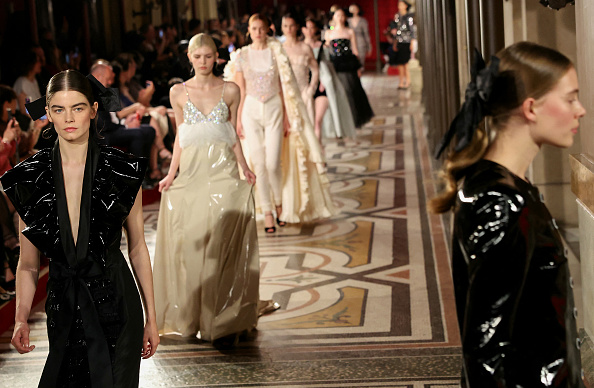
“Nobody really needs couture, to be honest,” said Demna after his Balenciaga haute couture show this week in Paris. No, most people do not need a bespoke gown that costs six figures and takes highly trained petites mains thousands of hours to make by hand. And yet.
Partaking in the official haute couture fashion week in Paris—which is rife with arcane rules about how the clothes are made—can pay off handsomely for the few designers left in the club. For the 15 or so brands that invest in the game, including Dior and Chanel, couture can multiply press and red-carpet opportunities, and have a trickle-down effect on sales of ready-to-wear and beauty and fragrance.
Then there are the orders, which can total in the millions for a single client. Wealthy couture diehards fly in for the shows and then quickly convene in cosseted showrooms to make their selections while munching macarons. Competition can be fierce, especially when a stylist nabs a gown early on for, say, Cardi B. When you’re paying this much to look unique, no one wants a duplicate.
Couture is famously over-the-top, and this season was no exception, with rampant feathered capes, obscuring hoods and trailing trains. But philanthropist, creative director and avid couture client Fredrik Robertsson told me he found the looks very wearable this season: “less PR showstoppers and more things people actually want.” He pointed to the calmer suits and cocktail dresses at Schiaparelli, which has in the past paraded out looks such as one bearing a faux lion’s head .
Couture can sag somewhat under the weight of its history. Craftsmanship, fashion’s favourite buzzword, can be a burden too, with designers feeling the need to embellish every gown with hand-embroidered butterflies and panoplies of pearls. But the following five looks show how a range of designers are making couture relevant today.
Demna, who goes by a mononym, is perhaps the contemporary designer most intent on bringing couture into the future. While he’s never far from Cristóbal Balenciaga’s archive—with its dramatic shapes and volumes—he’s also a student of streetwear. So the subcultures he reveres, from goth to skate kids, were present in his deceptively casual designs. Would the founder of the house turn in his grave at metal-band T-shirts masquerading as couture? Maybe not once he realised they were in fact hand-painted over a period of several days.
This top and skirt ensemble is made from unstitched cotton-jersey elements, which are then assembled and sewn together, and knotted on the model. It is a wearable sculpture, with the casual look of a pile of T-shirts.
Chanel, which is between creative directors after the departure of Virginie Viard, showed its haute couture collection at the Opéra Garnier. While many of the looks echoed the vibe of the classic theatre—including a sumptuous pink silk opera coat—some of the most successful moments were surprisingly dressed down. Robertsson, the Swedish couture client, exclaimed, “Chanel even had sweatpants!”
Shown on model-du-jour Amelia Gray Hamlin, the black Chanel sweatsuit was not technically a sweatsuit. It was a wool crepe jersey set trimmed in duchesse satin ruffles and organza. It was also shown in cream, and it will sell.
Maria Grazia Chiuri, one of the only female designers making couture, showed an elegantly restrained collection in a room filled with shimmering artwork by Faith Ringgold, who died earlier this year. Nodding to an Olympic year without being too heavy-handed, Chiuri presented Grecian-inspired draped dresses, flat lace-up sandals, and sporty tanks and bodysuits.
This long asymmetrical dress in cream-coloured silk jersey over a tank top is almost sporty, and a refreshing break from some of the more hobbling ensembles on display this past week. But that’s no ordinary tank top: It’s embroidered with silver-coloured micro-tube beads that have hematite-clawed jewels on them.
Daniel Roseberry, the charming Texan who’s revamped a dusty Parisian couture house, is a true believer in the art of couture. But he’s also savvy about its press potential, so this season, the show didn’t start until paparazzi magnets Kylie Jenner and Doja Cat had arrived.
The house’s founder, Elsa Schiaparelli, was a surrealist innovator who collaborated with her friend Salvador Dalí on one of the first trompe l’oeil garments . Roseberry continues his predecessor’s taste for trickery in his work. This jacket is embroidered all over with what appear to be small white feathers, but are in fact 10,500 silk-organza snippets. Because each “feather” is handmade, the jacket takes over 7,000 hours of work to create. Worn over a pair of smart black cropped pants, it’s almost work appropriate.
Jean Paul Gaultier, which maintains a healthy and bustling couture business, has adopted the clever strategy of inviting buzzy non-couture designers to collaborate on its collections. Simone Rocha, Glenn Martens, Olivier Rousteing and Chitose Abe of Sacai have all worked it out on the remix with Gaultier. Nicolas Di Felice, the artistic director behind Courrèges’s Pinault-backed renaissance, was up this season.
Di Felice, whose friends span Paris’s creative industries, brought his cool-kid approach to Gaultier. Many pieces featured couture details like rows of hook-and-eye closures, and partially hidden tulle corsets. But there were Di Felice signatures, too: koala-pouch front pockets, narrow trousers, tiny party dresses. This cheeky gown is carefully constructed to look like the top slip is falling away to reveal a bustier.
 Copyright 2020, Dow Jones & Company, Inc. All Rights Reserved Worldwide. LEARN MORE




BNW Developments has established a Sydney presence, joining Arada and Sobha Realty among the growing number of UAE developers pursuing Australian buyers and development opportunities.
The Australian leather house has opened an immersive four-day pop-up in Manhattan, unveiling its Bloom Collection and redefining what a product launch can look like.
Strong family financial planning can help reduce taxes and support younger generations. From intrafamily loans and asset gifts to inheritance disclaimers, strategic cooperation can create meaningful financial benefits—when families have the trust and structure to make it work.
4 min
Happy is the family whose members—parents, grandparents and grown children—trust each other enough to cooperate on shared goals, especially financial ones. When that is truly the case, Uncle Sam’s tax rules can help as well.
This matters especially now that mortgage rates are above 7%, and many families are looking for ways to help younger members. If the elders have resources and are confident younger ones can cooperate, a family loan could make homeownership possible while providing the elders with a useful income stream.
Other strategies can actually lower taxes, such as when funding 529 plans or Roth IRAs, or when someone inherits a traditional IRA with required withdrawals larger than they will need.
Here are three strategies useful for functional families.
It is perfectly legal for families to lend money to a relative for a down payment or even a private mortgage.
But it is important not to cut corners, says Ryan McKeown, a CPA with Modern Wealth Enhancement in Minnesota. If the loan is for a down payment, be honest with the mortgage provider and have a formal agreement. The lender owes tax on the interest payments received.
If the loan is for a private mortgage, both sides should have legal representation with a formal written agreement, including payment terms. The lender owes tax on the interest, and the borrower often can deduct it if he or she itemizes.
To avoid IRS trouble, the interest rate shouldn’t be lower than the agency’s Applicable Federal Rate at the time of the loan. Currently that is about 5% for loans longer than nine years; about 4.5% for loans three to nine years; and about 4% for loans three years or less. Currently, traditional mortgage rates are generally above 7%.
In addition, the lender could use the $19,000 annual gift-tax exemption (described below) to forgive some or all of the interest or principal annually. If both lenders and borrowers are married, that is up to $76,000 a year. There is no tax for the borrower on such forgiveness, because it is from a gift.
If you’re going this route, McKeown advises against having a fixed plan to forgive the debt. Instead, do it in one-off letters specifying the amount—and keep careful records. Otherwise the IRS might try to treat the loan as a taxable gift.
Powerful tax-saving moves for families often use gift-tax provisions. Under current law, anyone can give anyone else up to $19,000 of assets annually, free of gift tax. That means a married couple with three grandchildren could give them a total of $114,000 in 2026.
The gifts can be cash or other assets, like stock. For noncash gifts, the cost basis—which is the starting point for measuring taxable gain after a sale—“carries over” to the recipient. So if someone buys $1,000 of stock and gives it away when it is worth $5,000, the recipient’s cost basis is $1,000. If the recipient later sells the shares for $8,000, the taxable gain is $7,000.
Here’s an example showing how gifts could save a family taxes. Grandma is a widow of modest means, while her child and spouse have prospered. The couple has two children, and they want to contribute $5,000 to a 529 college-savings plan for each—but they need to sell stock to do it. Their tax rate on the sale would be 18.8%, and they would need to sell about $11,000 of stock.
However, Grandma’s federal tax rate on the stock sale is 0%. If the couple gives $10,000 of shares to Grandma, she could sell them, pay no tax, and fund the grandchildren’s 529 plans. This saves about $1,000 of tax.
These moves are legal, and they could be used in other ways, such as to help a young person fund a Roth IRA.
But trust among family members is essential: Under the law, givers can’t put conditions on a gift. Grandma could use her stock proceeds to take a cruise, but she makes 529 contributions instead.
Mark Sellner, a retired tax attorney and CPA living in Sarasota, Fla., uses this strategy. His children sell stock he gives them and fund 529 plans for his grandchildren.
The family’s tax savings aren’t huge, but he likes other benefits. The sales by his children don’t boost his adjusted gross income, which in turn could raise his Medicare Irmaa premiums or his 3.8% surtax on net investment income.
Sellner doesn’t worry about his children using the funds for another purpose.
“There can’t be any strings attached to gifts. Of course, it is up to us to decide whether to make them in the future,” he says.
Two caveats: The “kiddie tax” applies to most children under age 24, and it is levied at the parents’ rate on investment income above $2,700 in 2026. Consider this before making gifts to a young person.
Investors who give away stock also forgo the step-up, an important provision that exempts assets held at death from capital-gains tax.
Sellner knows he’s losing a step-up, but says, “The children could use a little more now. Why should they wait 20 years to get it?”
A disclaimer is a highly useful strategy in which one heir renounces an inheritance in favor of another heir. Assuming family members cooperate, this can save taxes.
Here’s one example. Dad died and had a large traditional IRA that he left to Mom. She has enough assets and income to cover her expenses, and she lives in a state with a stiff estate tax. The inherited IRA would put her estate over the threshold.
Also surviving are three young-adult children. If Mom disclaims all or part of Dad’s IRA within nine months of his death, that amount could go directly to the children. They will have 10 years to empty the account, and the family as a whole will likely save estate and income taxes.
Disclaimers have many key details, especially regarding beneficiary documents. Although heirs have great freedom in choosing what assets to disclaim, the rules about who gets disclaimed property are rigid. It is best if the original owner names tiers of heirs so that if one disclaims, the next recipient is clear.
