
Unicef Has a Growing Circle of Ultra-Wealthy Individuals on Tap

By ABBY SCHULTZ
Sat, Sep 28, 2024 7:00am 4 min
4 min
4 min

 4 min
4 min
During the Covid pandemic in 2021, Silicon Valley venture capitalist John O’Farrell organised a call with several tech CEOs to urge them to back Unicef’s efforts to distribute vaccines globally as he and his wife, Gloria Principe, were doing.
Stewart Butterfield , co-founder and—at the time—the CEO of Slack, and his wife, Jen Rubio , co-founder and CEO of Away, “gave US$25 million on the spot,” and challenged other tech CEOs to give, too, says Kristen Jones, Unicef’s fundraising manager, global philanthropy.
O’Farrell is on the national board of the organisation and a member of the Unicef International Council, a network of 150 wealthy individuals from 22 countries.
“We were trying to mobilise resources really quickly,” Jones says. In this instance, an International Council member showed how the “influence and trust” of individuals and their network can be extended to Unicef and its mission.
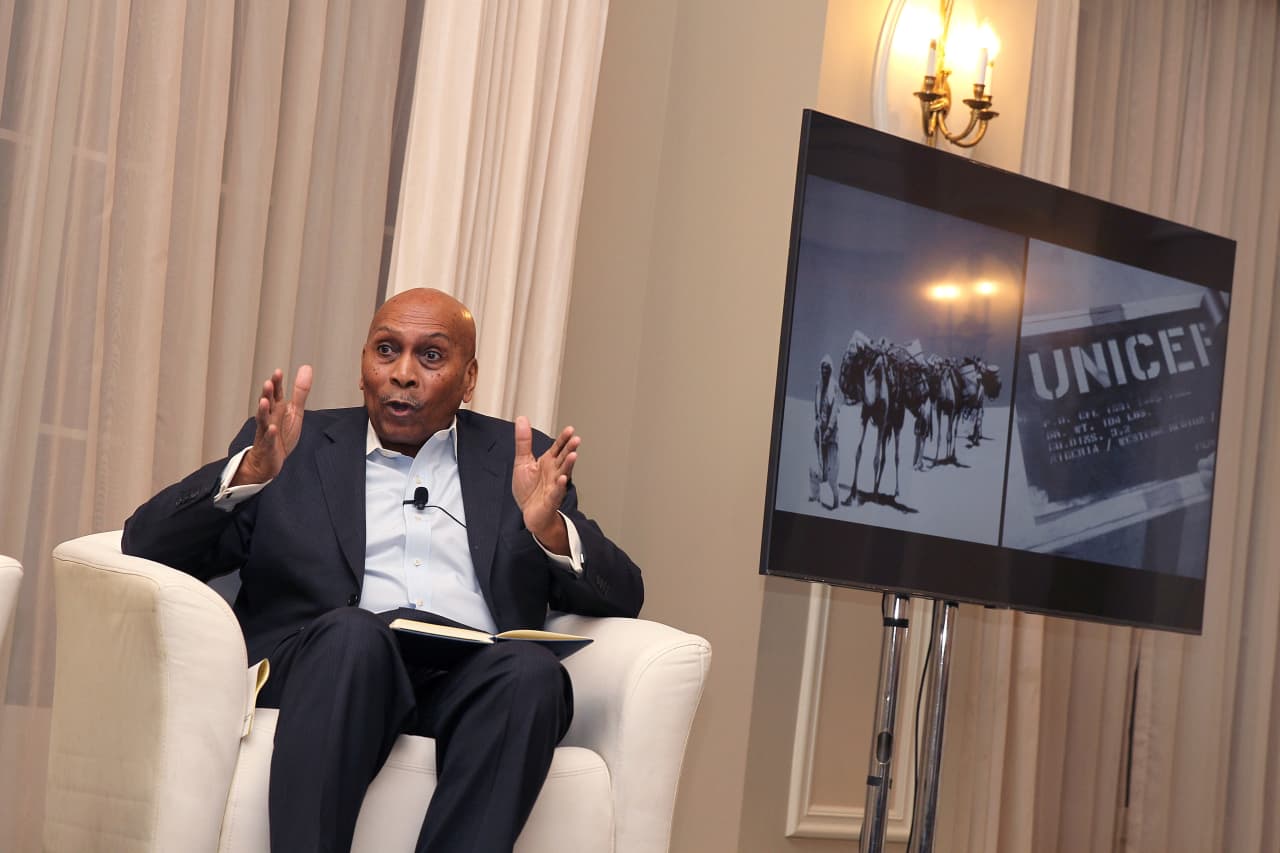
Unicef, officially the United Nations Children’s Fund, is a U.N. agency focused on humanitarian and developmental aid to children. It relies on funding from governments and intergovernmental agencies. But it also depends on the private sector, from US$1 gifts provided by individuals across the world to giving by corporations, foundations, and wealthy donors.
Total giving to Unicef from the private sector totalled US$2.07 billion last year, representing 23% of total revenue, according to its annual report. Of that total, US$829 million was unrestricted—money that is particularly valuable because it’s flexible.
“That funding is critical for us to be able to cover underfunded operations, emergencies or situations of armed conflict that are not in the headlines anymore,” says Carla Haddad Mardini, director of Unicef’s division of private fundraising and partnerships.
The International Council was formed in 2017 not only to boost private-sector donations, but to create a powerful group of individuals who could bring their knowledge, expertise, vision, and networks to the organisation, Haddad Mardini says.
“We don’t see them as donors, we see them as partners,” she says.
That’s because the council’s engagement with Unicef goes behind giving. “They support by opening their networks to us, thinking with us about the global problems that make children more vulnerable,” Haddad Mardini says. “It’s invaluable in terms of the advocacy that they do and the influence that they exert.”
The council, of course, also provides needed funding. Since it was formed, members—who give US$1 million when they join—have donated more than US$552 million.
This past year, the council brought on 15 new members, half from countries in the Southern Hemisphere, including India, Vietnam, Indonesia, and Mexico. The incoming chair is Muhammed Aziz Khan, founder and chairman of the Summit Group, a Bangladesh industrial conglomerate, whose foundation is focused on the education of vulnerable children in the country.
“We want this group to be as diverse as possible,” Haddad Mardini says. “They’re not there for their own visibility, they are there to really meaningfully and purposefully make a difference.”
Bernard Taylor, an arbitrator and mediator at Judicial Arbitration and Mediation ADR Services and a retired partner with Alston & Bird, an Atlanta-based international law firm, has been an active supporter of Unicef for years, joining its Southeast Regional Board in the U.S. in 2007. In 2018, he joined the council and this past summer, became chair of the organisation’s National Board.
One of Taylor’s earliest experiences with Unicef was a trip to Madagascar not long after the island in the southwest Indian Ocean off the coast of Africa had been hit by successive cyclones.
“It was really eye-opening from the standpoint of seeing the despair that so many people were living through and that the children were living through,” Taylor says. After returning home and taking his children on a trip to the local mall to buy supplies for a school project, he was overwhelmed by the abundance that surrounded them.
“Just a short plane ride away, people were living in despair and death—we had to do something about that, and what I saw was that Unicef was doing something about it,” he says. “That’s how I got involved and committed.”
Often, the council responds to emergencies such as the urgent need for global vaccine distribution during the pandemic. In 2022, the council raised US$3.2 million to support Unicef’s work in Afghanistan, and another US$5.5 million in response to the war in Ukraine.
But as Haddad Mardini says, the council also goes beyond check-writing.
“We are all focused on pulling together our resources, our expertise,
our networks,” Taylor says. “As a private philanthropy, we’re able to be nimble, to be fast and flexible in ways that can address the issues that Unicef is struggling with. As a council member, I’m able to utilise my influence with peers and business leaders and even governmental entities.”
Recently, he spoke with one of Georgia’s U.S. senators to inform him about Unicef’s activities and to get his support. “Maybe you would call us extenders of influence—we increase, substantially, the influence and the ability of Unicef to do its work.”
The experience of Taylor, O’Farrell and others as private sector executives can also be influential to the thinking of Unicef’s executives, Jones says.
“They’re bringing their private sector experience and what they’re seeing in their partnerships,” she says. “It’s a space where they feel comfortable being very open and candid. It’s a nice dialogue with leadership.”
 Copyright 2020, Dow Jones & Company, Inc. All Rights Reserved Worldwide. LEARN MORE




BNW Developments has established a Sydney presence, joining Arada and Sobha Realty among the growing number of UAE developers pursuing Australian buyers and development opportunities.
The Australian leather house has opened an immersive four-day pop-up in Manhattan, unveiling its Bloom Collection and redefining what a product launch can look like.
Strong family financial planning can help reduce taxes and support younger generations. From intrafamily loans and asset gifts to inheritance disclaimers, strategic cooperation can create meaningful financial benefits—when families have the trust and structure to make it work.
4 min
Happy is the family whose members—parents, grandparents and grown children—trust each other enough to cooperate on shared goals, especially financial ones. When that is truly the case, Uncle Sam’s tax rules can help as well.
This matters especially now that mortgage rates are above 7%, and many families are looking for ways to help younger members. If the elders have resources and are confident younger ones can cooperate, a family loan could make homeownership possible while providing the elders with a useful income stream.
Other strategies can actually lower taxes, such as when funding 529 plans or Roth IRAs, or when someone inherits a traditional IRA with required withdrawals larger than they will need.
Here are three strategies useful for functional families.
It is perfectly legal for families to lend money to a relative for a down payment or even a private mortgage.
But it is important not to cut corners, says Ryan McKeown, a CPA with Modern Wealth Enhancement in Minnesota. If the loan is for a down payment, be honest with the mortgage provider and have a formal agreement. The lender owes tax on the interest payments received.
If the loan is for a private mortgage, both sides should have legal representation with a formal written agreement, including payment terms. The lender owes tax on the interest, and the borrower often can deduct it if he or she itemizes.
To avoid IRS trouble, the interest rate shouldn’t be lower than the agency’s Applicable Federal Rate at the time of the loan. Currently that is about 5% for loans longer than nine years; about 4.5% for loans three to nine years; and about 4% for loans three years or less. Currently, traditional mortgage rates are generally above 7%.
In addition, the lender could use the $19,000 annual gift-tax exemption (described below) to forgive some or all of the interest or principal annually. If both lenders and borrowers are married, that is up to $76,000 a year. There is no tax for the borrower on such forgiveness, because it is from a gift.
If you’re going this route, McKeown advises against having a fixed plan to forgive the debt. Instead, do it in one-off letters specifying the amount—and keep careful records. Otherwise the IRS might try to treat the loan as a taxable gift.
Powerful tax-saving moves for families often use gift-tax provisions. Under current law, anyone can give anyone else up to $19,000 of assets annually, free of gift tax. That means a married couple with three grandchildren could give them a total of $114,000 in 2026.
The gifts can be cash or other assets, like stock. For noncash gifts, the cost basis—which is the starting point for measuring taxable gain after a sale—“carries over” to the recipient. So if someone buys $1,000 of stock and gives it away when it is worth $5,000, the recipient’s cost basis is $1,000. If the recipient later sells the shares for $8,000, the taxable gain is $7,000.
Here’s an example showing how gifts could save a family taxes. Grandma is a widow of modest means, while her child and spouse have prospered. The couple has two children, and they want to contribute $5,000 to a 529 college-savings plan for each—but they need to sell stock to do it. Their tax rate on the sale would be 18.8%, and they would need to sell about $11,000 of stock.
However, Grandma’s federal tax rate on the stock sale is 0%. If the couple gives $10,000 of shares to Grandma, she could sell them, pay no tax, and fund the grandchildren’s 529 plans. This saves about $1,000 of tax.
These moves are legal, and they could be used in other ways, such as to help a young person fund a Roth IRA.
But trust among family members is essential: Under the law, givers can’t put conditions on a gift. Grandma could use her stock proceeds to take a cruise, but she makes 529 contributions instead.
Mark Sellner, a retired tax attorney and CPA living in Sarasota, Fla., uses this strategy. His children sell stock he gives them and fund 529 plans for his grandchildren.
The family’s tax savings aren’t huge, but he likes other benefits. The sales by his children don’t boost his adjusted gross income, which in turn could raise his Medicare Irmaa premiums or his 3.8% surtax on net investment income.
Sellner doesn’t worry about his children using the funds for another purpose.
“There can’t be any strings attached to gifts. Of course, it is up to us to decide whether to make them in the future,” he says.
Two caveats: The “kiddie tax” applies to most children under age 24, and it is levied at the parents’ rate on investment income above $2,700 in 2026. Consider this before making gifts to a young person.
Investors who give away stock also forgo the step-up, an important provision that exempts assets held at death from capital-gains tax.
Sellner knows he’s losing a step-up, but says, “The children could use a little more now. Why should they wait 20 years to get it?”
A disclaimer is a highly useful strategy in which one heir renounces an inheritance in favor of another heir. Assuming family members cooperate, this can save taxes.
Here’s one example. Dad died and had a large traditional IRA that he left to Mom. She has enough assets and income to cover her expenses, and she lives in a state with a stiff estate tax. The inherited IRA would put her estate over the threshold.
Also surviving are three young-adult children. If Mom disclaims all or part of Dad’s IRA within nine months of his death, that amount could go directly to the children. They will have 10 years to empty the account, and the family as a whole will likely save estate and income taxes.
Disclaimers have many key details, especially regarding beneficiary documents. Although heirs have great freedom in choosing what assets to disclaim, the rules about who gets disclaimed property are rigid. It is best if the original owner names tiers of heirs so that if one disclaims, the next recipient is clear.
