
Elton John Fans Pay US$8 Million for His Treasures at Auction

By ABBY SCHULTZ
Fri, Feb 23, 2024 11:21am 3 min
3 min
3 min

 3 min
3 min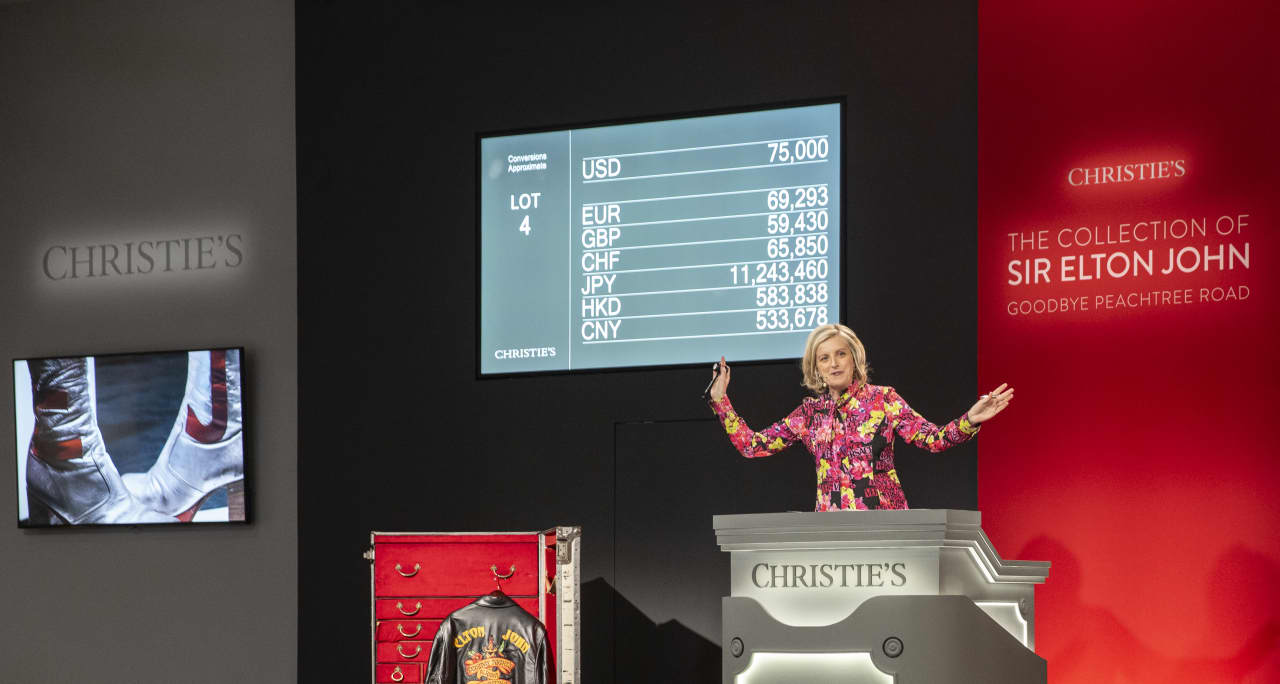
The aptly named “opening night” at Christie’s for the eclectic mix of art, photography, costumes, and objects that filled Elton John’s Atlanta home drew a crowd of bidding fans who snapped up everything on offer for a total of US$8 million.
Among items the lucky winners snagged was a collector’s edition of a pinball machine signed by John that plays 16 full-length studio master tracks of his hit songs and features interactive LED lights and LCD displays; a 1990 Bentley Continental two-door convertible; a pair of silver leather platform boots; and silver rocket-shaped cocktail shakers.
Many of the collectible treasures in the 49-lot sale sold above estimates, in total achieving 155% of the low-end of anticipated prices. According to Christie’s, 40% of bidders and buyers were new to Christie’s.
Before the sale, the auction house shared that a heart-shaped collage by Damien Hirst that was made for John and his husband, David Furnish—expected to fetch up to US$450,000—would be withdrawn as the family decided to retain the piece.
The biggest sale of the evening was a painting by Banksy that John acquired directly from the elusive British graffiti artist. Flower Thrower Triptych , 2017, sold for US$1.55 million, US$1.925 million with fees.
Wednesday’s evening auction was the first of two live and six online sales that are filled with a total of nearly 900 items that spoke to John’s passions, style, and vision.

Many lots sparked brisk back-and-forth bidding between collectors in the packed saleroom, on the phone with specialists, and online. The auction house generated excitement from the get-go with a pair of 1975 prescription Sir Winston Eyeware sunglasses that sold for a hammer price of US$18,000, six times a presale high estimate. With fees, the sunglasses sold for US$22,680.
That opening lot was followed by the sale of a pair of Elizabeth II silver cocktail shakers shaped like rockets, made by Mark of Theo Fennell in London in 1993, that fetched US$40,000, four times the high estimate, after vigorous bidding. With fees, the shakers cost US$50,400.
Then came a pair of silver leather tall platform boots, circa 1971, that sold for US$70,000—seven times the high estimate, and US$94,500 with fees.
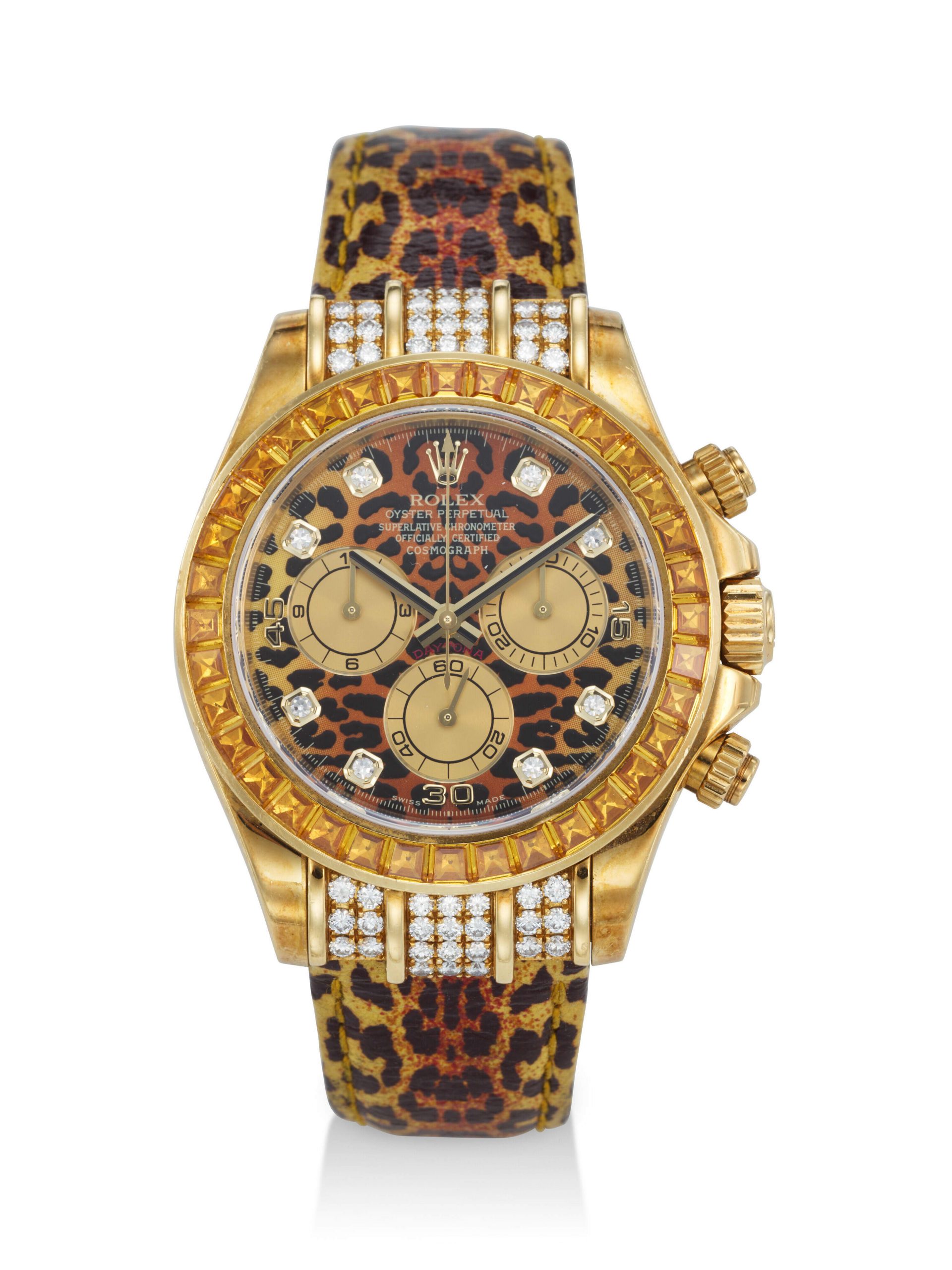
Glittery watches and jewellery also stole the show. An “exuberant and rare” 18K gold, diamond, and yellow sapphire-set automatic chronograph Rolex with a leopard-print dial sold for US$140,000, more than double a high estimate. The total with fees was US$176,500.
A Cartier “crash” model watch from 1991, sold for US$220,000, above a US$100,000 high estimate, or US$227,200 with fees.
The sale also featured photography from Robert Mapplethorpe, Richard Avedon, Helmut Newton, Andy Warhol, and Cindy Sherman, among others. There was also art by Keith Haring, Sol Lewitt, and Julian Schnabel.
John’s conservatory grand piano, a Yamaha Model C6F, circa 1992, that had taken center stage in his home sold for US$160,000, more than three times a high estimate; with fees, it fetched US$201,600.
The evening auction ended with the sale of John’s 1990 Bentley continental two-door convertible for US$350,000 (10 times the high estimate), or US$441,00 with fees, and the sale of the pinball machine, which fetched US$55,000, or US$69,300 with fees.
Elton John fans have plenty of opportunities to bid again on the singer’s collectibles, including more costumes, watches, fine and decorative arts, and jewellery. Another 281 items will be sold at a live sale at Christie’s on Thursday, and there are six online auctions continuing through next week.
One online sale features John’s friendship with Versace, and including couture, decorative arts, photographs, and jewellery; another titled “Honky Château” celebrates the singer’s aesthetic with brightly coloured art glass, painting, and sculpture.
 Copyright 2020, Dow Jones & Company, Inc. All Rights Reserved Worldwide. LEARN MORE




BNW Developments has established a Sydney presence, joining Arada and Sobha Realty among the growing number of UAE developers pursuing Australian buyers and development opportunities.
The Australian leather house has opened an immersive four-day pop-up in Manhattan, unveiling its Bloom Collection and redefining what a product launch can look like.
Strong family financial planning can help reduce taxes and support younger generations. From intrafamily loans and asset gifts to inheritance disclaimers, strategic cooperation can create meaningful financial benefits—when families have the trust and structure to make it work.
4 min
Happy is the family whose members—parents, grandparents and grown children—trust each other enough to cooperate on shared goals, especially financial ones. When that is truly the case, Uncle Sam’s tax rules can help as well.
This matters especially now that mortgage rates are above 7%, and many families are looking for ways to help younger members. If the elders have resources and are confident younger ones can cooperate, a family loan could make homeownership possible while providing the elders with a useful income stream.
Other strategies can actually lower taxes, such as when funding 529 plans or Roth IRAs, or when someone inherits a traditional IRA with required withdrawals larger than they will need.
Here are three strategies useful for functional families.
It is perfectly legal for families to lend money to a relative for a down payment or even a private mortgage.
But it is important not to cut corners, says Ryan McKeown, a CPA with Modern Wealth Enhancement in Minnesota. If the loan is for a down payment, be honest with the mortgage provider and have a formal agreement. The lender owes tax on the interest payments received.
If the loan is for a private mortgage, both sides should have legal representation with a formal written agreement, including payment terms. The lender owes tax on the interest, and the borrower often can deduct it if he or she itemizes.
To avoid IRS trouble, the interest rate shouldn’t be lower than the agency’s Applicable Federal Rate at the time of the loan. Currently that is about 5% for loans longer than nine years; about 4.5% for loans three to nine years; and about 4% for loans three years or less. Currently, traditional mortgage rates are generally above 7%.
In addition, the lender could use the $19,000 annual gift-tax exemption (described below) to forgive some or all of the interest or principal annually. If both lenders and borrowers are married, that is up to $76,000 a year. There is no tax for the borrower on such forgiveness, because it is from a gift.
If you’re going this route, McKeown advises against having a fixed plan to forgive the debt. Instead, do it in one-off letters specifying the amount—and keep careful records. Otherwise the IRS might try to treat the loan as a taxable gift.
Powerful tax-saving moves for families often use gift-tax provisions. Under current law, anyone can give anyone else up to $19,000 of assets annually, free of gift tax. That means a married couple with three grandchildren could give them a total of $114,000 in 2026.
The gifts can be cash or other assets, like stock. For noncash gifts, the cost basis—which is the starting point for measuring taxable gain after a sale—“carries over” to the recipient. So if someone buys $1,000 of stock and gives it away when it is worth $5,000, the recipient’s cost basis is $1,000. If the recipient later sells the shares for $8,000, the taxable gain is $7,000.
Here’s an example showing how gifts could save a family taxes. Grandma is a widow of modest means, while her child and spouse have prospered. The couple has two children, and they want to contribute $5,000 to a 529 college-savings plan for each—but they need to sell stock to do it. Their tax rate on the sale would be 18.8%, and they would need to sell about $11,000 of stock.
However, Grandma’s federal tax rate on the stock sale is 0%. If the couple gives $10,000 of shares to Grandma, she could sell them, pay no tax, and fund the grandchildren’s 529 plans. This saves about $1,000 of tax.
These moves are legal, and they could be used in other ways, such as to help a young person fund a Roth IRA.
But trust among family members is essential: Under the law, givers can’t put conditions on a gift. Grandma could use her stock proceeds to take a cruise, but she makes 529 contributions instead.
Mark Sellner, a retired tax attorney and CPA living in Sarasota, Fla., uses this strategy. His children sell stock he gives them and fund 529 plans for his grandchildren.
The family’s tax savings aren’t huge, but he likes other benefits. The sales by his children don’t boost his adjusted gross income, which in turn could raise his Medicare Irmaa premiums or his 3.8% surtax on net investment income.
Sellner doesn’t worry about his children using the funds for another purpose.
“There can’t be any strings attached to gifts. Of course, it is up to us to decide whether to make them in the future,” he says.
Two caveats: The “kiddie tax” applies to most children under age 24, and it is levied at the parents’ rate on investment income above $2,700 in 2026. Consider this before making gifts to a young person.
Investors who give away stock also forgo the step-up, an important provision that exempts assets held at death from capital-gains tax.
Sellner knows he’s losing a step-up, but says, “The children could use a little more now. Why should they wait 20 years to get it?”
A disclaimer is a highly useful strategy in which one heir renounces an inheritance in favor of another heir. Assuming family members cooperate, this can save taxes.
Here’s one example. Dad died and had a large traditional IRA that he left to Mom. She has enough assets and income to cover her expenses, and she lives in a state with a stiff estate tax. The inherited IRA would put her estate over the threshold.
Also surviving are three young-adult children. If Mom disclaims all or part of Dad’s IRA within nine months of his death, that amount could go directly to the children. They will have 10 years to empty the account, and the family as a whole will likely save estate and income taxes.
Disclaimers have many key details, especially regarding beneficiary documents. Although heirs have great freedom in choosing what assets to disclaim, the rules about who gets disclaimed property are rigid. It is best if the original owner names tiers of heirs so that if one disclaims, the next recipient is clear.
