
China’s Country Garden Buys Time to Repay Debt—but Not Long
The property giant has a second chance to make an interest payment this week

By CAO LI
Tue, Sep 5, 2023 7:49am 3 min
3 min
3 min


The property giant has a second chance to make an interest payment this week
3 min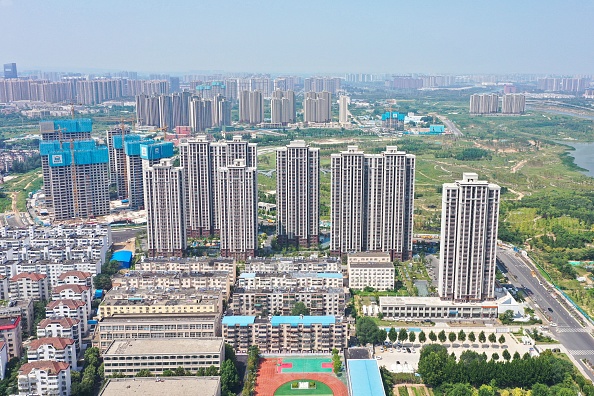
HONG KONG—China’s top surviving private developer bought more time to sort out its liquidity problems, giving investors hope that it will cobble together enough cash to avoid defaulting on its U.S. dollar bonds this week.
Country Garden Holdings on Friday said it got approval from investors in mainland China to extend the maturity date of $537 million in domestic bonds by three years. The yuan-denominated debt was originally due Monday. An offshore unit of the 31-year-old property giant separately made an interest payment of around $600,000 on a bond denominated in Malaysian ringgit on Monday, according to a person familiar with the matter.
The debt extension and bond payment created optimism that Country Garden can address a debt load that includes a range of foreign currency bonds—and a make-or-break interest payment this week.
The developer’s Hong Kong-listed shares jumped 15% on Monday, closing at their highest level in about three weeks. Other Chinese property stocks also gained, while the broader Hang Seng Index rose 2.5%.
Country Garden’s bond prices also edged higher, although most of its dollar bonds remained below 10 cents on the dollar, levels that indicate a high probability of default.
Chinese authorities have taken more steps in recent days to shore up the country’s beleaguered housing market, where sales have declined for most of the last two years. Last Thursday, the People’s Bank of China lowered minimum down payments on first and second home purchases and told banks they can lower the rates on existing mortgages. Regulators also recently expanded the definition of a first-time home buyer, a category that comes with lower mortgage rates and smaller down payments.
The rule changes helped to draw more people to real estate showrooms over the weekend. Demand for new homes in Shanghai increased noticeably after the new measures were implemented, according to Chen Julan, a senior analyst with China Index Academy. In Beijing, some developers withdrew discounts and adjusted their prices slightly higher, the research firm said.
The new rules could give a temporary boost to home sales in about a dozen major cities, said Song Hongwei, a research director of Tongce Research Institute, which tracks and analyses China’s real-estate market. He said lower-tier, poorer cities may not reap similar benefits and predicted that the overall housing market will eventually weaken again.
Country Garden’s recent cash crunch has largely been a result of slumping home sales in many parts of China. The company is one of the biggest surviving privately run developers and has a large presence in the country’s poorer regions. In August, it sold homes valued at a total of around $1.1 billion, almost three-quarters lower than a year earlier.
The company missed $22.5 million in coupon payments on bonds with a total face value of $1 billion in early August, and has a 30-day grace period to come up with the money. That grace period expires this week.
Even if it does pay the interest on its dollar bonds this week, it has many more coupon payments due in the coming months. Investors are skeptical that it can avoid default—unless its sales start growing again. Country Garden’s most recent financial report said that as of June 30, it had the equivalent of $15 billion in bonds, bank debt and other borrowings due within a year.
The company lost more than $7 billion in the first half of 2023, its worst financial performance since it went public in 2007, after its contracted sales for the period shrank 30%. Country Garden told investors it was “deeply remorseful” but said it was committed to turning things around.
China’s economy has struggled through much of this year, with falling exports, weak manufacturing and a slowdown in consumer spending all pointing to problems broader than a property slowdown. But cracks in the property sector, which was once seen as a major source of wealth creation in China, are exacerbating the broader economic malaise.
Chinese property developers’ falling property margins and weak sales will weigh on earnings until the end of next year, according to analysts at S&P Global Ratings. Not all developers will feel the same degree of pain. Those with links to the government or with good access to financing are better positioned to endure the fall in margins, the S&P analysts said in a note on Monday.
 Copyright 2020, Dow Jones & Company, Inc. All Rights Reserved Worldwide. LEARN MORE




BNW Developments has established a Sydney presence, joining Arada and Sobha Realty among the growing number of UAE developers pursuing Australian buyers and development opportunities.
The Australian leather house has opened an immersive four-day pop-up in Manhattan, unveiling its Bloom Collection and redefining what a product launch can look like.
A vibrant 1954 Palm Springs home featuring eight colorful murals by late artist Shawn Savage is on the market for $2.295 million. The 2,237-square-foot property features bold hot-pink doors, three bedrooms, a pool, mountain views and playful interiors blending modern glamour with classic Palm Springs style.
3 min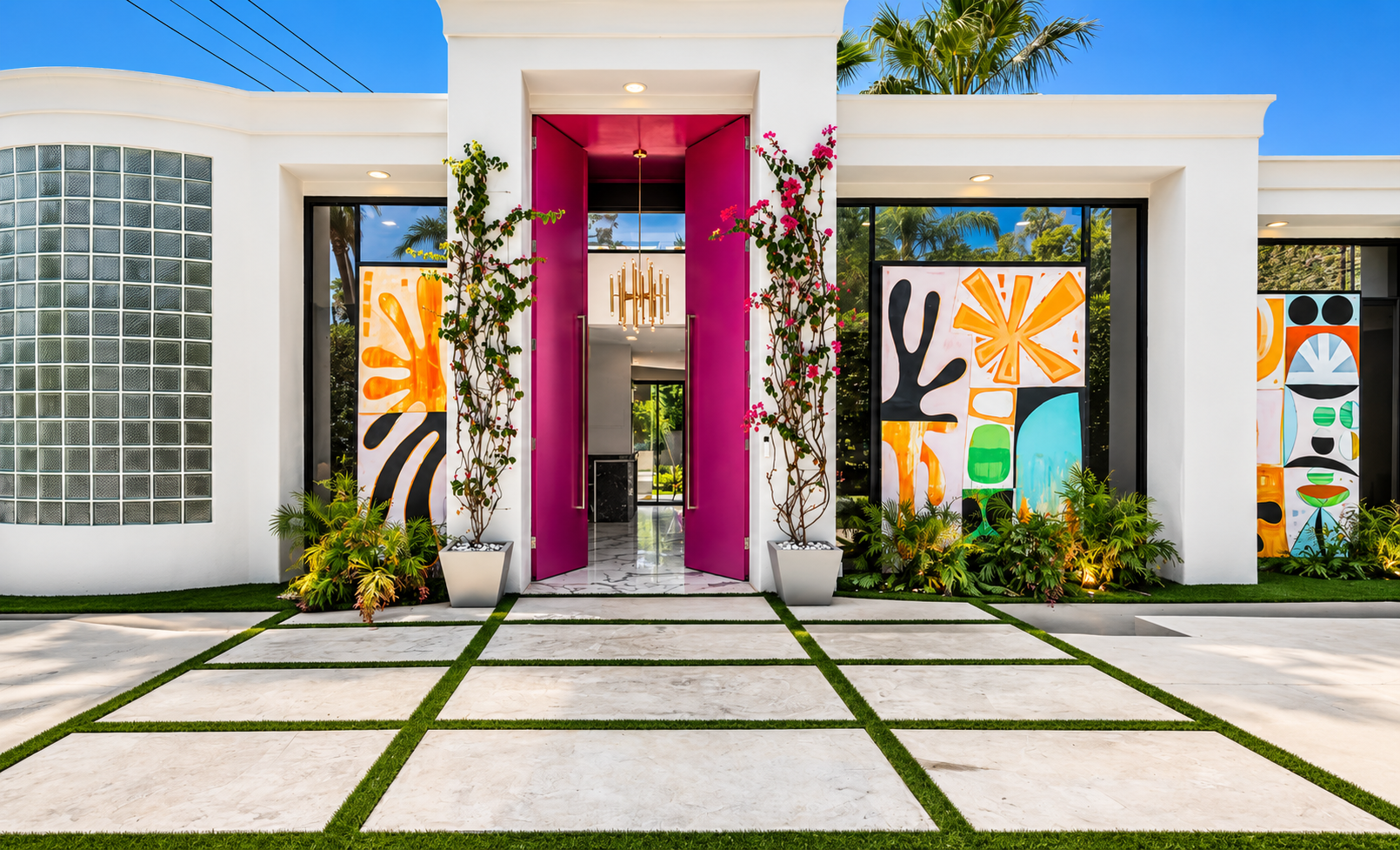
A bold 1950s home in Palm Springs, California, adorned with eight colorful murals by the late artist Shawn Savage, is coming to market ahead of the city’s annual Modernism Week.
The white stucco home on El Camino Way, built in 1954 and recently renovated, has an asking price of $2.295 million. Its staggered facade features three playfully abstract murals on either side of double-height hot pink doors.
MORE: Megamansion Outside Princeton, N.J., With a Pub and Two-Story Library Heads to Auction
The sellers are Los Angeles-based partners John Freeman and Mathieu Faure, who knew it was “the one” when they saw it after several months of searching in the winter of 2023. “It’s a happy house,” Freeman said. “We really liked the feel of the house: the uniqueness, the openness, the brightness—and the art.”
Located in the Mesa neighborhood of Palm Springs, which backs up to the San Jacinto Mountains, the 2,237-square-foot house features three bedrooms, an angled bonus room and a yard with a pool, desert mountain views and another colorful mural running alongside the pool.
“I never thought in my life I would have a house with pink doors,” said Faure, a producer at Apple TV who is originally from Paris. “It’s so colorful, it’s so different. And so Palm Springs.”
The layout of the home creates a smooth flow from the front doors through the open-plan common area—a foyer, bar, and living and dining room—into the kitchen around a fireplace wall and out to the yard. A corridor leads to a private bedroom wing, where the primary suite has floor-to-ceiling windows and the primary bath is only a tad smaller than the bedroom.
Faure has filled the home with Jonathan Adler furniture, rugs and accessories, riffing on the energetic California vibes of the house to create an aesthetic of “modern American glamour,” he said.
“It was enjoyable for me to play with different types of furniture and make this house ‘happy chic,’ as I describe it,” he said.
MORE: Beverly Hills Villa of Late Philanthropist Glorya Kaufman Sells for $19.25 Million
“He did a fantastic job,” said Freeman, who is an attorney and consultant. “It does kind of bring a smile to my face whenever I walk into the house.”
Since the furniture and decor were chosen for the particularities of the space, the couple is open to selling them with the home. Their West Hollywood house is already furnished; the collection doesn’t match the vibes of a Houston loft they bought near family; and Faure can’t imagine these pieces in New York—where he’s lived in the past—he said.
The duo bought the Palm Springs house for $1.925 million in 2024, according to property records, and will list the home Monday. They are represented by Stewart Smith, Patrick Jordan and Kevin Stanley of Bennion Deville Homes/Luxury Portfolio International.
The previous owners had purchased the home in 2021 for $975,000 and then spent more than two years and $700,000 on the renovation, according to Realtor.com. They commissioned Savage, a local Palm Springs artist and painter known for his joyful abstract work, to decorate the home.
MORE: Alpine Villa From Lady Gaga Movie ‘House of Gucci’ Lists for €2.9 Million
Savage, who died in 2024, lived in the Coachella Valley from 2003, and his work can be found in various local institutions and is on exhibit at the Illumine Gallery in Palm Springs. “Some artists pass through a place. Shawn Savage became a part of it,” the gallery’s description states.
Unsurprisingly, the murals invite lots of friendly conversations, as well as guided tours and interested lookers, but never to a degree that it disturbed the peacefulness of their home or the neighborhood, the sellers said. “It felt like living in an art gallery, and you have the exterior that you would share with the world,” Faure explained.
The neighborhood also played a role in their decision to buy, because of its access to the hiking trails of the San Jacinto Mountains, the lack of through-roads and the neighborly environment.
“It’s a very friendly place,” Faure said.

