David Akellian planned to spend his retirement traveling the world. But that required getting on a plane. When the Covid-19 crisis hit, he quickly pivoted to a different mode of travel and bought a 16-metre yacht.
Mr. Akellian, 61, the former head of global wealth management for Refinitiv, a financial market data firm, always had a penchant for sailing and had planned on buying a boat anyway. As a child growing up in northern New Jersey, his family had a sailboat and spent a lot of time on the Long Island Sound. He just never imagined he would be spending this much time aboard.
During the pandemic, Mr. Akellian, who had been living in a three-bedroom home in Wyckoff, N.J., with his wife, Susan Akellian, has been spending weeks or even months at a time living on the yacht, he said, cruising to the Bahamas and frequently docking at a marina in Jupiter, Fla. He’s currently planning to spend a few weeks in the Bahamas, then cruise back up the East Coast for the summer, making stops on the coastlines of Georgia and South Carolina, weaving through Chesapeake Bay and eventually docking in Connecticut. The $1.9 million yacht he bought last July is a Navetta 52, built by the yacht maker Absolute Yachts, and has three bedrooms, a large terrace, a main salon with 360-degree views and an outdoor galley with a dining table. It is built for cruising, with high ceilings and large windows. The motor yacht is small enough that Mr. Akellian can operate it without a crew.
“I figured I could buy a US$2 million home in Jupiter or I could buy a US$2 million boat and go different places and explore different areas,” Mr. Akellian said. “Economically it just felt right.”
Spending long periods living on board a yacht has long appealed to superrich business titans such as DreamWorks co-founder David Geffen. Now, as the pandemic drags on, it has gained popularity among a subset of people fortunate enough to be able to afford it and looking for a low-risk way to travel. “A lot of our clients have wanted a safe haven, a private domain where they could be away from other people and feel safe with their families,” said Jim Dixon of Winch Design, an international design firm that works on yacht projects.
The proof is in the numbers, which show three years of consistent order-book growth in the yacht sector, according to Boat International. The yachting trade publishing company found that, at the end of December 2021, there were 1,024 boats on order and in production for the following year, up almost 25% from the tally at the end of the 2020. The surging numbers of new and would-be yacht owners have left marinas packed and global shipyards with lengthy order backlogs, compounded by supply-chain issues brought on by Covid and the war in Ukraine.
“The clients without yachts are desperately searching for a slot or a production boat already in build, which has a shorter lead time,” said Mr. Dixon, noting that while he’s constantly in communication with shipyards about their capacity, many of his new projects now won’t be completed until 2026 or 2027.
When the pandemic hit, Florida developer Gil Dezer, 47, best known for condos such as the Bentley Residences in Sunny Isles Beach, was fortunate enough to already own his 84-foot motor yacht, a Sunseeker Predator retrofitted with a special engine package that achieves 45 miles an hour. He bought it for US$7.7 million in 2010. At the height of the early pandemic, he and his then-girlfriend were occasionally traveling 200 to 250 miles a day. Sometimes, his two children would join them, doing Zoom school aboard, he said.
“It used to be, we would go out once a month for three days or so, but during Covid it was a savior because it meant we weren’t stuck at home,” he said. “We took it out for months at a time and went up the East Coast to Martha’s Vineyard. We got to see the United States.”
The expeditions came with a price. Mr. Dezer said his boat’s superfast engines burn about 220 gallons of diesel per hour, whereas a typical boat of that size burns about 60. Mr. Dezer said his then-girlfriend occasionally felt some cabin fever but he never did. With four bedrooms and often just two people aboard, he said there was plenty of room to grab a moment of privacy.
But even those who already have a yacht can’t avoid the supply-chain issues. Mr. Akellian said he recently ran around for weeks trying to buy a small inflatable tender for his boat, but with at least one large tender manufacturer based in Ukraine, it was next to impossible. When he finally found one, manufactured in Turkey, he was told it wouldn’t arrive for more than a month, he said.
Vural Ak, 54, a Turkish entrepreneur and speed enthusiast whose interests include a rental car company, agricultural businesses and a motor sport racetrack, completed his superyacht, the roughly 280-foot motor yacht Victorious, last year. Superyachts are generally defined by brokers as those over 25 meters in length. Mr. Ak, who normally lives in Istanbul, said he intends to spend four or five months a year on the boat and, as such, like many other yacht owners, is looking to maximize its autonomy.
The long-distance Victorious has a range of about 15,000 miles and enough refrigerated food storage and freezers to provision for six months at sea. It has a gentleman’s club with a wood-burning fireplace, a beach club, a gym, a massage room, a beauty salon, a hammam, a children’s playroom for Mr. Ak’s three children and a flexible workspace that can be transformed into an entertainment area. The cost: roughly $100 million.
Elaborate heating and air-conditioning systems mean the boat can operate easily at almost any temperature,” Mr. Ak said. “It can be in Saudi Arabia or in Antarctica,” he said.
Mr. Ak’s journey to build Victorious predates the pandemic but it still influenced the design. He included a space that could be used as either an isolation or hospital room with its own separate HVAC system in case someone on the boat is required to quarantine.
He purchased the incomplete yacht from Graeme Hart, New Zealand’s richest man, in 2016, he said. Then, struggling to find a shipyard that could complete the boat to his desired specifications, he eventually resorted to starting his own shipbuilding company in Istanbul. His wife, Nur Ak, and friends thought he had lost his mind, he said.
But the new venture has given Mr. Ak a front-row seat to the frenzied state of the yachting world. After taking his boat to a yacht show in Monaco earlier this year, he entered contract talks to build four yachts, a striking wave of demand for such a new company. Meanwhile, he’s finding that “the logistics chain is nearly broken,” he said. “You order something and it comes only after many, many months,” he said.
Zaniz Jakubowski, a London-based designer who goes by the name Zaniz and who recently designed a roughly 350-foot yacht, said she’s also seeing an uptick in new owners looking to make their yachts more efficient, asking about the latest innovations in fuel efficiency and in wastewater treatment systems, which can reduce the volume of waste over long passages. They are also more focused on fast connectivity and solid Wi-Fi, so owners can work remotely more reliably, she said.
“I have clients who now live aboard three to four months of the year,” she said. “I think people have realized how wonderful it is to be on board for extended periods, which then changes the design slightly.”
She said clients looking to maximize their time on board are asking for spaces that can be used in several different ways. On one of her most recent projects, a luxury superyacht, Zaniz said she included an office with a personal assistant’s office attached. The project also included a “touch-and-go” helipad immediately outside the office so that clients could come in for a meeting without moving around the whole yacht to get to the main helipad. She also designed a series of cold rooms, including a flower storage room and freezer space for ice cream.
“If you’re out in the middle of the water and you want to dress your boat with flowers, and you’re going to get a delivery every two or three weeks from Holland, you need to store the flowers in the correct environment with the correct temperature,” she said. “If you have a craving for a certain ice cream from America, you need your coolers to be there.”
Mr. Dixon said he recently had a client who wanted to grow his own fruits and vegetables on board.
There are, of course, drawbacks to spending long stretches of time on the water, Mr. Akellian said, especially if one’s yacht doesn’t fall into the superyacht category. For one, Mr. Akellian said he doesn’t have a dishwasher on board, so he has to hand wash everything and minimize the pots and pans he is using. He also has no oven, so he relies on a stove top and microwave. For laundry, he mostly heads out to a laundromat since the washer on board doesn’t have sufficient capacity. “I’ve never been one to separate the whites from the colours,” he said. Mrs. Akellian, 61, still works in New Jersey and visits periodically.
Another inevitable part of yachting is wear and tear on the boat. Mr. Dezer said he had to put his boat, which had been getting battered, in the shop for repairs late last year. It is slated to be back in the water next month.
In the superyacht market, there is also some growing anxiety around the confiscation of a number of superyachts owned by Russian oligarchs, as governments around the world hunt down the luxury real estate, private jets, yachts and other assets of Russian elites located around the globe amid the war in Ukraine. Many in the yacht market expect that if these confiscated yachts start hitting the market, it could cool prices in the booming boat market.
“It’s natural it’s going to have an effect,” said Richard Lambert, senior partner and head of sales for yacht brokerage Burgess Yachts, though he noted that the American market accounts for about 30% of the global market, while Russian superyachts only make up about 10% to 12% of the total market.
Another factor could cause choppier waters for yacht owners: the volatile price of fuel. On a Facebook group for yacht enthusiasts, Mr. Akellian said he has noticed more people worrying about the price of fuel.
“When I burn my engines for the full day and then go to the dock to refuel, they say ‘That’ll be $800.’ You’re thinking, ‘Oh, my God. That’s more than my first car cost.’ ”
Mr. Dezer said he would like to upgrade to a new boat, but most shipyards are no longer manufacturing superfast boats with engines such as the ones on his Sunseeker Predator. He said most companies are now trying to be more sensitive about the environment.
“If you have to worry about gas, you shouldn’t have one of these boats. That’s my answer,” Mr. Dezer said.
Reprinted by permission of The Wall Street Journal, Copyright 2021 Dow Jones & Company. Inc. All Rights Reserved Worldwide. Original date of publication: April 21, 2022.—



 7 min
7 min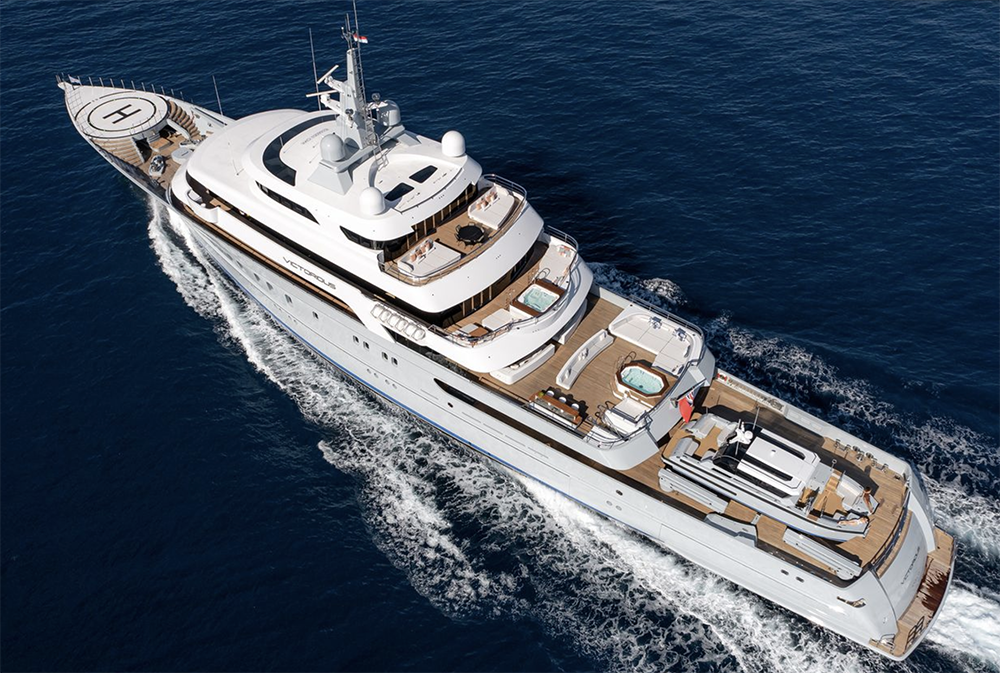
 Copyright 2020, Dow Jones & Company, Inc. All Rights Reserved Worldwide.