
The Global House Price Boom Could Haunt The Recovery From Covid-19
Decreasing affordability raises both financial and political risks.

By Mike Bird
Mon, May 17, 2021 11:10am 3 min
3 min


Decreasing affordability raises both financial and political risks.
3 min
The year of the pandemic saw the largest increase in global house prices since the U.S. housing boom of the mid-2000s. And there is no sign the rally is coming to an end.
That provides immediate economic support for the global recovery from Covid-19. But a prolonged house price upswing would mean big new problems for both financial stability. And it could result in economic strife if middle-class citizens accustomed to a one-way housing bet suddenly find the rug pulled out from beneath them down the line.
House prices rose by 4.91% across 16 economies monitored by the Federal Reserve Bank of Dallas last year, the sharpest increase since 2006. The move was large by the standards of a normal year—but explosive in the context of a global economic contraction of around 3.3%.
And the trend shows little sign of abating. The U.S. housing market is millions of homes short of buyer demand. Prices have climbed in places as varied as the eurozone, South Korea, Australia, New Zealand and Canada.
Booming prices reflect a major difference between the liftoff from the financial crisis of 2008 and the nascent post-pandemic boom. The financial crisis emanated from a fragile, undercapitalized banking sector: The obvious postcrisis response was to lend much more conservatively. But at the beginning of last year, banks were far less overextended and, with greater government support, were much more rapidly able to pass on interest rate cuts to borrowers.
At the same time, banks are far more exposed to housing markets than they once were. Across 18 advanced economies, mortgage lending has grown from around a third of total bank lending in 1960 to very nearly 60%. The financial crisis seems to have only been a brief speed bump in this secular trend.
The experience of countries that didn’t have a major banking crisis in 2008 shows what could happen on a far larger scale now. Most countries with large run-ups in household debt during the last decade—China, South Korea, Thailand, Canada and Sweden—were places where banks didn’t suffer in 2008. And rather than the brief, one-off increase in leverage of the kind many analysts expect following the pandemic today, household borrowing climbed continually over the following decade.
Many such countries have attempted to slow down rapid increases in house prices. The Korean government has enacted dozens of individual tweaks to tax and lending regulations. The latest Canadian federal budget announced a tax on vacant and underused property owned by foreigners, following existing levies in Vancouver and Toronto. So far, few measures have had an impact large enough to stall the boom.
Earlier this year, Swedish central bank governor Stefan Ingves compared the household debt situation to sitting on a volcano. The analogy is apt, given how sensitive the health of economies is to increased leverage among households in particular. Economists Atif Mian, Amir Sufi and Emil Verner have published research demonstrating that burgeoning household debt tends to slow down economic growth.
That’s not to say there’s nothing to be done. There have been a small number of successes in controlling and preventing house price booms to note. They bear much closer examination for policy makers in the rest of the world.
Japan’s case is the most obvious. The country’s lack of zoning restrictions and rent controls are regularly credited with the country’s flat home prices, particularly in Tokyo where the total population is still increasing. All the same, making fair international comparisons is difficult because interest rates have been so much lower than other parts of the world for so much longer, and overall economic growth has been so weak.
According to a study published in the Journal of Housing Economics in 2018, Singapore’s flurry of efforts to cool house prices between 2009 and 2013 also seems to have helped to stall the country’s buoyant house price growth. The measures included higher taxes on home-flipping, higher deposit requirements for second-time buyers, longer residential loan terms, and caps on the amount of a borrower’s income that could be spent on home loan repayments. But Singapore is also an example of how difficult such progress is to defend: Prices jumped to a new record in the first quarter of the year. And Singapore’s market is unique in other respects—the lion’s share of housing is publicly developed for Singaporeans to purchase, and homeownership rates are among the highest in the world.
There are other areas to look at. Outright taxes on the value of houses, the land beneath them, or both are popular with economists but have yet to find their way into public policy in most parts of the world. Even without such radical steps, fixing other positive biases housing receives in tax systems around the world would be a good start.
Dealing with an asset that is a totemic symbol of middle-class security and the main source of household wealth but is also a major financial stability risk is an unenviable task for policy makers.
But with many parts of the world already in the foothills of a new house price boom, it’s an issue that must be considered urgently if they want to avoid the mistakes of the past.
Reprinted by permission of The Wall Street Journal, Copyright 2021 Dow Jones & Company. Inc. All Rights Reserved Worldwide. Original date of publication: May 8, 2021
 Copyright 2020, Dow Jones & Company, Inc. All Rights Reserved Worldwide. LEARN MORE


BNW Developments has established a Sydney presence, joining Arada and Sobha Realty among the growing number of UAE developers pursuing Australian buyers and development opportunities.
The Australian leather house has opened an immersive four-day pop-up in Manhattan, unveiling its Bloom Collection and redefining what a product launch can look like.
A vibrant 1954 Palm Springs home featuring eight colorful murals by late artist Shawn Savage is on the market for $2.295 million. The 2,237-square-foot property features bold hot-pink doors, three bedrooms, a pool, mountain views and playful interiors blending modern glamour with classic Palm Springs style.
3 min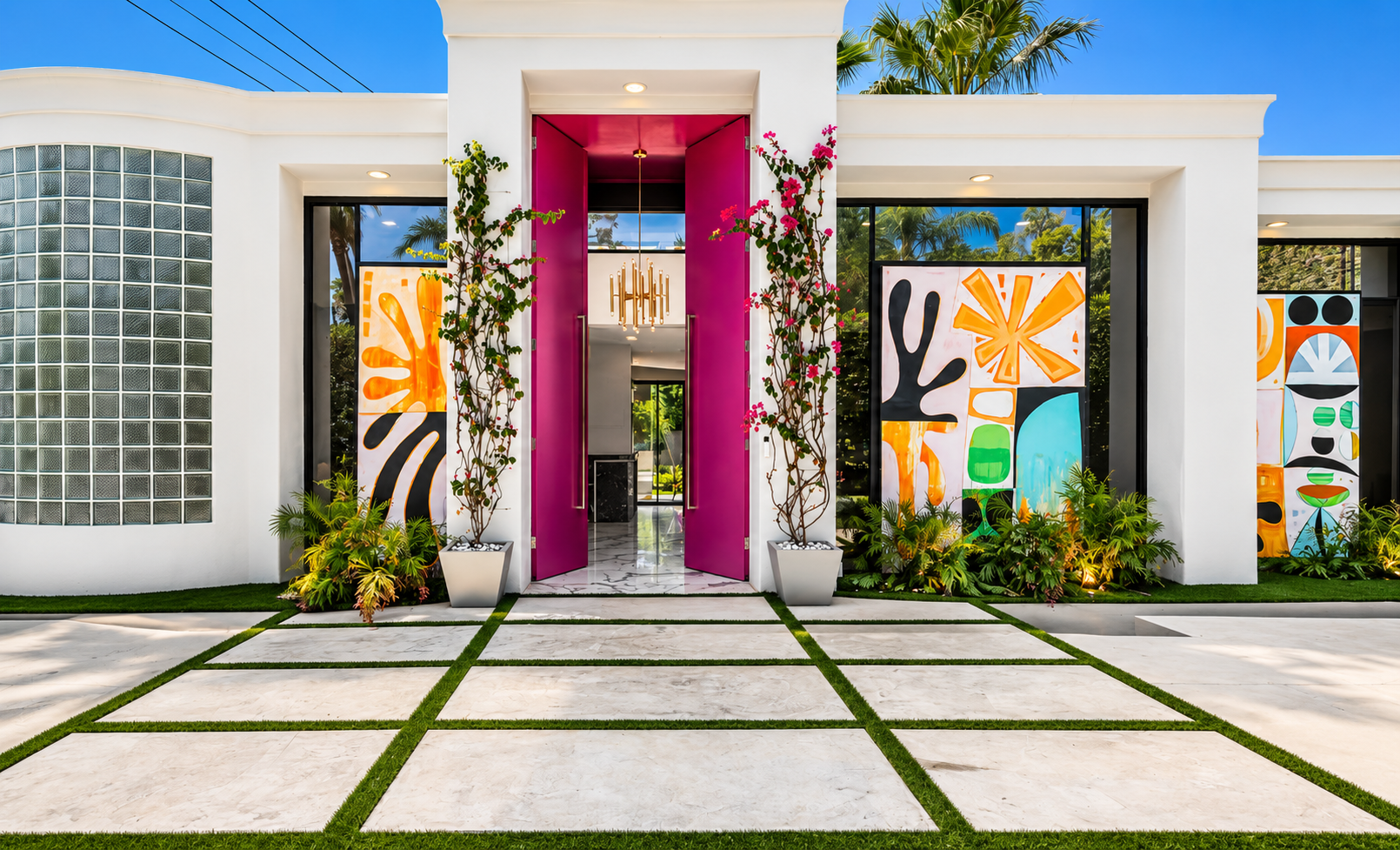
A bold 1950s home in Palm Springs, California, adorned with eight colorful murals by the late artist Shawn Savage, is coming to market ahead of the city’s annual Modernism Week.
The white stucco home on El Camino Way, built in 1954 and recently renovated, has an asking price of $2.295 million. Its staggered facade features three playfully abstract murals on either side of double-height hot pink doors.
MORE: Megamansion Outside Princeton, N.J., With a Pub and Two-Story Library Heads to Auction
The sellers are Los Angeles-based partners John Freeman and Mathieu Faure, who knew it was “the one” when they saw it after several months of searching in the winter of 2023. “It’s a happy house,” Freeman said. “We really liked the feel of the house: the uniqueness, the openness, the brightness—and the art.”
Located in the Mesa neighborhood of Palm Springs, which backs up to the San Jacinto Mountains, the 2,237-square-foot house features three bedrooms, an angled bonus room and a yard with a pool, desert mountain views and another colorful mural running alongside the pool.
“I never thought in my life I would have a house with pink doors,” said Faure, a producer at Apple TV who is originally from Paris. “It’s so colorful, it’s so different. And so Palm Springs.”
The layout of the home creates a smooth flow from the front doors through the open-plan common area—a foyer, bar, and living and dining room—into the kitchen around a fireplace wall and out to the yard. A corridor leads to a private bedroom wing, where the primary suite has floor-to-ceiling windows and the primary bath is only a tad smaller than the bedroom.
Faure has filled the home with Jonathan Adler furniture, rugs and accessories, riffing on the energetic California vibes of the house to create an aesthetic of “modern American glamour,” he said.
“It was enjoyable for me to play with different types of furniture and make this house ‘happy chic,’ as I describe it,” he said.
MORE: Beverly Hills Villa of Late Philanthropist Glorya Kaufman Sells for $19.25 Million
“He did a fantastic job,” said Freeman, who is an attorney and consultant. “It does kind of bring a smile to my face whenever I walk into the house.”
Since the furniture and decor were chosen for the particularities of the space, the couple is open to selling them with the home. Their West Hollywood house is already furnished; the collection doesn’t match the vibes of a Houston loft they bought near family; and Faure can’t imagine these pieces in New York—where he’s lived in the past—he said.
The duo bought the Palm Springs house for $1.925 million in 2024, according to property records, and will list the home Monday. They are represented by Stewart Smith, Patrick Jordan and Kevin Stanley of Bennion Deville Homes/Luxury Portfolio International.
The previous owners had purchased the home in 2021 for $975,000 and then spent more than two years and $700,000 on the renovation, according to Realtor.com. They commissioned Savage, a local Palm Springs artist and painter known for his joyful abstract work, to decorate the home.
MORE: Alpine Villa From Lady Gaga Movie ‘House of Gucci’ Lists for €2.9 Million
Savage, who died in 2024, lived in the Coachella Valley from 2003, and his work can be found in various local institutions and is on exhibit at the Illumine Gallery in Palm Springs. “Some artists pass through a place. Shawn Savage became a part of it,” the gallery’s description states.
Unsurprisingly, the murals invite lots of friendly conversations, as well as guided tours and interested lookers, but never to a degree that it disturbed the peacefulness of their home or the neighborhood, the sellers said. “It felt like living in an art gallery, and you have the exterior that you would share with the world,” Faure explained.
The neighborhood also played a role in their decision to buy, because of its access to the hiking trails of the San Jacinto Mountains, the lack of through-roads and the neighborly environment.
“It’s a very friendly place,” Faure said.

