
TIME TO UPGRADE YOUR OLD PHONE? MORE CONSUMERS SAY, ‘NOT YET’

By YANG JIE
Wed, Aug 24, 2022 12:38pm 4 min
4 min
4 min

 4 min
4 minThe global smartphone market is taking a breather.
With inflation lifting the cost of daily necessities like gasoline and food, many phone owners are sticking with their current models longer, according to industry executives. Companies are making fewer phones and fewer phone parts, and they are planning for a further rough patch ahead.
China’s Xiaomi Corp., the world’s third-largest smartphone maker after Apple Inc. and Samsung Electronics Co., said Friday that it shipped 26% fewer smartphones in the April-to-June quarter compared with a year earlier, and smartphone-related revenue fell 28% to the equivalent of $6.2 billion.
Xiaomi cited shrinking consumer demand in China, which had pandemic-related lockdowns in the quarter, as well as rising food and fuel prices around the globe.
In the same quarter, worldwide smartphone shipments declined nearly 9% compared with a year earlier to 286 million units, according to research firm International Data Corp. The biggest drag on the market was China, but the U.S. and most other regions were also weaker, IDC said.
Sean Mullee, a 23-year-old economist in Washington, D.C., recently moved to the capital from Ohio and said he found the cost of living high, especially now with inflation running at more than 8%. Mr. Mullee, who has an iPhone X he got a couple of years ago, said he wasn’t planning to upgrade for now.
“When your car breaks down, it’s like, ‘OK, well I need a car, so I have to go get one.’ But until then, I’m going to keep putting it off,” he said.
The situation has changed from the first two years of the pandemic, when people staying at home were using their phones more. In that period, demand was strong and the biggest problem for the industry was the supply chain, which was hit by shipping delays, Covid-19 lockdowns and a shortage of semiconductors. Those issues haven’t gone away but are gradually easing.
“What started out as a supply-constrained industry earlier this year has turned into a demand-constrained market,” said Nabila Popal, an analyst with IDC.
The slowdown isn’t uniform. Sales of smartphones priced above $900 grew more than 20% in the first half of this year compared with the same period a year earlier, according to Counterpoint Research. The segment includes Samsung’s foldable smartphones and many of Apple’s latest iPhones.
Only about one in 10 smartphones globally fell into that premium category in the first half of the year, but it accounted for 70% of industry profits, Counterpoint said. Canalys Research analyst Runar Bjørhovde said wealthy consumers aren’t as bothered by the higher cost of daily expenses and still want to have the latest phones in their pockets.
On the flip side, some big carriers are seeing more subscribers default on their payments as inflation takes a bite out of household finances. “Naturally they’re not going to see people buying new phones if they can’t even pay for their phone subscriptions,” said Mr. Bjørhovde.
Samsung introduced budget 5G models in March, a move it said was aimed at stimulating demand, while it is also pitching foldable phones that cost as much as $1,800 in the premium market.
Apple, which is expected to roll out the latest versions of its iPhone in September, benefits from being primarily a high-end brand, but there are signs that it can’t rest easy.
The biggest iPhone assembler, Foxconn Technology Group, said this month that it saw slowing demand for smartphones, as did Qualcomm Inc., a chip supplier to Apple and others, in July.
Apple supplier Taiwan Semiconductor Manufacturing Co., a leader in advanced smartphone chips, said recently that its smartphone business is no longer its biggest revenue generator. The No. 1 spot is now held by high-performance computing chips that are used in applications such as graphics processing and autonomous driving.
China, which accounts for nearly a quarter of global smartphone shipments, is at the centre of concerns about global demand.
From July 29 to Aug. 1, Apple took the unusual step of discounting its iPhones in China and running ads online advertising the sale. It knocked the equivalent of nearly $100 off the price of its iPhone 13 Pro Max and 13 Pro models.
Wang Xiang, the president of Xiaomi, alluded to a similar situation on Friday when reporting the company’s weak results, including a 67% drop in net profit. “Due to the weak market demand, we are trying various ways to clear our inventory, which has caused a decline in profit,” he said.
Zhao Haijun, co-chief executive officer of Shanghai-based Semiconductor Manufacturing International Corp., said he saw some companies involved in making smartphones or smartphone parts suddenly cutting orders.
“That triggered a panic in the supply chain,” Mr. Zhao said on an investor call this month.
Feng Xiao, a 37-year-old sports-event organiser based in Shanghai, echoed Mr. Mullee in the U.S. when asked whether she was planning to upgrade her phone. “My iPhone 12, which I’ve used for about two years, is still just fine,” she said.
Analysts said they thought demand would likely start to improve later this year or next year and the people who say they are happy with their phones would eventually get restless. That assumes there won’t be major global disruptions such as a deepening of the U.S.-China conflict over Taiwan or a new surge in inflation.
“We continue to believe that any reduction today is not demand that is lost, but simply pushed forward,” said IDC’s Ms. Popal.
—Jiyoung Sohn contributed to this article.
 Copyright 2020, Dow Jones & Company, Inc. All Rights Reserved Worldwide. LEARN MORE




BNW Developments has established a Sydney presence, joining Arada and Sobha Realty among the growing number of UAE developers pursuing Australian buyers and development opportunities.
The Australian leather house has opened an immersive four-day pop-up in Manhattan, unveiling its Bloom Collection and redefining what a product launch can look like.
AI-powered travel agents are challenging online booking platforms, but Airbnb’s exclusive listings and direct customer relationships could give it an edge. Its next challenge: turning repeat guests into loyal customers through stronger rewards and innovation.
3 min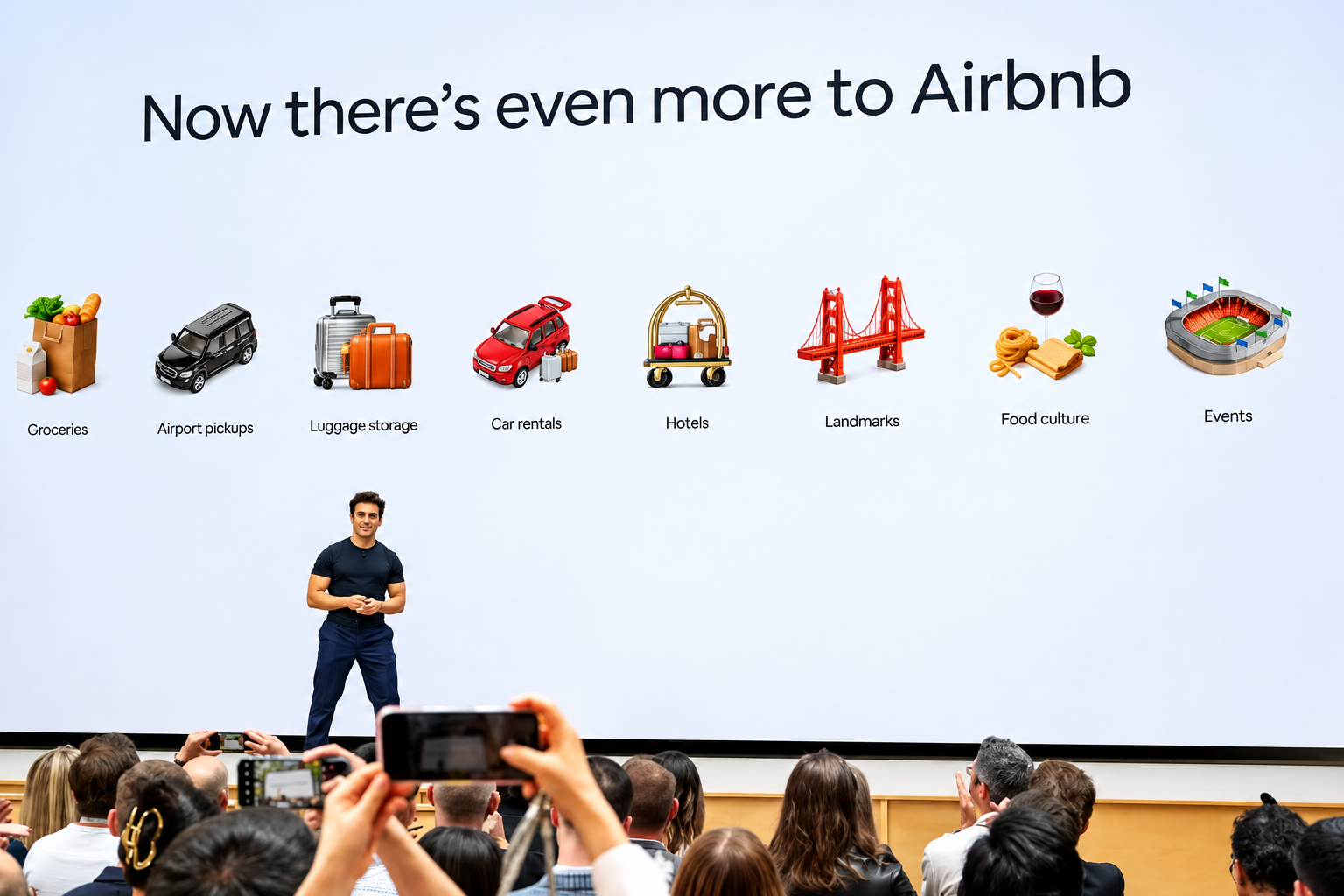
AI agents like Muse can already find you the cheapest hotel room in Paris. But they can’t locate a cheaper version of that Catskills cabin you’ve been eyeing, because it might only be available on Airbnb ABNB -1.43%decrease.
Investors should pay attention to that distinction. When Meta Platforms META 3.38%increase launched its Muse agent last month, travel stocks including Booking Holdings BKNG -1.19%decrease, Expedia and Airbnb all fell sharply.
Airbnb, though, has a real chance to emerge as a winner from the upheaval. The catch: Its stock already reflects above-industry growth. To justify its valuation, Airbnb will need to turn repeat customers into loyal ones.
Online travel companies make much of their money by simplifying search and collecting fees on bookings. AI agents threaten that model.
But not all travel marketplaces are equally exposed. Booking and Expedia largely sell hotel rooms that travelers can also book directly or through competing sites. If an agent can find the same room elsewhere, it has little reason to favor either Booking or Expedia.
Booking and Expedia also sell sponsored listings that steer travelers toward particular properties. Wells Fargo estimates those will account for about 8% of Expedia’s revenue and a much higher percentage of profit next year.
Airbnb has more ways to adapt. More than half its listings are available only on its platform, and more than 90% of its traffic comes directly to its app or website.
The customer relationship doesn’t end after booking, either. Bernstein analyst Richard Clarke notes that 90% of Airbnb guests go on to message their hosts about arrival times, keys or local taxes, giving Airbnb a connection to both sides of the transaction.
How the companies have responded to the possible agentic future is telling.
Expedia quickly signed on as a Muse partner. Airbnb hasn’t, and Chief Executive Brian Chesky says AI chatbots have so far been a boon, sending customers to Airbnb’s website.
Chatbots might work for buying paper towels, he quipped at a Skift conference last month, but people enjoy planning trips. He argued that browsing dozens of homes isn’t something a text-based chatbot is well suited for.
Still, the AI jitters arrived just as Airbnb was persuading investors it deserved its pricey multiple. For years after its 2020 initial public offering, the stock—which trades around 25 to 30 times forward earnings—went nowhere. Investors saw a mature operator trading at a growth premium.
This year, Airbnb growth seems to be accelerating. The stock jumped in August after the company raised its full-year revenue-growth guidance with its second-quarter results. Wells Fargo analyst Ken Gawrelski credits a run of product improvements under a revamped leadership team.
Among the changes: letting guests reserve now and pay later, adding hotels, and a redesigned home page and app. Investors were also betting on what comes next, including thousands more hotels, car rentals and, eventually, advertising.
The irony is that some of those growth drivers push Airbnb closer to the kind of business Booking and Expedia run—the kind of business AI agents could threaten. Even if AI agents capture a large share of travel planning and booking, Airbnb would capture the demand. But it and others would slowly lose control over how customers find and choose properties.
That would undermine the advertising opportunity investors are counting on. The bigger point for Airbnb and other marketplaces is that losing control of customer acquisition could mean surrendering some of their pricing power and margins.
To bulletproof itself, Airbnb might look to another e-commerce giant that has so far kept AI agents at arm’s length: Amazon.
Like Amazon, Airbnb has a loyal customer base and hard-to-match supply. But it has nothing like Prime membership to make customers think twice before taking their business elsewhere.
That is where loyalty comes in. Business travelers stick with Hilton or Marriott because enough nights earn them perks. Leisure travelers rarely accumulate stays with one chain. Airbnb has millions of listings and plenty of repeat customers, but no broad rewards program. It has begun experimenting with credits on hotel stays, but it should make loyalty a priority, not just a promotion.
Airbnb also plans to launch its own AI agent next year. But travelers using an agent might still want it to search Airbnb, Vrbo, Booking and hotel websites alike, rather than limit itself to one company’s inventory.
Eventually, Airbnb might have to strike deals with agent makers, using its unique homes as leverage to negotiate favorable terms, says Gawrelski. Such deals, along with rewards for loyal guests, could over the long term eat into the company’s roughly 13% take rate, he adds. But if they bring in enough additional bookings, the trade-off could be worthwhile.
History offers a reason not to panic. The shift from desktop to mobile unsettled investors in Alphabet and Amazon, but both emerged as major beneficiaries. Companies with valuable assets can come out of a platform shift stronger, if they adapt quickly enough.
Airbnb has homes the bots can’t easily replace. Now it needs to give guests a reason to insist on booking them there.
