Nobel Prize in Economics Awarded to Harvard’s Claudia Goldin for Work on Gender Gaps - Kanebridge News
Share Button

Nobel Prize in Economics Awarded to Harvard’s Claudia Goldin for Work on Gender Gaps

Economic historian and labour economist has tracked the changing fortunes of women in the workplace

By SARAH CHANEY CAMBON
Tue, Oct 10, 2023 8:53amGrey Clock 3 min

BOSTON—Harvard University’s Claudia Goldin is a labor economist, teacher and mentor. She is now also a Nobel Prize winner for her groundbreaking research on women in the workforce.

Goldin was awarded the Nobel Prize in Economic Sciences on Monday, the third woman to receive the economics prize since the award started in 1969. The 77-year-old Harvard economist has spent decades analysing troves of data to produce research illuminating the history of women’s job-market experiences.

Goldin’s expansive work portfolio includes pieces on the drivers of female labor-force participation, the origins of the gender pay gap and hiring biases against women. Her paper, “Why Women Won,” which documented the evolution of women’s legal rights, published this month.

“Goldin’s discoveries have vast societal implications,” said Randi Hjalmarsson, professor of economics at the University of Gothenburg in Sweden.

Goldin was admittedly tired upon entering Monday’s press conference at Harvard. She was, after all, asleep when she received the early-morning call with the news of her Nobel Prize. Still, her passion regarding decades of research and relationship-building radiated as she spoke at a press briefing.

“The increase of women in economics is important for a host of reasons,” Goldin said. “For me personally it has been important because I have had the most wonderful co-authors.”

One such co-researcher, Claudia Olivetti of Dartmouth College, said Goldin’s body of work has shaped much of the current research on women and labor markets. Perhaps less well known, Olivetti said, is Goldin’s extraordinary mentorship of women.

Goldin “has been a source of inspiration to many women in economics, generously sharing her experiences and demonstrating the possibilities of success,” Olivetti said.

Some professors view themselves as researchers, rather than teachers. Not Goldin.

“I could never do research without doing teaching,” she said. “When I teach, I am forced to confront what I think is the truth.”

Goldin was the first woman to secure tenure in Harvard’s economics department. She follows Esther Duflo in 2019 and Elinor Ostrom in 2009 as female recipients of the economics Nobel Prize.

Goldin is married to Lawrence Katz, also a Harvard economist. Both are avid bird watchers and hikers, colleagues said. She has a 13-year-old golden retriever named Pika and no children.

Around the world, 50% of women have paid jobs, compared with 80% of men, although that gap is smaller in advanced economies. Across the developed economies, women earn 13% less on average and are less likely to play senior roles in the organisations they work for.

Goldin’s research questioned the assumption that women had steadily, or would inevitably, narrow those gaps. Using data that had previously attracted little attention, she established that far fewer women worked in paid employment in the early 1900s than in 1800, while that share rebounded as the 20th century advanced, albeit slowly.

Her writing includes 1990’s “Understanding the Gender Gap: An Economic History of American Women.” Examining 200 years of data, Goldin tracked the changing fortunes of women in the workplace as it changed from farm to factory to office.

She also identified some of the considerations that affected the decisions made by women about their participation in the workforce, as well as the constraints they faced at particular times. In one well-known paper, she examined the effect of the contraceptive pill on decisions about work and marriage.

The pay gap between male and female workers had long been attributed to differences in educational attainment, with women typically spending fewer years in formal education.

But that can no longer be true of many developed countries, where women are now better educated on average than men. Instead, Goldin’s work indicates that the gap in pay occurs with the birth of a first child, with women typically devoting more time to child care.

But darker forces are also at work. In one paper, Goldin and co-author Cecilia Rouse from Princeton University showed that the number of female members of the leading U.S. symphony orchestras rose sharply in the 1980s partly because of the adoption of “blind” auditions, where the candidate for an orchestra position auditioned behind a screen, concealing their gender or race from those doing the hiring.

In their paper, called “Orchestrating Impartiality: The Impact of ‘Blind Auditions’ on Female Musicians,” the authors found data across decades of hiring by symphonies both before and after the introduction of blind auditions to show that about a quarter of the increase in female members of orchestras over that time was due to blind auditions, suggesting previous bias.


MOST POPULAR

BNW Developments has established a Sydney presence, joining Arada and Sobha Realty among the growing number of UAE developers pursuing Australian buyers and development opportunities.

The Australian leather house has opened an immersive four-day pop-up in Manhattan, unveiling its Bloom Collection and redefining what a product launch can look like.

Related Stories
Lifestyle
AI Agents Are a Threat to Travel Businesses. Airbnb Could Still Be a Winner.
By David Wainer 13/10/2026
Lifestyle
Amazon in Talks to Buy AI Startup Decart for Around $7 Billion
By Kate Clark and Lauren Thomas 12/10/2026
Lifestyle
Dolly Parton’s Onetime Hollywood Hills Home Lists for the First Time in a Generation Asking $7.95M
By 06/10/2026

AI-powered travel agents are challenging online booking platforms, but Airbnb’s exclusive listings and direct customer relationships could give it an edge. Its next challenge: turning repeat guests into loyal customers through stronger rewards and innovation.

By David Wainer
Tue, Oct 13, 2026 3 min

AI agents like Muse can already find you the cheapest hotel room in Paris. But they can’t locate a cheaper version of that Catskills cabin you’ve been eyeing, because it might only be available on Airbnb ABNB -1.43%decrease.

Investors should pay attention to that distinction. When Meta Platforms META 3.38%increase launched its Muse agent last month, travel stocks including Booking Holdings BKNG -1.19%decrease, Expedia and Airbnb all fell sharply.

Airbnb, though, has a real chance to emerge as a winner from the upheaval. The catch: Its stock already reflects above-industry growth. To justify its valuation, Airbnb will need to turn repeat customers into loyal ones.

Online travel companies make much of their money by simplifying search and collecting fees on bookings. AI agents threaten that model.

But not all travel marketplaces are equally exposed. Booking and Expedia largely sell hotel rooms that travelers can also book directly or through competing sites. If an agent can find the same room elsewhere, it has little reason to favor either Booking or Expedia.

Booking and Expedia also sell sponsored listings that steer travelers toward particular properties. Wells Fargo estimates those will account for about 8% of Expedia’s revenue and a much higher percentage of profit next year.

Airbnb has more ways to adapt. More than half its listings are available only on its platform, and more than 90% of its traffic comes directly to its app or website.

The customer relationship doesn’t end after booking, either. Bernstein analyst Richard Clarke notes that 90% of Airbnb guests go on to message their hosts about arrival times, keys or local taxes, giving Airbnb a connection to both sides of the transaction.

How the companies have responded to the possible agentic future is telling.

Expedia quickly signed on as a Muse partner. Airbnb hasn’t, and Chief Executive Brian Chesky says AI chatbots have so far been a boon, sending customers to Airbnb’s website.

Chatbots might work for buying paper towels, he quipped at a Skift conference last month, but people enjoy planning trips. He argued that browsing dozens of homes isn’t something a text-based chatbot is well suited for.

Still, the AI jitters arrived just as Airbnb was persuading investors it deserved its pricey multiple. For years after its 2020 initial public offering, the stock—which trades around 25 to 30 times forward earnings—went nowhere. Investors saw a mature operator trading at a growth premium.

This year, Airbnb growth seems to be accelerating. The stock jumped in August after the company raised its full-year revenue-growth guidance with its second-quarter results. Wells Fargo analyst Ken Gawrelski credits a run of product improvements under a revamped leadership team.

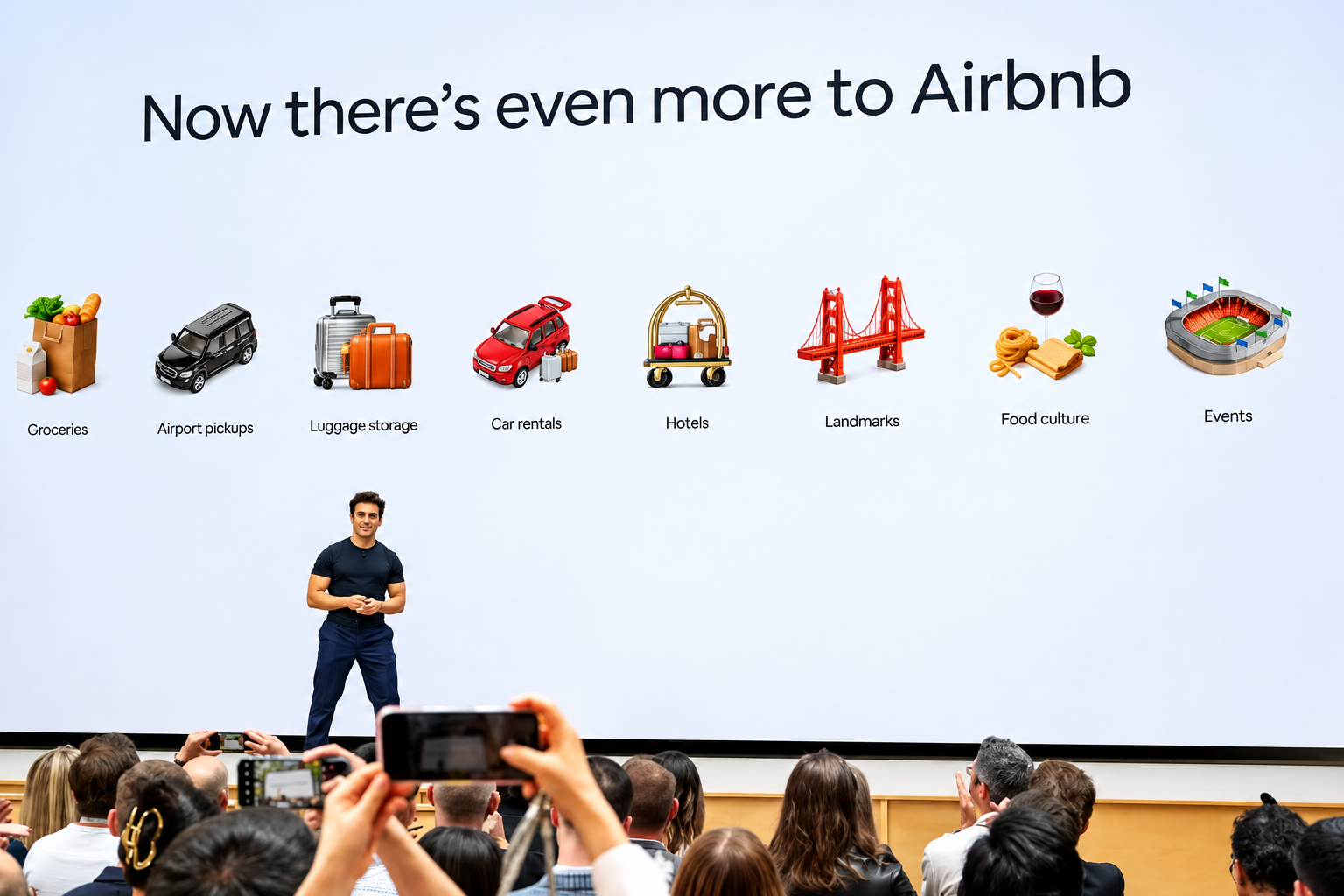
Among the changes: letting guests reserve now and pay later, adding hotels, and a redesigned home page and app. Investors were also betting on what comes next, including thousands more hotels, car rentals and, eventually, advertising.

The irony is that some of those growth drivers push Airbnb closer to the kind of business Booking and Expedia run—the kind of business AI agents could threaten. Even if AI agents capture a large share of travel planning and booking, Airbnb would capture the demand. But it and others would slowly lose control over how customers find and choose properties.

That would undermine the advertising opportunity investors are counting on. The bigger point for Airbnb and other marketplaces is that losing control of customer acquisition could mean surrendering some of their pricing power and margins.

To bulletproof itself, Airbnb might look to another e-commerce giant that has so far kept AI agents at arm’s length: Amazon.

Like Amazon, Airbnb has a loyal customer base and hard-to-match supply. But it has nothing like Prime membership to make customers think twice before taking their business elsewhere.

That is where loyalty comes in. Business travelers stick with Hilton or Marriott because enough nights earn them perks. Leisure travelers rarely accumulate stays with one chain. Airbnb has millions of listings and plenty of repeat customers, but no broad rewards program. It has begun experimenting with credits on hotel stays, but it should make loyalty a priority, not just a promotion.

Airbnb also plans to launch its own AI agent next year. But travelers using an agent might still want it to search Airbnb, Vrbo, Booking and hotel websites alike, rather than limit itself to one company’s inventory.

Eventually, Airbnb might have to strike deals with agent makers, using its unique homes as leverage to negotiate favorable terms, says Gawrelski. Such deals, along with rewards for loyal guests, could over the long term eat into the company’s roughly 13% take rate, he adds. But if they bring in enough additional bookings, the trade-off could be worthwhile.

History offers a reason not to panic. The shift from desktop to mobile unsettled investors in Alphabet and Amazon, but both emerged as major beneficiaries. Companies with valuable assets can come out of a platform shift stronger, if they adapt quickly enough.

Airbnb has homes the bots can’t easily replace. Now it needs to give guests a reason to insist on booking them there.