
The Science-Backed Schedule for Your Perfect Weekend
Allocate your time into these six categories to build your best days off

By ALEX JANIN
Tue, Jan 9, 2024 10:19am 5 min
5 min
5 min


Allocate your time into these six categories to build your best days off
5 min
WSJ’s Life & Work team presents Life Math, a series on how to optimise your time in 2024. Today: The best way to spend your time on the weekend.
Saturday and Sunday are often the most anticipated days of the week, yet optimising them remains an elusive goal for many of us.
Squandered weekends leave us feeling less happy and less motivated at work, research suggests. Those who put planning and intention into their weekends emerge on Monday feeling satisfied, accomplished and more productive throughout the workweek, says Elizabeth Grace Saunders, a time-management coach in Farmington Hills, Mich.
If we don’t plan our time well, we can end up marching through our obligations, or wasting time, without ever focusing on what we really want to do.
How to plan the perfect weekend? Behavioural researchers and time-management coaches suggest breaking it into six components: sleep, hobbies, socialising, exercise, work and chores, and unscheduled time.
Using recommendations from experts and federal guidelines, we came up with this equation. It’s important to remember these numbers aren’t hard and fast—stay flexible and make the math work for your life.
The perfect weekend equation:
Sleep (7 to 9 hours x 2 + ≤ 20 to 60 minutes napping) + Hobbies (~ 2 hours) + Socialising (0 to 2 events) + Exercise (≥ 45 minutes) + Work (≤ 2 hours) + Unplanned time (~ 3 to 4 hours) = A Great Weekend
Here’s how to incorporate those elements to build your best days off.
This part of the “perfect weekend” equation is the most rigid.
Despite the tendency many of us have to take advantage of the time off by staying up and sleeping in later, we should try to keep our sleep schedules as consistent as possible to avoid social jet lag, sleep researchers say.
Sleep researchers generally permit one hour of wiggle room—so if you typically go to sleep at 11 p.m., try not to stay up past midnight. If your weekday alarm goes off at 7 a.m., rise and shine by 8 a.m. on the weekends. Finding yourself sleepy later in the day? Take a 10- to 30-minute nap in the early afternoon.
Most importantly: Make sure you’re getting the recommended seven to nine hours of sleep each night, even on weekends. If you’re among the roughly one-third of Americans who don’t get that recommended sleep during the week, you may be able to “catch up” by sleeping a few extra hours on the weekend, says David Reichenberger, who studies the links between sleep and health at Pennsylvania State University.
But don’t count on catching up forever. A recent study Reichenberger co-wrote found that among a small group of people who slept five hours a night during the week, their cardiovascular health measures worsened and didn’t return to baseline even after they were allowed to catch up on sleep over the weekend.
Having a hobby, or an activity we engage in during our time off for pleasure, has been linked to fewer symptoms of depression and higher levels of happiness, life satisfaction and even reduced risk of cardiovascular disease and cognitive decline.
Saunders, the time-management coach in Michigan, generally recommends people set aside roughly two hours for hobbies on the weekend.
Don’t worry if you’re not, say, a dedicated baker, painter or pianist. Hobbies can encompass much more than we might typically consider, says Daisy Fancourt, a professor of psychobiology and epidemiology at University College London who researches the link between social and behavioural factors and health.
Something as simple as reading a book or cooking a tasty meal can serve the same purpose: to give us a sense of happiness, meaning and control in our lives outside of work.
Scheduling unstructured time may sound silly. But failing to block out free time can leave us filling it with whatever’s right in front of us, like working or mindlessly scrolling, says Laura Vanderkam, an author and time-management expert based outside Philadelphia.
If you can, leave unplanned a chunky part of your Saturday or Sunday, roughly three to four hours, says Saunders. “If you make your weekend as packed and as busy as your weekday is, you will not come out of the weekend feeling refreshed,” she says.
This time is a good opportunity to let our brains enter so-called “default mode,” where our thinking extends beyond the here and now, allowing us to reflect and find meaning and purpose.
“It’s really important that all of us have dedicated, protected time in our lives to just be here now,” says Mary Helen Immordino-Yang, a developmental psychologist and neuroscientist at the University of Southern California.
Robust social relationships are powerfully linked to physical and mental health and longevity benefits, and the weekend is a natural time to take advantage of them.
Social activities often require more advance planning than other parts of the weekend equation, so set aside time during the week to text or email friends and family about getting together, says Saunders, the time-management coach.
People typically spend twice as much time—nearly an hour—socialising on weekend days as on weekdays, according to the U.S. Bureau of Labor Statistics’s latest data on time use.
The amount of time you should spend socialising on the weekend depends on how energised or drained that togetherness makes you feel, she says. Introverts typically benefit from one social event every weekend or every other weekend, she says, whereas two social events per weekend is a sweet spot for extroverts.
If you have kids and most of your socialising naturally revolves around them, try to set some adults-only social time, too, says Vanderkam. You may find it easier to relax without your kids running around, and it can be easier to have uninterrupted grown-up conversations.
Pick a couple of small, achievable projects to see through to the finish line rather than trying to take on five things at once, says Vanderkam. You probably can’t clean out the entire garage, sort through your kid’s closet, vacuum out the car, wash all the laundry and grocery shop in one weekend.
Professional work, too, is sometimes inevitable on weekends. Avoid it if you can, but if a little work will help you feel less anxious, set some boundaries, behavioural researchers say. Stick to a clear time frame and goal, such as finalising one section of a report within a two-hour window.
Federal guidelines recommend at least 150 minutes of moderate-intensity aerobic exercise weekly, plus strengthening activities twice a week. If you’re spreading that out across the week, you may only need to set aside about 45 minutes for Saturday and Sunday.
But there’s good news for people who like to cram most of their exercise into the weekend. People who condensed their workouts into one or two days experienced health benefits similar to those who spread them out, a 2022 JAMA Internal Medicine study found.
The flexibility of the weekend allows for longer, varied workouts that can overlap with “hobbies” and “social” categories, says Heather Milton, a clinical exercise physiologist and supervisor of the NYU Langone Sports Performance Center. Try to incorporate both elements of aerobic and strength training, as well as some flexibility, she recommends.
It can help to plan an exercise block for the same time each weekend—such as a weekly Saturday morning yoga class or Sunday morning jog. Don’t have the time? Just try to move. Ideally, every 30 minutes or so, says Milton.
“Weekends are great for relaxation, but try not to Netflix and chill for 12 hours of the day without getting off the couch,” she says.
 Copyright 2020, Dow Jones & Company, Inc. All Rights Reserved Worldwide. LEARN MORE




BNW Developments has established a Sydney presence, joining Arada and Sobha Realty among the growing number of UAE developers pursuing Australian buyers and development opportunities.
The Australian leather house has opened an immersive four-day pop-up in Manhattan, unveiling its Bloom Collection and redefining what a product launch can look like.
AI-powered travel agents are challenging online booking platforms, but Airbnb’s exclusive listings and direct customer relationships could give it an edge. Its next challenge: turning repeat guests into loyal customers through stronger rewards and innovation.
3 min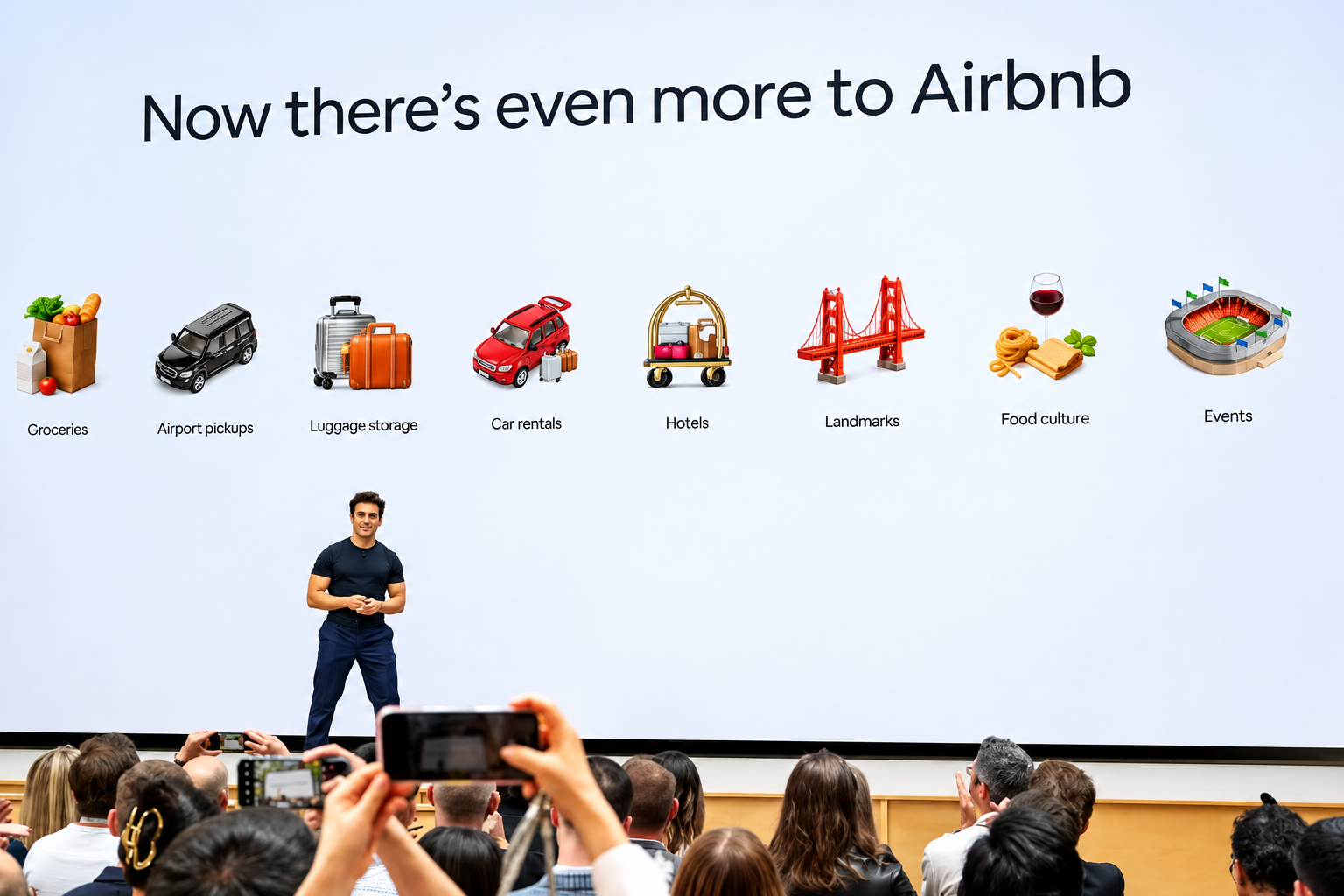
AI agents like Muse can already find you the cheapest hotel room in Paris. But they can’t locate a cheaper version of that Catskills cabin you’ve been eyeing, because it might only be available on Airbnb ABNB -1.43%decrease.
Investors should pay attention to that distinction. When Meta Platforms META 3.38%increase launched its Muse agent last month, travel stocks including Booking Holdings BKNG -1.19%decrease, Expedia and Airbnb all fell sharply.
Airbnb, though, has a real chance to emerge as a winner from the upheaval. The catch: Its stock already reflects above-industry growth. To justify its valuation, Airbnb will need to turn repeat customers into loyal ones.
Online travel companies make much of their money by simplifying search and collecting fees on bookings. AI agents threaten that model.
But not all travel marketplaces are equally exposed. Booking and Expedia largely sell hotel rooms that travelers can also book directly or through competing sites. If an agent can find the same room elsewhere, it has little reason to favor either Booking or Expedia.
Booking and Expedia also sell sponsored listings that steer travelers toward particular properties. Wells Fargo estimates those will account for about 8% of Expedia’s revenue and a much higher percentage of profit next year.
Airbnb has more ways to adapt. More than half its listings are available only on its platform, and more than 90% of its traffic comes directly to its app or website.
The customer relationship doesn’t end after booking, either. Bernstein analyst Richard Clarke notes that 90% of Airbnb guests go on to message their hosts about arrival times, keys or local taxes, giving Airbnb a connection to both sides of the transaction.
How the companies have responded to the possible agentic future is telling.
Expedia quickly signed on as a Muse partner. Airbnb hasn’t, and Chief Executive Brian Chesky says AI chatbots have so far been a boon, sending customers to Airbnb’s website.
Chatbots might work for buying paper towels, he quipped at a Skift conference last month, but people enjoy planning trips. He argued that browsing dozens of homes isn’t something a text-based chatbot is well suited for.
Still, the AI jitters arrived just as Airbnb was persuading investors it deserved its pricey multiple. For years after its 2020 initial public offering, the stock—which trades around 25 to 30 times forward earnings—went nowhere. Investors saw a mature operator trading at a growth premium.
This year, Airbnb growth seems to be accelerating. The stock jumped in August after the company raised its full-year revenue-growth guidance with its second-quarter results. Wells Fargo analyst Ken Gawrelski credits a run of product improvements under a revamped leadership team.
Among the changes: letting guests reserve now and pay later, adding hotels, and a redesigned home page and app. Investors were also betting on what comes next, including thousands more hotels, car rentals and, eventually, advertising.
The irony is that some of those growth drivers push Airbnb closer to the kind of business Booking and Expedia run—the kind of business AI agents could threaten. Even if AI agents capture a large share of travel planning and booking, Airbnb would capture the demand. But it and others would slowly lose control over how customers find and choose properties.
That would undermine the advertising opportunity investors are counting on. The bigger point for Airbnb and other marketplaces is that losing control of customer acquisition could mean surrendering some of their pricing power and margins.
To bulletproof itself, Airbnb might look to another e-commerce giant that has so far kept AI agents at arm’s length: Amazon.
Like Amazon, Airbnb has a loyal customer base and hard-to-match supply. But it has nothing like Prime membership to make customers think twice before taking their business elsewhere.
That is where loyalty comes in. Business travelers stick with Hilton or Marriott because enough nights earn them perks. Leisure travelers rarely accumulate stays with one chain. Airbnb has millions of listings and plenty of repeat customers, but no broad rewards program. It has begun experimenting with credits on hotel stays, but it should make loyalty a priority, not just a promotion.
Airbnb also plans to launch its own AI agent next year. But travelers using an agent might still want it to search Airbnb, Vrbo, Booking and hotel websites alike, rather than limit itself to one company’s inventory.
Eventually, Airbnb might have to strike deals with agent makers, using its unique homes as leverage to negotiate favorable terms, says Gawrelski. Such deals, along with rewards for loyal guests, could over the long term eat into the company’s roughly 13% take rate, he adds. But if they bring in enough additional bookings, the trade-off could be worthwhile.
History offers a reason not to panic. The shift from desktop to mobile unsettled investors in Alphabet and Amazon, but both emerged as major beneficiaries. Companies with valuable assets can come out of a platform shift stronger, if they adapt quickly enough.
Airbnb has homes the bots can’t easily replace. Now it needs to give guests a reason to insist on booking them there.
