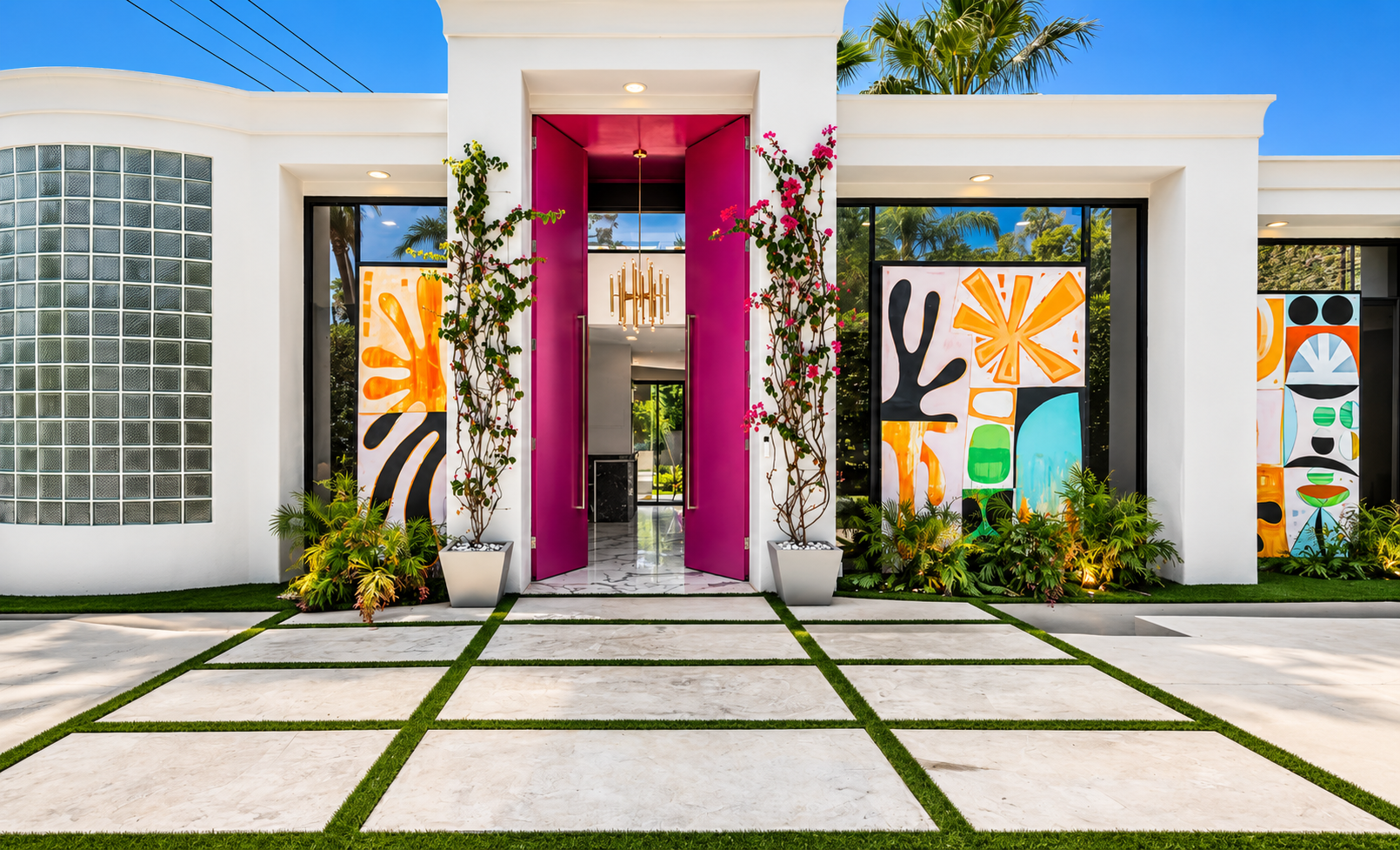
Shortly after Bryan Graybill and Daniel Dokos moved into their dream home in Sag Harbor, N.Y., in 2022, the couple realised they had a problem: Their beloved Covid dog, a redheaded goldendoodle named Rufus, didn’t like the house.
“He was sort of a little pouty,” said Graybill, an interior designer, who said they adopted Rufus from a dog breeder in Montecito, Calif., where they rode out the pandemic.
Now, the couple is doing what any self-respecting dog parents would do: They are moving.
“I’m slightly ashamed to admit that we’ve become ‘those people,’ making life decisions around our dog,” said Graybill. And yet, he said, “He’s the joy of our life.”
The house is coming on the market for $14.95 million, said Preston Kaye of Hedgerow Exclusive Properties, which is co-listing the property with Noble Black and Erica Grossman of Douglas Elliman . Graybill and Dokos, a lawyer, who also have homes in East Hampton and Montecito, plan to split their time between the two. They also have a place in New York City.
Before Rufus, Graybill said the couple thought the newly built Sag Harbor house would be their “forever home.”
When they got married in 2015, they lived mainly in East Hampton and began building a house there. During construction, they rented a place in Sag Harbor and unexpectedly fell in love with the area and bought property there, too. “It’s sort of a vibrant little town, even in the middle of winter,” Graybill said. They wound up renting out the newly built East Hampton house until recently.
In 2018, they paid $2.65 million for a nearly ½-acre property in Sag Harbor with about 110 feet of frontage on Upper Sag Harbor Cove. Graybill said at the time, the property had a modest, roughly 1,600-square-foot house built in the 1950s.
Graybill said he initially assumed the house would be overly-complicated to renovate because of its proximity to the water. “Buying the property was a roll of the dice,” he said. “We didn’t know how much we could do.”
As it turned out, they could do quite a bit.
Diving into historic research, the couple learned that a stretch of the now-defunct elevated railroad that once ran from Bridgehampton to Sag Harbor crossed a corner of their property, which was also home to a warehouse during the area’s whaling heyday in the 1800s.
With approval from local officials, Graybill and Dokos substantially renovated the 1950s home, building a roughly 4,200-square-foot house with five bedrooms in its footprint. “It required a huge feat of engineering acrobatics to figure it out,” Graybill said. Because the house is set back 12 feet from the water, they were able to add a pool, a pool house and a two-car garage between the house and the street.
Graybill said the property’s original 1880s building inspired him to commission a warehouse-like structure with loading dock doors, high ceilings and open spaces. Part two of the design was to convert the industrial space to a home, using features like interior window walls. Permitting took about three years, and it took another two years to complete construction.
Graybill said despite being smaller than their East Hampton home, which is about 6,500 square feet, the house in Sag Harbor felt “intimate” and had all the amenities they wanted, including a pool, a pool bar and an office that looks west over the cove and north over a marsh and bird sanctuary. Graybill, who trained in London under the late restaurant designer David Collins , said he adopted certain U.K. sensibilities in the Sag Harbor home, such as high-set windows to maximize natural light, and a “boot room” near the front door where visitors can sit and remove their shoes and coats. The large kitchen is a “working” kitchen with pots and pans hanging within reach. “It’s not a relaxation area,” he said. “You’re in the kitchen to cook.”
They spent about $8 million on construction, landscaping and hard and soft costs, Graybill said. “I thought it would be our forever home, so I really leaned into everything being custom.”
Graybill said they “went a little indulgent” on interior finishes like light fixtures, paint, plaster and kitchen appliances, and the windows were made in Charleston, S.C., by a company specialising in historic windows.
The median sale price in Sag Harbor was $1.9 million during the fourth quarter of 2023, down 12% from the prior-year period, according to real-estate appraisal firm Miller Samuel. But sales were up 61.5% year-over-year during the quarter, while inventory rose 16.8% compared with the fourth quarter of 2022.
Graybill said they designed the house before adopting Rufus, so there are no doggy amenities. “Gosh no, and as a result he sleeps in the bed with us and walks freely on whatever furniture he wants,” he said. After a romp on the beach, Rufus also bathes in their tub. (Graybill said part of the decision to move to East Hampton is that the house there has a covered porch where they can put a dog sink.)
Like other pet owners, Graybill and Dokos adopted Rufus during Covid when they were living in Montecito and spending more time at home. “Dan had never had a dog,” said Graybill, who grew up with poodles and lab retrievers and was initially reluctant to get a dog because he knew how much responsibility it would be. “We like our freedom,” he said.
But Graybill said one night as they lay in bed, Dokos texted him a picture of a local breeder’s two golden doodles. “One was William and one was Harry,” he recalled. When they went to see the dogs the next day, Harry—the smaller of the pups—ran right up to Dokos. They brought him home that afternoon and named him Rufus, which means redheaded in Latin. The trio fell into a new routine that included daily jaunts on the beach.
Graybill said when they moved to Sag Harbor, Rufus’ joyful demeanour changed.
They took him to nearby bay beaches, but they were narrow and a bit rocky. “The dog was constrained,” Graybill said. He couldn’t run as fast or as far as he had in California. “He couldn’t dig.”
Graybill said he and Dokos thought Rufus would acclimate until they drove to East Hampton one day and the dog was back in his element. “The smile on his face—if dogs could smile—I said to Dan, ‘I think the dog is happier in East Hampton,’” Graybill said.
Graybill said he has no regrets about deciding to sell the house, in part because he and Dokos enjoyed the building process together. “I’m giving up this life we wanted to build in Sag Harbor,” he said, “but I’m gaining this daily ritual of going to the beach with my husband and dog, and I just really cherish that.”



 4 min
4 min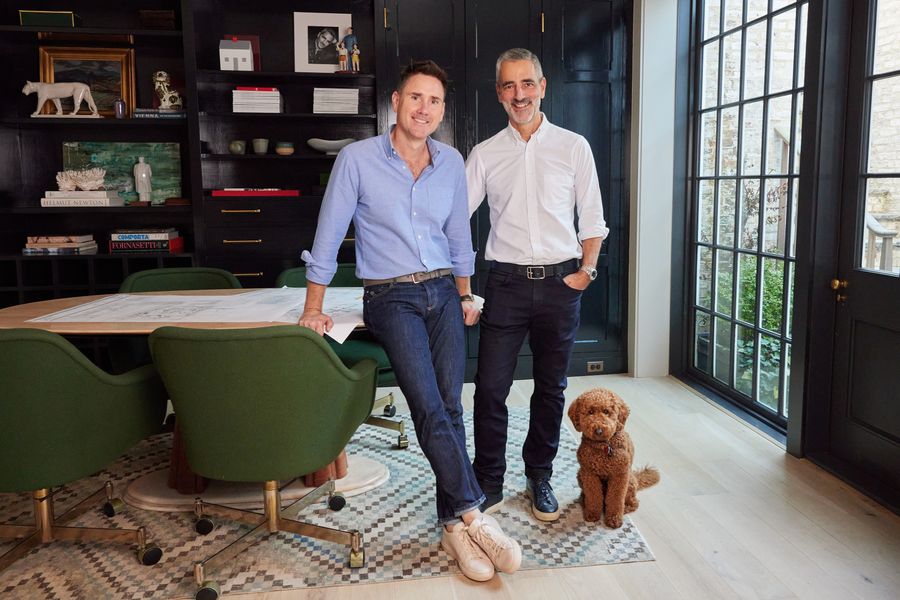
 Copyright 2020, Dow Jones & Company, Inc. All Rights Reserved Worldwide.