Are Pearls Too Old-Fashioned for 2024? Not if You Wear Them This Way. - Kanebridge News
Share Button

Are Pearls Too Old-Fashioned for 2024? Not if You Wear Them This Way.

The classic pearl necklace was a Barbara Bush staple. New designs, and freshwater varieties, are making the look anything but stuffy.

By FARAN KRENTCIL
Sun, Jun 2, 2024 7:00amGrey Clock 3 min

It takes marine pearls about two years to develop in their shells. It took Bonnie Fraker about two seconds to declare why she wouldn’t wear them around her neck. “A pearl necklace makes me look dated,” said the retired Manhattan teacher, 73. “Perhaps there’s such a thing as ‘too classic.’”

Still, pearls persist. Ask Leigh Batnick Plessner, chief creative officer at Catbird, the Brooklyn fine-jewellery label that counts Meghan Markle and Taylor Swift as fans. “Pearl necklaces are still in demand,” she said. “But the appetite has really changed from traditional necklaces to more surprising takes.”

The traditional strand has long signified opulence and power. Julius Caesar commanded that only aristocrats could wear the gem during his reign. Figures as diverse as Marie Antoinette and the Yongzheng Emperor of the Qing Dynasty coveted the strands. In the 20th century, stateswomen like Queen Elizabeth II and Mamie Eisenhower wore them to official events. By the 1980s, punks paired pearls with their spiked collars to subvert yuppie style. Still, pearls were most associated with formidable women like Margaret Thatcher and Barbara Bush, along with the preppy clique in the 1988 film “Heathers.”

Instead of stringing the old-school pearl necklace along, many of today’s brands make pearl chokers, sometimes with smaller “baby” pearls that sit at mid-neck instead of resting on clavicles. Dior’s Couture runway in Paris featured pearl chokers; California designer Sophie Buhai makes hers with a black satin-cotton cord and single central pearl. The style “looks more modern,” said June Ambrose, a creative director and costume designer for stars like Mary J. Blige and Ciara. Ambrose wears pearls from both thrift stores and Valentino.

Also popular: freshwater pearls, uniquely shaped instead of uniformly round. Once considered the messy stepsister of marine pearls, the gems look like smeared blobs of ivory glitter—in other words, odd enough for the fashion world to swoon. “I like the individualism of them,” said Simone Rocha, the designer whose recent couture line for Jean Paul Gaultier included gowns that subbed in strands of iridescent baroque pearls for typical satin straps. Off the runway, some women flaunt them as a way to look sophisticated but not uptight. “They feel a bit more rebellious,” noted Taffy Msipa, 28, an interior creative director in Bath, U.K., who wears her Monica Vinader freshwater pearl necklace with slouchy suits. “I like how they let me look elegant, but elegant in my way.”

There’s also the “half-and-half,” an industry term for a necklace that’s half pearls and half something else. On the recent Cannes red carpet, actress Michelle Yeoh, 69, wore Mikimoto’s version with cultured pearls on one side and a spray of diamonds, inlaid with white gold, on the other.

After Yeoh’s appearance, Instagram fans lauded the look with comments like “Not your grandmama’s pearls!” and “weird but amazing,” while searches for “half and half necklace” spiked 30% on Google Trends. A gold-and-pearl version of the style popped up in the “Mean Girls” movie remake, while pop star Dua Lipa has sported Vivienne Westwood’s pearl-and-rhinestone collar.

Don’t want to part with your classic strand of marine pearls? Dallas-based therapist Katie-Beth Crumrine, 23, had her vintage double-loop necklace shortened to a collar-length one. She wears it with linen Madewell tops and jeans. “It helps elevate my look,” she said. “But isn’t snobby.” Mixing pearls with casual pieces like ceramic beads can also keep them current. Meanwhile, the creative director Ambrose tells famous clientele to pair pearls with minimal makeup, because “a pearl necklace and a bare face is chic; a pearl necklace, a full face of makeup and a red lip is really trying.”

Some modern pearl looks eschew necks altogether. See the pearl-strung friendship bracelets by Vinader, and Rocha’s irregular pearl earrings. (“I like it when they’re kind of odd and not matching,” she said.) According to jewellery designer Plessner, varied interpretations have become the point. “Pearls are kind of like a Rorschach test for your fashion personality,” she explained. “You want to be weird or ethereal or powerful? There’s a pearl look for that.”

Are Pearls Too Old-Fashioned? We Asked NYC Women.

“They’re more classy than old-fashioned. They remind me of Jackie O. But would I wear them right now? No. Maybe when I’m older.” —Brittany Bower, 29, Hospital Nurse

“No! I wear my pearls a lot, actually. I really like the weight of how they feel on my neck.” —Tara Rubin, 69, Casting Director

“Yes, but in a nice way. They remind me of my great grandmother, Nita. She used to wear them. She used to let me play with them, which I loved. I don’t think I’d wear them now, though.”  —Sydney Willard, 29, Barista

“Nothing’s old-fashioned in 2024! I would wear pearls today, but, like, with a sweatshirt.” —Asia Harris, 24, Student

“I used to think they were kind of old-fashioned, like in ‘The Crown’, and then I started wearing them to the gym with a black workout tank. I have never felt more like a cool New York girl.”  —Tara Strahl, 42, Library Consultant


MOST POPULAR

BNW Developments has established a Sydney presence, joining Arada and Sobha Realty among the growing number of UAE developers pursuing Australian buyers and development opportunities.

The Australian leather house has opened an immersive four-day pop-up in Manhattan, unveiling its Bloom Collection and redefining what a product launch can look like.

Related Stories
Lifestyle
AI Agents Are a Threat to Travel Businesses. Airbnb Could Still Be a Winner.
By David Wainer 13/10/2026
Lifestyle
Amazon in Talks to Buy AI Startup Decart for Around $7 Billion
By Kate Clark and Lauren Thomas 12/10/2026
Lifestyle
Dolly Parton’s Onetime Hollywood Hills Home Lists for the First Time in a Generation Asking $7.95M
By 06/10/2026

AI-powered travel agents are challenging online booking platforms, but Airbnb’s exclusive listings and direct customer relationships could give it an edge. Its next challenge: turning repeat guests into loyal customers through stronger rewards and innovation.

By David Wainer
Tue, Oct 13, 2026 3 min

AI agents like Muse can already find you the cheapest hotel room in Paris. But they can’t locate a cheaper version of that Catskills cabin you’ve been eyeing, because it might only be available on Airbnb ABNB -1.43%decrease.

Investors should pay attention to that distinction. When Meta Platforms META 3.38%increase launched its Muse agent last month, travel stocks including Booking Holdings BKNG -1.19%decrease, Expedia and Airbnb all fell sharply.

Airbnb, though, has a real chance to emerge as a winner from the upheaval. The catch: Its stock already reflects above-industry growth. To justify its valuation, Airbnb will need to turn repeat customers into loyal ones.

Online travel companies make much of their money by simplifying search and collecting fees on bookings. AI agents threaten that model.

But not all travel marketplaces are equally exposed. Booking and Expedia largely sell hotel rooms that travelers can also book directly or through competing sites. If an agent can find the same room elsewhere, it has little reason to favor either Booking or Expedia.

Booking and Expedia also sell sponsored listings that steer travelers toward particular properties. Wells Fargo estimates those will account for about 8% of Expedia’s revenue and a much higher percentage of profit next year.

Airbnb has more ways to adapt. More than half its listings are available only on its platform, and more than 90% of its traffic comes directly to its app or website.

The customer relationship doesn’t end after booking, either. Bernstein analyst Richard Clarke notes that 90% of Airbnb guests go on to message their hosts about arrival times, keys or local taxes, giving Airbnb a connection to both sides of the transaction.

How the companies have responded to the possible agentic future is telling.

Expedia quickly signed on as a Muse partner. Airbnb hasn’t, and Chief Executive Brian Chesky says AI chatbots have so far been a boon, sending customers to Airbnb’s website.

Chatbots might work for buying paper towels, he quipped at a Skift conference last month, but people enjoy planning trips. He argued that browsing dozens of homes isn’t something a text-based chatbot is well suited for.

Still, the AI jitters arrived just as Airbnb was persuading investors it deserved its pricey multiple. For years after its 2020 initial public offering, the stock—which trades around 25 to 30 times forward earnings—went nowhere. Investors saw a mature operator trading at a growth premium.

This year, Airbnb growth seems to be accelerating. The stock jumped in August after the company raised its full-year revenue-growth guidance with its second-quarter results. Wells Fargo analyst Ken Gawrelski credits a run of product improvements under a revamped leadership team.

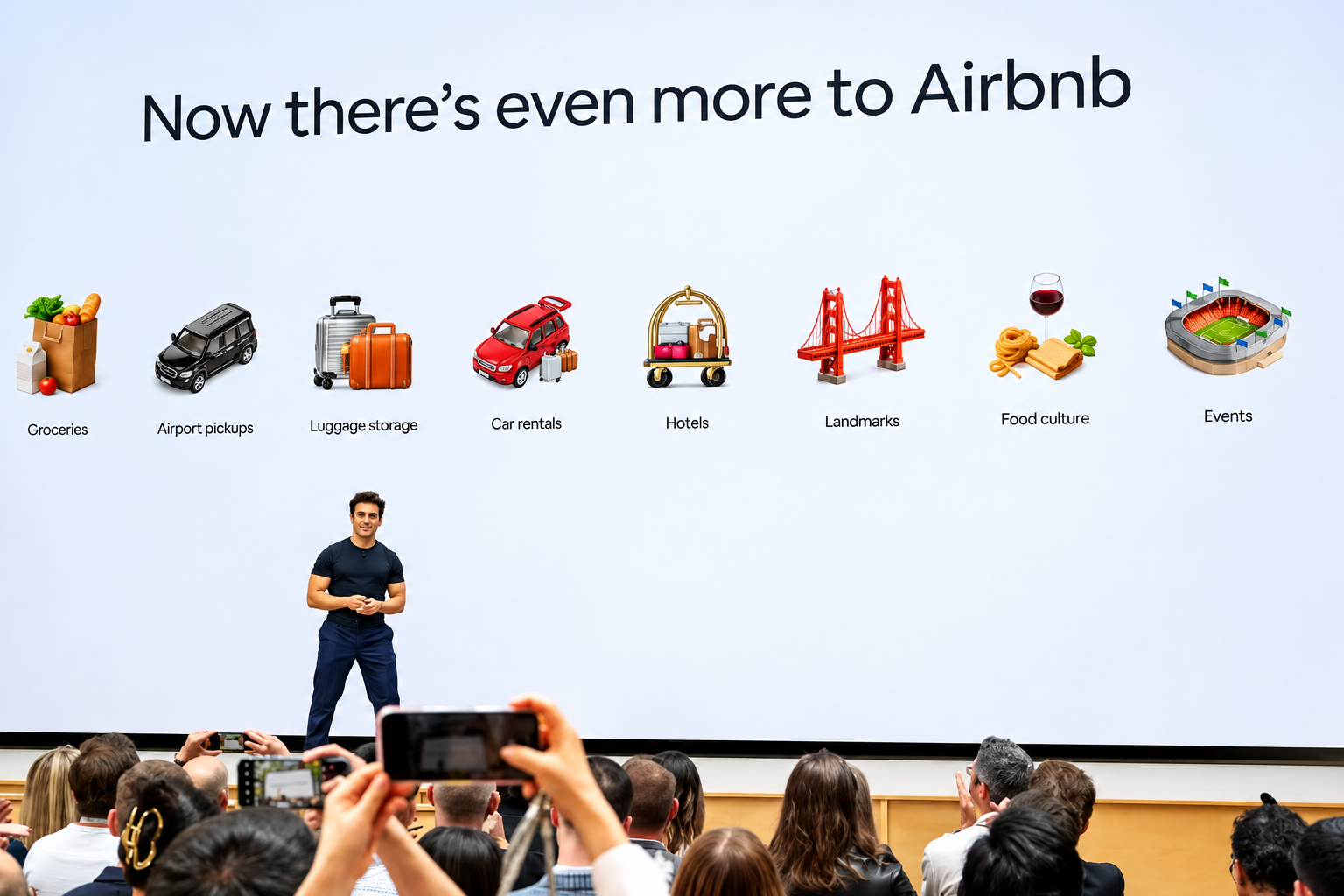
Among the changes: letting guests reserve now and pay later, adding hotels, and a redesigned home page and app. Investors were also betting on what comes next, including thousands more hotels, car rentals and, eventually, advertising.

The irony is that some of those growth drivers push Airbnb closer to the kind of business Booking and Expedia run—the kind of business AI agents could threaten. Even if AI agents capture a large share of travel planning and booking, Airbnb would capture the demand. But it and others would slowly lose control over how customers find and choose properties.

That would undermine the advertising opportunity investors are counting on. The bigger point for Airbnb and other marketplaces is that losing control of customer acquisition could mean surrendering some of their pricing power and margins.

To bulletproof itself, Airbnb might look to another e-commerce giant that has so far kept AI agents at arm’s length: Amazon.

Like Amazon, Airbnb has a loyal customer base and hard-to-match supply. But it has nothing like Prime membership to make customers think twice before taking their business elsewhere.

That is where loyalty comes in. Business travelers stick with Hilton or Marriott because enough nights earn them perks. Leisure travelers rarely accumulate stays with one chain. Airbnb has millions of listings and plenty of repeat customers, but no broad rewards program. It has begun experimenting with credits on hotel stays, but it should make loyalty a priority, not just a promotion.

Airbnb also plans to launch its own AI agent next year. But travelers using an agent might still want it to search Airbnb, Vrbo, Booking and hotel websites alike, rather than limit itself to one company’s inventory.

Eventually, Airbnb might have to strike deals with agent makers, using its unique homes as leverage to negotiate favorable terms, says Gawrelski. Such deals, along with rewards for loyal guests, could over the long term eat into the company’s roughly 13% take rate, he adds. But if they bring in enough additional bookings, the trade-off could be worthwhile.

History offers a reason not to panic. The shift from desktop to mobile unsettled investors in Alphabet and Amazon, but both emerged as major beneficiaries. Companies with valuable assets can come out of a platform shift stronger, if they adapt quickly enough.

Airbnb has homes the bots can’t easily replace. Now it needs to give guests a reason to insist on booking them there.