
Built to Withstand 200 MPH Winds: ‘Hurricane-Proof’ Florida New Build Lists for $6.85 Million

By CASEY FARMER
Mon, Aug 19, 2024 10:29am 2 min
2 min
2 min

 2 min
2 min
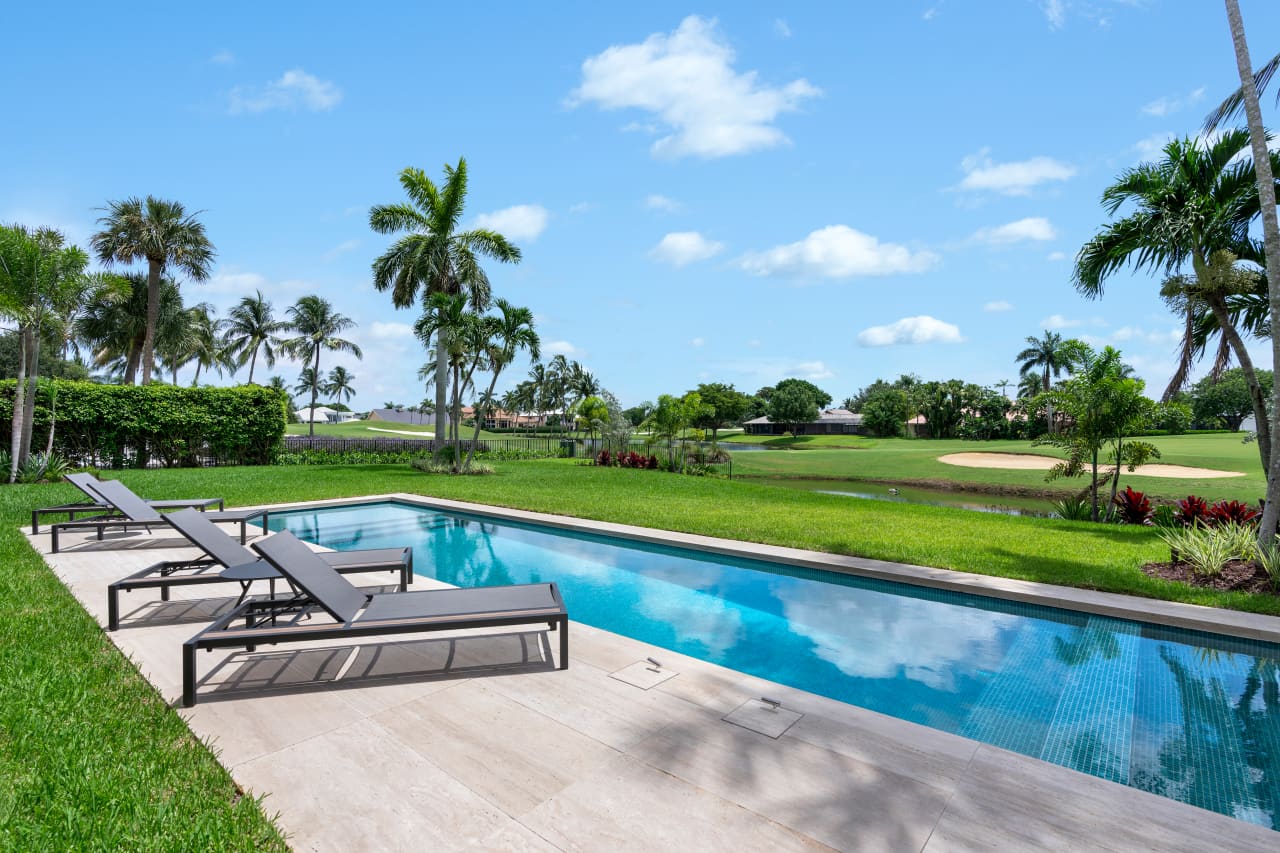
A newly built home on a golf course in Boca Raton, Florida, that promises to be hurricane-proof hit the market on Tuesday with a $6.85 million price tag.
The house, which was completed this year, is entirely made up of steel supports and poured concrete and was constructed with insulated concrete forms, which allows the home to withstand winds stronger than 200 miles per hour, said the home’s developer Meir Kroll.
“There’s this picture [of the west coast of Florida after Hurricane Michael in 2018] of all these homes on the beach totally decimated, and then there’s this one house that’s standing. That house was an [insulated concrete form] home,” Kroll said.
Senada Adzem of Douglas Elliman, who brought the home to market on Tuesday with her colleague Brian Ross, said the potential environmental impact on a property has become increasingly important to her clients.
“They want to know that they’re safe. They want to know that if they’re travelling in the summer, … their home is going to be there when they come back,” she said.
Kroll moved to Boca Raton in 2021 from Los Angeles, where he worked as a luxury developer and built homes for sports agent Rich Paul and MLS player Javier Hernandez. Kroll bought the property to build his first Florida project in 2022 for $840,000, according to public records.
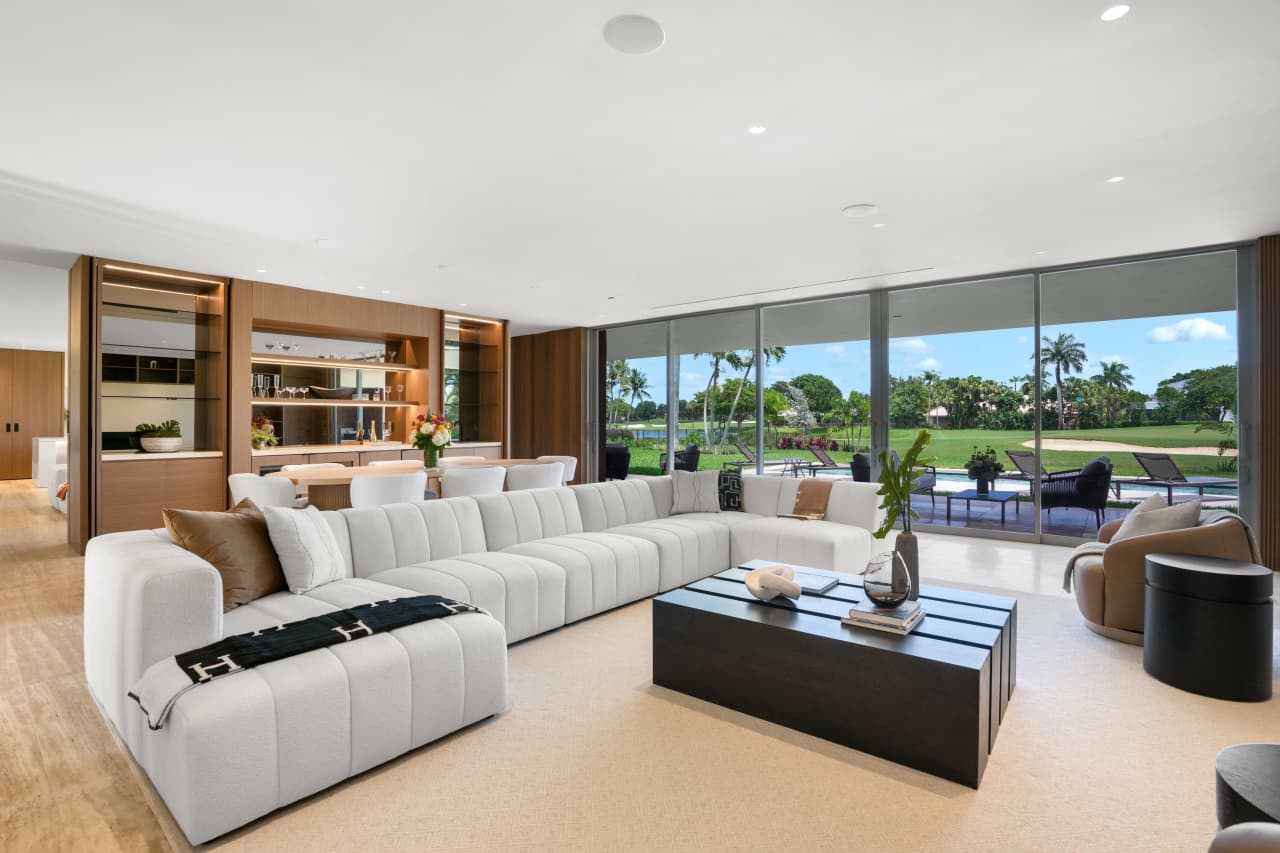
With its contemporary-style white exterior and dark wood accents, the nearly 7,000-square-foot home stands out in the country club community of Boca Grove, where many homes were built in the 1980s and ’90s and sport tiled roofs and a Mediterranean-inspired style.
Instead, working with Spanish architect Jorge Bibiloni Studio, this home draws inspiration from the villas of Mallorca, where Bibiloni is based.
“His design aesthetic is warm contemporary but minimalist,” Kroll said. “There are a lot of spec projects in Florida that are eccentric and over-designed. I think there’s beauty sometimes in subtlety.”
The sleek style with wood accents continues inside the two-storey home, which has five bedrooms, seven full bathrooms and one half-bath. The primary suite has two large walk-in closets and a separate formal sitting room.
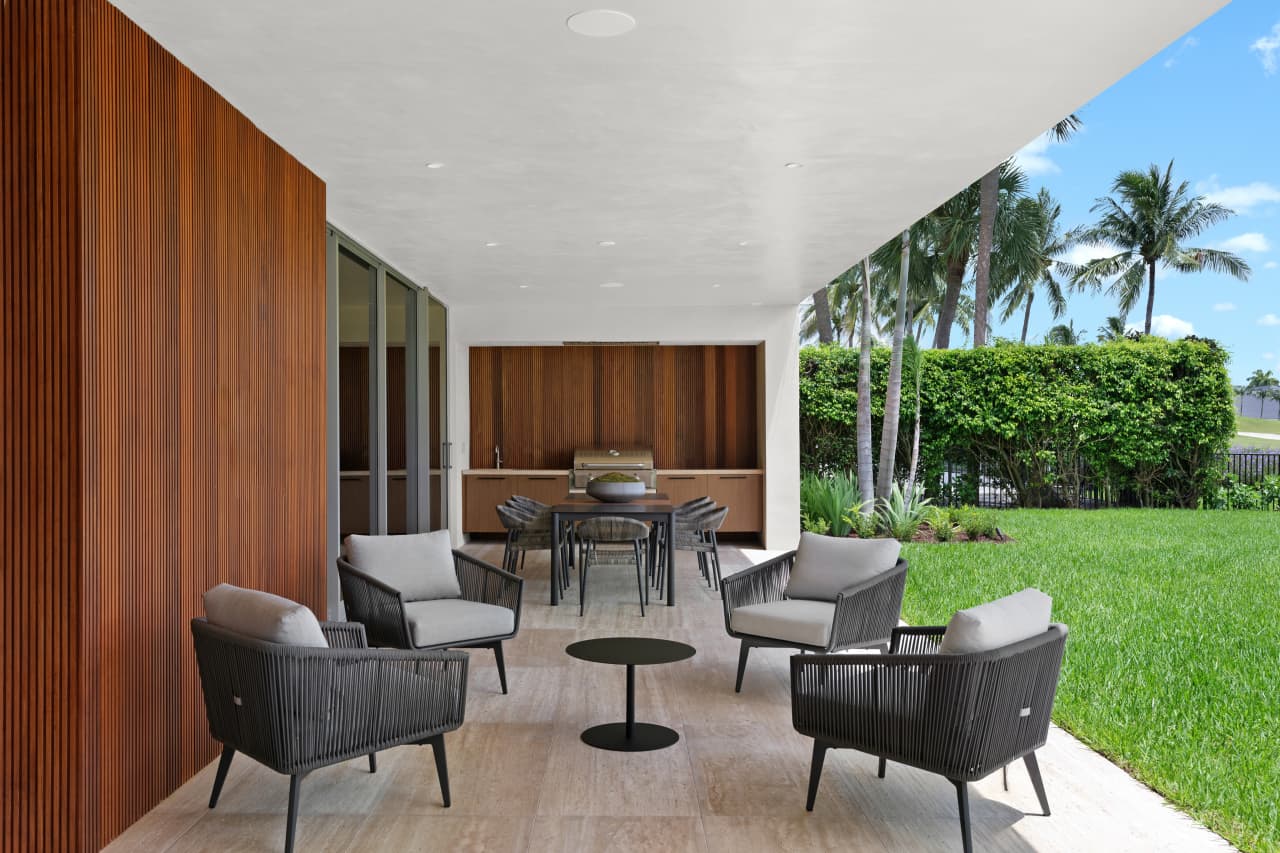
Sliding-glass doors on the first level lead out to a covered patio with a full summer kitchen, an outdoor dining area, and a heated pool and spa. A sundeck runs along the length of the second level, overlooking the golf course.
 Copyright 2020, Dow Jones & Company, Inc. All Rights Reserved Worldwide. LEARN MORE




The Australian leather house has opened an immersive four-day pop-up in Manhattan, unveiling its Bloom Collection and redefining what a product launch can look like.
Following the successful launch of its Palais Collection, MAISON de SABRÉ has unveiled a new modular handbag system offering more than 720 styling combinations.
Georgetown agent Jamie Peva blends history and real estate on Instagram, turning local stories into a powerful sales strategy.
5 min
On a recent morning in Georgetown—Washington, D.C.’s oldest neighborhood—real-estate agent Jamie Peva strode down leafy N Street, brimming with historical tidbits.
Jackie Kennedy once lived on the street, he said. So did Ben Bradlee, former executive editor of the Washington Post, along with a former Miss America and a powerful U.S. Senator. Bradlee’s widow, author Sally Quinn, and Eric Schmidt, former CEO of Google, own stately homes there.
“I’ve seen a picture of Lyndon Johnson coming out of this house,” said Peva, passing a Federal-style brick mansion. “Also, the Beatles went to a lawn party here.”
Peva, a 60-year-old agent with Washington Fine Properties, has sold Georgetown real estate for over three decades, often traversing the neighborhood by bicycle. Of the roughly 2,500 houses in the historic neighborhood, he has been involved in the sale of 460, he estimated. A self-styled historian of the neighborhood, he knows stories behind its houses and their owners going back generations.
With a knack for lively storytelling, he shares his knowledge with some 37,500 Instagram followers, who have made Peva—sporting the bow ties he has worn since boarding school—an unlikely social-media influencer. Many of his followers are locals, and most have no plans to buy or sell real estate—until they do. It is then, according to Peva, that his spirited reels bring him to mind.
“It’s the digital version of a refrigerator magnet,” he said.
After Peva’s first video in November 2023, his eponymous Instagram account sparked a 10% increase in sales volume in the first year, and another 20% the next, he estimated. “It’s been very good for business, there is no question about it,” he said.
But Peva’s posts have also made him a local celebrity. As he walked down N street, the driver of a Mercedes station wagon slowed down to honk and wave. A lady walking a large dark gray dog stopped to ask what he was filming that day (a reel about a Colonial-era bottling plant.) Peva knew the dog from walking his two springers, Jumpy and Peggy-O, in the neighborhood.
“I need to make a video about the pooches of Georgetown,” he mused.
A growing number of real-estate agents now use social media to sell, and some have millions of followers with reels featuring ultraluxury pads, selling tips or reality TV-style reports on their daily lives. While Peva posts about his listings—and sometimes those of other agents—he mostly focuses on Georgetown history, local businesses and community events, saying his goal is to benefit both his business and the neighborhood.
“If we don’t find something genuinely interesting and worth sharing, we won’t do it,” said Peva’s daughter, Violet Peva, a New York social-media strategist who films, edits and posts his reels. “We cover many topics, not just real-estate information.”
Peva is originally from Connecticut, but has lived in Georgetown for over 30 years, currently in a cottage-style house with a white picket fence. Over the years, Georgetown has changed. The Georgetown Set, a powerful group of Cold War-era residents whose Sunday-night potluck dinners are said to have swayed U.S. policy, has long faded away. The community is still home to high-profile Washingtonians, including a Republican senator and several cabinet members. But it increasingly also attracts technology and finance executives, according to Peva. He now routinely signs nondisclosure agreements, ensuring privacy for wealthy clients. The shift has made him rethink his marketing approach.
“For years, a big part of our Georgetown business was made up of people who maintained a low profile,” he said. Real-estate agents were similarly low-key. Today, curb appeal is more important, he said, and agents are promoting themselves more. “As this change was underfoot, I was thinking that I needed to evolve myself too,” he said.
Though his own social-media use is mostly limited to following sailing accounts, he asked his daughter to help him post his listings online. Violet, now 26, started coming to D.C. once a month to film his reels. After an early video, on a condominium building called the Elliott, her sister Fern called her to report: “Daddy’s blowing up on Instagram,” Violet recalled. The reel got over 50,000 views. The next two each drew over 300,000. Peva’s most popular post ever, with over 838,000 views, was about the Grateful Dead playing in Georgetown. Sometimes, Peva interviews Georgetowners such as Quinn, the author, or Jamie Stachowski, the owner of a local butcher shop.
Peva, who majored in history in college, now spends up to two hours a day on research, usually in the morning while on his stationery bike. Online, he pores over old newspapers or the Library of Congress website, and he has a collection of articles and books—in and out of print—about Georgetown.
Companies often approach Peva for promotional posts, he said, but he turns them down, feeling that followers would lose interest in constant commercials. One exception is a recent paid post on Mount Vernon, the former home of George Washington. Peva wanted to share its history, he said, and didn’t want to lose the opportunity to another Instagrammer.
Anthony Arend, a professor at Georgetown University, has lived in his current home for 19 years without any plans to sell or buy real estate. But he follows Peva and often likes his posts.
“He is very charismatic, he is energetic, and he obviously knows a lot about the community,” said Arend, who has referred house-hunting friends to Peva.
One of Peva’s biggest deals—the $10.5 million sale of a 19th-century Italianate mansion—came after he made two 2024 reels featuring the property. In March, he sold the longtime O Street home of Tim and Jane Matz for $5.8 million after featuring it on his Instagram. Peva had showed them the home 25 years earlier, with Violet in a baby carrier on his back.
Last year, Kate Watts, 49, a digital consultant, called Peva to sell her late father’s three-bedroom house on Q Street; her husband had seen Peva on Instagram. In an October reel, Peva praised the architecture of the house, designed by modernist Hugh Newell Jacobsen. Halfway through, he mentioned an open house the next day, ending with an upbeat: “Did I also mention this house is for sale? $3.75 million!” The reel got 27,000 views, the open house was packed, and the buyers made an offer at the list price on the same day.


