When Abby Tennenbaum, 44, and her husband, Ross Tennenbaum , 46, purchased a $2.1 million vacation property in 2021 about 80 miles southeast of Seattle in the mountain resort community of Suncadia, Washington, they encouraged their two young daughters to collaborate with the family’s interior designer, Emily LaMarque, on decorating the house. The 3,143-square-foot, five-bedroom home had a budget of $500,000 for furnishings and decorating.
The Tennenbaum sisters—Ella, 12, and Edie, 8—gave LaMarque feedback on paint colours and wallpaper patterns, but they also expressed other specific preferences. They weren’t into insect art (though butterflies were okay).
They thought it would be neat to have indoor swings—which the house now has on all three of its levels. And Edie, who has always loved bunk beds, worked with LaMarque to design a bunk room, which is both sisters’ favourite space. “It looks so good and it’s so cool,” Edie says of the sleeping spot that has four full-sized beds.
The girls even convinced their parents, Abby and Ross Tennenbaum, that the kitchen needed a snow cone machine. Abby is an occupational therapist turned stay-at-home mother and Ross is the CFO of Avalara, a tax software company.
Children have long contributed thoughts on their bedroom designs: Pink! Blue! Princesses! Rocket ships! But now they are driving interior decisions around the house. “We’ve always talked with our clients’ children,” says Lynn Stone, co-founder of Hunter Carson Design, which is based in Manhattan Beach, California. “What we are seeing now is something different: Now we expect the kids to get involved.”
Stone and her co-founder, Mandy Gregory, routinely receive emails, Pinterest boards, Instagram messages and TikToks from their clients’ mini-mes. “Kids send us texts if they are out shopping, saying, ‘Do you think this will work in our room?’” Stone says. “One client’s daughter said, ‘Please, don’t meet with Lynn and Mandy without me, and if you do, FaceTime me!’”
A sampling of product requests from their pint-sized clients include CB2’s Goop-designed Gwyneth Boucle Swivel Chair (“Teens love this chair,” Stone says), Gucci wallpaper, Bella Notte handmade linens, customised neon signs, shelves to show off Lego collections and bedroom mini fridges (“Parents often say no to mini fridges,” Stone says). One teenager emailed Stone a screenshot of a Sotheby’s auction artwork in the $20,000 range that she wanted for her bedroom. Stone told her, “I too love this, but I don’t see it making its way into either of our houses.”
In 2021, Stone and Gregory were hired by stay-at-home mom Neeraj Rotondo, 56, to update her son’s bedroom and bathroom in the roughly 5,000-square-foot, five-bedroom Manhattan Beach house where Rotondo’s family had lived for more than a decade. The Mediterranean-style house is currently estimated at $6.2 million, according to Redfin. Rotondo’s son, Sam, who was 14-years-old at the time, gave his opinions: He wanted his room to have a couch-like bed, framed N.B.A. jersey artwork and a space to play card games with friends. The bedroom cost $8,000 and the bathroom was $23,000.
While that project was underway, Neeraj Rotondo’s two daughters, Leena and Kayla Rotondo, who were teenagers, convinced their mother that the family’s unused media room needed a refresh. “It was brown and navy with reclining chairs and super not welcoming,” says Kayla, 19.
Kayla was inspired by a Pinterest photo of reality star Khloé Kardashian ’s theatre room, especially its long, glamorous cream-coloured couch. Stone and Gregory outfitted the Rotondos’ screening room with a custom-built daybed with grey velvet cushioning, floating lounge chairs, fluffy cream pillows and faux fur blankets, shimmery grasscloth wallpaper, hand-blown glass sconces and candy jars. It cost $42,000.
“It was soooo fun that we were young and we got to bring our idea to life,” says Leena, 20. Her sister agrees. “It feels like the only room in the house that was just for me and Leena,” Kayla says. “It wasn’t anyone’s vision but ours.”
Savannah, Georgia-based Khoi Vo , who is the CEO of the American Society of Interior Designers, thinks it’s “wonderful” that youngsters are interested in home design, which gives family members a forum for communicating with each other and thinking about how they live together. “As a dad to a pre-teen, I think any chance a parent can get to engage in dialogue with their kids is an opportunity,” says Vo.
Vo emphasises that families need to recognise an interior design project’s constraints, whether it’s money, time, space, scale or all of the above. “A child might say, ‘I want a turret that I can shoot an arrow out of and a moat with alligators,” he says, noting that, yes, of course it’s okay to say no to the castle.
“If you’re designing a space just for you—you’re the only one who is going to use it—you don’t need to seek your 12-year-old son’s opinion,” Vo says. When it comes to the living room, though, Vo says it’s fine to talk as a family about it—but, that doesn’t mean the son needs the wall of television screens he wants for sports night.
Houston interior designer David Euscher thinks the pandemic made everyone become more aware of how they live in their own environments and how spaces influence behaviour. “Even without that event,” he says, “young people look for ways to exercise some control over their lives, and influencing their parents’ design choices at home is one way to do it,” he says.
In 2022, Wendy Becktold, 53, of Berkeley, Calif., hired local interior designer Nureed Saeed, owner of Nu Interiors, to design a bedroom for her son, Simon. Wendy Becktold, an editor, and her family moved into a roughly 2,400-square-foot, three bedroom 1922 Craftsman house in 2016, which she and her husband purchased for $1.3 million.
“Since I’m the youngest child, when we moved, I obviously got the smallest room,” says Simon, 16, who has an older sister. “For my furniture, I got hand-me-downs from everyone else. It was little-kid, vandalised furniture all around my room. So I leveraged that, and was like, well, mom, I have the smallest room and the worst furniture. Maybe it would be a good idea to get a little room redo. I guess it worked.”
Saeed created image boards featuring varying furniture and colours and she and Simon talked through the selections. He gravitated toward Midcentury Modern shapes, walnut woods and a colour palette of navy, tan, white and black with a hint of greige.
“Definitely more adult than I would have expected out of a 14-year-old,” Saeed says. As his space morphed into his new one with fresh paint, furniture and lighting, Simon says, “It was surreal to watch it become my room after I’d been speculating about how cool it was going to be.”
Once the bedroom project was complete, Saeed moved onto designing the living room and entryway, where Simon expressed his preferences for modern furniture. “I didn’t want to overstep my role as the youngest child,” he says, “but I did definitely say, ‘This is cool,’ ‘This is a good idea,’ ‘I’m not as keen on these things, like a couch.’”
The house project had limits. “We made careful considerations for our interior design selections because it’s quite an investment,” Wendy Becktold says. The bedroom project, for example, cost close to $10,000, but she says it was worth it, as the new space can be useful even after Simon leaves the nest someday.
The Becktolds’ project is an example of how Saeed thinks there has been a societal shift in how children are regarded today. “We view them as their own humans who, even at young ages, their opinions are worth honouring and listening to,” she says.
“It’s not like children sit down buttoned-up for a kick off meeting, but at some point, parents are always like: My kids really like this thing but I don’t know how to integrate it,” says Los Angeles-based Emily LaMarque, founder of an eponymous firm, who designed the Tennenbaum family’s house in Washington.
LaMarque says her recent clients’ offspring often fall into two camps: those who are inspired by nature or music. “There’s a lot of Taylor Swift,” she says, noting that for music fans, it’s less about capturing a specific musician’s aesthetic and more about exuding a vibe—though LaMarque will coordinate album cover posters with other artwork and decor.
One 10-year-old gave LaMarque four iterations of her bedroom floor plan. “Specifically, she said ‘I want a pale wood bed here. I want two nightstands. I want my two guitars to go here. I want a credenza—and I want a record player on it so it needs to be deep enough and I want plants on it.’”
LaMarque riffed back and forth with one 13-year-old drama lover, whose bedroom they decided to outfit with a nook that has curtains that can be tied back so the girl could have a theatre area. LaMarque says, “when she got her new bedding that she had helped pick out, she was literally jumping up and down.”



 5 min
5 min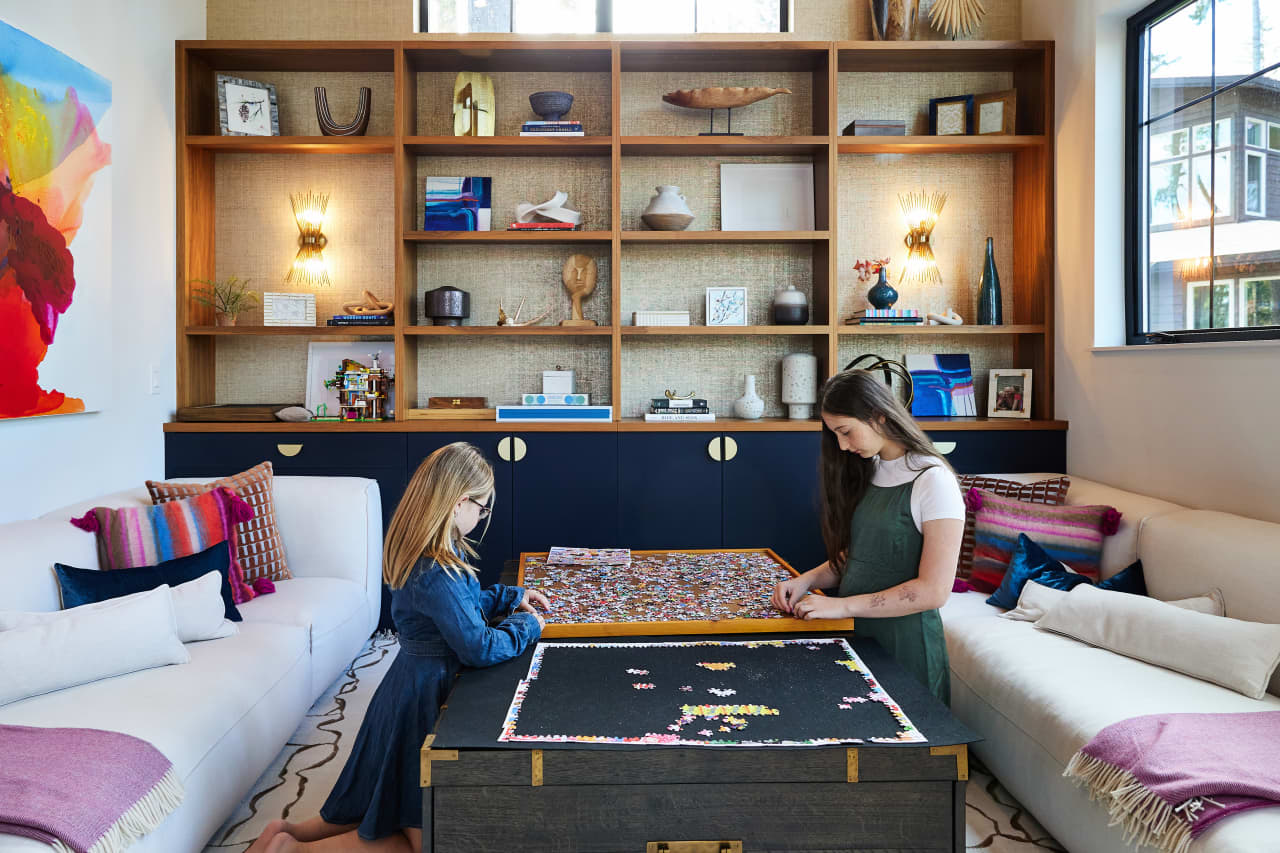
 Copyright 2020, Dow Jones & Company, Inc. All Rights Reserved Worldwide.