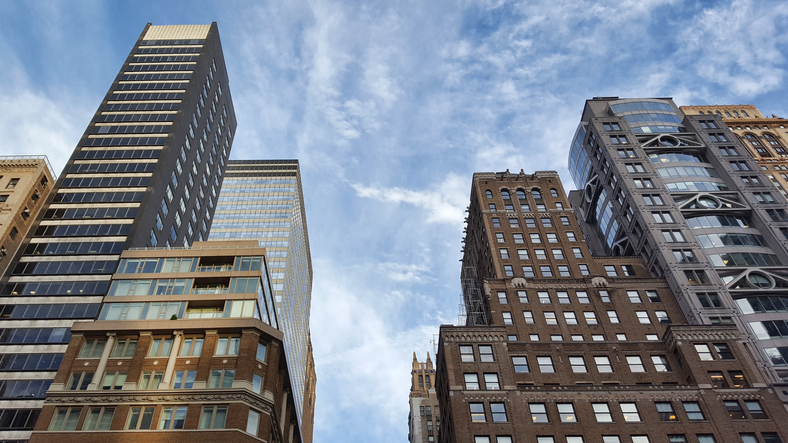
Developer efforts to convert emptying office towers into residential buildings have largely gone nowhere. That may be finally changing.
The prospect of transforming unused office space into much-needed housing seemed a logical way to resolve both issues. But few conversions moved forward because the cost of acquiring even an aging office building remained too high for the economics to pencil out.
Now that office vacancy has reached record levels, sellers are willing to take what they can. That has caused values to plunge for nothing-special buildings in second-rate locations, making the numbers on many of those properties now viable for conversions.
Seventy-three U.S. conversion projects have been completed this year, slightly up from 63 in 2023, according to real-estate services firm CBRE Group. But another 309 projects are planned or under way with about three-quarters of them office to residential. In all, about 38,000 units are in the works, CBRE said.
“The pipeline keeps replenishing itself,” said Julie Whelan , CBRE’s senior vice president of research.
In the first six months of this year, half of the $1.12 billion in Manhattan office-building purchases were by developers planning conversion projects, according to Ariel Property Advisors.
While New York, Chicago and Washington, D.C., are leading the way, conversions also are popping up in Cincinnati, Phoenix, Houston and Dallas. A venture of General Motors and Bedrock announced Monday a sweeping redevelopment of Detroit’s famed Renaissance Center that includes converting one of its office buildings into apartments and a hotel.
In Cleveland, 12% of its total office inventory is either undergoing conversions or is planned for conversion. Many projects there are clustered around the city’s 10-acre Public Square. The former transit hub went through a $50 million upgrade about 10 years ago, adding fountains, an amphitheater and green paths.
“You end up with so much space that you paid so little for, that you can create amenities that you would never build if you were doing new construction,” said Daniel Neidich, chief executive of Dune Real Estate Partners, a private-equity firm that has teamed up with developer TF Cornerstone to invest $1 billion on about 20 conversion projects throughout the U.S. in the next three years.

Conversions won’t solve the office crisis, or make much of a dent in the U.S. housing shortage . And many obsolete office buildings don’t work as conversion projects because their floors are too big or due to other design issues. The 71 million square feet of conversions that are planned or under way only account for 1.7% of U.S. office inventory, CBRE said.
But city planners believe that conversions will play an important part in revitalising depressed business districts, which have been hollowed out by weak return-to-office rates in many places.
And developers are starting to find ways around longstanding obstacles in larger buildings. A venture led by GFP Real Estate is installing two light wells in a Manhattan office-conversion project at 25 Water St. to ensure that all the apartments will get sufficient light and air.
Cities such as Chicago, Washington, D.C., and Calgary, Alberta, have started to roll out new subsidies, tax breaks and other incentives to boost conversions.
The projects are breathing new life into iconic properties that no longer work as office buildings. The Flatiron Building in New York will be redeveloped into condominiums. In Cincinnati, the owner of the Union Central Life Insurance Building is converting it into more than 280 units of housing with a rooftop pool, health club and commercial space.
In the first couple of years of the pandemic, office building owners were able to hold on to their properties because of government assistance and because tenants continued to pay rent under long-term leases.
As leases matured and demand remained anaemic, landlords began to capitulate and dump buildings at enormous discounts to peak values. In Washington, D.C., for example, Post Brothers last year paid about $66 million for 2100 M Street, which had sold for as much as $150 million in 2007.
Washington, D.C., has been particularly hard hit by the office downturn because the federal government has been especially permissive in allowing employees to work from home .
“We’re able to make it work as a conversion because it was no longer priced as though it could be repositioned as office,” said Matt Pestronk , Post’s president and co-founder.
Increasingly, more deals are taking place behind the scenes as converters reach deals with creditors to buy debt on troubled office buildings and then push out the owners. GFP Real Estate reduced costs of its $240 million conversion of 25 Water Street by buying the debt at a discount and cutting deals with tenants to exit the building before their leases matured.
One of the first projects planned by the venture of Dune and TF Cornerstone likely will be the Wanamaker Building in Philadelphia. TF Cornerstone just purchased the debt on the office space in the building and is in the process of taking title.
“The banks are foreclosing and doing short sales,” said Neidich, Dune’s CEO. “There’s a ton of it going on.”
In Washington, D.C., a conversion of the old Peace Corps headquarters building near Dupont Circle is 70% leased just four months after opening, said developer Gary Cohen . Rents are higher than expected.
“If that’s the way to get people downtown, that’s what we have to do,” Cohen said.
Not all developers agree that the economics of conversions work, even at today’s low prices. Miki Naftali , who has converted more than five New York properties over the years, said he has been very actively looking at conversion candidates but hasn’t yet found a deal that works financially.
One of the issues facing converters is that even if an office building is dying, it often has a few existing tenants who would need to be relocated. Some buildings would need atriums to ensure that all the apartments have sufficient light and air.
“When you start to add everything up, if your costs get close to new construction, that’s when you get to the point that it doesn’t make financial sense,” Naftali said.
Some landlords are including clauses in leases that give them the right to evict tenants to make room for a major conversion. Others are keeping a small ownership stake when they sell buildings so that they can learn the conversion process for future buildings.
“The world is looking at these assets in a different way,” said developer William Rudin , whose company decided to learn the conversion process by keeping a stake in 55 Broad Street, a downtown New York office building it sold last year to a converter.


 4 min
4 min