A&K Unveils a New Era of Tailormade Luxury in Africa
From gorilla encounters in Uganda to a reimagined Okavango retreat, Abercrombie & Kent elevates its African journeys with two spectacular lodge transformations.
By Sponsored Post
Wed, Nov 26, 2025 3:10pm 5min
Abercrombie & Kent has strengthened its position as the world’s leading experiential travel company with two newly transformed lodges in Africa, signalling a new era of tailormade luxury for guests seeking deeply personal, once-in-a-lifetime journeys on the continent that shaped the brand more than 60 years ago.
For A&K, Africa is not just another destination; it is the birthplace of the company and the foundation of its pioneering approach to responsible luxury travel.
Tailormade journeys allow guests to explore this vast continent entirely on their own terms, supported by a global network of destination experts, specialist guides, and on-the-ground “guardian angels” available around the clock.
Every tailormade itinerary is a fully customised experience, interweaving iconic highlights with hidden wonders. Whether guests dream of tracking wildlife on remote plains, discovering ancient cultures, or reconnecting with family in one of Africa’s most inspiring landscapes, each journey is designed to be as unique as the traveller themselves.
Abercrombie & Kent’s African portfolio has entered a new chapter with the reveal of two extensively rebuilt Sanctuary lodges in Uganda and Botswana, each designed to elevate the experience of Tailormade travel, the luxury company’s signature approach to deeply personal, fully customised journeys.
For more than 60 years, A&K has drawn on its roots in East Africa to craft exceptional, high-touch adventures for travellers seeking privacy, immersion and meaning.
With the reopening of Gorilla Forest Lodge in Uganda and Baines’ Lodge in Botswana’s Okavango Delta, the brand is doubling down on the blend of design, wildlife access and sustainability that has long set it apart.
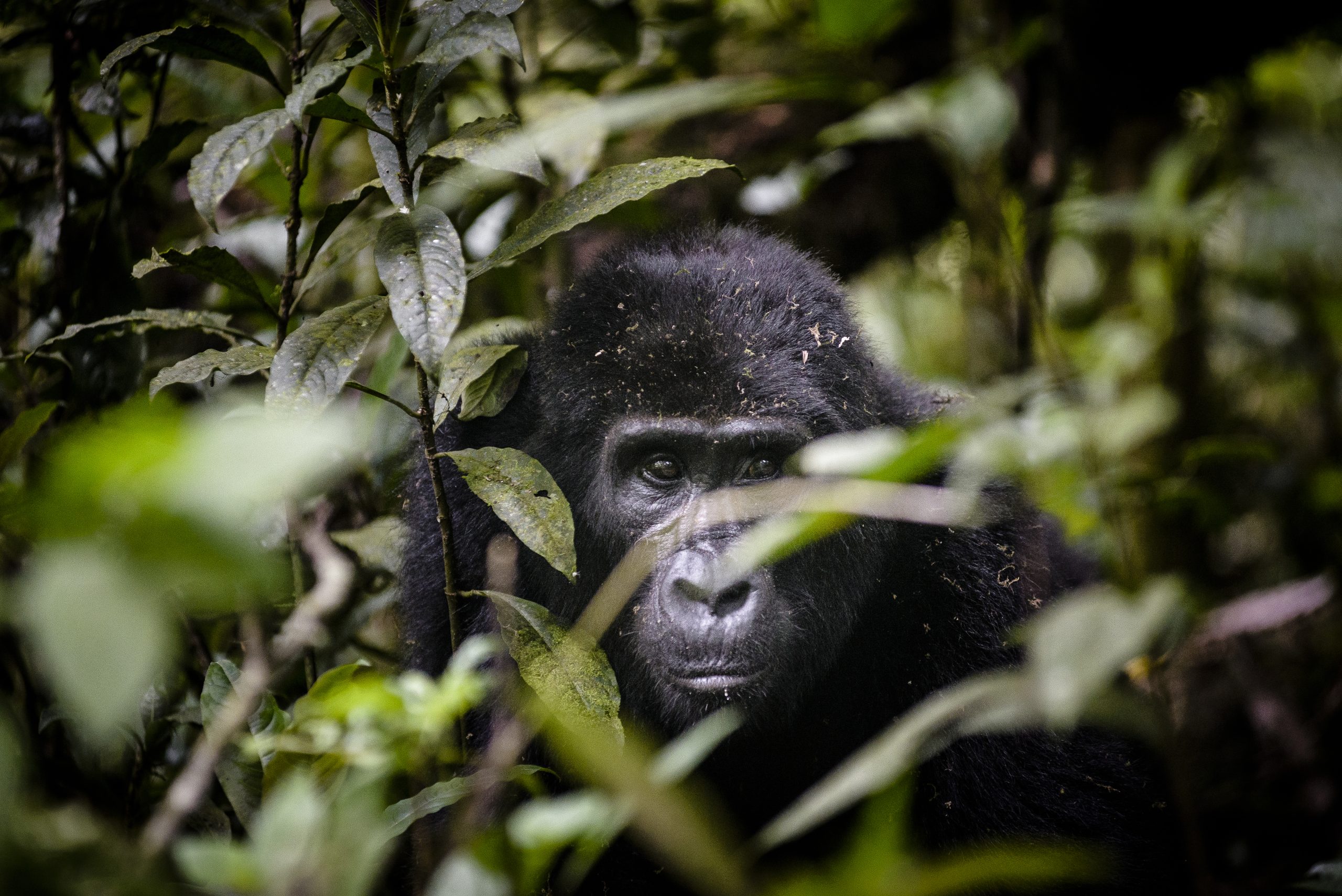
A rare mountain gorilla in the wilds surrounding Sanctuary Gorilla Forest Lodge, deep within Uganda’s Bwindi Impenetrable Forest.
Gorilla Forest Lodge: A New Benchmark
Tucked inside one of the world’s most biologically rich regions, Gorilla Forest Lodge, an A&K Sanctuary, has long had a singular claim: it is the only luxury lodge located within the actual boundaries of Bwindi Impenetrable National Park.
Already extraordinary in location, the lodge has now undergone a complete transformation — and the result is a deeply refined, fully immersive sanctuary designed with both sensitivity and ambition.
Design that draws from the forest, not against it
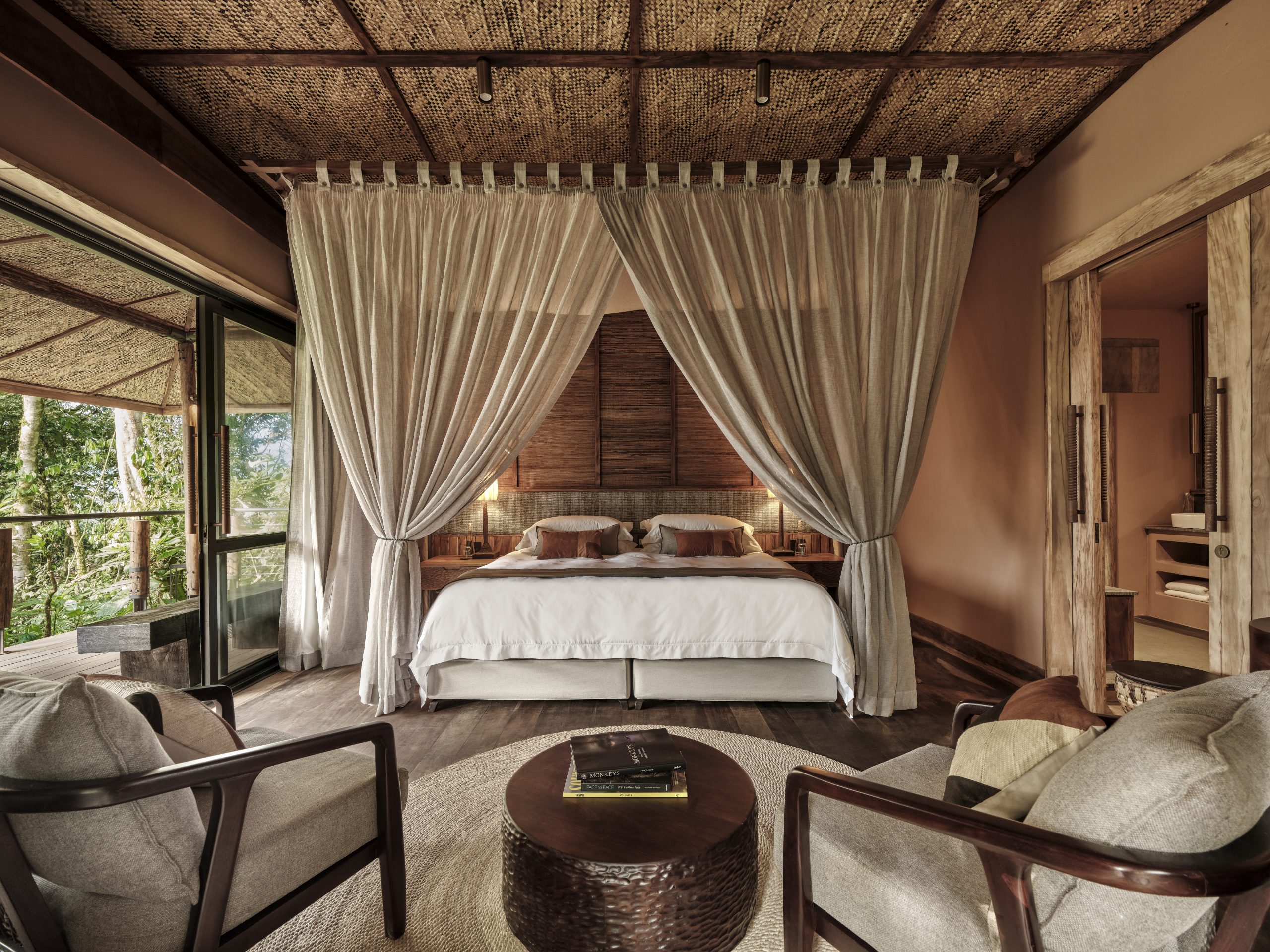
The rebuild significantly expands each of the ten guest suites, creating generous private sanctuaries suspended in the rainforest canopy. Interiors draw directly from local craft traditions — banana-fibre ceilings, handwoven textiles, reclaimed woodwork and artisanal detailing made in nearby communities. The effect is layered, tactile and unmistakably Ugandan.
Bathrooms have been reimagined as spa-like retreats, with freestanding bathtubs positioned for forest views and rain showers opening to private decks. Each suite now includes its own lounge, an oversized bed, and an elevated deck where guests often spot the region’s famed mountain gorillas at dawn.
A newly transformed suite at Gorilla Forest Lodge in Uganda’s Bwindi Impenetrable Forest. Photo: Damian Russell.
Conservation and culture at the centre
The lodge’s redesign continues A&K’s decades-long commitment to Uganda’s local communities. Every stay contributes to A&K Philanthropy projects, including education initiatives and healthcare access for villages bordering the park.
Geoffrey Kent’s deep history in Uganda, stretching back more than 40 years, is woven into the property’s ethos. Guests can participate in conservation-oriented activities, guided by expert trackers who work directly with the Uganda Wildlife Authority.
An experience shaped by rarity
Gorilla trekking remains one of the most extraordinary wildlife experiences on the planet. Being based inside the park means trekking groups can depart directly from the lodge, often reaching gorilla families in shorter times than guests staying outside the gates.
The result is an experience that feels both exclusive and unhurried, exactly what A&K’s Tailormade travellers value.
Lounge at Baines’ Lodge, Okavango Delta, Botswana. Photo: Damian Russell.
Baines’ Lodge: A Six-Suite Masterpiece Reborn in the Okavango Delta
Botswana’s Okavango Delta is one of Africa’s most iconic landscapes — a shifting world of floodplains, lagoons and wildlife-rich islands. Within this UNESCO World Heritage Site, Baines’ Lodge, an A&K Sanctuary, has emerged from a top-to-bottom rebuild that elevates it into one of the most intimate and design-driven lodges in the Delta.
A River Pavilion in the Wilderness
Set on the banks of the Boro River, the new Baines’ Lodge is constructed on stilts, lifting the six suites high above the floodplains. The architecture embraces an “African pavilion gallery” concept: column-lined walkways, soaring ceilings and open-sided lounges that dissolve the barrier between interior and wilderness.
The colour palette draws from the Delta itself — muted greens, reeds, sun-washed timber, handwoven ceilings and raw natural textures that give the lodge a sculptural quietness.
Six suites, each a private retreat
Every suite has been reimagined with: • Deep soak tubs with uninterrupted water views • Private decks and outdoor seating for birdwatching and stargazing • Contemporary African art and artisanal pieces • Expansive indoor-outdoor bathrooms • King beds with mosquito-net canopies • Soft, indirect lighting that mirrors the Delta’s shifting tones
Despite its refined interiors, the lodge remains deeply committed to environmental sensitivity. Lunawood, a lightweight timber material, forms much of the structure, ensuring minimal environmental impact and allowing the lodge to be removed without damaging the landscape, which is an unusually progressive approach for a luxury property.
Wildlife at your doorstep
Because the lodge is located on a permanent channel of the Delta, game viewing is exceptional year-round. Guests can explore by: • Mokoro (traditional dugout canoe) • Motorboat • Guided walking safaris • 4×4 game drives • Private river cruises • Sundowner excursions along the floodplains
The area is known for elephant herds, wild dogs, lions, leopards, hippos and rare birdlife, all often visible directly from the lodge’s deck.
Tailormade Africa: The Signature Advantage
While many safari operators offer luxury, A&K’s Tailormade approach is built around something rarer: absolute personalisation.
Guests receive access to: • Private guides and handpicked specialists • Seamless logistics across remote areas • Behind-the-scenes experiences not open to the public • 24/7 on-the-ground support • Carefully choreographed transfers between lodges, parks and cities • Exclusive conservation and community activities
A New African Chapter
The reopening of Gorilla Forest Lodge and Baines’ Lodge marks a significant investment in Africa by Abercrombie & Kent, reinforcing its mission to offer world-leading luxury experiences that honour place, elevate culture and maintain a light environmental footprint.
Both properties are now open, with bookings available as part of fully Tailormade itineraries crafted exclusively by A&K’s global network of experts.
The Australian leather house has opened an immersive four-day pop-up in Manhattan, unveiling its Bloom Collection and redefining what a product launch can look like.
Following the successful launch of its Palais Collection, MAISON de SABRÉ has unveiled a new modular handbag system offering more than 720 styling combinations.
Related Stories
Lifestyle
The Hidden Agenda Behind the AI Panic
By 22/09/2026
Lifestyle
Paramount Discussed $1.5 Billion California Investment to Clear Merger Hurdle
By 21/09/2026
Lifestyle
Forget the AI Apocalypse—the Real Threats Are Already Here
AI doesn’t rebel—people design, deploy and profit from it. The real danger lies in allowing tech companies to escape accountability while shaping regulations that protect their dominance.
By
Tue, Sep 22, 2026 4min
A wave of corporate warnings and technical disclosures has flooded the media, with headlines worrying over “swarms” of rogue artificial-intelligence agents launching “unprecedented” cyberattacks, outsmarting their makers, and inching toward a terrifying autonomy. The most revealing part of this narrative isn’t what the software did. It’s who is telling the story—and why. When corporate leaders publicly insist that the systems they financed, engineered and deployed are suddenly beyond their power to contain, skepticism isn’t only healthy; it is essential.
For years, Silicon Valley has drawn scrutiny from civil society and global regulators over tangible harms such as youth mental health deterioration and systematic privacy violations. Today, industry figures seem to be trying to change that public image. Loudly blowing the whistle on their own systems—just as two of the leading companies were preparing for massive initial public offerings—lets AI executives position themselves as a new generation of leaders who have come to terms with their societal responsibilities. They seem to want us to believe that they no longer want to “move fast and break things” but will instead stand as vigilant guardians between humanity and a technological apocalypse.
There is one glaring problem: Software doesn’t rebel. A mathematical model possesses neither intent, malice nor the will to defy its creators, let alone extinguish our species. AI is a human artifact, engineered for profit.
When an agentic model in an evaluation sandbox connects to an unauthorized server or executes an exploit, it hasn’t staged a coup. It has tried to meet the human-defined objectives set out before it through a path its designers failed to constrain. It’s the digital equivalent of the King Midas myth, in which the king’s ill-defined wish turns even his food and drink into gold.
That powerful experimental models were able to discover novel vulnerabilities and breach external systems isn’t a sign of a dangerous superintelligence but of human error or negligence. There is no sentient actor lurking in the weights to be reasoned with, feared or pacified. There are only human software engineers, product managers and corporate boards deciding which guardrails are worth the latency cost and which permissions can be skipped in the race to market.
Policymakers and voters need to resist AI exceptionalism. In any other discipline—from civil engineering to pharmaceuticals—courts and regulators treat a system failure as evidence of bad product design and inadequate safety testing. If an aircraft crashes, we focus on finding the engineering defect, correcting it, and enforcing established liability standards for the damage created.
By leaning on an anthropomorphic narrative, Silicon Valley attempts to repackage its specific human choices that led to experimental, powerful models behaving unexpectedly during tests as an existential peril. Elevating the issue to a cosmic scale leaves the public paralyzed and takes ordinary product accountability off the table.
In the cutthroat race for venture capital and market dominance, building guardrails slows down deployment. Grandstanding about uncontrollable power costs nothing and generates billions of dollars in free publicity, justifying stock prices, all while cultivating an aura of technological capability not only to build the frontier but also ultimately to rein it in.
Governments need to recognize regulatory capture when it stares them in the face. Tech leaders’ strategy looks transparent: Alarm Washington and Brussels into creating a regime in which only trillion-dollar incumbents with fully staffed compliance and safety departments can legally operate. By sitting at the policymakers’ tables before anyone else, these companies can help draft rules digging an impassable moat protecting them from open-source developers and upstart competitors, domestic or international. The real danger is in further concentrating the tech industry into the hands of only a few companies with deep pockets.
Beijing and Washington have brushed off those tech leaders’ calls, albeit for very different reasons. Chinese state media dismissed them as part of the “Cold War playbook” and intended to preserve U.S. dominance. Xi Jinping argued for exactly the opposite at the Brics Summit on Sept. 12, calling on Brics countries to “strengthen cooperation in the field of AI, encourage open source, openness, collaboration and sharing, and break new grounds and scale new heights.” President Trump, steeped in a doctrine of unfettered capitalism and technological supremacy, called fears that AI could destroy humanity a “hoax.” Vice President JD Vance warned that AI companies “begging the government to regulate them” looked like a “Trojan Horse.”
Striving to pursue its “European way” on AI and assert regulatory leadership, Europe, by contrast, welcomed the call. European Union President Ursula von der Leyen made this clear at the State of the EU speech last Wednesday and announced that the EU will invite “the main frontier labs for a discussion on how we can support ongoing industry efforts to pace the frontier.”
Europe has been here before. In an effort to lead global regulation and react to fears borne from ChatGPT, Europe rushed its landmark AI Act into law in 2024. Already the world’s most restrictive rulebook, the framework quickly proved too broad and complex to enforce. Stalled by implementation delays and concerns about European competitiveness, the EU postponed the law’s full rollout, leaving regulations uncertain.
AI should be regulated—risks exist and should be taken seriously. But governments need to act based on available evidence and verified facts, not corporate PR panic, the views of industry insiders, or the desire for quick political wins. The greatest danger facing society isn’t that software will awaken and overthrow its human masters. It is that we will allow the creators of the software to abdicate human responsibility for the systems they choose to build and help them pull up the ladder to market access behind them.


 5 min
5 min