Alfred Hitchcock’s Vandamm House Never Existed, Until They Built Their Own
Two architecture lovers created a real-life version of the home in Utah. It is now on the market for $45 million.
By FRED A. BERNSTEIN
Thu, Jul 2, 2026 8:10am 5min
Near the end of “North By Northwest,” Alfred Hitchcock’s 1959 thriller, the protagonist, Roger Thornhill (played by Cary Grant), follows the seductress Eve Kendall (played by Eva Marie Saint) to a sprawling Modernist house reminiscent of Frank Lloyd Wright’s Fallingwater.
Except this house is situated not over a waterfall but, absurdly, atop Mount Rushmore.
The Vandamm House, named for the movie’s villain, never existed except on a Hollywood soundstage.
But it seems so real on the screen that Christine Madrid French, an expert on the architecture of Hitchcock’s films, says people sometimes tell her: “I went to Mount Rushmore, but I forgot to visit the house.”
John Boccardo, who grew up in Los Gatos, Calif., was 11 when the film came out. He saw it nearly a dozen times at the Studio Theatre in San Jose.
He was especially taken with the Vandamm House, which seemed completely real to him.
“I promised myself I would visit it one day,” says Boccardo. In the meantime, he drew surprisingly realistic renderings of it, from memory, while still in grade school. undefined
Years later, as an architecture student at SCI-Arc (Southern California Institute of Architecture) in downtown Los Angeles, he learned that the house didn’t exist.
A couple of rooms and two small sections of its exterior had been built on MGM’s Culver City lot under the supervision of production designer Robert Boyle.
For scenes in which the house was in the background, Hitchcock relied on paintings of the imaginary building by special-effects artist Matthew Yuricich.
The paintings, known as mattes in Hollywood, weren’t terribly realistic, but with Cary Grant and Eva Marie Saint moving across the screen, moviegoers didn’t notice.
“It may be the most famous Modernist house that never existed,” says French, an architecture and film historian and the author of “The Architecture of Suspense: The Built World in the Films of Alfred Hitchcock.”
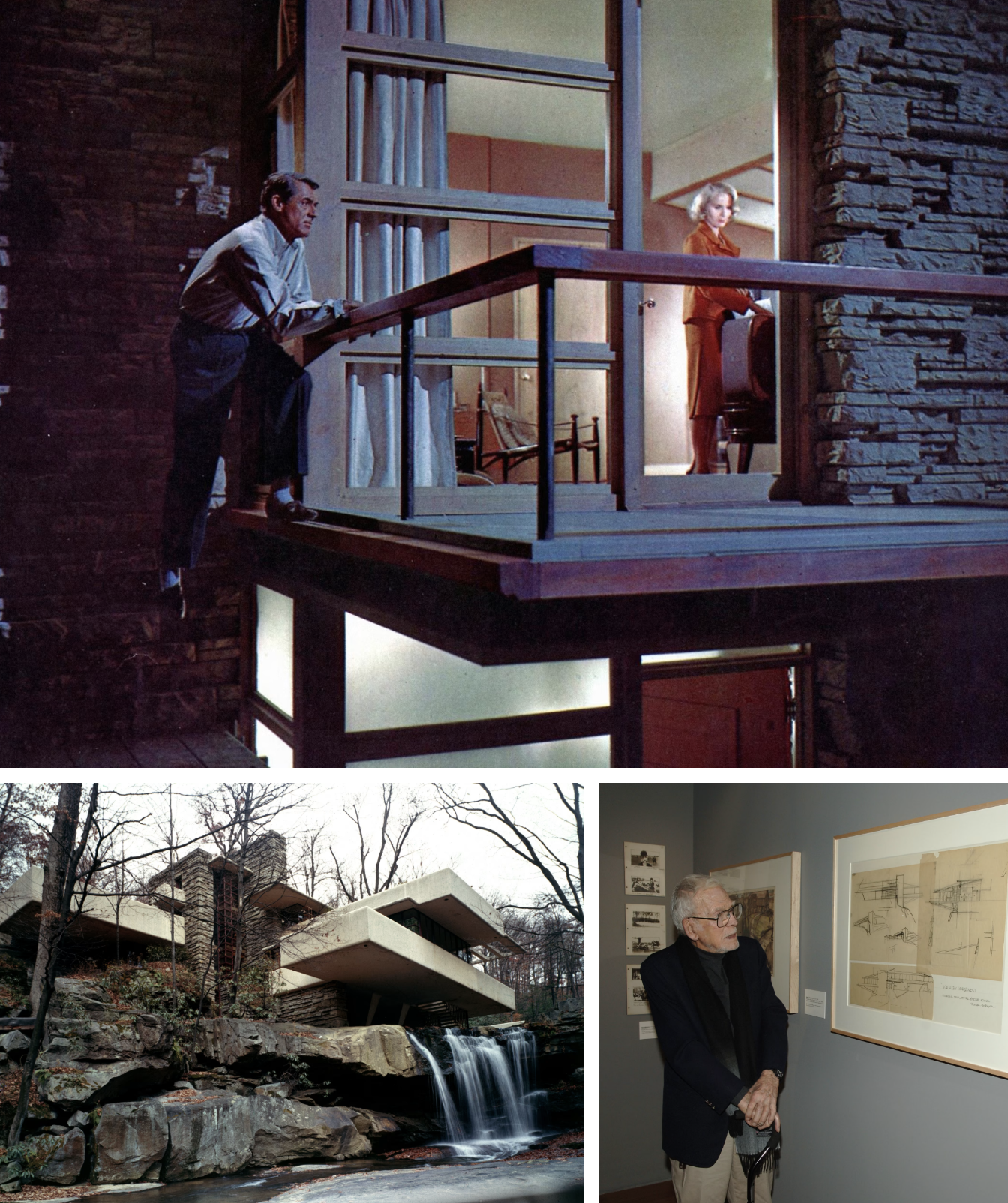
In ‘North By Northwest,’ Cary Grant scaled a stone wall to rescue Eva Marie Saint. In 2008, the film’s production designer, Robert Boyle, viewed his own drawings in an exhibition at the Academy of Motion Picture Arts and Sciences gallery in Beverly Hills. Boyle used Frank Lloyd Wright’s Fallingwater, in Bear Run, Pennsylvania, as a model. Alamy (North by Northwest); Getty Images
Boccardo went on to become a successful architect who worked in both northern and southern California.
Then, while semi-retired and living in Utah, he decided it was time to build the Vandamm House. His partner, Derek Esplin, threw himself into the project, working out details of everything from financing to furnishing. Says Esplin, a film producer, “I took it on as my life’s work.”
Boccardo, 78, Esplin, 59, and their three dogs (two schnauzers and an aussiedoodle) moved into the house in February.
The men have used it the last four months to ensure that everything is working perfectly. Now they are offering the house for sale at $45 million. The furniture and fixtures are available separately. “It can be turnkey,” Esplin says. The broker is Paul Benson of Engel & Völkers in Park City.
“I expect to get the full price,” says Benson. “It is not an outlier. We sold a house by the same architect in Park City last year for $65 million. And this is one of the most exceptional homes ever built in the state of Utah. You couldn’t recreate it for $45 million.”
Boccardo and Esplin declined to say how much it cost to build the house. But they got a bargain when they paid about $2 million for the 1.7 acre lot in 2021. (Benson says the land alone would command $7 million to $10 million today.) They chose the site, high above Park City, after searching for property that would let the house, with its dramatic cantilevers, be seen from below.
The property, which offers unobstructed views of the Wasatch Range, is in the Pinnacle , a gated community (complete with a clubhouse and a concierge) within the Promontory, a larger gated community—like a nightclub’s VVIP room entered through its VIP room.
With the site selected, they turned to Salt Lake City architect Michael Upwall, who is known for designing very large houses for the very rich. The dramatic aerie in HBO’s “Mountainhead,” with Steve Carrell, was one of his.
Laying out the house, Boccardo and Upwall, who served as co-architects, knew it would have a large living room with a wall of windows at one end and a stairway at the other. The stairway would lead, via a mezzanine, to one of the bedrooms. But that was all they could glean from the movie.
To finish the floorplans, says French, they had to answer all the questions the filmmakers never asked, such as “What’s behind that door?”and “What’s around that corner?”
And how many bedrooms, bathrooms and kitchens are there? Their answer: six, eleven and three. (Boccardo and Esplin met French when they attended a lecture she gave about Hitchcock. The two men have since hired her to write about their house.)
Boccardo and Esplin also had to answer questions the filmmakers, even the wildly imaginative Hitchcock, would never have thought to ask:
How many black leather seats, fully reclining and heated, should there be in the home theatre? (18)
How much will it cost to fire-harden the house? (Over $1 million. “You can’t make a house completely fireproof, but you can improve its chance of surviving,” Esplin says. A special pump allows the water in the extra-deep, 75-foot lap pool to be used for firefighting.)
How much should we spend on custom walnut cabinetry? (Also over $1 million.)
What if our dogs’ feet get cold? (Relax. The house’s 100-foot-long gravel dog run is heated.)
Structural engineer Cambria M. Flowers figured out how to support the living room, which cantilevers 40 feet into thin air. The answer was to build two 160-foot-long steel-reinforced concrete beams, 120 feet of which anchor the cantilever while also supporting the ceiling of the garage.
Thick diagonal beams, like those shown prominently in “North By Northwest,” were slipped in later to provide additional stability. In the end, the project required 400 tons of steel, 4,000 cubic yards of concrete and 24 miles of electrical wire, according to contractor Gary Hill.
Now the men are ready to return to the last dream house they built, against dramatic red rocks in the southern Utah town of Ivins. Boccardo hopes the buyer of the Vandamm house is a lover of “North By Northwest.”
Esplin says that he and Boccardo, who dreamt of the house for more than 60 years, occasionally wonder if they really want to sell it. But then they remind themselves that it will be okay for someone else to own it. After all, Esplin says, “Many houses are built without stories. But this house has a story. And the story of this house belongs to us.”
Copyright 2020, Dow Jones & Company, Inc. All Rights Reserved Worldwide. LEARN MORE
BNW Developments has established a Sydney presence, joining Arada and Sobha Realty among the growing number of UAE developers pursuing Australian buyers and development opportunities.
The Australian leather house has opened an immersive four-day pop-up in Manhattan, unveiling its Bloom Collection and redefining what a product launch can look like.
Related Stories
Property
Dopamine Design: A Couple Lists Their 1950s ‘Happy House’ in Palm Springs Ahead of Modernism Week
By Chava Gourarie 05/10/2026
Property
Dubai and Abu Dhabi’s Trophy-Home Developers Are Doubling Down on Waterfront Living
By Jake Emen 01/10/2026
Property
BNW joins growing wave of UAE developers targeting Australia
A vibrant 1954 Palm Springs home featuring eight colorful murals by late artist Shawn Savage is on the market for $2.295 million. The 2,237-square-foot property features bold hot-pink doors, three bedrooms, a pool, mountain views and playful interiors blending modern glamour with classic Palm Springs style.
By Chava Gourarie
Mon, Oct 5, 2026 3min
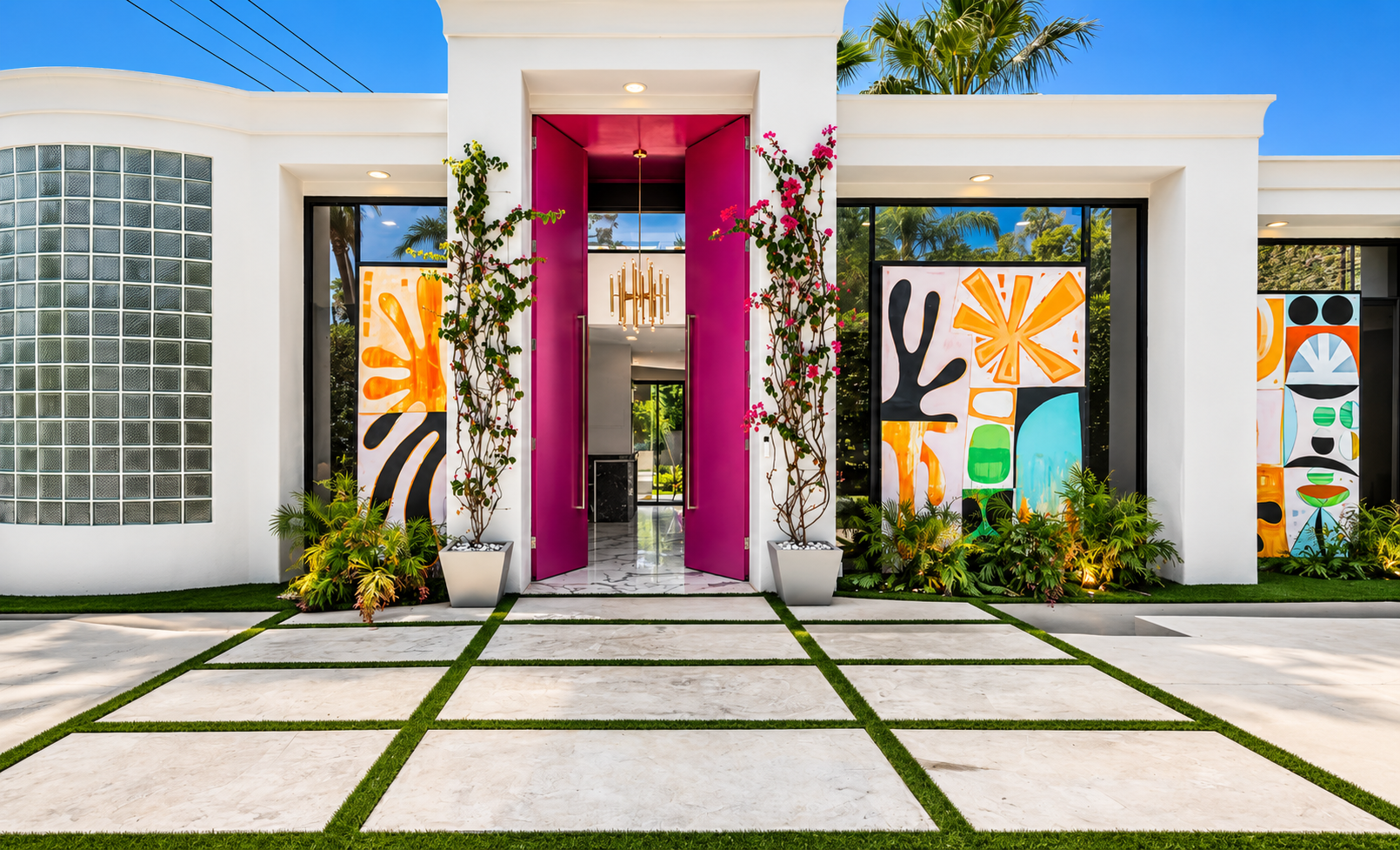
A bold 1950s home in Palm Springs, California, adorned with eight colorful murals by the late artist Shawn Savage, is coming to market ahead of the city’s annual Modernism Week.
The white stucco home on El Camino Way, built in 1954 and recently renovated, has an asking price of $2.295 million. Its staggered facade features three playfully abstract murals on either side of double-height hot pink doors.
The sellers are Los Angeles-based partners John Freeman and Mathieu Faure, who knew it was “the one” when they saw it after several months of searching in the winter of 2023. “It’s a happy house,” Freeman said. “We really liked the feel of the house: the uniqueness, the openness, the brightness—and the art.”
Located in the Mesa neighborhood of Palm Springs, which backs up to the San Jacinto Mountains, the 2,237-square-foot house features three bedrooms, an angled bonus room and a yard with a pool, desert mountain views and another colorful mural running alongside the pool.
“I never thought in my life I would have a house with pink doors,” said Faure, a producer at Apple TV who is originally from Paris. “It’s so colorful, it’s so different. And so Palm Springs.”
Abstract murals can be found on the facade.Patrick Ketchum
The layout of the home creates a smooth flow from the front doors through the open-plan common area—a foyer, bar, and living and dining room—into the kitchen around a fireplace wall and out to the yard. A corridor leads to a private bedroom wing, where the primary suite has floor-to-ceiling windows and the primary bath is only a tad smaller than the bedroom.
Faure has filled the home with Jonathan Adler furniture, rugs and accessories, riffing on the energetic California vibes of the house to create an aesthetic of “modern American glamour,” he said.
“It was enjoyable for me to play with different types of furniture and make this house ‘happy chic,’ as I describe it,” he said.
“He did a fantastic job,” said Freeman, who is an attorney and consultant. “It does kind of bring a smile to my face whenever I walk into the house.”
Since the furniture and decor were chosen for the particularities of the space, the couple is open to selling them with the home. Their West Hollywood house is already furnished; the collection doesn’t match the vibes of a Houston loft they bought near family; and Faure can’t imagine these pieces in New York—where he’s lived in the past—he said.
The duo bought the Palm Springs house for $1.925 million in 2024, according to property records, and will list the home Monday. They are represented by Stewart Smith, Patrick Jordan and Kevin Stanley of Bennion Deville Homes/Luxury Portfolio International.
The previous owners had purchased the home in 2021 for $975,000 and then spent more than two years and $700,000 on the renovation, according to Realtor.com. They commissioned Savage, a local Palm Springs artist and painter known for his joyful abstract work, to decorate the home.
Savage, who died in 2024, lived in the Coachella Valley from 2003, and his work can be found in various local institutions and is on exhibit at the Illumine Gallery in Palm Springs. “Some artists pass through a place. Shawn Savage became a part of it,” the gallery’s description states.
Unsurprisingly, the murals invite lots of friendly conversations, as well as guided tours and interested lookers, but never to a degree that it disturbed the peacefulness of their home or the neighborhood, the sellers said. “It felt like living in an art gallery, and you have the exterior that you would share with the world,” Faure explained.
The neighborhood also played a role in their decision to buy, because of its access to the hiking trails of the San Jacinto Mountains, the lack of through-roads and the neighborly environment.



 5 min
5 min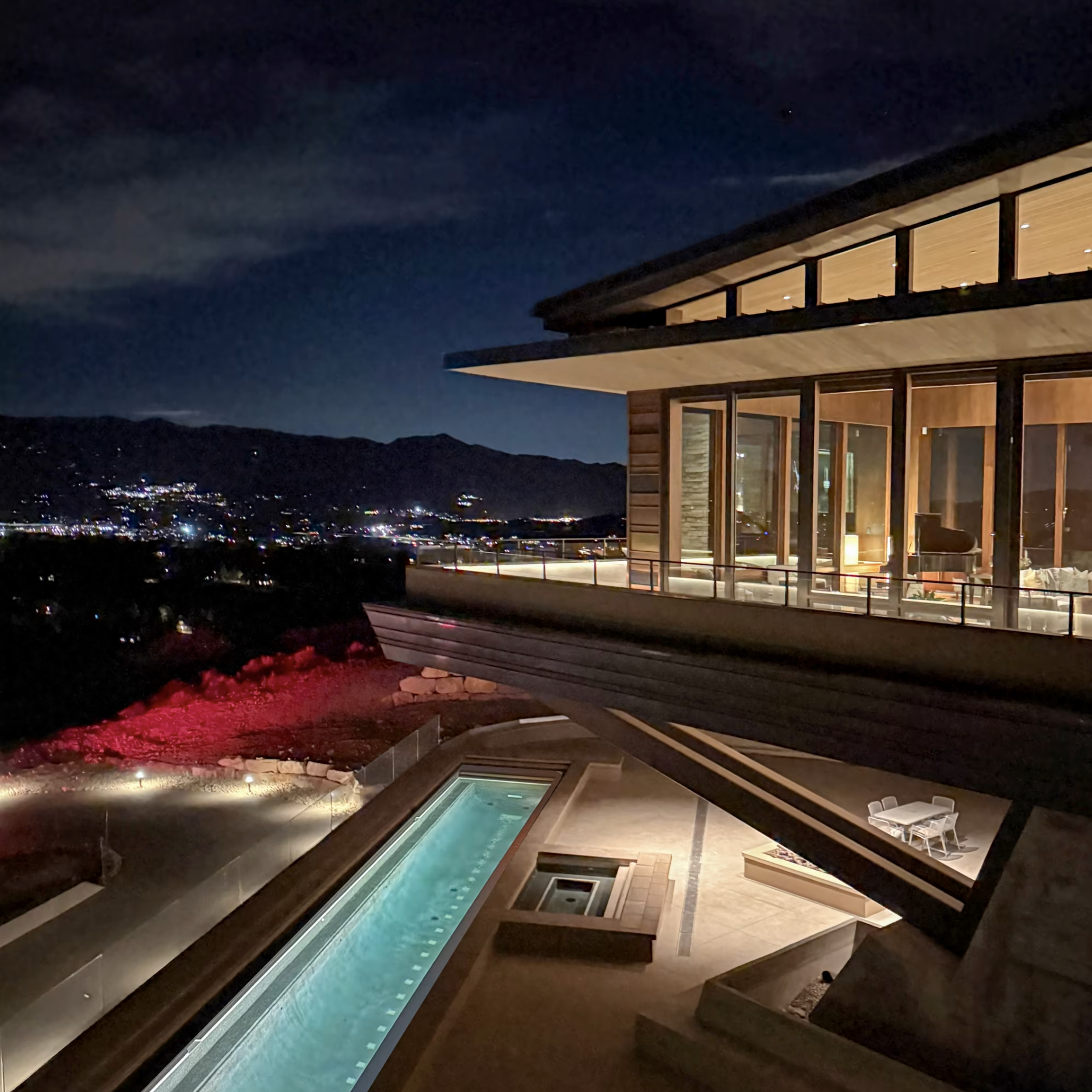
 Copyright 2020, Dow Jones & Company, Inc. All Rights Reserved Worldwide.