Helicopter Parents Are Co-Piloting Their Adult Children’s Careers - Kanebridge News
Share Button

Helicopter Parents Are Co-Piloting Their Adult Children’s Careers

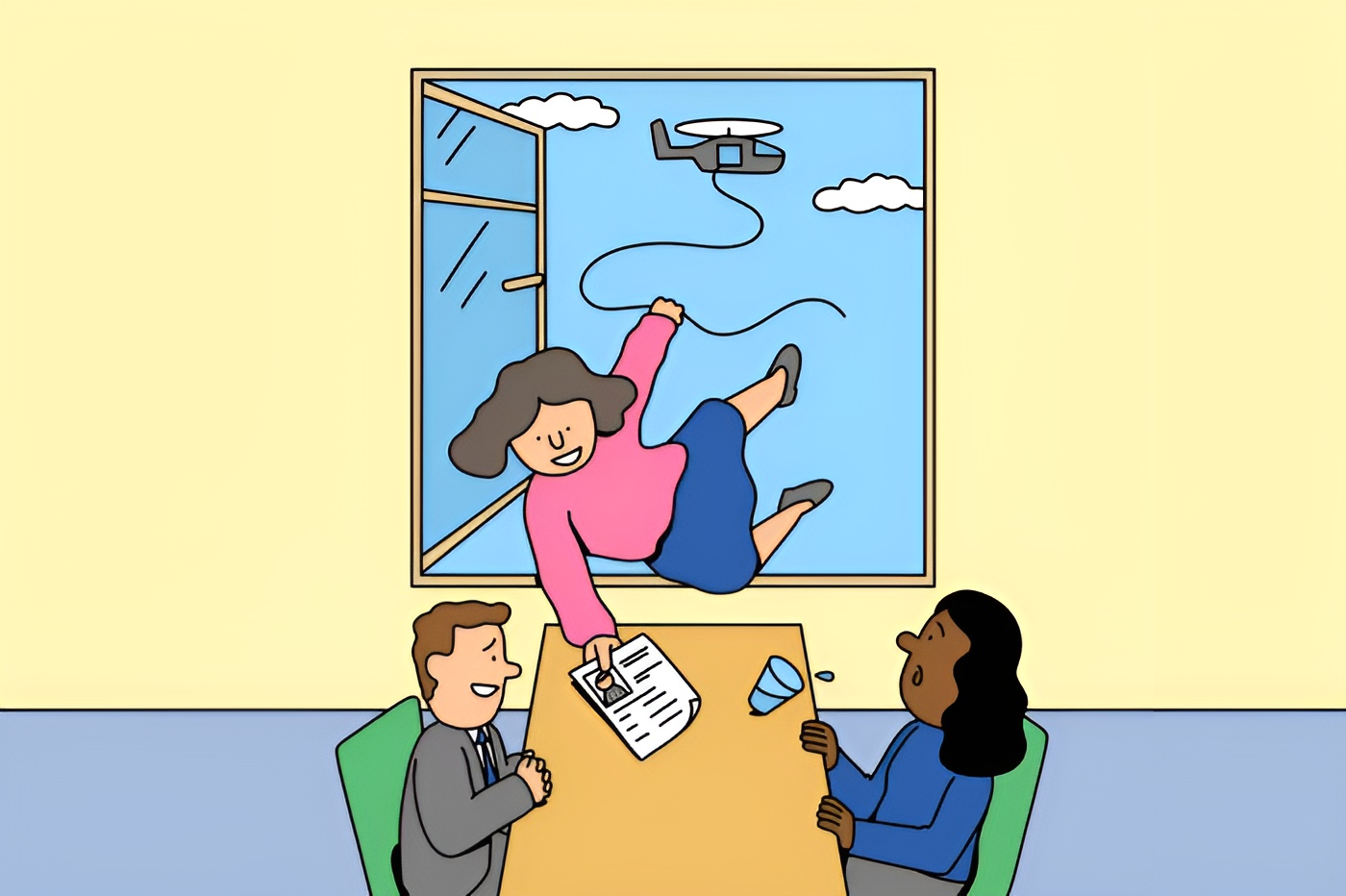
A growing number of employers say Gen Z job seekers are bringing their parents into the hiring process, from attending interviews and negotiating offers to questioning performance reviews. Recruiters warn the trend may raise concerns about independence, even as some families see it as support in a challenging job market.

By Ray A. Smith
Mon, Aug 3, 2026 5:36pmGrey Clock 4 min

Steven Clark had the unpleasant task of firing a 24-year-old—twice. Once was in a brief conversation with the new hire, who’d showed up late or not at all four times in his first week at a construction job.

Then Clark had to do it all over again, this time with the guy’s mother.

She called him a few hours later, pleading to give her son another chance. When Clark told her no, things got heated before he ended the call.

“I said, ‘Look, you know, this is between us and your son. He’s the employee,’” says Clark, who is chief operating officer of a Fairbanks, Alaska-based staffing firm.

Gen Zers make up nearly one-fifth of the adult workforce, and bosses and recruiters say it often feels like the nervous parents who hovered over them through childhood and college are right alongside them. What began as the occasional parent ride-along to a job interview coming out of the Covid era is now full-on career “co-piloting,” said Jasmine Escalera, head career coach at résumé templates service Zety.

More parents are calling up hiring managers, applying for jobs on their adult child’s behalf, and even showing up—or lurking just off-screen—on Zoom calls to help navigate difficult conversations or go over benefits packages.

“The first time it happened, I was appalled,” says Clark, who has fielded calls from parents asking why their child didn’t get a job. “Since then it’s become more of a here-we-go-again reaction.”

Human resource professionals have expressed outrage on social media.

“Parents should not be calling employers to check on their application status or ask questions on behalf of their child,” says Lynne Alba, a director of talent acquisition and physician recruitment at a large health system on Long Island, who vented about the phenomenon in a Tik Tok video she reposted on LinkedIn.

Lynne Alba
Lynne Alba Lynne Alba

At a recent job fair, a mother approached Alba with her daughter’s résumé, explaining that she wanted to work as a nurse. “While I appreciated that she was trying to help, I intentionally shifted my attention to her daughter. No matter what Mom said, I wanted to hear directly from the candidate,” says Alba.

Some parents who step in say it’s a challenging job market for young people, and that they would only intervene in extreme circumstances—social anxiety, a toxic boss, unfair treatment. There’s also a gray area of intervention that some see as an extension of the parental advice and networking help that’s been happening for generations.

Rick Wainschel last year published a post on LinkedIn asking his network to help his daughter, a recent college graduate, find a corporate entry-level position.

Wainschel, a vice president at an automotive marketing technology company, says he doesn’t think his outreach qualifies as helicoptering. “Well, maybe a little,” he said, before quickly adding he was being half tongue-in-cheek. “It was really merely just to help her get a network established. I just think the work world is a challenging place.”

Wainschel’s post, which was OK’d by his daughter on the condition he didn’t embarrass her, didn’t lead to a job but did result in productive conversations, he said. She found a job with a credit union on her own shortly after.

Recruiters and other HR types say aggressive parental involvement signals a lack of independence and raises fears that mom and dad will be checking in regularly if their kid gets hired.

What’s more, they say, such interference rarely, if ever, works.

The phenomenon is becoming so commonplace it made the agenda of human resources organization SHRM’s national conference in June. When James Harrell asked a room of 250 professionals if they ever had a parent calling on behalf of a young employee or coming to an interview, more than half raised their hands.

“The first time it happened to me, I got high up on my soapbox and I shook my fist,” Harrell says. “The 15th time I said, ‘OK, well, I gotta figure out how to do something differently.’”

Harrell helped run an apprenticeship program for high-school students while he was the human capital management chief for the San Antonio Independent School District. To run interference, the district introduced a “signing day” when parents could come and ask questions.

After a Gen Z employee at Nation’s Best Holdings, a chain of hardware and home goods stores, didn’t get an “exceeds expectations” designation on his performance review last year, HR chief Amber Little got a call asking why.

Amber Little
Amber Little Amber Little

It was one of a number of calls from parents her office has picked up recently about issues ranging from negative feedback to understanding which health insurance plan to choose. Little has even noticed parents are now calling in sick for their adult kids.

“Instead of coaching them, they do it for them,” Little says. When it happens, she adds, “we encourage them to tell their child to come talk to us and we will walk them through it.”

A Zety survey of more than 1,000 Gen Zers found 20% had a parent attend a job interview with them.

“You get a sense it’s all hands on deck for some families,” says Keith Wolf, managing partner of recruiting firm Murray Resources in Houston. His office has received emails from parents seeking jobs for their children, and Wolf says he’s always wondered if the kids even knew.

Paul “PB” Branson, who graduated from the University of Missouri-Columbia in May, bristles at the thought. The 22-year-old says while he understands their anxiety, parents shouldn’t be joining their children’s job interviews or contacting employees on their behalf.

“That trend,” he says, “has really hurt my generation by creating this kind of stereotype that we need our hands held.”


MOST POPULAR

The Australian leather house has opened an immersive four-day pop-up in Manhattan, unveiling its Bloom Collection and redefining what a product launch can look like.

Following the successful launch of its Palais Collection, MAISON de SABRÉ has unveiled a new modular handbag system offering more than 720 styling combinations.

Related Stories
Lifestyle
The Rise of Million-Dollar Companies With Just One Employee
By 30/07/2026
Lifestyle
MAISON de SABRÉ turns luxury shopping into theatre with New York’s Floral Atelier
By Jeni O'Dowd 15/07/2026
Lifestyle
A British Watch Is About to Make Lunar History
By Jeni O'Dowd 08/07/2026

Artificial intelligence is making it easier than ever to build a business without building a team. As AI takes over coding, customer support, marketing, administration, and other day-to-day tasks, a growing number of solo founders are scaling startups to millions in revenue with few—or even no—employees. While the trend is lowering barriers to entrepreneurship, it is also reshaping hiring, raising questions about the future of work and how businesses will grow in the AI era.

By
Thu, Jul 30, 2026 5 min

Ben Broca launched a company last December that offers AI tools to entrepreneurs. He’s already added 10,000 paying customers and is on track to bring in $10 million in revenue this year.

One thing he hasn’t added: any other employees.

The 40-year-old is part of a class of entrepreneurs who are launching, and then often running, new companies on their own. Artificial intelligence tools answer Broca’s emails, help write and debug code, field requests from customers, sign up new subscribers and grant refunds when issues arise.

Broca relishes his ability to make whatever decisions he wants on his own, often from his sun-drenched Sausalito, Calif., living room. “I think compromises make lukewarm results,” he said.

Once upon a time, running a business of a certain size required a team. AI is turning that assumption upside down, and more aspiring entrepreneurs are going it alone.

Ben Broca sitting in his home office.
Tech has seen an explosion of solo founders in the past year. Broca said he likes being able to work at his own speed, unencumbered by a team. Jonah Reenders for WSJ

An analysis by the payments company Stripe shows there are thousands of solo operators on the company’s platform that are generating over $1 million in revenue, with their ranks doubling between 2023 and 2025. The number of solo operators crossing the $10 million threshold nearly tripled in that same span.

In the past, people without business contacts or particular savvy might not have known how to get their ideas off the ground, said Ernie Tedeschi, Stripe’s chief economist. “Now, AI can be a built-in business partner,” he said.

AI’s ability to handle various administrative tasks makes it potentially useful for launching solo businesses in many fields. But the technology’s ability to also handle key tasks in tech, like coding, make that field a particular hot spot.

Analyzing Census Bureau data, Bank of America Institute economist Taylor Bowley found that among all industries, new business applications in the information sector have seen the biggest percentage increase—nearly 45%—over the past year. At the same time, the rate of information-sector applicants saying they plan to hire workers has experienced the sharpest decline of any measured industry.

This Census dataset doesn’t track solo-operated businesses. But the numbers broadly show—in tech and beyond—that applications are flat among businesses likely to hire workers, but generally rising elsewhere. Economists say that’s a strong sign that solo operators are on the upswing.

“The bar for getting started has never been lower,” said Julian Weisser, who runs a San Francisco-based accelerator for solo founders working in tech. The accelerator—which offers founders seed money and mentorship in exchange for an equity stake—attracted 4,500 applicants for 10 slots made available in its most recent cycle, nearly five times the number it drew when it launched last May.

Going it alone with AI can still be surprisingly expensive. Broca said he was losing money on many customers’ accounts while paying to access Anthropic’s Claude to run his clients’ requests—that AI company, as well as others, charges based on usage. He has since switched to free open-source AI models from China.

Broca said he has raised $30 million from investors and, at the same time, has saved millions in salary since he hasn’t needed a team of software engineers.

Another risk: If it’s easy for one entrepreneur to launch an AI-assisted business, copying them can be easy, too. This creates anxiety for founders like Troy Johnston, who runs an AI-assisted business alone in Orlando, Fla.

“Everybody has the sword and we all have the ability to unsheathe Excalibur now,” said Johnston, 40, who used AI to code an app that helps people get the most out of credit card benefits. The company makes around $3,000 a month in profit, with no employees, and is continuing to grow.

Headshot of Troy Johnston.
Troy Johnston said AI’s power and ease of use is an incredible boon for entrepreneurs like him—and also a double-edged sword. Luann Koerper

What one-person businesses will mean for the labor market remains to be seen. Polling has shown Americans are worried that AI will replace jobs, and top economists are wrestling with that possibility, too. But AI is also creating lots of new jobs, and the go-it-alone entrepreneurs show how the technology can both open doors and limit employment opportunities.

“If everyone’s hiring less, but you get four times more firms, what does that do to head count?” said Rembrand Koning, an associate professor at Harvard Business School who studies entrepreneurship. He co-authored a recent study that found that among 50,000 startups the researchers examined, those focused on AI tended to operate with 25% fewer employees.

Koning also believes a soft hiring environment that’s left some people mired in long job searches has encouraged more to try their hand at launching businesses.

Some founders cite different motives. “It’s a perfect storm of post-pandemic burnout and a re-evaluation of one’s priorities, and also booming AI and a sense of what’s possible,” said Samir Ahmad, 39, who lives in Breinigsville, Pa.

Two years ago, Ahmad decided to leave the corporate job he had worked at Verizon for almost two decades to start a solo coaching and consulting business. He had been seeing social-media posts touting the ease and virtues of AI, which he used to chart a business plan and help with marketing. “It was like my chief of staff, a second in command,” he said.

The business ultimately petered out within months, though, and Ahmad is now back to a full-time corporate role with a utility company.

For Claire Vo, 41, AI helped her turn a passing impulse into a business. She was working full-time as a tech executive when she tapped AI in late 2023 to help code an app that would help her manage documentation and design for new products, with customers ranging from financial services to healthcare firms.

“I was copying and pasting from ChatGPT,” said Vo, who lives in San Francisco.

Claire Vo smiling into the camera while recording a podcast.
Claire Vo used AI to code an app that’s on track to make seven figures in profit this year. Claire Vo

She put the app online for $1 a month, and within weeks people downloaded it thousands of times. Nearly three years later, Vo’s company—which she ran solo for nine months before hiring an engineer—now has 100,000 users and is on track to make seven figures in profit this year. AI handles the company’s marketing, sales and customer support.

While AI is a shortcut, Vo said her network and credibility in the industry were key. “I think people over-index on how easy AI is and under-index on how much I did to get to this point,” she said.