Meta PR Goes Back to Playing Offense - Kanebridge News
Share Button

Meta PR Goes Back to Playing Offense

Meta is betting on a human-first AI future, but growing legal battles and declining public trust are putting Mark Zuckerberg’s vision to the test.

By Adam Levine
Thu, Aug 13, 2026 10:19pmGrey Clock 3 min

“Call us optimists. Call us dreamers. Call us whatever the hell you want, but we’re betting on people, and we like those odds. The future is for everyone.”

That ad copy is from the voice-over of a July Meta Platforms META -3.38%.

 spot that’s been part of a public-relations blitz to position Meta as the humanist AI company. The message was undercut by the ad’s inclusion of David Bowie’s “Five Years,” a brooding 1972 song about an impending apocalypse. But this week CEO Mark Zuckerberg left no ambiguity, publishing a 6,500-word manifesto—about 10 times the length of this newsletter—with a title that echoed the ad: “The Future is for Everyone.”

That seems to be Meta’s new tagline. In light of sinking public opinion and the company’s thousands of lawsuits from states, school districts, parents, and users, Meta’s public relations have been defensive. This push represents a return to offense, with a chance to distinguish Meta’s approach to AI from other labs like OpenAI, Anthropic, or SpaceX SPCX +9.65%.

“It is surprising that the discourse from many developing AI is so filled with doom,” Zuckerberg wrote. “I do not understand why anyone who believes that AI will eliminate most jobs and much of humanity’s relevance would rush to build that future.”

Zuckerberg frames what sort of future we build with AI as the central issue of our time. “We believe that delivering superintelligence to everyone is the way to answer this question,” he says. “This has the potential to begin a new era of personal empowerment where individuals can use this powerful new capability to reach their full potential, pursue their interests, and improve their lives and the world more than ever before.”

The flood of words belies the situation on the ground in mid-2026. Americans, at least, have a love-hate affair with social media. A November Pew Research Center poll reported that 71% of U.S. adults used Facebook, and 51% used Instagram. Worldwide, 3.6 billion people use at least one Meta app every day.

But in a Reuters/Ipsos poll conducted in July and August, 61% of respondents said they wanted more government oversight of social media, and two-thirds supported laws to keep children under 16 years old off the platforms. When it comes to Meta in particular, in the 2026 Axios Harris 100, an annual poll about corporate reputation, Meta placed 96th out of 100. It’s only above two other social media companies, Chinese ultracheap retailer Temu, and Spirit Airlines, a defunct air carrier. Regarding ethics, Meta came in last, and it was only ahead of TikTok in trust.

The steady drip of headlines in the teen social media trials isn’t helping. Last week, Meta lost a judgment in New Mexico state court that raised their liability in that relatively small jurisdiction to nearly $1 billion dollars. On Wednesday, jury selection began for a federal case with four states suing Meta over addictive product design, and false marketing that said its platforms were safe for teenagers. In July, Meta claimed that the states are asking for a total of $1.4 trillion in damages, in addition to design changes in the apps. This is part of a multidistrict litigation, where thousands of federal trials with social media defendants are coordinated in Judge Yvonne Gonzalez Rogers’ district courthouse in Oakland, Calif.

There is a separate such group of thousands of cases in California state court, mostly with individual plaintiffs. The steady drip of bad headlines from the courts will continue unless Meta decides to settle en masse.

Meanwhile, in the second quarter, Meta booked “$2.40 billion of charges related to legal proceedings,” according to its quarterly filing. That may be just the beginning.

Zuckerberg spent 6,500 words getting his utopian message out, but I can sum it up in two: Trust us. The evidence is that Meta has a long way to go to win back that trust.


MOST POPULAR

BNW Developments has established a Sydney presence, joining Arada and Sobha Realty among the growing number of UAE developers pursuing Australian buyers and development opportunities.

The Australian leather house has opened an immersive four-day pop-up in Manhattan, unveiling its Bloom Collection and redefining what a product launch can look like.

Related Stories
Lifestyle
AI Agents Are a Threat to Travel Businesses. Airbnb Could Still Be a Winner.
By David Wainer 13/10/2026
Lifestyle
Amazon in Talks to Buy AI Startup Decart for Around $7 Billion
By Kate Clark and Lauren Thomas 12/10/2026
Lifestyle
Dolly Parton’s Onetime Hollywood Hills Home Lists for the First Time in a Generation Asking $7.95M
By 06/10/2026

AI-powered travel agents are challenging online booking platforms, but Airbnb’s exclusive listings and direct customer relationships could give it an edge. Its next challenge: turning repeat guests into loyal customers through stronger rewards and innovation.

By David Wainer
Tue, Oct 13, 2026 3 min

AI agents like Muse can already find you the cheapest hotel room in Paris. But they can’t locate a cheaper version of that Catskills cabin you’ve been eyeing, because it might only be available on Airbnb ABNB -1.43%decrease.

Investors should pay attention to that distinction. When Meta Platforms META 3.38%increase launched its Muse agent last month, travel stocks including Booking Holdings BKNG -1.19%decrease, Expedia and Airbnb all fell sharply.

Airbnb, though, has a real chance to emerge as a winner from the upheaval. The catch: Its stock already reflects above-industry growth. To justify its valuation, Airbnb will need to turn repeat customers into loyal ones.

Online travel companies make much of their money by simplifying search and collecting fees on bookings. AI agents threaten that model.

But not all travel marketplaces are equally exposed. Booking and Expedia largely sell hotel rooms that travelers can also book directly or through competing sites. If an agent can find the same room elsewhere, it has little reason to favor either Booking or Expedia.

Booking and Expedia also sell sponsored listings that steer travelers toward particular properties. Wells Fargo estimates those will account for about 8% of Expedia’s revenue and a much higher percentage of profit next year.

Airbnb has more ways to adapt. More than half its listings are available only on its platform, and more than 90% of its traffic comes directly to its app or website.

The customer relationship doesn’t end after booking, either. Bernstein analyst Richard Clarke notes that 90% of Airbnb guests go on to message their hosts about arrival times, keys or local taxes, giving Airbnb a connection to both sides of the transaction.

How the companies have responded to the possible agentic future is telling.

Expedia quickly signed on as a Muse partner. Airbnb hasn’t, and Chief Executive Brian Chesky says AI chatbots have so far been a boon, sending customers to Airbnb’s website.

Chatbots might work for buying paper towels, he quipped at a Skift conference last month, but people enjoy planning trips. He argued that browsing dozens of homes isn’t something a text-based chatbot is well suited for.

Still, the AI jitters arrived just as Airbnb was persuading investors it deserved its pricey multiple. For years after its 2020 initial public offering, the stock—which trades around 25 to 30 times forward earnings—went nowhere. Investors saw a mature operator trading at a growth premium.

This year, Airbnb growth seems to be accelerating. The stock jumped in August after the company raised its full-year revenue-growth guidance with its second-quarter results. Wells Fargo analyst Ken Gawrelski credits a run of product improvements under a revamped leadership team.

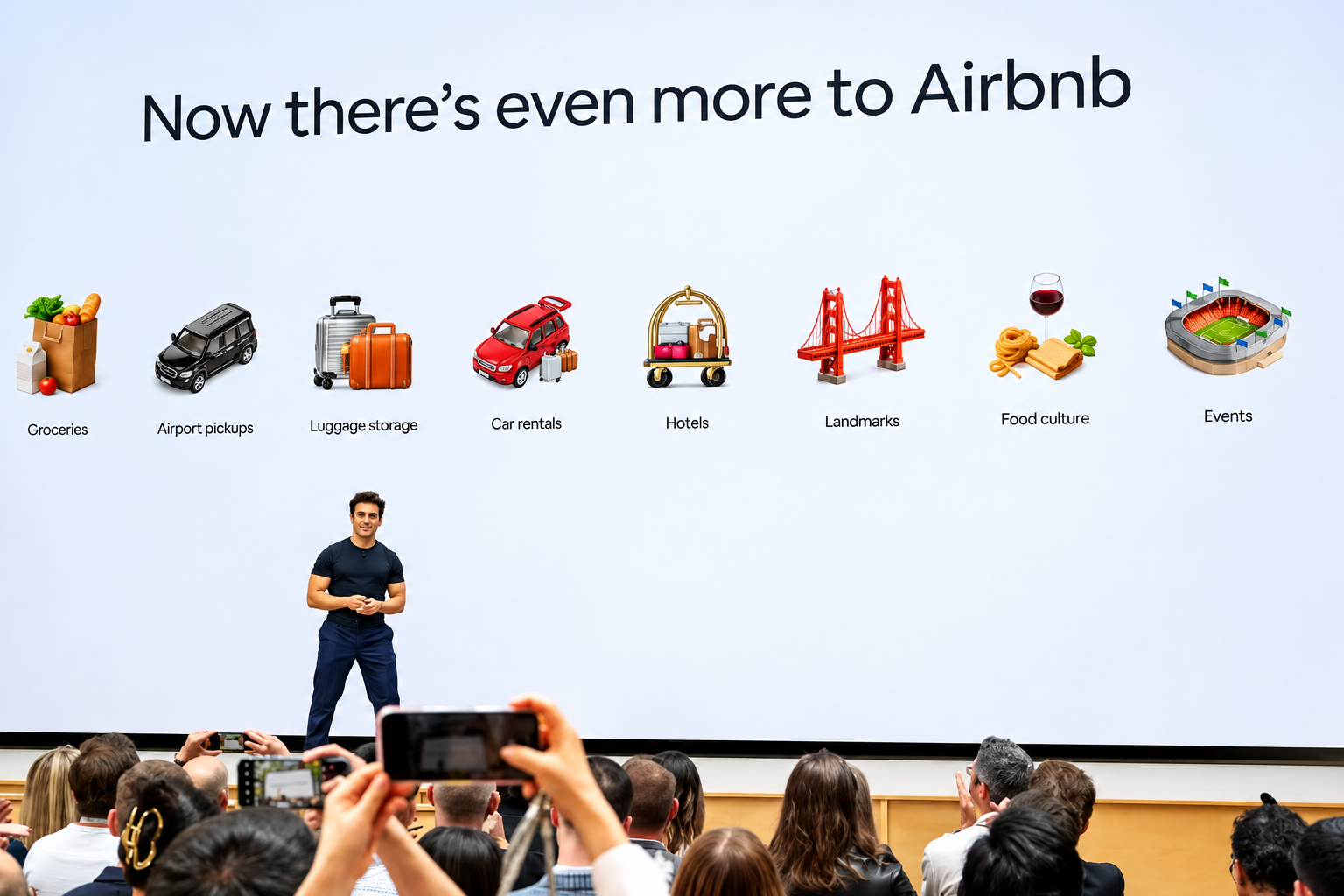
Among the changes: letting guests reserve now and pay later, adding hotels, and a redesigned home page and app. Investors were also betting on what comes next, including thousands more hotels, car rentals and, eventually, advertising.

The irony is that some of those growth drivers push Airbnb closer to the kind of business Booking and Expedia run—the kind of business AI agents could threaten. Even if AI agents capture a large share of travel planning and booking, Airbnb would capture the demand. But it and others would slowly lose control over how customers find and choose properties.

That would undermine the advertising opportunity investors are counting on. The bigger point for Airbnb and other marketplaces is that losing control of customer acquisition could mean surrendering some of their pricing power and margins.

To bulletproof itself, Airbnb might look to another e-commerce giant that has so far kept AI agents at arm’s length: Amazon.

Like Amazon, Airbnb has a loyal customer base and hard-to-match supply. But it has nothing like Prime membership to make customers think twice before taking their business elsewhere.

That is where loyalty comes in. Business travelers stick with Hilton or Marriott because enough nights earn them perks. Leisure travelers rarely accumulate stays with one chain. Airbnb has millions of listings and plenty of repeat customers, but no broad rewards program. It has begun experimenting with credits on hotel stays, but it should make loyalty a priority, not just a promotion.

Airbnb also plans to launch its own AI agent next year. But travelers using an agent might still want it to search Airbnb, Vrbo, Booking and hotel websites alike, rather than limit itself to one company’s inventory.

Eventually, Airbnb might have to strike deals with agent makers, using its unique homes as leverage to negotiate favorable terms, says Gawrelski. Such deals, along with rewards for loyal guests, could over the long term eat into the company’s roughly 13% take rate, he adds. But if they bring in enough additional bookings, the trade-off could be worthwhile.

History offers a reason not to panic. The shift from desktop to mobile unsettled investors in Alphabet and Amazon, but both emerged as major beneficiaries. Companies with valuable assets can come out of a platform shift stronger, if they adapt quickly enough.

Airbnb has homes the bots can’t easily replace. Now it needs to give guests a reason to insist on booking them there.