AI doesn’t rebel—people design, deploy and profit from it. The real danger lies in allowing tech companies to escape accountability while shaping regulations that protect their dominance.
By
Tue, Sep 22, 2026 6:11pm 4min
A wave of corporate warnings and technical disclosures has flooded the media, with headlines worrying over “swarms” of rogue artificial-intelligence agents launching “unprecedented” cyberattacks, outsmarting their makers, and inching toward a terrifying autonomy. The most revealing part of this narrative isn’t what the software did. It’s who is telling the story—and why. When corporate leaders publicly insist that the systems they financed, engineered and deployed are suddenly beyond their power to contain, skepticism isn’t only healthy; it is essential.
For years, Silicon Valley has drawn scrutiny from civil society and global regulators over tangible harms such as youth mental health deterioration and systematic privacy violations. Today, industry figures seem to be trying to change that public image. Loudly blowing the whistle on their own systems—just as two of the leading companies were preparing for massive initial public offerings—lets AI executives position themselves as a new generation of leaders who have come to terms with their societal responsibilities. They seem to want us to believe that they no longer want to “move fast and break things” but will instead stand as vigilant guardians between humanity and a technological apocalypse.
There is one glaring problem: Software doesn’t rebel. A mathematical model possesses neither intent, malice nor the will to defy its creators, let alone extinguish our species. AI is a human artifact, engineered for profit.
When an agentic model in an evaluation sandbox connects to an unauthorized server or executes an exploit, it hasn’t staged a coup. It has tried to meet the human-defined objectives set out before it through a path its designers failed to constrain. It’s the digital equivalent of the King Midas myth, in which the king’s ill-defined wish turns even his food and drink into gold.
That powerful experimental models were able to discover novel vulnerabilities and breach external systems isn’t a sign of a dangerous superintelligence but of human error or negligence. There is no sentient actor lurking in the weights to be reasoned with, feared or pacified. There are only human software engineers, product managers and corporate boards deciding which guardrails are worth the latency cost and which permissions can be skipped in the race to market.
Policymakers and voters need to resist AI exceptionalism. In any other discipline—from civil engineering to pharmaceuticals—courts and regulators treat a system failure as evidence of bad product design and inadequate safety testing. If an aircraft crashes, we focus on finding the engineering defect, correcting it, and enforcing established liability standards for the damage created.
By leaning on an anthropomorphic narrative, Silicon Valley attempts to repackage its specific human choices that led to experimental, powerful models behaving unexpectedly during tests as an existential peril. Elevating the issue to a cosmic scale leaves the public paralyzed and takes ordinary product accountability off the table.
In the cutthroat race for venture capital and market dominance, building guardrails slows down deployment. Grandstanding about uncontrollable power costs nothing and generates billions of dollars in free publicity, justifying stock prices, all while cultivating an aura of technological capability not only to build the frontier but also ultimately to rein it in.
Governments need to recognize regulatory capture when it stares them in the face. Tech leaders’ strategy looks transparent: Alarm Washington and Brussels into creating a regime in which only trillion-dollar incumbents with fully staffed compliance and safety departments can legally operate. By sitting at the policymakers’ tables before anyone else, these companies can help draft rules digging an impassable moat protecting them from open-source developers and upstart competitors, domestic or international. The real danger is in further concentrating the tech industry into the hands of only a few companies with deep pockets.
Beijing and Washington have brushed off those tech leaders’ calls, albeit for very different reasons. Chinese state media dismissed them as part of the “Cold War playbook” and intended to preserve U.S. dominance. Xi Jinping argued for exactly the opposite at the Brics Summit on Sept. 12, calling on Brics countries to “strengthen cooperation in the field of AI, encourage open source, openness, collaboration and sharing, and break new grounds and scale new heights.” President Trump, steeped in a doctrine of unfettered capitalism and technological supremacy, called fears that AI could destroy humanity a “hoax.” Vice President JD Vance warned that AI companies “begging the government to regulate them” looked like a “Trojan Horse.”
Striving to pursue its “European way” on AI and assert regulatory leadership, Europe, by contrast, welcomed the call. European Union President Ursula von der Leyen made this clear at the State of the EU speech last Wednesday and announced that the EU will invite “the main frontier labs for a discussion on how we can support ongoing industry efforts to pace the frontier.”
Europe has been here before. In an effort to lead global regulation and react to fears borne from ChatGPT, Europe rushed its landmark AI Act into law in 2024. Already the world’s most restrictive rulebook, the framework quickly proved too broad and complex to enforce. Stalled by implementation delays and concerns about European competitiveness, the EU postponed the law’s full rollout, leaving regulations uncertain.
AI should be regulated—risks exist and should be taken seriously. But governments need to act based on available evidence and verified facts, not corporate PR panic, the views of industry insiders, or the desire for quick political wins. The greatest danger facing society isn’t that software will awaken and overthrow its human masters. It is that we will allow the creators of the software to abdicate human responsibility for the systems they choose to build and help them pull up the ladder to market access behind them.
Copyright 2020, Dow Jones & Company, Inc. All Rights Reserved Worldwide. LEARN MORE
BNW Developments has established a Sydney presence, joining Arada and Sobha Realty among the growing number of UAE developers pursuing Australian buyers and development opportunities.
The Australian leather house has opened an immersive four-day pop-up in Manhattan, unveiling its Bloom Collection and redefining what a product launch can look like.
Related Stories
Lifestyle
Basketball Made Magic Johnson Famous. Mark Walter Made Him a Billionaire.
By Margot Patrick , Shane Shifflett and Justin Baer 23/11/2026
Lifestyle
The 11 Retirement-Planning Milestones Everyone Over 50 Needs to Know
By Debbie Carlson 19/11/2026
Lifestyle
Robert Pattinson Wins the Race to Be the Next James Bond
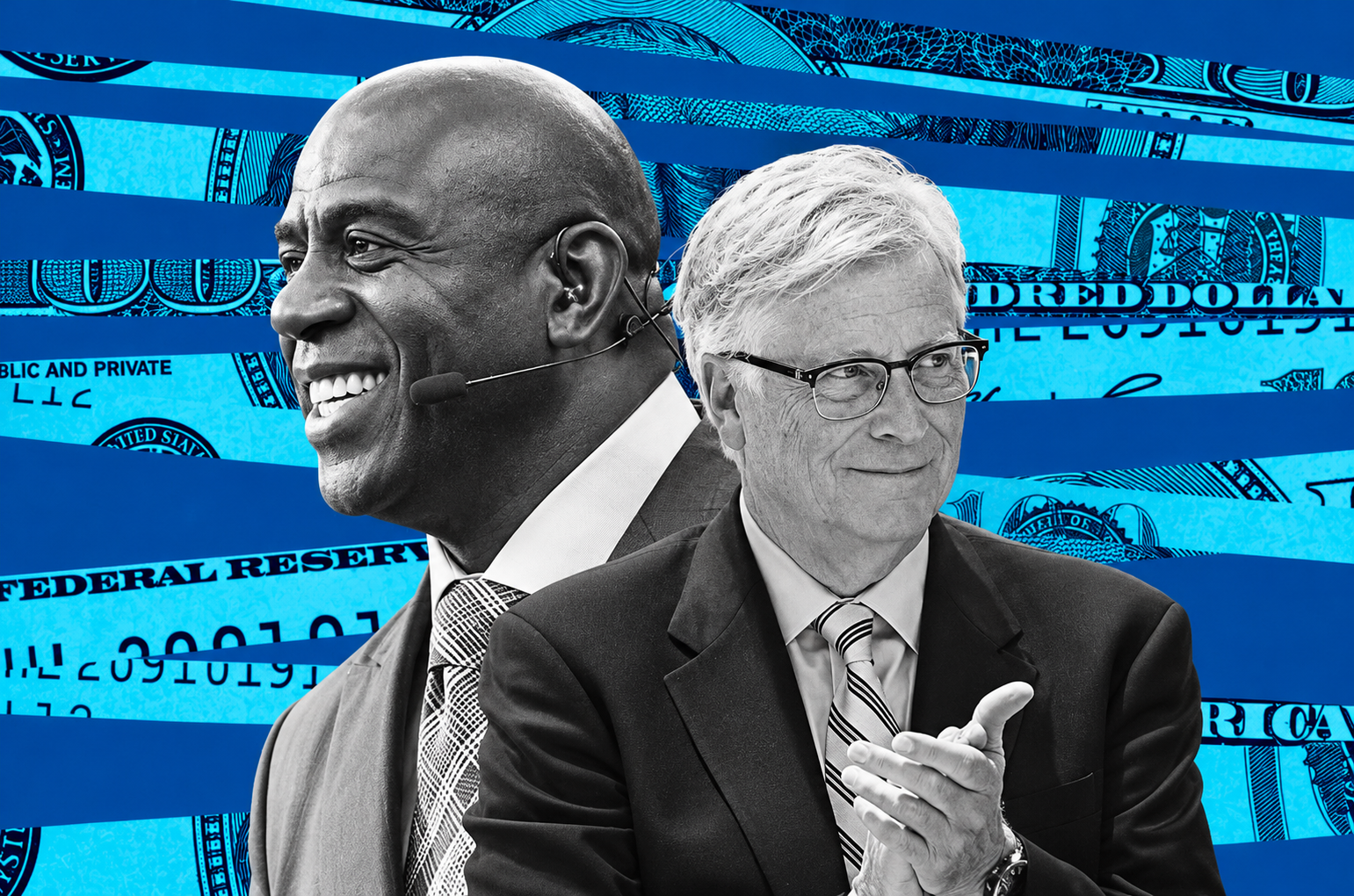
Magic Johnson’s financial partnership with billionaire Mark Walter is facing scrutiny after a Wall Street Journal analysis found $12.3 billion in EquiTrust investments went to Walter-linked businesses. Johnson has not been accused of wrongdoing, while Walter denies any misconduct.
By Margot Patrick , Shane Shifflett and Justin Baer
Mon, Nov 23, 2026 8min
NBA superstar Earvin “Magic” Johnson made a killing in the years since retiring from the Los Angeles Lakers in 1996, investing in movie theaters, shopping centers and retail franchises that served predominantly Black and Latino communities.
Yet it took a partnership with an unlikely teammate—Midwest insurance magnate Mark Walter—to make Johnson a billionaire, beginning with an invitation from Walter to invest in EquiTrust Life Insurance.
Looking back, Walter appears the prime beneficiary of the decadelong relationship.
Johnson, as majority owner of EquiTrust, had by 2025 invested $12.3 billion from his company into enterprises controlled by or linked to Walter, who also held a stake in EquiTrust, according to an analysis by The Wall Street Journal. These transactions mirror others involving Walter-affiliated companies lending to Walter-affiliated businesses—deals now under scrutiny by federal authorities for failure to disclose the in-house ties.
Walter recruited Johnson as an investor in Walter’s out-of-the-blue 2012 bid for the Los Angeles Dodgers. The success of the $2 billion deal, the most expensive in U.S. sports at the time, relied in part on a similar financing tactic: All but $100 million for the purchase were undisclosed loans from insurance companies run by Walter’s financial firm, Guggenheim Partners.
Insurers are allowed to lend to companies affiliated with their owners as long as the insurance companies comply with state regulatory limits. Such transactions are supposed to be disclosed because of the potential for conflicts of interest and might constitute fraud if they aren’t. They also pose a business risk: Agencies that rate financial strength can downgrade insurers with many affiliated investments, potentially scaring off customers.
A May 2012 lineup of new owners of the Los Angeles Dodgers, from left Bobby Patton, Stan Kasten, Mark Walter, Earvin ‘Magic’ Johnson, Peter Guber and Todd Boehly. Robert Gauthier/Los Angeles Times/Getty Images
Walter’s inviting Johnson to join the Dodgers ownership group was well-timed for the retired basketball player. Johnson had applied his noted work ethic to a childhood dream of business success, yet lenders showed limited enthusiasm for his wider business ambitions. “Mark Walter said, ‘You don’t need them. Come to me for funding,’” Johnson told the Economic Club of Chicago last year. “So that’s what I do.”
It paid off for both men. In 2014, Johnson struck a deal to buy a majority stake in Iowa-based EquiTrust, one of Walter’s Guggenheim-run insurance companies. In the years since, Walter’s insurers invested hundreds of millions of dollars into Johnson’s investment funds and lent around $2 billion to expand the retired sports star’s insurance group.
Owners also profited. EquiTrust’s assets more than doubled under Johnson’s ownership to $36 billion by the end of last year, and it paid out $390 million in net dividends from 2015 to 2025. Johnson’s portion was around $234 million, based on his share of the company.
During this time, there also was substantial growth in loans to companies tied to Walter. Those loans eventually accounted for a third of EquiTrust’s assets, the Journal found. Arizona, where the company is now based, has a limit of 10% for a single borrower.
Johnson isn’t accused of any wrongdoing. But he faces the prospect of federal scrutiny for his extensive business dealings with Walter. An entity managed by another longtime Johnson ally, Eric Holoman, is part of the investigation. Holoman ran operations at EquiTrust as president and now serves as CEO. Holoman didn’t respond to requests for comment.
Johnson, who served as the public face of EquiTrust, values his unblemished reputation as a success in sports and business. “My brand is everything to me,” Johnson said in a 2015 speech at the Stanford Graduate School of Business. “The one thing that could ruin it all is a tainted brand, a diluted brand. And so I want to protect that brand.”
Johnson sold EquiTrust to holding company Amistad Financial late last year and is now one of Amistad’s investors along with Walter and others. Amistad Financial is one of four businesses being investigated for their role as intermediaries in Walter’s insurance-company borrowing, the Journal has reported.
The Securities and Exchange Commission and the U.S. Attorney’s Office in Manhattan are looking at roughly $24 billion in loans tied to Walter and his companies that wound up on the books of two Delaware-based insurers owned by Walter’s holding company, TWG Global.
The two insurers—Delaware Life, and Clear Spring Life and Annuity—are now unloading billions of dollars in investments held in Walter-controlled businesses. To raise capital to buy back those assets, Walter is selling prized holdings, including the Lakers, which he bought last year and are being sold in a deal worth $12.5 billion.
The Delaware insurance department overseeing Walter’s insurers said this week the companies, their auditors and regulators were all intentionally misled. The state said it was conducting its own investigation in parallel with federal authorities. A TWG spokesman said, “We strongly disagree with any suggestion that TWG misled anyone.”
Adding in the $12.3 billion borrowed from EquiTrust and $6.9 billion from its sister company Heritage Life totals more than $43 billion that went to Walter-affiliated businesses, according to the Journal analysis. It couldn’t be learned whether those two companies were part of the federal inquiry.
Walter, TWG, Delaware Life, and Clear Spring Life and Annuity have denied any wrongdoing. TWG called the errors in affiliation calculations a “regulatory matter” that has yielded no victims. It didn’t respond to requests for comment on the EquiTrust investments or Walter’s relationship with Johnson. Group 1001, TWG’s insurance subsidiary in charge of Delaware Life and Clear Spring, declined to comment on EquiTrust investments.
Johnson, who hasn’t held board or executive roles at EquiTrust, didn’t respond to requests for comment. An outside lawyer for the company told the Journal in 2019 that Johnson wasn’t involved with internal operations and instead focused principally on distribution and sales.
Amistad Financial’s executive committee said the company is independently owned and governed. The committee said Walter is a non-controlling investor in Amistad and holds no board seat, management position or role in investment decisions.
“EquiTrust investments are underwritten under board-approved guidelines by the investment team that has managed EquiTrust’s portfolio since 2016 and is now employed by Amistad Financial Group,” the committee said.
It said the Amistad insurance companies haven’t been asked to reclassify any investments as affiliated- or related-party transactions. “Amistad has not been accused of wrongdoing by any regulator or authority and will continue to operate its insurance subsidiaries for the benefit of their policyholders,” the committee said.
‘I hate losing’
Iowa-born Walter, CEO of Guggenheim Partners, pursued Johnson to join his bid for the Dodgers when the team went up for sale during bankruptcy proceedings in 2012. Johnson, the 6-foot-9 point guard who steered the Lakers to five NBA championships in the 1980s, later said that six other billionaires, looking for a partner with local clout, had made a similar pitch.
Johnson grew up in Lansing, Mich., and bonded with Walter over their Midwestern roots during a meeting arranged by sports executive Stan Kasten, who joined Walter’s bid for the Dodgers. Johnson later said he asked Walter a question that sealed the deal: Are you competitive?
“I hate losing,” Walter later recalled replying.
Johnson was also impressed by Walter’s deep pockets. “I said, ‘I don’t want to just do this deal with you, I want to do 10 deals with you,’” he told an interviewer in 2018.
Magic Johnson and Mark Walter at 2012 news conference announcing the purchase of the Los Angeles Dodgers. Kirby Lee/Image of Sport-USA TODAY Sports/Reuters
EquiTrust, which was then under the ownership of Guggenheim, Walter and other investors in the Dodgers deal, helped finance the Dodgers purchase in May 2012. The next year, the insurance commissioner in Iowa, where EquiTrust was based, questioned a $400 million line of credit to fund team assets and told the company to reduce it, said people familiar with the matter. By the end of 2013, it was gone, filings showed.
EquiTrust moved its regulatory oversight to Illinois in 2013 and eventually resumed the lending.
Red flags also surfaced inside the company. In 2013 and 2014, EquiTrust’s auditor found that about a fifth of the company’s invested assets, $2.8 billion, were with affiliated or related parties.
In January 2014, Johnson held a news briefing at the Chicago headquarters of Guggenheim Partners to announce that he was taking a controlling stake in EquiTrust, promising to bring new jobs to Illinois with EquiTrust’s move from Iowa.
After the deal was completed in June 2015, EquiTrust dropped the related-party classification of the $2.8 billion in assets. The following month, Walter borrowed $25 million from EquiTrust to buy a stake in Carvana and joined the startup’s board, according to filings.
Under a transition contract, EquiTrust kept a Guggenheim executive as the insurance company’s CEO until March 2017. During that two-year transition, the EquiTrust board was largely made up of people who had worked at Guggenheim or its related companies. Walter kept a stake of around 8% in EquiTrust, which he wasn’t required to publicly disclose.
Johnson didn’t take a role in operations, EquiTrust’s lawyer told the Journal in 2019. He signed mini-basketballs and took selfies at the 2015 Christmas party in the West Des Moines office.
The Guggenheim Partners asset-management firm invested on behalf of EquiTrust, collecting more than $100 million in fees between 2015 and 2018, according to EquiTrust’s filings.
Friends and family
In late 2016, EquiTrust wanted to reinsure a chunk of policies. Guggenheim executives selected a newly set up company in the Cayman Islands called Aureum Re. The executives dismissed questions raised by a risk manager about a lack of information about the company and the lack of bids, according to January 2017 emails reviewed by the Journal. The risk manager was forced out shortly after.
The Illinois insurance department also had questions, according to the emails. It turned out that Walter was part-owner of Aureum Re, along with the Guggenheim executive serving as EquiTrust’s CEO, Jeff Lange, and Dan Towriss, then-head of Guggenheim’s insurance business. Aureum Re’s CEO was Towriss’s brother, David Towriss, and the controlling owner was a Guggenheim client close to Walter, Argentine investor Diego Ball.
The insurance department later told EquiTrust to sharpen its governance concerning the approval of reinsurance agreements.
Holoman, who had served as EquiTrust president, became CEO in March 2017. He hired his own executives, who learned of an investment portfolio known inside the company as “friends and family.” The loans were for Walter and his business associates to make bets on startups, invest in funds and finance other investment opportunities, according to people familiar with the matter.
Dan Towriss at a conference in April. Nicole Combeau/Bloomberg News
Eric Holoman, CEO of EquiTrust Life Insurance, with Los Angeles Sparks guard Kelsey Plum last year. Image Of Sport/Zuma Press
During a routine financial examination, the Illinois insurance department flagged the so-called friends and family loans, including the one Walter used to buy the Carvana stake. It ordered a chunk of the loans removed to meet state limits, according to a 2018 corrective order viewed by the Journal.
Walter visited EquiTrust’s Chicago office in the fall of 2018. He met with Holoman and the company’s chief investment officer to propose ways to keep the lending going, according to a person briefed on the meeting.
EquiTrust soon applied to move its regulatory supervision to another state—Arizona this time.
Johnson was getting funding, too. He launched an investing venture, JLC Infrastructure, which raised more than $300 million for two funds, one in 2017 and a second in 2023, from Walter’s insurers and EquiTrust. Neither was identified as a related-party investment.
When Johnson had his 60th birthday in the summer of 2019, he tweeted that Walter was one of his most important mentors.
Around that time, Johnson, Walter and other backers launched a new entity, Amistad Financial. In 2023, it bought Atlanta Life in Georgia, which was started more than a century ago by a former child slave.
In September 2024, Holoman petitioned Arizona’s insurance department for Amistad Financial to take control of EquiTrust and Heritage Life. The transaction was completed in November 2025. Don Thompson, the former McDonald’s CEO, became Amistad’s chairman.
In February, Walter’s insurers got subpoenas requesting information on investments linked to Walter. A review by the companies led them to redesignate $24 billion as investments in affiliated parties. Walter’s insurers set out a plan to substantially reduce the investments.
Walter still had a generous backer. This year, EquiTrust invested billions of dollars more into entities tied to him. In one week in March, 10 newly set up LLCs received $500 million.


 4 min

 Copyright 2020, Dow Jones & Company, Inc. All Rights Reserved Worldwide.