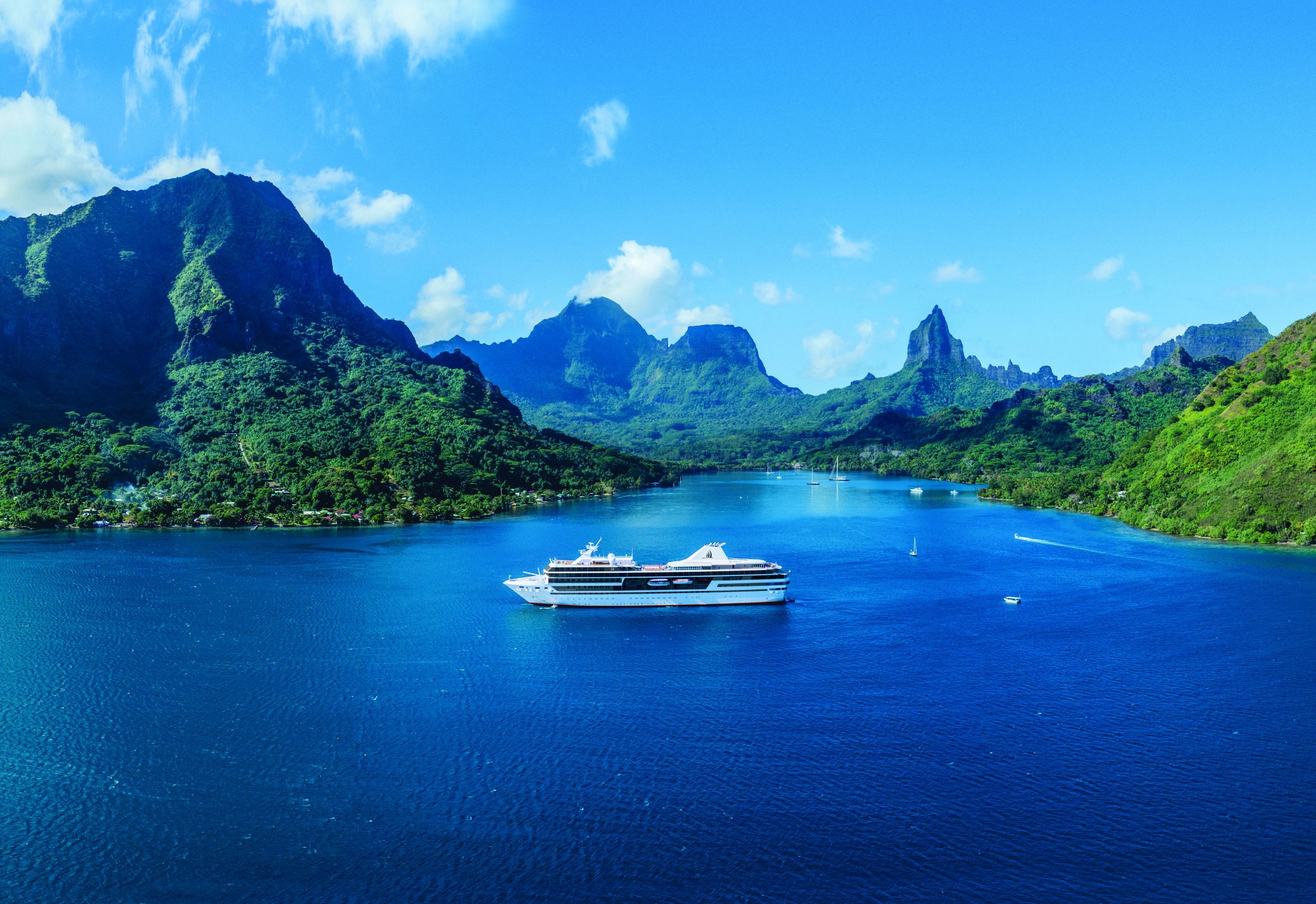
A long-standing cultural cruise and a new expedition-style offering will soon operate side by side in French Polynesia.
By Jeni O'Dowd
Tue, Jan 13, 2026 1:25pm 3min
From late 2026 and into 2027, PONANT Explorations Group will base two ships in French Polynesia, offering travellers a choice between a culturally immersive classic and a far more exploratory deep-Pacific experience.
The move builds on more than 25 years of operating in the region with the iconic m/s Paul Gauguin, while introducing the expedition-focused Le Jacques Cartier to venture into lesser-known waters.
Together, the two vessels will cover all five Polynesian archipelagos — the Society, Tuamotu, Austral, Gambier and Marquesas Islands — as well as the remote Pitcairn Islands.
THE PAUL GAUGUIN: CULTURAL IMMERSION, POLYNESIAN STYLE
Long regarded as the benchmark for cruising in French Polynesia, m/s Paul Gauguin will remain based year-round in the region.
Renovated in 2025, the ship continues to focus on relaxed, culturally rich journeys with extended port stays designed to allow guests to experience daily life across the islands.
A defining feature of the onboard experience is the presence of the Gauguins and Gauguines — Polynesian hosts who share local traditions through music, dance and hands-on workshops, including weaving and craft demonstrations.
The atmosphere is deliberately intimate and internationally minded, catering to travellers seeking depth rather than distance.
Across the 2026–27 seasons, the ship will operate 66 departures, primarily across the Society Islands, Tuamotu and Marquesas, with select voyages extending to Fiji, Tonga and the Cook Islands.
LE JACQUES CARTIER: EXPLORATION AT THE EDGE
Le Jacques Cartier introduces a more adventurous dimension to PONANT’s Polynesian offering, with itineraries focused on the least visited corners of the South Pacific.
The ship will debut three new “Discovery” itineraries, each 14 nights in length, which can also be combined into a single, extended 42-night voyage — the most comprehensive Polynesian itinerary currently available.
In total, the combined journey spans six archipelagos, 23 islands and the Pitcairn Islands, a British Overseas Territory rarely included on cruise itineraries.
Unlike the Paul Gauguin’s cultural focus, Le Jacques Cartier centres on exploration.
Each day includes one guided activity led by local experts, with excursions conducted via tenders, local boats and zodiacs. Scuba diving is available on board, supported by a resident instructor.
Across the 2026–27 period, the ship will operate nine departures, offering a deliberately limited and low-impact presence in some of the Pacific’s most isolated communities.
THREE NEW DISCOVERY ITINERARIES
The new itineraries aboard Le Jacques Cartier include:
– Secret Polynesia: Unexplored Tuamotu, the Gambier Islands and the Austral Islands – From Confidential French Polynesia to Pitcairn Island – Polynesian Bliss: Marquesas and Tuamotu
Each voyage departs from Papeete, with prices starting from $15,840 per person.
SCOUTING THE PACIFIC’S MOST REMOTE COMMUNITIES
In preparation for the new itineraries, PONANT Explorations Group undertook extensive scouting across the Austral and Tuamotu Islands to develop activities in collaboration with local communities.
José Sarica, the group’s R&D Expedition Experience Director, worked directly with residents to design experiences including welcome ceremonies, cultural workshops and visits to marae, the region’s sacred open-air temples.
Six new ports of call have been confirmed as part of this process, spanning both the Tuamotu and Austral archipelagos.
SIX NEW PORTS OF CALL CONFIRMED
New stopovers include:
– Mataiva, known for its rare mosaic lagoon – Hikueru, home to one of the largest lagoons in the Tuamotus – Makemo, noted for its red-footed boobies and frigatebirds – Raivavae, famed for its crystal-clear lagoon pools – Tubuai, rich in marae and spiritual heritage – Rurutu, known for limestone caves and seasonal humpback whale sightings
A DUAL EXPERIENCE, ONE DESTINATION
By pairing its long-established cultural voyages with expedition-led exploration, PONANT Explorations Group is positioning French Polynesia not as a single experience, but as two distinct journeys — one grounded in tradition and comfort, the other pushing into the furthest reaches of the Pacific.
For travellers seeking either immersion or discovery, the South Pacific is about to feel both familiar and entirely new.
BNW Developments has established a Sydney presence, joining Arada and Sobha Realty among the growing number of UAE developers pursuing Australian buyers and development opportunities.
The Australian leather house has opened an immersive four-day pop-up in Manhattan, unveiling its Bloom Collection and redefining what a product launch can look like.
Related Stories
Lifestyle
AI Agents Are a Threat to Travel Businesses. Airbnb Could Still Be a Winner.
By David Wainer 13/10/2026
Lifestyle
Amazon in Talks to Buy AI Startup Decart for Around $7 Billion
By Kate Clark and Lauren Thomas 12/10/2026
Lifestyle
Dolly Parton’s Onetime Hollywood Hills Home Lists for the First Time in a Generation Asking $7.95M
AI-powered travel agents are challenging online booking platforms, but Airbnb’s exclusive listings and direct customer relationships could give it an edge. Its next challenge: turning repeat guests into loyal customers through stronger rewards and innovation.
By David Wainer
Tue, Oct 13, 2026 3min
AI agents like Muse can already find you the cheapest hotel room in Paris. But they can’t locate a cheaper version of that Catskills cabin you’ve been eyeing, because it might only be available on AirbnbABNB -1.43%decrease.
Airbnb, though, has a real chance to emerge as a winner from the upheaval. The catch: Its stock already reflects above-industry growth. To justify its valuation, Airbnb will need to turn repeat customers into loyal ones.
Online travel companies make much of their money by simplifying search and collecting fees on bookings. AI agents threaten that model.
But not all travel marketplaces are equally exposed. Booking and Expedia largely sell hotel rooms that travelers can also book directly or through competing sites. If an agent can find the same room elsewhere, it has little reason to favor either Booking or Expedia.
Booking and Expedia also sell sponsored listings that steer travelers toward particular properties. Wells Fargo estimates those will account for about 8% of Expedia’s revenue and a much higher percentage of profit next year.
Airbnb has more ways to adapt. More than half its listings are available only on its platform, and more than 90% of its traffic comes directly to its app or website.
The customer relationship doesn’t end after booking, either. Bernstein analyst Richard Clarke notes that 90% of Airbnb guests go on to message their hosts about arrival times, keys or local taxes, giving Airbnb a connection to both sides of the transaction.
How the companies have responded to the possible agentic future is telling.
Expedia quickly signed on as a Muse partner. Airbnb hasn’t, and Chief Executive Brian Chesky says AI chatbots have so far been a boon, sending customers to Airbnb’s website.
Chatbots might work for buying paper towels, he quipped at a Skift conference last month, but people enjoy planning trips. He argued that browsing dozens of homes isn’t something a text-based chatbot is well suited for.
Still, the AI jitters arrived just as Airbnb was persuading investors it deserved its pricey multiple. For years after its 2020 initial public offering, the stock—which trades around 25 to 30 times forward earnings—went nowhere. Investors saw a mature operator trading at a growth premium.
This year, Airbnb growth seems to be accelerating. The stock jumped in August after the company raised its full-year revenue-growth guidance with its second-quarter results. Wells Fargo analyst Ken Gawrelski credits a run of product improvements under a revamped leadership team.
Among the changes: letting guests reserve now and pay later, adding hotels, and a redesigned home page and app. Investors were also betting on what comes next, including thousands more hotels, car rentals and, eventually, advertising.
The irony is that some of those growth drivers push Airbnb closer to the kind of business Booking and Expedia run—the kind of business AI agents could threaten. Even if AI agents capture a large share of travel planning and booking, Airbnb would capture the demand. But it and others would slowly lose control over how customers find and choose properties.
That would undermine the advertising opportunity investors are counting on. The bigger point for Airbnb and other marketplaces is that losing control of customer acquisition could mean surrendering some of their pricing power and margins.
To bulletproof itself, Airbnb might look to another e-commerce giant that has so far kept AI agents at arm’s length: Amazon.
Like Amazon, Airbnb has a loyal customer base and hard-to-match supply. But it has nothing like Prime membership to make customers think twice before taking their business elsewhere.
That is where loyalty comes in. Business travelers stick with Hilton or Marriott because enough nights earn them perks. Leisure travelers rarely accumulate stays with one chain. Airbnb has millions of listings and plenty of repeat customers, but no broad rewards program. It has begun experimenting with credits on hotel stays, but it should make loyalty a priority, not just a promotion.
Airbnb also plans to launch its own AI agent next year. But travelers using an agent might still want it to search Airbnb, Vrbo, Booking and hotel websites alike, rather than limit itself to one company’s inventory.
Eventually, Airbnb might have to strike deals with agent makers, using its unique homes as leverage to negotiate favorable terms, says Gawrelski. Such deals, along with rewards for loyal guests, could over the long term eat into the company’s roughly 13% take rate, he adds. But if they bring in enough additional bookings, the trade-off could be worthwhile.
History offers a reason not to panic. The shift from desktop to mobile unsettled investors in Alphabet and Amazon, but both emerged as major beneficiaries. Companies with valuable assets can come out of a platform shift stronger, if they adapt quickly enough.
Airbnb has homes the bots can’t easily replace. Now it needs to give guests a reason to insist on booking them there.


 3 min
3 min