China’s Ghost Cities Are a Problem for Europe’s Luxury Brands, Too - Kanebridge News
Share Button

China’s Ghost Cities Are a Problem for Europe’s Luxury Brands, Too

Chinese consumers watching the value of their homes fall are losing the confidence to spend on designer goods

By CAROL RYAN
Wed, Oct 9, 2024 8:41amGrey Clock 3 min

How closely is demand for $3,000 handbags tied to home prices in China? Quite closely, it turns out, which is unfortunate for luxury brands.

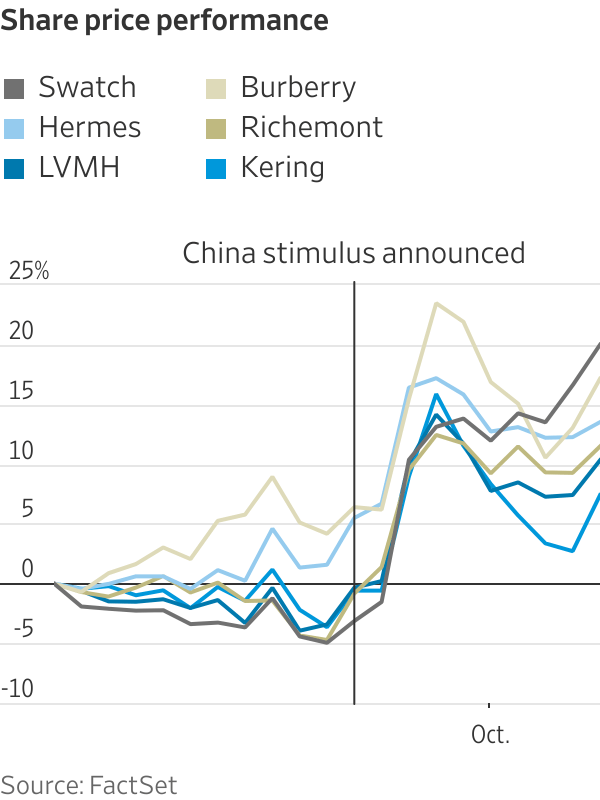
Europe’s luxury stocks fell in early trading Tuesday after China’s economic planning agency failed to announce additional measures to kickstart growth that some investors had hoped for. The sector is still up 10% on average since Beijing launched its initial stimulus plans late last month.

Beijing hopes a cut to mortgage rates, and lower down-payment requirements for buyers of second homes, will jump-start the country’s troubled housing market. A package of loans to brokers and insurers to buy Chinese shares has had initial success at lifting the stock market.

Luxury spending in China has traditionally been more correlated with its home prices than with the financial markets or overall economic growth. Around 60% of net household wealth was tied up in property before prices peaked in 2021. Barclays estimates that falling home prices have destroyed about $18 trillion in household wealth since then, which is equivalent to roughly $60,000 per family.

This, along with worries about the wider economy, is hurting consumer confidence. Retail sales rose just 2.1% in August compared with the same month last year, according to data from China’s National Bureau of Statistics. When global luxury brands start to report their third-quarter results next week, Chinese demand is expected to have slowed since they last updated investors.

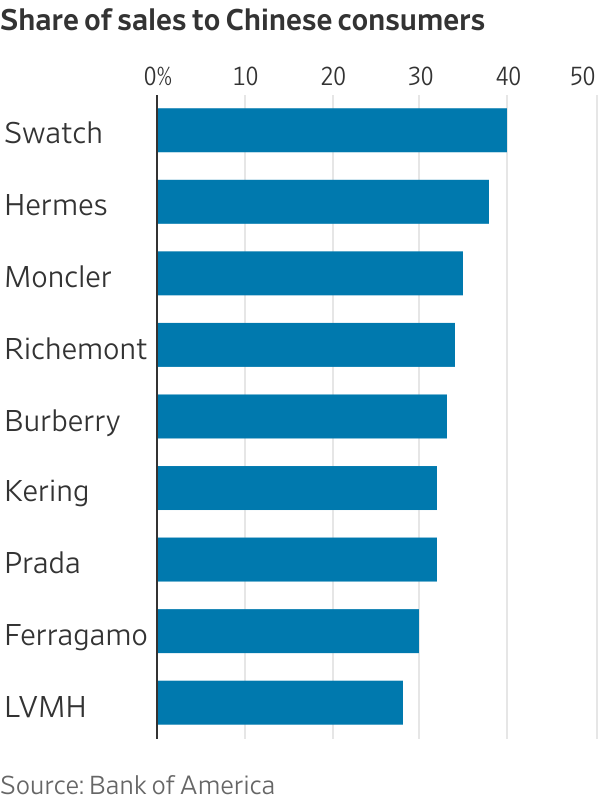
Flagging sales come at an unhelpful time for Europe’s luxury companies, which rely on Chinese consumers for a third of global luxury spending. After several bumpy years during the pandemic, luxury brands and their investors hoped that a comeback in Chinese spending would compensate for a slowdown among Europeans and Americans.

This looks increasingly unlikely. Luxury sales to Chinese shoppers are expected to shrink 7% in 2024 and by 3% next year, according to UBS estimates. As luxury brands have high fixed costs, including the most expensive retail rents in the world, a slowdown with such key customers could have an outsize impact on profit margins.

The last time the luxury industry went through such a rocky patch in China, barring the pandemic, was between 2014 and 2016 when Beijing was cracking down on corruption, including officials who were gifting Louis Vuitton handbags and Rolex watches in exchange for political favours. The global luxury industry barely grew for two years during China’s anticorruption drive, which also coincided with a property-market correction in the country. It didn’t help that shoppers in other markets were also tiring of logos back then.

Europe’s luxury stocks look expensive today compared with that time. As a multiple of expected earnings, listed brands’ shares now trade at a roughly 40% premium to their 2014 to 2016 average.

To justify the higher price tag, Beijing’s housing and wider economic stimulus would need to indirectly lift luxury demand. Measures rolled out so far may not be enough to slow the slide in home prices. China’s housing market is oversupplied by around 60 million units, according to Bloomberg Economics estimates.

New incentives to kick-start consumption are expected soon but will probably target mass-market products like white goods. China already rolled out trade-in subsidies for home appliances earlier this year and a range of consumption coupons.

None of this is very helpful for sellers of expensive luxury goods. For brands to see a recovery, Chinese consumers that spend anywhere from $7,000 to $43,000 a year on luxury products would need to feel much better about their finances than they currently do. Spending by this group has fallen 17% so far this year compared with the same period of 2023, according to a report by Boston Consulting Group.

Half-finished, abandoned housing estates are a big headache for China’s government, and are also on the mind of executives in Paris and Milan. Though the fortunes of luxury bosses likely isn’t high on Chinese officials’ priority list, their fates may be intertwined.


MOST POPULAR

Following the successful launch of its Palais Collection, MAISON de SABRÉ has unveiled a new modular handbag system offering more than 720 styling combinations.

Automobili Lamborghini and Babolat have expanded their collaboration with five new colourways for the ultra-exclusive BL.001 racket, limited to just 50 pieces worldwide.

Related Stories
Property
An 18th-Century Barbados Villa Built Over a Network of Ancient Caves Lists for $22.5 Million
By CHAVA GOURARIE 11/05/2026
Property
Wealth on the rise as billionaires reshape Australia’s property landscape
By Staff Writer 23/04/2026
Property
Late Swarovski Billionaire’s Private Island Near Venice, Italy, Asks €24 Million
By Casey Farmer 23/04/2026

Kit Braden, an executive at French beauty empire L’Occitane, has spent every winter for the past 13 years at the stone vacation home.

By CHAVA GOURARIE
Mon, May 11, 2026 2 min

A historic Barbados estate with a 300-year-old villa and 11 acres overlooking the Caribbean Sea is now for sale with a guide price of $22.5 million.

The seller is Kit Braden, chairman of the U.K. branch of French beauty empire L’Occitane Group, whose family has spent every winter for the last 13 years at the island property, known as Fustic Estate.

“It’s very much a family house,” Braden said. “We love having a lot of people there. It’s a collection point to keep everyone together.”

The main villa dates to 1712, though it’s been reimagined and expanded substantially over the years.

It spans 13,000 square feet and features seven en suite bedrooms across three wings, as well as expansive verandas, stone courtyards and rows of louvered doors in gay Caribbean pastels.

In the 1970s, when the home was owned by Charles Graves—brother of British poet Robert Graves—it was reimagined by stage designer Oliver Messel, one of the foremost theater designers of the last century. Messel expanded the home, added a lagoon pool with a natural waterfall and other theatrical features, according to Braden.

“The whole place is a little bit magical,” he said.

The home sits about 350 feet above the water, and surrounded by lush gardens that slope towards the water.

“We look down through our garden—which is about 12 acres of tropical gardens and palm trees and wonderful old mahogany trees—onto the Caribbean,” Braden said.

He and his wife first saw the property on New Year’s Eve 2013, during a quick trip from where they were staying in Grenada.

The couple spent an hour walking the perimeter, some of it still untouched jungle, in the pouring rain.

“By the time we got back, I had fallen in love with it,” Braden said.

His wife, however, wasn’t so sure. But in Braden’s telling, a second visit in sunnier weather with two of their children brought her around.

“She had to be talked into that it was a jolly good idea; now she absolutely loves it,” he said.

When they bought the property, the edge that runs along the waterfront was a jungle, so they cleared the ridge and transformed it into gardens.

They also bought an additional sea-level parcel with two beach cottages, giving the property direct access to the water and the town below via a five-minute walk.

The property also has a 15-person staff, a reflecting pond, an outdoor pavilion suitable for yoga and a commercial grade kitchen that can serve more than 100 guests, according to a brochure from Knight Frank, which posted the listing in March. They did not provide further comment.

For Braden, the property is special because of its natural beauty, its proximity to the town of Saint Lucy and its history—which dates way way back to when the island of Barbados was first formed via tectonic activity.

“It was basically tectonic plates that collided about a million years ago so the seabed is the top of the hill,” Braden said. “We’re on coral rock.”

As a result, Fustic Estate includes an extensive network of caves that were likely used by the Arawaks, a Venezuelan fishing tribe that followed the fish to these islands about a thousand years ago.

“If the fish were good they’d camp here,” Braden said. “There’s evidence that they stayed there in those caves, they lived there in good winters.”

Now it’s someone else’s turn to live on the land shared by Arawaks, the plantation owners of 1712, Charles Graves and the Braden brood.