Cold Plunges Are Hot. But Can You Do It in Your Home Pool?
With interest booming, wellness experts and pool builders have seen more homeowners hoping to take cold therapy immersion into their own backyards.
By ERIC GROSSMAN
Fri, Jan 9, 2026 12:35pm 4min
Cold plunges have gone from fringe curiosity to full-blown cultural phenomenon, the wellness world’s equivalent of a headline-grabbing breakout star.
Adherents slip into icy water on a daily basis, chasing an electric jolt of clarity that feels like a flip has been switched inside your brain.
Dedicated cold plunge practices are everywhere from upscale fitness studios and pro sports locker rooms to renowned wellness destinations such as Mountain Trek Health Reset Retreat in British Columbia.
Considering the ever-expanding assortment of companies flooding the market with cold plunge tubs and other custom devices dedicated to achieving icy bliss—with costs potentially reaching into the tens of thousands—some homeowners are tempted to use their swimming pools as an alternative.
“We’re absolutely seeing more homeowners use their pools as year-round cold plunges, especially in colder climates,” said Nick McNaught, CEO and co-founder of Toronto-based Stay Unbounded, which offers cold exposure workshops, retreats and certifications.
“The motivation is often simplicity and cost. If the water is already cold, people see value in keeping the pool open longer or winterizing it differently to support cold exposure.”
Suzanne Vaughan, president of Massachusetts-based pool builder SwimEx, points out the inherent convenience that comes with taking a frosty dip out back.
“From what homeowners tell us, the appeal of a cold plunge at home is less about chasing extremes and more about having a simple ritual that’s always available,” she said.
“It’s quick, accessible and easy to build into a daily routine.”
Among new clients Vaughan works with, year-round cold plunge use is usually planned from the start rather than as an afterthought.
“More are choosing indoor pools or small attached structures because that makes temperature control, equipment protection and day-to-day use much easier in colder climates,” she said.
Blue Cube / Courtesy of Jeff Dotson
If someone is thinking about using an existing home pool as a cold plunge, the main questions are likely to involve practicality and protection.
“Larger volumes of water take more energy and time to keep at colder temperatures, and you need a plan to protect plumbing, finishes and equipment from freeze–thaw cycles,” she added.
“Whatever the design, you want a system that’s built for the temperature range you have in mind, and a pool professional who can help you winterize safely.”
One such professional is Hunter Gary, a certified master pool builder and owner of H2 Outdoor Living in Tennessee.
“Most everyone has a ‘number’ in degrees when it comes to cold plunging. When a client asks our company to design a cold plunge for them, I ask ‘what’s your number?’” Gary said.
“A smaller body of water or cold plunge vessel may be much easier for maintaining a balanced temperature…but if using a pool gets you excited about a more serious approach to inviting this wellness experience in your life, then go for it.”
Amy McDonald, owner and CEO of Under a Tree, a wellness consultancy, said transforming a pool into a plunge might not be worth time and investment
“It is almost impossible to retrofit a standard swimming pool into a cold plunge,” she said.
“The energy and money to do it properly is greater compared to just creating a complimentary contrast circuit.”
A proper setup needs to be exceptionally cold, she noted, so depending on where the pool is located it might not get chilly enough to provide optimal health benefits.
“That could work in northern areas of the U.S., but it takes a lot for a pool to generate and keep that kind of cold, not even considering if the pool ices over,” she said.
McNaught echoed those concerns, citing how home pools aren’t designed specifically for cold plunging, so temperature consistency, cleanliness, ease of access and safety become important factors.
“Dedicated cold plunge setups offer more control, smaller volumes and lower ongoing maintenance,” he said.
“For many people, a pool works as an entry point. Over time, those who commit to the practice transition to a dedicated setup because it better supports frequency, comfort and long-term use.”
Beyond geography and climate, industry experts pointed out other challenges homeowners are likely to face.
“Pools are saturated with chlorine and other chemicals that directly absorb into the bloodstream. The advantage of many cold plunges is that no chemicals are required for residential use,” said David Haddad, as the co-founder of Oregon-based BlueCube Wellness.
“Constant ozonation and filtration is enough to kill organic compounds without exposure to sanitizing chemicals.”
Most cold-plunge systems are monitored to stay between 50-60 degrees Fahrenheit—with experienced plungers often preferring lower temperatures.
While “the ultimate experience might be a glacial lake in Finland, unfortunately that’s a bit out of reach for most of us,” said Andreas Stelluti, co-founder at Texas-based Colderatti, whose vessels feature the world’s first chemical-free cold plunge technology, powered by a triple filtration system that removes 99% of impurities to provide a system with drinking-quality water.
“Having a cold plunge at home brings that experience to your backyard, making it very easy and accessible, so you have the ability to make it part of your lifestyle,” he added.
Stelluti noted that as spring arrives and clients’ home pools start to warm up again, they begin to miss the cool water.
“Many say ‘I really need this to be part of my lifestyle year-round’ and that desire for consistent, accessible cold immersion is what motivates them to invest in a dedicated cold plunge setup,” he explained.
“Unfortunately, you can’t use your pool as a year-round cold plunge during the summer. Especially not here in Texas.”
Copyright 2020, Dow Jones & Company, Inc. All Rights Reserved Worldwide. LEARN MORE
BNW Developments has established a Sydney presence, joining Arada and Sobha Realty among the growing number of UAE developers pursuing Australian buyers and development opportunities.
The Australian leather house has opened an immersive four-day pop-up in Manhattan, unveiling its Bloom Collection and redefining what a product launch can look like.
Related Stories
Lifestyle
AI Agents Are a Threat to Travel Businesses. Airbnb Could Still Be a Winner.
By David Wainer 13/10/2026
Lifestyle
Amazon in Talks to Buy AI Startup Decart for Around $7 Billion
By Kate Clark and Lauren Thomas 12/10/2026
Lifestyle
Dolly Parton’s Onetime Hollywood Hills Home Lists for the First Time in a Generation Asking $7.95M
AI-powered travel agents are challenging online booking platforms, but Airbnb’s exclusive listings and direct customer relationships could give it an edge. Its next challenge: turning repeat guests into loyal customers through stronger rewards and innovation.
By David Wainer
Tue, Oct 13, 2026 3min
AI agents like Muse can already find you the cheapest hotel room in Paris. But they can’t locate a cheaper version of that Catskills cabin you’ve been eyeing, because it might only be available on AirbnbABNB -1.43%decrease.
Airbnb, though, has a real chance to emerge as a winner from the upheaval. The catch: Its stock already reflects above-industry growth. To justify its valuation, Airbnb will need to turn repeat customers into loyal ones.
Online travel companies make much of their money by simplifying search and collecting fees on bookings. AI agents threaten that model.
But not all travel marketplaces are equally exposed. Booking and Expedia largely sell hotel rooms that travelers can also book directly or through competing sites. If an agent can find the same room elsewhere, it has little reason to favor either Booking or Expedia.
Booking and Expedia also sell sponsored listings that steer travelers toward particular properties. Wells Fargo estimates those will account for about 8% of Expedia’s revenue and a much higher percentage of profit next year.
Airbnb has more ways to adapt. More than half its listings are available only on its platform, and more than 90% of its traffic comes directly to its app or website.
The customer relationship doesn’t end after booking, either. Bernstein analyst Richard Clarke notes that 90% of Airbnb guests go on to message their hosts about arrival times, keys or local taxes, giving Airbnb a connection to both sides of the transaction.
How the companies have responded to the possible agentic future is telling.
Expedia quickly signed on as a Muse partner. Airbnb hasn’t, and Chief Executive Brian Chesky says AI chatbots have so far been a boon, sending customers to Airbnb’s website.
Chatbots might work for buying paper towels, he quipped at a Skift conference last month, but people enjoy planning trips. He argued that browsing dozens of homes isn’t something a text-based chatbot is well suited for.
Still, the AI jitters arrived just as Airbnb was persuading investors it deserved its pricey multiple. For years after its 2020 initial public offering, the stock—which trades around 25 to 30 times forward earnings—went nowhere. Investors saw a mature operator trading at a growth premium.
This year, Airbnb growth seems to be accelerating. The stock jumped in August after the company raised its full-year revenue-growth guidance with its second-quarter results. Wells Fargo analyst Ken Gawrelski credits a run of product improvements under a revamped leadership team.
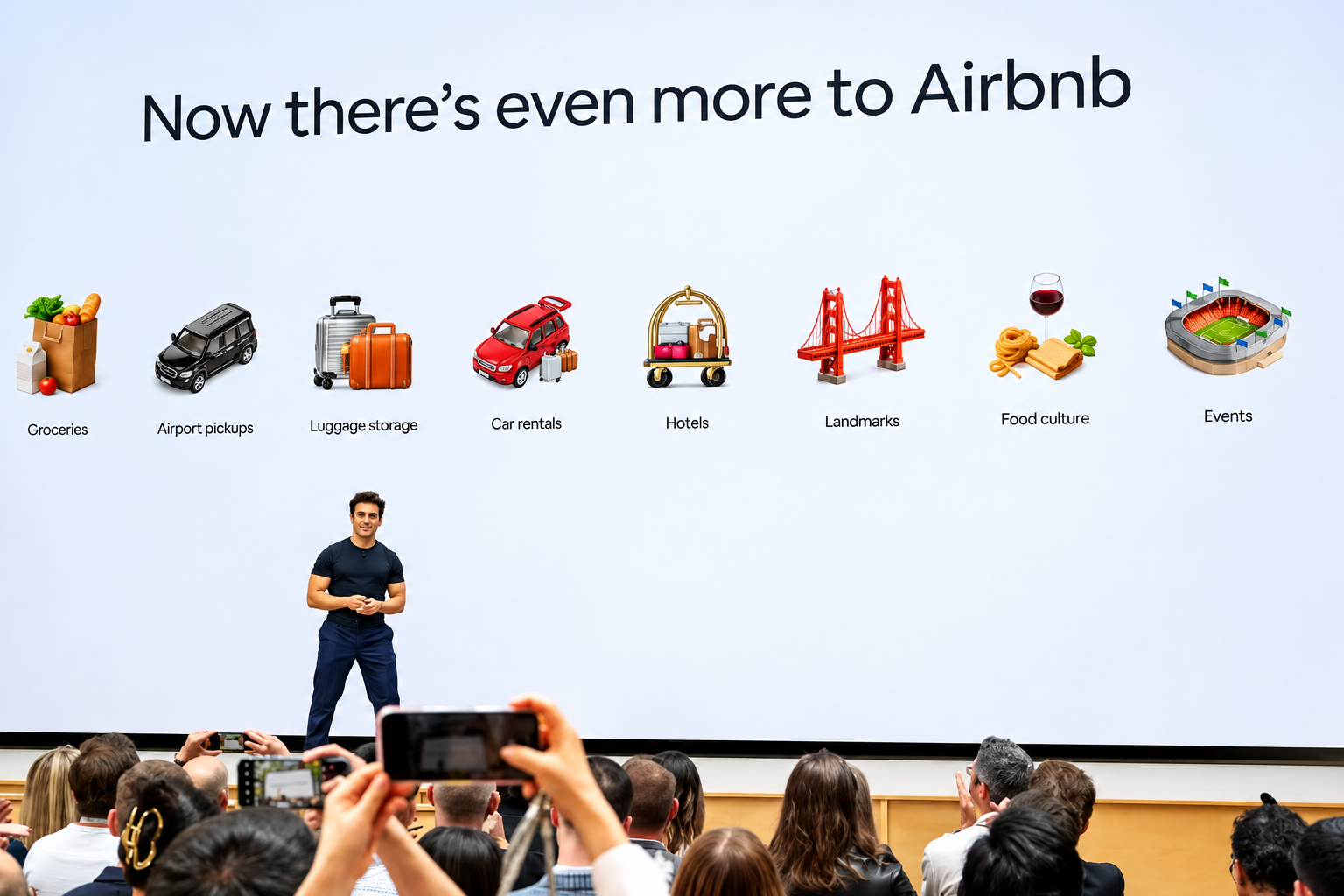
Among the changes: letting guests reserve now and pay later, adding hotels, and a redesigned home page and app. Investors were also betting on what comes next, including thousands more hotels, car rentals and, eventually, advertising.
The irony is that some of those growth drivers push Airbnb closer to the kind of business Booking and Expedia run—the kind of business AI agents could threaten. Even if AI agents capture a large share of travel planning and booking, Airbnb would capture the demand. But it and others would slowly lose control over how customers find and choose properties.
That would undermine the advertising opportunity investors are counting on. The bigger point for Airbnb and other marketplaces is that losing control of customer acquisition could mean surrendering some of their pricing power and margins.
To bulletproof itself, Airbnb might look to another e-commerce giant that has so far kept AI agents at arm’s length: Amazon.
Like Amazon, Airbnb has a loyal customer base and hard-to-match supply. But it has nothing like Prime membership to make customers think twice before taking their business elsewhere.
That is where loyalty comes in. Business travelers stick with Hilton or Marriott because enough nights earn them perks. Leisure travelers rarely accumulate stays with one chain. Airbnb has millions of listings and plenty of repeat customers, but no broad rewards program. It has begun experimenting with credits on hotel stays, but it should make loyalty a priority, not just a promotion.
Airbnb also plans to launch its own AI agent next year. But travelers using an agent might still want it to search Airbnb, Vrbo, Booking and hotel websites alike, rather than limit itself to one company’s inventory.
Eventually, Airbnb might have to strike deals with agent makers, using its unique homes as leverage to negotiate favorable terms, says Gawrelski. Such deals, along with rewards for loyal guests, could over the long term eat into the company’s roughly 13% take rate, he adds. But if they bring in enough additional bookings, the trade-off could be worthwhile.
History offers a reason not to panic. The shift from desktop to mobile unsettled investors in Alphabet and Amazon, but both emerged as major beneficiaries. Companies with valuable assets can come out of a platform shift stronger, if they adapt quickly enough.
Airbnb has homes the bots can’t easily replace. Now it needs to give guests a reason to insist on booking them there.



 4 min
4 min

 Copyright 2020, Dow Jones & Company, Inc. All Rights Reserved Worldwide.