NEW WAVE: THE EVOLUTION OF AUSTRALIA’S COASTAL LUXURY
From the shacks of yesterday to the sculptural sanctuaries of today, Australia’s coastal architecture has matured into a global benchmark for design.
By Kirsten Craze
Mon, Dec 1, 2025 6:00am 4min
In the land down under, the beach is in our DNA. So is it any wonder that Australian architecture is leading the world in luxury coastal design?
With about 85 per cent of our population living within 50 kilometres of the coastline, we’ve perfected the art of the beach house. Yet over the past two decades, there’s been a sophisticated shift in the traditional coastal cottage.
The residential revolution that has washed over our most valuable waterfront locations has replaced the original weatherboard “shacks” by the sea with a contemporary design movement shaped by admiration and respect for the natural environment.
No longer simply about the view, today’s coastal architecture is about creating beautiful homes that perform seamlessly in an increasingly volatile climate while meeting the rising tide of high-net-worth buyers who want it all.
From infinity pools to wellbeing spaces that connect with nature, one-time weekenders have been transformed into permanent escapes, providing year-round indulgence.
The Wamberal beach house.
An island home
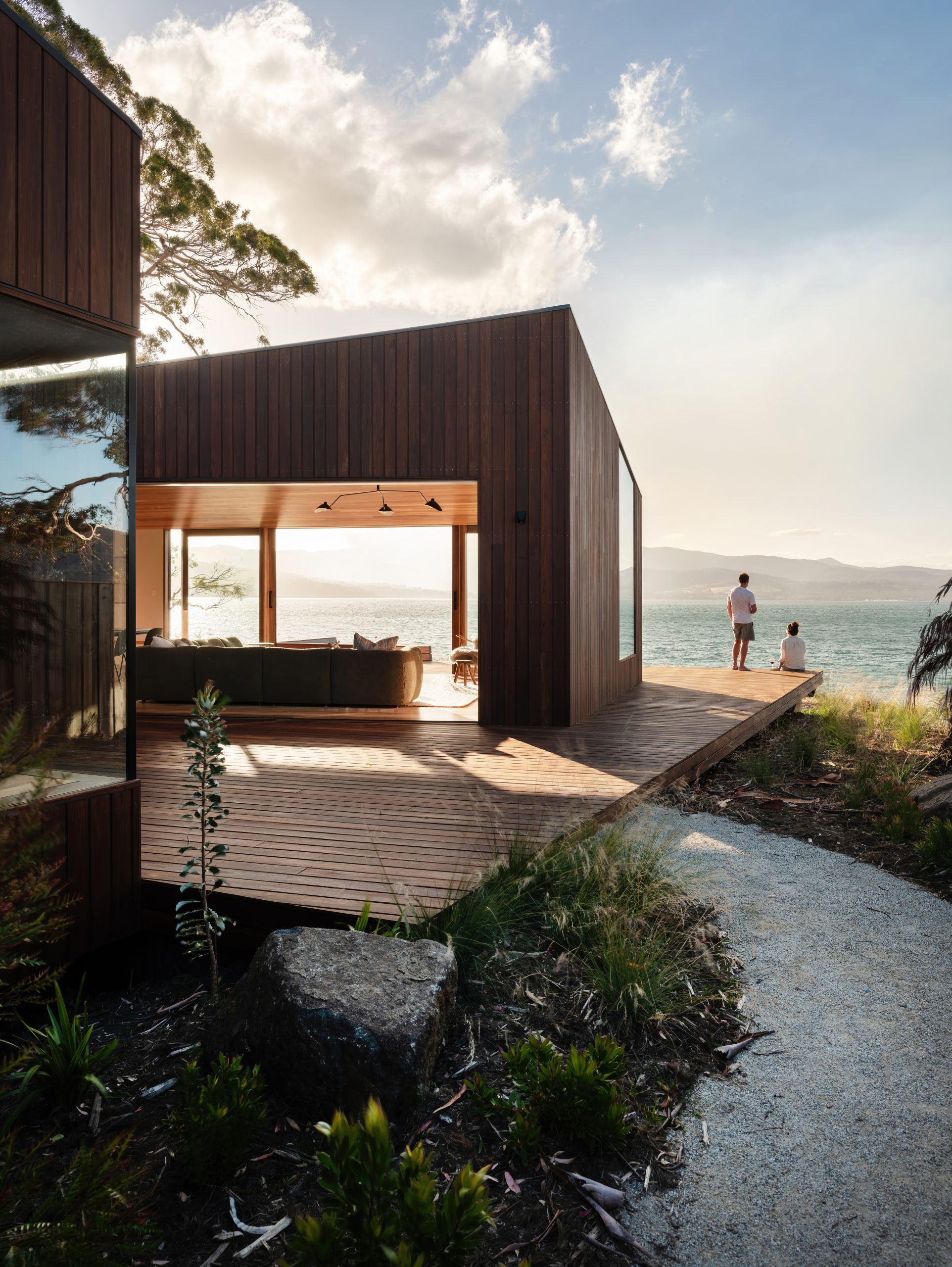
Belgian-born, Tasmania-based architect Lara Maeseele believes the quintessential coastal home has become a finely tuned instrument. With more vacant land to experiment with, and lower entry prices, she says the Apple Isle is perfectly placed for architects and homeowners to explore the new-age beach house.
“A highlight in Tassie is you can find these amazing vacant blocks on the coastline, and still be blown away by the unexpected views,” she says.
Having studied in Belgium and worked in London, Maeseele brings a northern European minimalist sensibility to the Australian beach house.
“Our way of life is so complex. When we get home, it’s nice to slow down, to declutter and find some peace and quiet.”
Nebraska House on Bruny Island took home the 2025 HIA Tasmanian Home of the Year and earned a commendation at the Houses Awards, but Maeseele still affectionately refers to her design overlooking the D’Entrecasteaux Channel as a “shack.”
“What we tried to do was make sure that from the foreshore, it was kept small and consistent with the neighbouring properties, and that’s the luxury element that I see in the shack. It sits quietly in its setting.”
With a water backdrop from most rooms, she says the ocean was a primary player when designing the house, but light was just as important for the clients.
“Both the western and eastern elevations slide wide open so it feels like a bit of an umbrella,” she says. “Then in winter, it’s fully insulated and glazed. When the sun sets, you have the most beautiful evenings, feeling cosy and sheltered while watching the wind and water outside.”
True to her European roots, Maeseele believes that when it comes to aesthetically pleasing and functional coastal design, the less-is-more approach should drive every project.
“We’re on an island, so we’re very aware any build leaves an impact,” she says. “We chose lightweight materials so, in the end, the house could be dismantled and the timber reused.”
Light pours into the Wamberal Beach house dining room.
Thriving by the sea
Sydney architect Jon King, who has designed both beach houses and boutique hotels, says the new generation of coastal design is a balancing act between luxury and environment.
Even in today’s dazzling designs, he believes comfort should still overshadow spectacle.
“If you’re going to make an exceptional beach house, it has to adapt. It needs to be beautiful when the sun is shining and the whales are jumping out of the water, but the next day it needs to withstand horrendous southerlies and wild storms,” he says.
“The material choices are vital because they need to look great, but last in that salty environment and in extreme winds and rain.”
What was once the domain of fibro cottages has developed into a sea of enviable, state-of-the-art designs.
“For a long time, we lived simply in beach environments because the land was cheap and our buildings were unsophisticated. But now, living on the coast has become coveted, even fetishised. People are making statements through architecture, and that changes everything.”
He says that in an effort to connect with nature, the temptation can be to build with vast walls of glass to capture the ultimate panorama, but subtle design can be more successful when it gives the dramatic backdrop a curated cameo.
“Most coastal locations are suburban in nature with small blocks and neighbours either side, so you can’t always get the view you want,” he says.
“But you can frame it beautifully rather than opening everything up to the elements.”
Cheyne Fox of White Fox Gold Coast, who has recently listed one of only two houses on Hayman Island in the Whitsundays, agrees that Australia’s coastal homes are unparalleled.
“Gone are the days when people wanted their properties to stand out and look at odds with the surrounds. Today’s luxury designs are very much about fitting in,” Fox says.
The Residence at Hayman spans three levels and offers more than 1,400 square metres of internal and external living space.
Designed by the late, internationally renowned architect Kerry Hill, it also features breezeways, terraces and an infinity pool designed to embrace the subtropical environment.
“When you get to Hayman Island, you get calico bags. There are no plastic bottles or even cars. There is a true respect for the environment, being so close to the Great Barrier Reef. And as such, the architecture reflects that ethos.”
She says high-net-worth buyers will pay top dollar for such indulgent and considered coastal designs.
“This is a once-in-a-lifetime proposition for a purchaser, but also a once-in-a-lifetime proposition for an agent.”
BNW Developments has established a Sydney presence, joining Arada and Sobha Realty among the growing number of UAE developers pursuing Australian buyers and development opportunities.
The Australian leather house has opened an immersive four-day pop-up in Manhattan, unveiling its Bloom Collection and redefining what a product launch can look like.
Related Stories
Property
Dopamine Design: A Couple Lists Their 1950s ‘Happy House’ in Palm Springs Ahead of Modernism Week
By Chava Gourarie 05/10/2026
Property
Dubai and Abu Dhabi’s Trophy-Home Developers Are Doubling Down on Waterfront Living
By Jake Emen 01/10/2026
Property
BNW joins growing wave of UAE developers targeting Australia
A vibrant 1954 Palm Springs home featuring eight colorful murals by late artist Shawn Savage is on the market for $2.295 million. The 2,237-square-foot property features bold hot-pink doors, three bedrooms, a pool, mountain views and playful interiors blending modern glamour with classic Palm Springs style.
By Chava Gourarie
Mon, Oct 5, 2026 3min
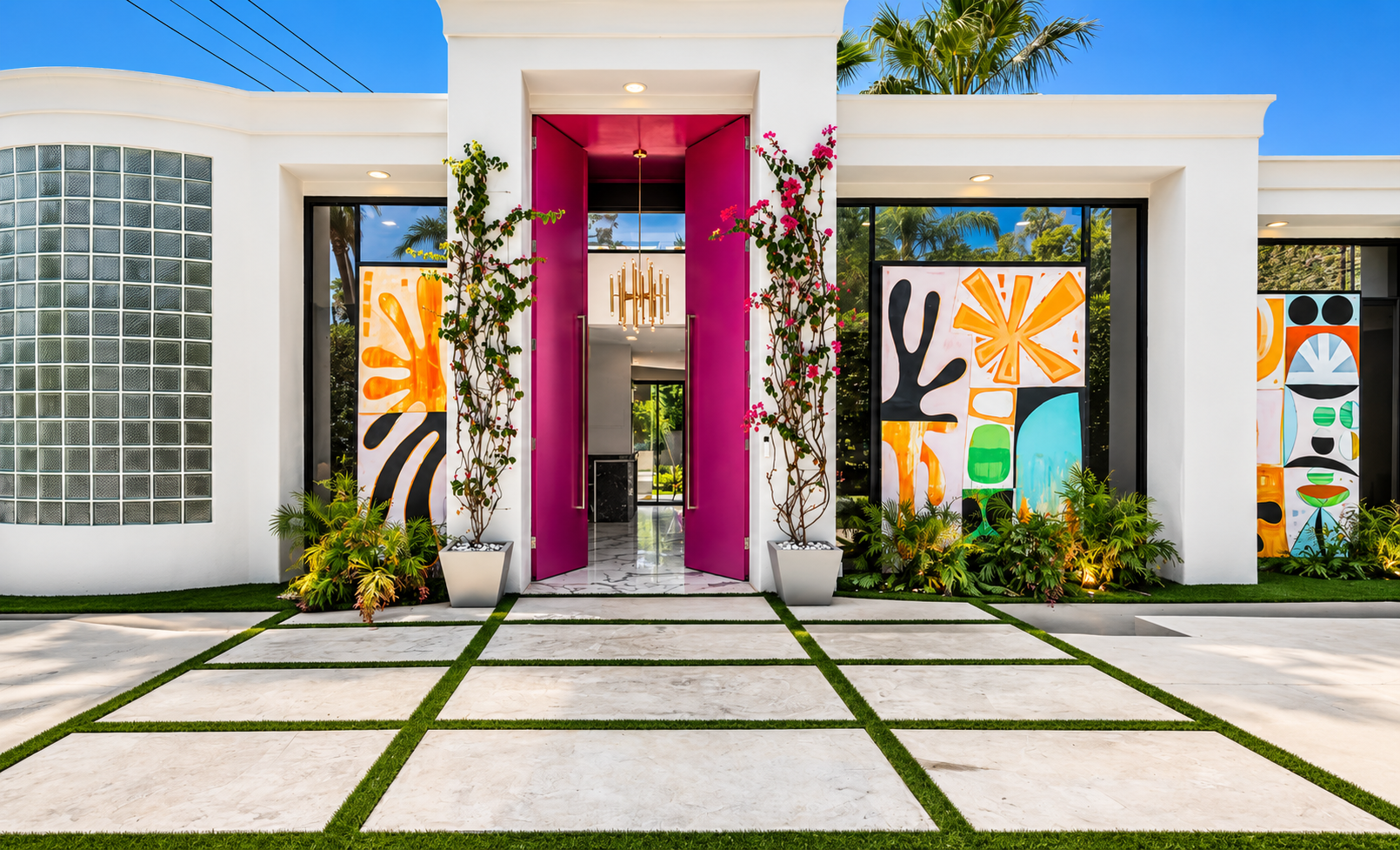
A bold 1950s home in Palm Springs, California, adorned with eight colorful murals by the late artist Shawn Savage, is coming to market ahead of the city’s annual Modernism Week.
The white stucco home on El Camino Way, built in 1954 and recently renovated, has an asking price of $2.295 million. Its staggered facade features three playfully abstract murals on either side of double-height hot pink doors.
The sellers are Los Angeles-based partners John Freeman and Mathieu Faure, who knew it was “the one” when they saw it after several months of searching in the winter of 2023. “It’s a happy house,” Freeman said. “We really liked the feel of the house: the uniqueness, the openness, the brightness—and the art.”
Located in the Mesa neighborhood of Palm Springs, which backs up to the San Jacinto Mountains, the 2,237-square-foot house features three bedrooms, an angled bonus room and a yard with a pool, desert mountain views and another colorful mural running alongside the pool.
“I never thought in my life I would have a house with pink doors,” said Faure, a producer at Apple TV who is originally from Paris. “It’s so colorful, it’s so different. And so Palm Springs.”
Abstract murals can be found on the facade.Patrick Ketchum
The layout of the home creates a smooth flow from the front doors through the open-plan common area—a foyer, bar, and living and dining room—into the kitchen around a fireplace wall and out to the yard. A corridor leads to a private bedroom wing, where the primary suite has floor-to-ceiling windows and the primary bath is only a tad smaller than the bedroom.
Faure has filled the home with Jonathan Adler furniture, rugs and accessories, riffing on the energetic California vibes of the house to create an aesthetic of “modern American glamour,” he said.
“It was enjoyable for me to play with different types of furniture and make this house ‘happy chic,’ as I describe it,” he said.
“He did a fantastic job,” said Freeman, who is an attorney and consultant. “It does kind of bring a smile to my face whenever I walk into the house.”
Since the furniture and decor were chosen for the particularities of the space, the couple is open to selling them with the home. Their West Hollywood house is already furnished; the collection doesn’t match the vibes of a Houston loft they bought near family; and Faure can’t imagine these pieces in New York—where he’s lived in the past—he said.
The duo bought the Palm Springs house for $1.925 million in 2024, according to property records, and will list the home Monday. They are represented by Stewart Smith, Patrick Jordan and Kevin Stanley of Bennion Deville Homes/Luxury Portfolio International.
The previous owners had purchased the home in 2021 for $975,000 and then spent more than two years and $700,000 on the renovation, according to Realtor.com. They commissioned Savage, a local Palm Springs artist and painter known for his joyful abstract work, to decorate the home.
Savage, who died in 2024, lived in the Coachella Valley from 2003, and his work can be found in various local institutions and is on exhibit at the Illumine Gallery in Palm Springs. “Some artists pass through a place. Shawn Savage became a part of it,” the gallery’s description states.
Unsurprisingly, the murals invite lots of friendly conversations, as well as guided tours and interested lookers, but never to a degree that it disturbed the peacefulness of their home or the neighborhood, the sellers said. “It felt like living in an art gallery, and you have the exterior that you would share with the world,” Faure explained.
The neighborhood also played a role in their decision to buy, because of its access to the hiking trails of the San Jacinto Mountains, the lack of through-roads and the neighborly environment.


 4 min
4 min