Page 16 – Kanebridge News

How Hello Kitty Took Over the World

Hello Kitty is celebrating her 50th birthday this year. Sanrio , the Japanese company behind the iconic character, has much to cheer about too.

Sanrio’s share price is at a record high after surging 10-fold from its trough in 2020. The company is delivering record profits with strong revenue growth. Operating profit last quarter rose 80% from a year earlier.

Sanrio’s young chief executive, Tomokuni Tsuji —14 years younger than Hello Kitty—probably deserves some applause. He took over the helm from his grandfather in 2020. Sales and profit had been sliding for years when the pandemic arrived. Sanrio had created some of the best-known franchises around the world, but it wasn’t harnessing the full potential of its large portfolio of cute characters.

Tsuji has put younger management in place and finally expanded into the digital world. That includes marketing its characters through social media and other online platforms and ramping up its e-commerce business. It is also expanding its high-margin licensing business, with Sanrio’s characters now gracing products from microwave ovens to sneakers. The licensing business not only is more profitable but also allows more local designs and creates more contact points in overseas markets.

As a result, Sanrio’s business outside of Japan is booming, particularly in China and the U.S. Its profit contribution from abroad, including royalties payment from overseas subsidiaries to the parent company, nearly doubled year on year in the June quarter. Sanrio struck a deal with China’s e-commerce giant Alibaba in 2022 to license its characters in the country. But the U.S. is among its fastest-growing markets: Sales in the Americas grew 141% year on year last quarter. The younger generation is increasingly familiar with Sanrio’s characters given the company’s strong presence on social media.

And the company has also managed to diversify itself away from reliance on Hello Kitty. She has long been Sanrio’s most recognisable character, but the company has developed new characters and done a better job of promoting some existing ones. Hello Kitty accounted for around 30% of Sanrio’s gross profit in product sales and licensing in the fiscal year ended March, compared with 76% a decade earlier. Cinnamoroll, a puppy with white fluffy fur, was voted Sanrio’s top character in an online poll by the company.

The company is also using different types of media to market its characters. It has a Netflix show called “Aggretsuko,” which features an angry red panda struggling with office life, that has been airing for five seasons. A Hello Kitty movie with Warner Bros. is in the making.

Sanrio’s stock now trades at 34 times forward earnings, which isn’t cheap at face value. But if the company can manage to continue its overseas expansion with new characters, it could bring not just cuteness overload, but profit overload too.

South Korea Can Go Only So Far Copying Japan’s Market Reforms

South Korea is taking a page from Japan to boost its stock market. There are certainly some low-hanging fruits to pick, but the country’s large family-controlled corporate empires, known as chaebols, could be an obstacle to more meaningful structural change.

The country’s stock exchange is set to unveil a stock index that will take into account factors such as profitability and shareholder returns. That is modelled after a similar move taken in 2014 by Japan, which uses its new index to essentially name and shame companies that failed to make the grade.

The new index is just a part of Korea’s “corporate value-up” program announced in February, aiming to boost the valuations of its market with shareholder-friendly policies. The government also proposed making changes to the tax code to encourage companies to pay more dividends. More broadly, South Korea hopes to copy the success of Japan’s drive to improve corporate governance and returns to investors.

Buybacks and dividends in Japan have risen, and shareholders have grown more vocal. Companies also are unloading their nonstrategic shareholdings in other companies, slimming down their balance sheets.

As a result, Japan has been one of the best-performing markets in the world in recent years. The Topix index hit a record high in July, nearly 35 years after its famous bubble burst.

On the other hand, South Korea’s stock market has long suffered from a so-called Korea discount , as it trades more cheaply than other emerging markets. Its main benchmark, Kospi Composite index, has been valued at an average 12 times forward earnings in the past decade, compared with around 15 times for Japan’s Topix and Taiwan’s Taiex each.

Japan’s index has gained 40% since the end of 2022, while Taiwan’s has surged 57%. Korea’s, by contrast, has gone up only 16% over the same period.

Similar to their counterparts in Japan, Korean companies haven’t historically been willing to return much capital to shareholders. The dividend yield on the Kospi is below 2%, which is lower than many markets. Buybacks are paltry and, more important, many Korean companies don’t cancel the shares they have bought back, instead keeping them as treasury shares, using that as a tool for major shareholders to keep control of the company.

On that front, there seems to be some progress. Treasury share cancellation, excluding Samsung Electronics , so far this year has already more than doubled the full-year level of 2023, according to Goldman Sachs . New regulations restricting how companies can use their treasury shares is probably one reason. Financial companies, in particular, have been eager to buy back and cancel their shares.

The elephant in the room, however, is the power of chaebols, which dominate Korea’s economy and stock market. Companies in the Samsung group, for example, make up more than 20% of the Kospi index. Besides the electronics brand, this includes companies in areas as disparate as financial services and shipbuilding. The interests of the families who control these vast corporate empires don’t usually align with those of the minority shareholders.

Instead, they have long used convoluted corporate structures, including extensive cross-shareholdings, to maintain their grip on the conglomerates. Given the chaebols’ strong economic and political influence in the country, they won’t be so easily pressured as Japanese companies have been to unwind these arrangements.

High inheritance taxes are another reason the families might not necessarily want high share prices for their companies. The government has proposed reducing the tax, but it might not be enough.

Korea’ stock market, which houses some of the world’s best-known brands, including Samsung and Hyundai Motor , has long been a laggard. The government’s new push might yield some successes, but its biggest companies could remain the toughest nuts to crack.

Ford Unveils Holographic Technology to Keep Eyes on the Road

Ford, working with Scottish company Ceres Holographics, showed off last week what could become the future of head-up displays, or HUDs as they’re commonly known.

HUDs almost magically display useful information such as speed and turn-by-turn directions on the lower part of the windshield, where it can be seen without taking the driver’s eyes off the road. For years now, automakers and their suppliers have imagined an autonomous world in which cars drive themselves, and the glass currently needed to see traffic could be turned into big display scenes at will. But the arrival of full self-driving is still a long way off.

At a conference in Detroit, Ford displayed an interim step: what might be called HUD 2, a bright, clear display stretching across the windshield with three sections, two for the driver and one for the passenger. The latter, which could include projected video, would not be visible to the driver.

Andy Travers, the CEO of Ceres Holographics, says that the new display possibilities could be interactive, and help solve the dangerous situation of driver distraction using current controls.

“It’s compelling cost-wise for automakers to put everything on the screen,” Travers says. “And they’re hiring programmers who are used to working with computers, not mobile cars that need to have drivers watching the road. We think it’s a lot better to make choices from projected images on the windshield than having to look away to a centrally mounted screen.”

Chrysler’s Halcyon EV includes advanced HUD concepts.
Stellantis

The windshield incorporates Ceres-developed (with Eastman and Carlex) thin-film technology that is produced with embedded holographic optical elements and then sandwiched between laminated glass sections to enable a transparent display of any kind of information. Travers says the film will not discolour over time. An inexpensive LED projector, technology in use now, is built into the instrument panel.

Regulators are taking notice of the distraction problem. According to Matthew Avery, director of strategic development at the safety agency Euro NCAP, “the overuse of touchscreens is an industry-wide problem, with almost every vehicle maker moving key controls onto central touchscreens, obliging drivers to take their eyes off the road and raising the risk of distraction crashes.”

Janice Tardiff, a coating application technical expert at Ford, says the passenger display on its initial prototype vehicles would target entertainment and possibly business applications.

The driver would get fuel or charge level, speedometer, navigation, and, on the centre display, points of interest and music. In a customer clinic testing the technology, participants liked the idea of being able to see sports events and movies, but weren’t sure that the clarity was sufficient for business applications. Some wanted the displays to be bigger.

Use of the film has been thoroughly tested and approved for next-generation HUD use, Tardiff says. The next steps are to improve colour, brightness, and resolution, optimise the size of the displays, and ensure good performance under different light conditions, she says.

HUD was an option on the Oldsmobile Cutlass in 1988, and it’s been steadily evolving since. Other companies are working on holographic technology, including Hyundai, Stellantis, Jaguar Land Rover, and General Motors. Technology shown by a U.K. company called Envisics on this year’s Chrysler Halcyon EV concept car imagined images on auto windows that would show points of interest along the chosen route, allow video calls en route, and map constellations in the night sky.

But not all of this would be able to go into current cars.

“While all this visual information is probably too distracting for a driver in control of the vehicle, it may not be when the vehicle is operated in an autonomous Level Four mode,” according to Envisics. “At this level, the driver can relax and utilise these functions and features.”

But some of it will be seen soon. A Chrysler/Dodge spokesman, Darren Jacobs, said via email, that “select design elements and features [seen on the Halcyon] like the head-up display and SmartCockpit are ready for production and will be included in Chrysler’s first all-electric vehicle.”

The Ford-Ceres technology is possible for production today, and it could lower driver distraction and prove satisfying for auto buyers—especially if image clarity can be improved.

Wealthy Families Increasingly Question Where in the World to Keep Their Assets

Ultra-rich families have often run their wealth from a single-family office located where their business exists, or their money was made, and where most members of their family live. But the dynamics for many of these families has radically changed as their businesses, homes, and children spread across the world, according to a report from Citi Private Bank.

Dealing with multiple jurisdictions creates possibilities but also complexities and raises a question for families of where the bulk of their assets should reside, as the bank details in the report, titled Asset Location and Global Mobility. Citi, through its global family office group, works with 1,800 family offices with an average net worth of US$2 billion, says Hannes Hofmann, head of the group.

“A lot more families are now saying, ‘how do you professionalize the decision where these assets are sitting?’” Hofmann says.

Citi’s family office clients are very global. In a survey published last week, 71% of the bank’s clients reported that they were international in some way. Of that group, 53% said they have assets in multiple countries; 44% cited having family members in several countries; and 19% said they have family who are considering a move to another country or changing their citizenship.

Potential changes to tax regulations affecting the wealthy resulting from elections in the U.K. and France in Europe, and several countries in Latin America, could spark further globalisation of the world’s wealthiest families, the survey said.

In selecting a location for a family office, Citi recommends considering four criteria: the stability of the country’s financial, economic, and political systems; its financial and legal infrastructure; access to talent and cost considerations; and convenience, “including where family members live, work, and play,” the report said.

“We’re telling everyone: As you think about your asset strategy, you want safety that there’s a rule of law and there’s also a financial system that will protect your assets if things go wrong,” Hofmann says. “We might assume this is something that you get everywhere in the world, but the truth is you don’t.”

Strong financial and legal infrastructure also ensures families can find informed advisors and that regulations are secure, supporting, for instance, the movement of assets across jurisdictions.

The purpose of Citi’s report is to show how the four criteria are interlinked, Hofmann says. It may make sense to place a family office in a major wealth centre such as the U.S., Switzerland, or Singapore, but assets can also be kept in jurisdictions such as Jersey in the Channel Islands, or Luxembourg, Monaco, and Dubai.

The report details key factors in each of these places. Monaco, for instance, is less than a square mile in size but “has for centuries attracted the wealthiest families in the world given its favorable tax system, robust, if limited economy, safety, advanced medical facilities, and agreeable Mediterranean climate,” Citi said.

The Bahamas, meanwhile, is a politically and economically stable country just off of Florida’s east coast, making it convenient to the U.S., Canada, and Central and South America.

The U.S., meanwhile, accounts for 32% of global liquid investable wealth, and attracts ultra wealthy individuals with its “almost unrivalled breadth of education, lifestyle, business, innovation, and investing opportunities.”

“People need to think about these places and where they want to have their assets, where they want to base their residency, and then of course, what potentially their exit strategies and contingency plans are,” Hofmann says. The latter is important for a world facing rising instability and conflict.

For those who don’t have a plan in place yet, the report offers several locations where golden visas and residency programs offer a path to a backup location, such as Spain, Malta, St. Kitts and Nevis, and New Zealand. Most of these are countries where the wealthy already have connections through education or business interests, the report said.

Some of these jurisdictions don’t have tax regimes or their tax regulations don’t apply for short stays. As a result, people are choosing to become “tax nomads”—dividing their time between countries so they don’t spend long enough in one place to be taxed.

“There are some very wealthy people [who] we work with and some very wealthy families who’ve taken this global location topic to an art form,” Hofmann says.

“A lot of people want to be in L.A. or Miami or New York and London, so you can spend a third of the year in the U.K. and the U.S. and then the remainder of the year you spend in other places and you’re not a tax resident anywhere for tax purposes,” he says.

This strategy is “completely legal,” Hofmann adds. “This is not tax avoidance, it’s just tax management.”

Landslides Swallowed Up Houses in California. Owners Still Have to Pay.

When Nic and Alison Grillo bought their home seven years ago in the Seaview neighbourhood of Rancho Palos Verdes, Calif., south of Los Angeles, Nic knew that the wider Palos Verdes Peninsula had multiple landslide zones. He grew up there.

But he had never heard of any issues happening in Seaview itself. An adjacent neighbourhood, called Portuguese Bend, is where there had been slides since the 1950s. Nic studied the geologist’s report he received and hired an inspector before closing on their four-bedroom, 1,800-square-foot, 1956 ranch house for $1.195 million. “I felt comfortable buying,” he says.

Then, in the summer of 2023, his neighbourhood started coming apart.

Today, there are foot-long cracks on the outside and inside of his house. Since June, two houses nearby have partially collapsed due to landslides and have been deemed unsafe; others were abandoned by owners spooked by the constant creaking of their houses as they were pulled apart by the ground crumbling beneath them. Power and gas were cut off in September, and some worry the sewage system will be next, which would mandate evacuation.

Nic, 45, estimates that he and Alison, a 42-year-old health clerk at an elementary school, have spent more than $25,000 over the past few months in an attempt to stay in their home. He bought a Tesla power wall and solar panels a few years ago, in case there were occasional power outages, but he never anticipated having to use them indefinitely. Now he’s added a generator, a propane tank, and a tankless water heater. They are using an REI solar camp stove to cook until they get hooked up to propane. They go days without showers.

Alison says they don’t want to leave, since two of their children are still in local schools. However, she says it has been hard not to get overwhelmed by it all. “This isn’t sustainable,” she says.

Nic, who works in medical-device sales, says he can’t afford to buy another house somewhere else because he doesn’t see any chance of selling the one he already owns, even at a discount, given what’s happening around it. His homeowners insurance doesn’t cover damages caused by land movement, which is standard for policies in the U.S.

“It’s scary. We are just taking it one day at a time,” he says.

Life in a Slide Zone

The roads on the Palos Verdes Peninsula, which juts into the Pacific Ocean south of Los Angeles, have been cracking for decades. A landslide in 1956 damaged over 100 houses in Portuguese Bend and has been moving ever since. In 1980, farther up in the city of Rolling Hills, a section known as the Flying Triangle started sliding. The movement was at a rate of 5 to 7 feet a year.

Now, triggered in part by periods of exceptionally heavy rainfall over the past two years, the rate of land movement has increased significantly. Some areas had reached a velocity of 7 to 13 inches a week and are currently averaging about 8 inches a week, or about 80 times faster than it was moving, on average, in October 2022, according to Mike Phipps, a geologist whose firm was hired by the City of Rancho Palos Verdes.

Geologists discovered a second slide this summer that is about twice as deep as the other tracked slides. That has been pushing out the slide area to almost double its size, from 380 acres to nearly 700 acres, says Phipps. A major concern is that it will continue to expand farther uphill, he says. Movement in another adjacent city, Rolling Hills, led SoCalGas to shut off gas on Sept. 16 to 37 homes, with a warning that power would follow in coming days.

About 44% of the country is at risk for a landslide, according to a new report by the United States Geological Survey. Homeowners in one of the Palos Verdes Peninsula slide areas, as in any of the areas across the U.S. that have been hit by landslides, such as Washington and western Pennsylvania, find themselves in a unique kind of financial hell. Insurance companies don’t write standard homeowner policies that cover landslide losses and surplus landslide policies aren’t available right now in California, according to the Insurance Information Institute. Mortgage companies expect loans to be paid, even if the underlying asset no longer exists or is damaged with no chance of repair; forbearance and forgiveness decisions are up to the individual bank, and they are loath to grant them.

Although some state legislatures, such as in Pennsylvania, are working to address the lack of financial recourse for slide victims, no measures are currently under way in California. If the area were declared a major disaster by President Biden, it would trigger access to emergency funds for individual homeowners via the Federal Emergency Management Agency, but the state of California hasn’t yet requested this declaration, saying the current situation doesn’t meet federal requirements for such action.

As a result, owners who don’t want to declare bankruptcy must still pay their mortgages, property taxes—barring a reassessment, which can sometimes take months—homeowner association and other fees, even if their home, and the land it sat on, no longer exists. For those whose homes are damaged, owners are left with few options except to either walk away or stay put and hope their home doesn’t sustain any further damage. Others believe the landslides will abate at some point in the future and trust that they will be able to sell their home when potential buyers simply forget about the landslide threat.

Wei Yen, 74, a retired finance officer, and his wife, Leesa Yen, 66, a teacher, owned one of eight homes that, in July 2023, slid off a cliff into a canyon in Rolling Hills Estates, in an area that had never had a landslide before. It is completely separate from the Portuguese Bend slide complex. The city has a mixture of townhomes and single-family homes that sell for anywhere from $1 million to $4 million. Five other homes were badly damaged.

The Yens bought their 2,000-square-foot, three-bedroom, three-bathroom townhome on Peartree Lane in Rolling Hills Estates in 2010 for $765,000. In early July 2023, Leesa noticed a skinny, 7-foot-long crack on the tiled patio outside the front door. A few days later, Wei noticed that the crack had expanded. The next day, one of their neighbors called the fire department over similar cracks. The department advised all the homeowners in the surrounding block to pack up essentials just in case. About six hours later, Wei was given 15 minutes to evacuate by the fire chief. By 9 a.m. the next day, the house, and the land on which it sat, started sliding into the adjacent canyon. “I was lucky to get out of there in time,” says Wei.

Now, a year later, the Yens’ home equity is gone. The property had been worth $1.55 million, according to Zillow , just before the slide. Now it is worthless, according to a letter from the city assessor’s office. They have a small mortgage, which they have no plans to ask the bank to modify because they worry their credit rating will be impacted and because they say they can afford it and feel responsible.

They are renting an apartment and had to buy new furniture and clothing, all of which is eating into their retirement savings. They lost what they estimate is around $500,000 worth of items that were precious to them, including antiques and art Wei collected throughout Asia in the 16 years he lived in Hong Kong. They are worried about looters, since the bottom of the slide is right next to a public trail. The danger of the collapsed structure has kept the Yens and public officials from going in.

“Mentally it’s very challenging,” he says. “I’m talking to a therapist for the first time in my life. I’m decimated by this. I see no way out. We asked for help and everyone said they’d do their best, but it’s been empty promises.”

“I didn’t realise I would have to start worrying again about finances in my 70s, ” he says. He says he might have to find a job.

Over in Seaview, Matt Stelwagen, 44, a supply-chain manager for a hospital, and his family moved out of their home in August. He bought his house in June 2022 for $2.5875 million. It was meant to be his forever home, where he and his wife could raise their son, who was 1 year old at the time. The pool cracked in July 2023. Over the next year, the floors started coming apart and the windows and doors would no longer shut. The floors became so uneven he could feel the house tilt, he says. The creaking noises at night from the moving and cracking were terrifying.

“We got to a point where mentally it was better for our stress levels and our son to get out,” he says. They are still paying the mortgage and taxes on the house, along with the rent on the house where they now live, a financial burden he says is staggering: His housing cost is now more than half his income. He’s paying for it through his salary and from savings. “We are stretched,” he says. “You make it work because you’re a parent and you want to provide a stable home life.”

He plans to get the house reassessed so he doesn’t have to pay such high taxes.

“We are exhausted,” says Stelwagen. He says he’s gone through stages, first feeling scared, then really upset and angry, and most recently putting his head down and trying to figure out what to do. “No one will come in with a cape and save me,” he says.

No One With a Cape

Efforts to stabilise the Portuguese Bend slide complex, moving for decades, stepped up in August 2023, when the city of Rancho Palos Verdes received a $23 million federal grant from FEMA. But the discovery this past summer of the deeper slide has made mitigation much more complicated.  The project is being revised because of emergency work and the discovery of the deeper movement. Whether current attempts to slow the movement will be successful is still uncertain, says the geologist Phipps. The landslide velocity has decelerated since July, but it is still moving a foot a week in some areas. That means within a week of drilling a well to dewater the ground, that well could be damaged by the landslide. “It’s a Herculean task,” he says.

Lacking other financial recourse, dozens of residents affected by the slides in Seaview and Portuguese Bend have individually and jointly filed legal claims, alleging myriad failures that have contributed to the slide activity, including insufficient stormwater sewers and drains. Defendants include the city of Rancho Palos Verdes, the city of Rolling Hills, CalWater, Los Angeles County, and the Rolling Hills Community Association of Rancho Palos Verdes, exposing hundreds of homeowners in Rolling Hills to liability.

Rancho Palos Verdes mayor John Cruikshank says he fully understands why people are frustrated. He thinks Southern California Edison should be more open to alternative energy sources, such as power walls and solar; he’s working to get the state to expand its emergency declaration and to request FEMA funding so that both will also support individual homeowners who have been displaced. But suing the city doesn’t make sense, he says. Of its 15,000 homes, about 400 are in the landslide area. “Everyone’s tax dollars are going to help. Why are we being sued by people who we are trying to help?” he says.

These legal fights could take years to resolve and owners are in need of assistance now. Aside from some small local outreach efforts, not much has been forthcoming. One of the biggest supporters after the 2023 Peartree slide in Rolling Hills Estates was a local high-school student named Christian Yoshino, who lives down the street from where the houses collapsed. He went door to door asking for donations, raising about $5,300 that was distributed to affected homeowners, based on need, by the Rotary Club of Palos Verdes Peninsula for necessities such as medicine, clothing and beds.

A lack of help is the norm in many communities affected by landslides, which have been exacerbated in recent years due to extreme weather events such as heavy rainstorms and fires that destabilise soil. Some states are trying. In Pennsylvania, where a landslide outside Pittsburgh last January forced homeowners to evacuate, a bill to create a new state landslide-insurance program for homeowners is up for consideration by the House of Representatives.

After a landslide in the city of Ketchikan, Alaska, damaged homes and killed one person in August 2024, affected residents were allowed to apply for assistance and temporary housing programs. In Washington state, where a mudslide in 2014 east of Oso destroyed dozens of homes and killed more than two dozen people, the governor successfully got President Obama to declare a major disaster, opening up FEMA aid to homeowners and funding a one-time program to buy back properties in the Oso slide.

A Buying Opportunity?

Until the power was cut in September, homes were still selling in Portuguese Bend and Seaview, says Jason Buck, with Re/Max Estate Properties. A 1,834-square-foot house in Seaview sold for $1.78 million in July, not far off its listing price. A four-bedroom, 1,994-square-foot house in the heart of upper Portuguese Bend sold for $800,000 in May, 22% lower than its listing price. But, Buck says, news of the damage and gas and power cuts have started to affect prices on houses in areas near the slide zone.

Buyers are now backing out of deals. Charlie Raine, a real-estate agent for Coastal Legacy, currently has a listing for a four-bedroom, 4,000-square-foot house in Seaview. It first went on the market in June 2024 for $1.95 million. It is currently listed at $1.45 million. Raine says buyers terminated an agreement in August after they saw news-media images of the house in the same shot as a construction project that made it look like a disaster zone. A second buyer, five days into a 12-day escrow, backed out after the power was cut in September.

During showings, Raine uses a cardboard model he made to demonstrate how lifting a house and inserting steel I-beams can, he says, keep it from damage when the earth moves due to fissures. It is a technique his own parents used on their home in 1986 in the Flying Triangle in Rolling Hills and which other homeowners are spending hundreds of thousands of dollars to do now in Portuguese Bend.

The marketing for Raine’s listing now includes a note that warns that the home has been adversely affected by the land movement in Seaview, but assures potential buyers that “there are methods available to retrofit the foundation and isolate the affected portion of the home from the movement.”

Rancho Palos Verdes is currently waiving permit fees for what it calls “temporary solutions” such as placing homes on cargo structures and inserting I-beams. Amy Recenmacher, a professor of civil and environmental engineering practice at the University of Southern California, says even if horizontal beams under the house could stop the house from splitting apart, they wouldn’t stop it from moving in a big slide. Placing a reinforced house atop vertical footings to stop it from moving with the slide is impractical in many cases; to be effective, the footings would have to be set into stationary ground or bedrock below the active slide. The Portuguese Bend slide extends hundreds and hundreds of feet deep.

Alejandro Bustillos, president, AB Structural Design, who drew the plan for Raine, says the design isn’t aimed at big hillside collapses; he says it works when fissures appear under a house causing slow movement because adjustable supports allow the house to “follow the movement without breaking apart.”

The price on a house across the street from Raine’s listing just dropped to $999,000 on Sept. 12 from $1.39 million after an investment group backed out of a contract. The listing, advertised on Zillow as an “enchanting storybook home,” with three bedrooms, 1,800 square feet and a new renovation, now says: “Seller has found replacement home and is ready to move immediately. +Incredible Opportunity + NON CONTINGENT CASH OFFERS ONLY.” The listing also warns that gas and electricity have been disconnected by the city.

In the upper section of Portuguese Bend, an area full of artists and teachers where the damage is particularly bad, residents are thinking long term. Tyson Schilz, 40, an electrical contractor, spent $875,000 in 2014 building a 3,700-square-foot, five-bedroom home in an area called Monks Lots, where landowners won a lawsuit in 2008 to overturn a building moratorium put in place by the city in 1978 over landslide concerns.

In December, Schilz realized his house was ripping in two pieces, so he decided to finish the job, spending several hundred thousand dollars raising it and splitting the roof in two. He cut the utilities and reinstalled them into the two, separated halves, among other measures.

“We’re not crying crocodile tears,” says Schilz. “It was always in the back of my mind that it could slide one day.” He is renting a place in nearby Manhattan Beach for the next year while his son finishes high school. He is hoping that in 10 years or so the land will have settled and everyone will have forgotten what happened, at which time he will either move back or sell. “I’m long landslide,” he says.

Corrections & Amplifications undefined SoCalGas cut gas to 37 homes on Sept. 16. An earlier version of this article incorrectly said it had cut gas to 35 homes. (Corrected on Sept. 20)

Electricity That Costs Nothing—or Even Less? It’s Happening More and More

KERKDRIEL, the Netherlands—For much of the spring and summer, Jeroen van Diesen got paid for using electricity.

Sometimes his neighbours came over to power up too, generating even more cash.

Van Diesen’s situation reflects the strange, new dynamics of electricity that could soon become the norm in many parts of the world: A big increase in wind and solar power has pushed wholesale prices to zero or below for many hours of the year, spurring a sea change in the way people use power—based on whether the sun is shining or the wind is blowing.

Most people pay a fixed price for each kilowatt-hour of electricity they consume throughout the day. The price is set by their power company and only changes at infrequent intervals—once a week, a month or even only once a year.

Van Diesen, a software salesman, recently signed up to receive electricity from two providers that charge him the hourly price on the Dutch wholesale power market, rather than a fixed price that resets monthly or annually. When the price of electricity falls low enough, smart meters in his house begin charging his two electric cars.

Wholesale prices swing wildly each hour of the day, and even more so as a larger share of electricity flows from wind and solar installations. Because the generation costs of wind or solar farms are negligible, market prices will be near zero when there is enough renewable power to cover most of a region’s electricity demand.

Electricity market dynamics get weirder when renewable-energy producers don’t have an incentive to stop feeding power into the grid, usually because of government subsidies. Then grids can be flooded with excess power, pushing prices into negative territory.

Van Diesen said he’s made 30 euros, equivalent to around $34, over the past five months charging his car, enough to cover the service fee from his power supplier, a Norwegian company called Tibber.

“I’m charging the car for free,” said van Diesen, who is part of a group of clean-energy enthusiasts in the Netherlands who call themselves green nerds. “To me it’s also like a hobby and a game—how far can I go?”

Doing laundry in the evening? The electricity could be free a few hours later when demand dies down and the wind picks up. Likewise, in regions with lots of solar power, charging an electric vehicle in the morning is usually far more expensive than powering up under the midday sun—or whenever the price is right.

In the U.S., most states don’t currently allow such real-time pricing, but many think that will change. Already, in some of the world’s biggest economies from Western Europe to California, the occurrence of zero and negative wholesale power prices is growing fast.

Negative prices

Wholesale prices across continental Europe have fallen to zero or below in 6% of all hours this year, up sharply from 2.2% in 2023 and just 0.3% in 2022, according to data collected by Entso-E, the group of European transmission system operators. In markets with lots of renewable capacity, this year’s figure was higher: 8% in the Netherlands, 11% in Finland and 12% in Spain. Analysts expect those numbers will grow as more solar panels and wind turbines are installed.

The changes sweeping Europe’s electricity markets, which were accelerated by the energy crisis brought on by the war in Ukraine, show what could happen in the U.S. in a few years when renewable capacity reaches a similar scale. In 2023, 44% of EU electricity was generated by renewables, compared with 21% in the U.S.

In some U.S. markets—sunny California, the wind-swept Great Plains, and Texas—zero and negative prices are already common. The wholesale price in Southern California was negative nearly 20% of all hours this year because of the region’s boom in solar-panel installations. That compares to around 5% last year, according to data collected by the U.S. Energy Information Administration.

U.S. regulators have been cautious about allowing households and companies to sign up for electricity plans that charge them wholesale prices, fearing consumers could be hit with big bills if prices jump. Texas consumers who signed such contracts were walloped with huge bills in 2021 when a rare winter storm sent prices soaring.

States’ reluctance, however, may now be waning as policymakers increasingly see real-time pricing as a way to lower peak demand, reduce the need for costly infrastructure and integrate more renewables into the grid.

California regulators this year ordered the state’s utilities to expand dynamic price pilot programs that have only been available for a select group of customers.

Your overall power bill still won’t be zero in a clean-energy future. Generation costs comprised around 60% of customer bills on average in the U.S. in 2023. Transmission and distribution costs account for most of the rest—and are expected to grow sharply in the coming decade to reinforce the grid for electric heating, electric transport and data centers.

Negative prices could also be reined in over the next few years as governments from Europe to California pare back renewable-energy subsidies. Governments are particularly focused on trimming subsidies for solar power, which is driving negative prices in a number of markets.

Green nerds

In Europe, energy-hungry manufacturers are shifting their operating strategies to maximise energy consumption when prices are close to zero or negative, while throttling back when prices are high.

Linde, a U.K.-based engineering company, is building a new generation of industrial gas plants that can be quickly ramped up and down depending on the wholesale price of power.

When solar and wind power drive prices down, Linde’s plants fire up and send the output to large tanks. When electricity prices shoot up again, the plants can ramp back down and supply customers out of the gases stored in the tanks.

“The tank functions like a virtual battery,” said Klaus Ohlig, a research and development executive at Linde Engineering.

Trimet, an aluminium producer that is one of Germany’s single-largest power consumers, is overhauling its smelters to vary their power consumption depending on the availability of renewable energy on the grid.

A new European Union law requires dynamic-price power contracts be made available to consumers across the 27-nation bloc. Tibber, a power retailer based in Norway that charges its customers the wholesale hourly price, has signed up more than one million households across the Nordic countries, Germany and the Netherlands.

Edgeir Aksnes, Tibber’s co-founder and chief executive, says he doesn’t expect customers to constantly track the hourly price before deciding when to charge their car or run appliances.

“We can automate all of this for you. You don’t have to think about it,” he said.

Some enthusiasts, however, like to get into the weeds.

Wouter van Embden, a 49-year-old Dutch entrepreneur and one of the country’s so-called green nerds, switched to Tibber earlier this year. On a recent summer Sunday, the battery in his home began charging as solar power flooded the Dutch grid and the wholesale power price fell to zero. He also charged his two electric cars and programmed his heat pump to make the water in the house tank extra hot.

Toward the evening, as prices rose with the drop-off in solar, van Embden’s battery—which he and his son built at home—would power his home as well as feed into the Dutch grid.

“I have to be honest, when I started building the battery I had so many outages. There was a lot of testing to do,” he said. “But now it’s working pretty stable.”

Retail Sales Are the Last Big Economic News Before Fed Rate Decision

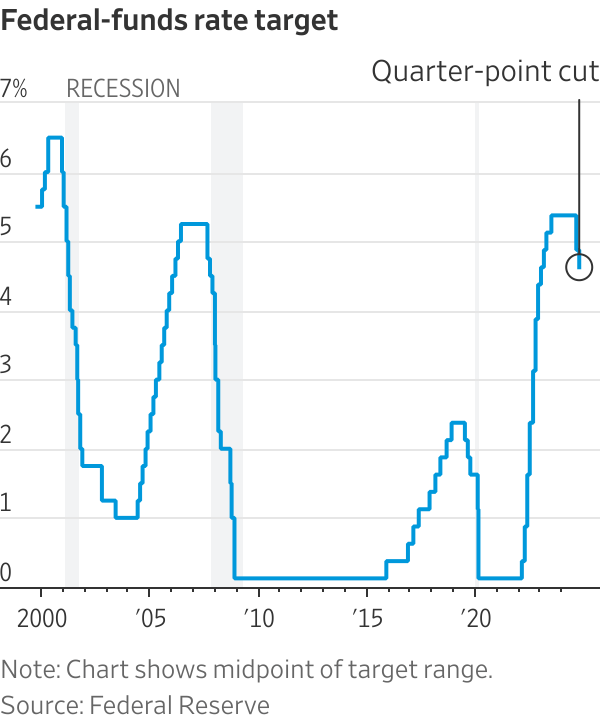
Tuesday’s retail sales report could be the scrap of evidence that tips the balance as Federal Reserve officials decide how much to cut interest rates on Wednesday.

It is practically a given that the central bank will reduce rates. Inflation has fallen to its lowest point since February 2021, giving the Fed more flexibility to focus on the second component of its dual mandate—achieving maximum employment. Although the labor market remains resilient, the most recent two jobs reports have been weaker than expected, putting some pressure on the Fed to loosen monetary policy.

The question now is by how much rates will fall—0.5 percentage point, or 0.25 point? The indications from interest-rate futures are split , recently favoring the more aggressive half-percentage-point decrease.

Andrew Hollenhorst, an economist at Citi , leans toward the likelihood the Fed is more cautious on Wednesday, cutting rates by 0.25 percentage points. But he notes that it it is a close call that depends on the dynamics of the bank’s rate-setting committee and the strength or weakness of Tuesday’s retail sales report.

A positive surprise would suggest that both consumers and the labor market remain resilient, paving the way for a more modest cut. If the report comes in well below expectations, however, Fed officials may grow concerned that a weaker labor market is weighing on consumer spending, which could lead to a bigger cut, Hollenhorst added.

Louis Navellier, founder and chief investment officer of the money-management firm Navellier agrees. “In theory, if the August retail sales report is horrible, then a 0.5% Fed key interest rate cut may be forthcoming on Wednesday,” he said.

Economists are expecting retail sales will decline by 0.2% in August from July, according to FactSet. They jumped by a surprising 1% in July .

Lower gasoline prices and car sales will likely drag the headline number lower. Indeed, stripping out car and gas sales, retail sales are projected to increase by about 0.3% month over month.

Yet there is growing concern that even excluding autos and gas sales, the sales figure will be soft. While spending was remarkably strong in July, the Fed’s latest Beige Book flagged that consumer spending ticked down in August, points out Bill Adams, chief economist for Comerica Bank . Many retailers, particularly those catering to lower-income shoppers, have warned that Americans are being cautious and exceedingly choosy about what they are buying and where.

The impact of the retail sales report will likely extend beyond the immediate rate cut. The insights it contains about U.S. consumers will also factor into the Fed’s quarterly update to its Summary of Economic Projections, containing officials’ latest forecasts for the U.S. economy, inflation, and near-term interest rates.

The so-called dot plot , which charts the individual interest-rate projections of the seven members of the Fed’s board of governors and the 12 regional Fed presidents, is always closely watched as investors try to chart the Fed’s future actions.

Hollenhorst believes the median dot showing where rates will be at the end of 2024 should show “at least” 0.75 percentage-point of cuts, factoring in 0.25 point at each meeting through the end of the year. But it is likely that officials will leave the door open for more cuts in case data on the job market or consumer spending sour faster than expected.

Michael Jordan Scores a Buyer for His Chicago Megamansion After More Than a Decade

Michael Jordan has found a buyer for his Chicago estate after more than 12 years.

The 7-acre compound, custom built for the basketball legend in the ’90s in the area’s Highland Park suburb, first hit the market in 2012 asking $29 million. By 2015, the price on the nine-bedroom home was reduced to $14.855 million—the digits of which add up to 23, Jordan’s jersey number—and it’s remained at that price ever since.

Spanning over 32,000 square feet on Point Lane, the home reflects the larger-than-lifeness of its owner, with 19 bathrooms, five fireplaces, a regulation-sized basketball court, a massive weight room where Jordan used to train, and a built-in aquarium, according to the Wall Street Journal.

The sale was first reported by Crain’s Chicago Business.

Outside the home, there is a tennis court, a putting green and a circular infinity pool with its own island, accessible by a small bridge. There are plenty of circular touches throughout, including a round skylight above a circular eat-in kitchen, an arched wine cellar and a circular sitting room with views directly onto the basketball court.

A large lounge area that was once an indoor pool includes glass sliding walls on either side that can open up completely during Chicago’s milder months.

Other unique features include doors from the original Playboy Mansion, a three-bedroom guesthouse and the number 23 emblazoned on the front gate.

Compass agent Katherine Malkin, who is marketing the property, confirmed the pending sale to The Athletic. Malkin did not respond to a request for comment, and the buyer and price were not immediately available. Jordan could not immediately be reached for comment.

It’s unlikely to exceed the asking price. A year after the home first hit the market in 2012, Jordan decided to sell via auction, but the home failed to even meet the reserve bid of $13 million. Despite the lack of movement, Jordan has not dropped the asking price any further since 2015.

Homes in Highland Park, a wealthy suburb of Chicago can fetch upward of $5 million, but Jordan’s home has been the priciest option on the market for a long time. Fellow Chicago Bulls legend Scottie Pippen sold a nearby home in 2023 after a five-year wait. That home, which Pippen bought for $2.6 million in 2004, sold for $1.7 million two decades later, according to Realtor.com.

It seems that despite the home court advantage, this is one game that Jordan has not been able to win.

China’s Troubles Are Hitting Home for U.S. Companies

For years, global companies showcased their Chinese operations as a source of robust growth. A burgeoning middle class, a stream of people moving to cities, and the creation of new services to cater to them—along with the promise of the further opening of the world’s second-largest economy—drew companies eager to tap into the action.

Then Covid hit, isolating China from much of the world. Chinese leader Xi Jinping tightened control of the economy, and U.S.-China relations hit a nadir. After decades of rapid growth, China’s economy is stuck in a rut, with increasing concerns about what will drive the next phase of its growth.

Though Chinese officials have acknowledged the sputtering economy, they have been reluctant to take more than incremental steps to reverse the trend. Making matters worse, government crackdowns on internet companies and measures to burst the country’s property bubble left households and businesses scarred.

Lowered Expectations

Now, multinational companies are taking a hard look at their Chinese operations and tempering their outlooks. Marriott International narrowed its global revenue per available room growth rate to 3% to 4%, citing continued weakness in China and expectations that demand could weaken further in the third quarter. Paris-based Kering , home to brands Gucci and Saint Laurent, posted a 22% decline in sales in the Asia-Pacific region, excluding Japan, in the first half amid weaker demand in Greater China, which includes Hong Kong and Macau.

Pricing pressure and deflation were common themes in quarterly results. Starbucks , which helped build a coffee culture in China over the past 25 years, described it as one of its most notable international challenges as it posted a 14% decline in sales from that business. As Chinese consumers reconsidered whether to spend money on Starbucks lattes, competitors such as Luckin Coffee increased pressure on the Seattle company. Starbucks executives said in their quarterly earnings call that “unprecedented store expansion” by rivals and a price war hurt profits and caused “significant disruptions” to the operating environment.

Executive anxiety extends beyond consumer companies. Elevator maker Otis Worldwide saw new-equipment orders in China fall by double digits in the second quarter, forcing it to cut its outlook for growth out of Asia. CEO Judy Marks told analysts on a quarterly earnings call that prices in China were down roughly 10% year over year, and she doesn’t see the pricing pressure abating. The company is turning to productivity improvements and cost cutting to blunt the hit.

Add in the uncertainty created by deteriorating U.S.-China relations, and many investors are steering clear. The iShares MSCI China exchange-traded fund has lost half its value since March 2021. Recovery attempts have been short-lived. undefined undefined And now some of those concerns are creeping into the U.S. market. “A decade ago China exposure [for a global company] was a way to add revenue growth to our portfolio,” says Margaret Vitrano, co-manager of large-cap growth strategies at ClearBridge Investments in New York. Today, she notes, “we now want to manage the risk of the China exposure.”

Vitrano expects improvement in 2025, but cautions it will be slow. Uncertainty over who will win the U.S. presidential election and the prospect of higher tariffs pose additional risks for global companies.

Behind the Malaise

For now, China is inching along at roughly 5% economic growth—down from a peak of 14% in 2007 and an average of about 8% in the 10 years before the pandemic. Chinese consumers hit by job losses and continued declines in property values are rethinking spending habits. Businesses worried about policy uncertainty are reluctant to invest and hire.

The trouble goes beyond frugal consumers. Xi is changing the economy’s growth model, relying less on the infrastructure and real estate market that fueled earlier growth. That means investing aggressively in manufacturing and exports as China looks to become more self-reliant and guard against geopolitical tensions.

The shift is hurting western multinationals, with deflationary forces amid burgeoning production capacity. “We have seen the investment community mark down expectations for these companies because they will have to change tack with lower-cost products and services,” says Joseph Quinlan, head of market strategy for the chief investment office at Merrill and Bank of America Private Bank.

Another challenge for multinationals outside of China is stiffened competition as Chinese companies innovate and expand—often with the backing of the government. Local rivals are upping the ante across sectors by building on their knowledge of local consumer preferences and the ability to produce higher-quality products.

Some global multinationals are having a hard time keeping up with homegrown innovation. Auto makers including General Motors have seen sales tumble and struggled to turn profitable as Chinese car shoppers increasingly opt for electric vehicles from BYD or NIO that are similar in price to internal-combustion-engine cars from foreign auto makers.

“China’s electric-vehicle makers have by leaps and bounds surpassed the capabilities of foreign brands who have a tie to the profit pool of internal combustible engines that they don’t want to disrupt,” says Christine Phillpotts, a fund manager for Ariel Investments’ emerging markets strategies.

Chinese companies are often faster than global rivals to market with new products or tweaks. “The cycle can be half of what it is for a global multinational with subsidiaries that need to check with headquarters, do an analysis, and then refresh,” Phillpotts says.

For many companies and investors, next year remains a question mark. Ashland CEO Guillermo Novo said in an August call with analysts that the chemical company was seeing a “big change” in China, with activity slowing and competition on pricing becoming more aggressive. The company, he said, was still trying to grasp the repercussions as it has created uncertainty in its 2025 outlook.

Sticking Around

Few companies are giving up. Executives at big global consumer and retail companies show no signs of reducing investment, with most still describing China as a long-term growth market, says Dana Telsey, CEO of Telsey Advisory Group.

Starbucks executives described the long-term opportunity as “significant,” with higher growth and margin opportunities in the future as China’s population continues to move from rural to suburban areas. But they also noted that their approach is evolving and they are in the early stages of exploring strategic partnerships.

Walmart sold its stake in August in Chinese e-commerce giant JD.com for $3.6 billion after an eight-year noncompete agreement expired. Analysts expect it to pump the money into its own Sam’s Club and Walmart China operation, which have benefited from the trend toward trading down in China.

“The story isn’t over for the global companies,” Phillpotts says. “It just means the effort and investment will be greater to compete.”

Corrections & Amplifications

Joseph Quinlan is head of market strategy for the chief investment office at Merrill and Bank of America Private Bank. An earlier version of this article incorrectly used his old title.

Boeing Stock Got Hammered. Why This Analyst Downgrade Terrified Investors.

Boeing stock has fallen to its lowest level since 2022 after a downgrade from a Wall Street analyst put a number on one of investors’ worst fears: stock dilution.

Wells Fargo analyst Matthew Akers on Tuesday downgraded Boeing stock to the equivalent of Sell from Hold. His price target was reduced to $119 a share from $185.

That is the lowest target price on Wall Street by almost $70 a share, according to FactSet. At $119 a share, down about 30% from recent levels, Boeing would have a market value of roughly $73 billion, levels not seen since early 2020 during the Covid-19 pandemic.

Boeing stock closed down 7.3% at $161.02, while the S&P 500 and Dow Jones Industrial Average were off 2.1% and 1.5%, respectively. It was the lowest close since Nov. 4, 2022, when it finished at $160.01, according to Dow Jones Market Data.

“We think Boeing had a generational free cash flow opportunity this decade, driven by ramping production on mature aircraft and low investment need,” wrote Akers. “But after extensive delays and added cost, we now see growing production cash flow running into a undefined new aircraft investment cycle, capping free cash flow a few years out.”

At this point in its product cycle, Boeing simply should be generating north of $10 billion in free cash flow a year. However, production and quality problems have pushed output lower and added costs. Wall Street sees Boeing using almost $8 billion in cash to fund operations in 2024.

What is more, Boeing likely will need to design a new single-aisle jet in the coming years to better compete with the Airbus A321 family of aircraft. That will take tens of billions of dollars spread out over several years.

Akers sees $30 billion in equity being raised by 2026 to help cover the cost of new investment. Some of that hefty total will go toward repairing Boeing’s balance sheet. The company ended the second quarter with more than $53 billion in long-term debt, up from less than $11 billion at the end of 2018, before the pandemic and significant problems with Boeing’s 737 MAX jet.

Raising $30 billion of equity at recent prices would require issuing roughly 190 million new shares, increasing the share count by about 31%. All things being equal, a higher share count reduces earnings per share.

“If Boeing were to postpone new plane development for several more years (launch early next decade) and instead just pay down debt, we estimate free cash flow per share could grow to about ~$20 late this decade,” added Akers. That might justify a $150 share price in coming years, but postponing a new plane would mean “ ceding significant narrowbody share” to Airbus.

Narrowbody is industry jargon for single-aisle aircraft such as the 737 MAX or A320.

Raising equity and offering customers a new plane, or not offering a new jet and holding off on raising equity: Boeing doesn’t have easy choices to make in coming years.

Overall, 60% of analysts covering Boeing stock rate shares at Buy, according to FactSet. The average Buy-rating ratio for stocks in the S&P 500 is about 55%. Even though Boeing’s Buy-rating ratio is above average, it has been sliding. Coming into the year, before an emergency- door plug blew out in midair on an Alaska Air flight on Jan. 5, the ratio was north of 75%.

The average analyst price target for Boeing shares is about $214.