Skip Busy Mykonos. Greece’s Holiday House Hunters in the Know Turn to This Alternative.
This peninsular region has beaches, mountains and luxury homes at much lower prices than in the popular Cyclades islands
By MICHAEL KAMINER
Mon, Nov 11, 2024 7:00am 6min
Kassandra is the most developed part of Halkidiki, in Greece’s northern Macedonia region.
Getty Images
Three peninsulas make up Halkidiki, an 1,130-square-mile area in Greece’s northern Macedonia region. Like a trident, Athos, Sithonia and Kassandra stretch into the Aegean sea.
Of the three, Kassandra “is the most developed part of Halkidiki,” according to Theodor Nikolaou, an agent with Engel & Völkers Greece in Thérmi. “Activity started in the 1970s and ’80s, and just continued, especially in coastal villages.”
While lower-profile and less touristed than Greek islands like Santorini or Mykonos, Kassandra still boasts sought-after restaurants, nightclubs and shops, said Ioanna Paloka, an agent with Savills Greece in Thessaloniki. “People prefer to buy here because of the amenities, the beautiful beaches, and the mixture of commercial and residential development,” she said. Beaches including Polychrono Beach, Hanioti Beach and Pefkochori Beach boast clear waters, soft sand and postcard-perfect coastal scenery.
Boundaries
Kassandra is the westernmost of Halkidiki’s peninsulas, and the most populated. At about 128 square miles, Kassandra descends from Cassandreia, its northernmost city, to the Aegean Sea. Kassandra is also the nearest peninsula to Thessaloniki, Greece’s second-largest city, and its international airport. “It’s the most accessible part of Halkidiki,” Paloka said.
Seaside locations are most coveted for luxury property, according to Nikolaou. They include the village of Sani, on the west side of Kassandra; Pefkochori, on the peninsula’s east side; and the area around Glarokavos Harbour, just south of Pefkochori. “The combination of sun, the blue of the sea, and the green of pine draws people from around the world,” he said.
Kassandra’s most exclusive locations are Sani, the east-peninsula village of Paliouri, Possidi in the southwest, and Pefkohori, Pakola said.
Thessaloniki is about 60 miles northwest of central Kassandra. Thessaloniki Airport Makedonia, the regional international airport, is a few miles further west. Athens is about 350 miles south.
Price Range
Beachfront properties in Kassandra command premium prices, Paloka said. “Most people at the high end prefer to buy beachfront.” Prices range from €3,000 (US$3,243) to €6,000 per square meter, she said. “For €6,000 per square meter, you’re buying about 20,000 square meters of land with a 1,000-square-meter house, a swimming pool, very modern, in a new development by the sea and surrounded by forests.”
For €5 million in Sani, Savills has listed a 350-square-meter home with six bedrooms and three bathrooms on about 17,000 square meters of land with sea views. In a new development in the village of Siviri, Savills is offering 350-square-meter beach-adjacent homes with seven bedroom suites, private pools, and garages for €2.05 million. Siviri, on Kassandra’s west side, is popular with tourists for its clusters of bars and cafes.
This Sani home is asking €2.7 million. Listglobally
Prices across Kassandra “depend on the distance from the sea,” said Nikolaou of Engel & Volkers Greece. “The closer you are, and the more private the property, the higher the price.” While prices average €2,500 to €4,000 per square meter across Kassandra, they can soar to €8,000 to €10,000 “for the best beachfront luxury property,” he said.
In Pallini, on Kassandra’s east coast, Engel & Volkers is offering an oceanfront hilltop estate on more than 4,000 square meters of land, with nine bedroom suites and amenities including a wine cellar and full bar. Built in 1991, the property is listed for €4,500,000.
The most expensive Kassandra listing in October was a 10-bedroom, 1000-square-meter Sani villa with sea views and a pool for €17,000,000, offered by the Hellenic Property agency.
Housing Stock
In the coastal parts of Kassandra undergoing rapid development, architecture is almost uniformly modern. “There are three types of homes here. Apartments and villas, which aren’t as hot. Multi-home complexes with sea views, which are better. And private luxury beachfront properties, which are at the top.”
Older and even “ancient” properties are common in Kassandra’s mountainous inland regions, according to Nikolaou. “These traditional stone houses in some of the old villages can qualify as luxury homes once they’re renovated, but many require extensive work,” he said. The village of Agia Paraskevi, in south-central Kassandra, has also become a popular tourist destination for its thermal spas and ancient churches.
Seaside locations are most coveted. Getty Images/imageBROKER RF
The higher end of the market consists almost exclusively of detached, modern homes, said Paloka. “Condominiums make up the lower end of the market here,” she said. “And there are almost no historical buildings in the most sought-after coastal areas.”
Luxury Amenities
Greek and international buyers are discovering Kassandra as an alternative to tourist hubs like Mykonos and Santorini. “The fact that Kassandra is not the islands is an amenity in itself,” Paloka said. “It’s very private, relaxed and peaceful, without that madness. Most of the infrastructure here only appeared over the last 10 years.” For golf and tennis, most locals frequent the seaside Sani Resort, which operates private athletic clubs along with its five high-end hotels. Most complexes also have private pools, according to Nikolaou of Engel & Volkers.
MORE : Republican Fundraiser and Rockstar Energy Drink Founder Russell Weiner Lists $47 Million Park City, Utah, House
As Kassandra’s profile has risen, its restaurant scene has flourished, with high-end eateries including Metoxi, in a temple-like stone building with sunset views; “creative Greek” spot Giria Elia in Pefkohori’s Hotel Anna Maria; and Kriopigi’s Fiki Fiki, the first Asian-Peruvian fusion restaurant in Halkidiki. Several private medical clinics operate on the peninsula, including the 24-hour Kassandria’s Health Center and Primary Medical Care of Pefkochori.
What Makes It Unique
“Kassandra is a picturesque environment, surrounded by forest, with clean, beautiful, crystal-clear seas,” said Paloka. “The proximity to Thessaloniki also makes it unique. You’re just an hour from the city centre, but you can enjoy all Kassandra has to offer.”
Kassandra’s annual Sani Festival brings A-list musical talent to the peninsula every year; the 2024 edition saw stars including Placido Domingo, Madeleine Peyroux, Tom Jones, and Emeli Sande on the roster.
Who Lives There
Nearly 40% of buyers in Kassandra are “from central Europe, especially German-speaking countries,” Nikolaou said. “They see the Mediterranean, and this part of Greece, as the Florida of Europe. They want a home in the region to use in retirement.” Another 25% of buyers come from the Balkans, including Bulgaria and Romania, “and other countries without direct access to the Mediterranean Sea. This is the first possible access for them,” he said. An additional 15% of buyers hail from Israel and the Middle East. “Thessaloniki once had a significant Jewish population, and Israelis love it. They want to invest here,” Nikolaou said. Just a handful of buyers come from North America, he added.
Kassandra is picturesque. Getty Images
Kassandra’s largest, most extravagant villas belong to Greeks, according to Paloka of Savills. But those owners are starting to take their profits. “Those properties had been second homes, and the Greek owners are now selling to mostly European buyers,” she said.
Greece’s golden visa program, which grants a five-year residency permit in exchange for a minimum real-estate purchase, has attracted “a huge number of foreigners, but to less expensive properties,” Paloka said. In October, however, the Greek government raised the minimum investment for a golden visa to €800,000 from €250,000 in sought-after destinations including Halkidiki, the region where Kassandra is located.
Notable Residents
Swiss-based Greek billionaire Aristotеlis Mistakidis “has bought a lot of property in Halkidiki, including a villa in Glarokavos,” Nikolaou said. Brad Pitt and Angelina Jolie vacationed in Kassandra when they were an item, and John Travolta and Robert De Niro “spend summers in Kassandra with their families,” Nikolaou said.
Outlook
“Consistency” is the hallmark of the market in Kassandra, said Paloka of Savills.
“Prices may have gone up on lower-end properties, but prime estates have stayed the same or maybe dropped just a bit. What’s key is that it’s more affordable than the islands, and a better value for your money.” Kassandra’s rental market is also “extremely strong, year-round,” meaning owners can generate revenue from their properties, she said. “Even at Christmas, people love coming here. The islands are great, but you can’t get flights there all year―you have to take a ferry off-season.”
Nikolaou, however, said that “the demand for second homes means prices will continue to increase.” He also noted that property prices per square meter “are much more of a value for the money, especially for beachfront properties.”
Investors “are now looking to Kassandra and Halkidiki to develop new tourist areas,” Nikolaou said. “They don’t want to go to the islands. If you count the kilometres of seashore here, it’s like you have 100 islands. And it’s sunny the whole year.”
Copyright 2020, Dow Jones & Company, Inc. All Rights Reserved Worldwide. LEARN MORE
BNW Developments has established a Sydney presence, joining Arada and Sobha Realty among the growing number of UAE developers pursuing Australian buyers and development opportunities.
The Australian leather house has opened an immersive four-day pop-up in Manhattan, unveiling its Bloom Collection and redefining what a product launch can look like.
Related Stories
Lifestyle
How Lego Is Getting More Adults to Tinker With Their Toy Bricks
By Saabira Chaudhuri 19/10/2026
Lifestyle
Apple Joins Nvidia in the $5 Trillion Valuation Club
By Rolfe Winkler 15/10/2026
Lifestyle
AI Agents Are a Threat to Travel Businesses. Airbnb Could Still Be a Winner.
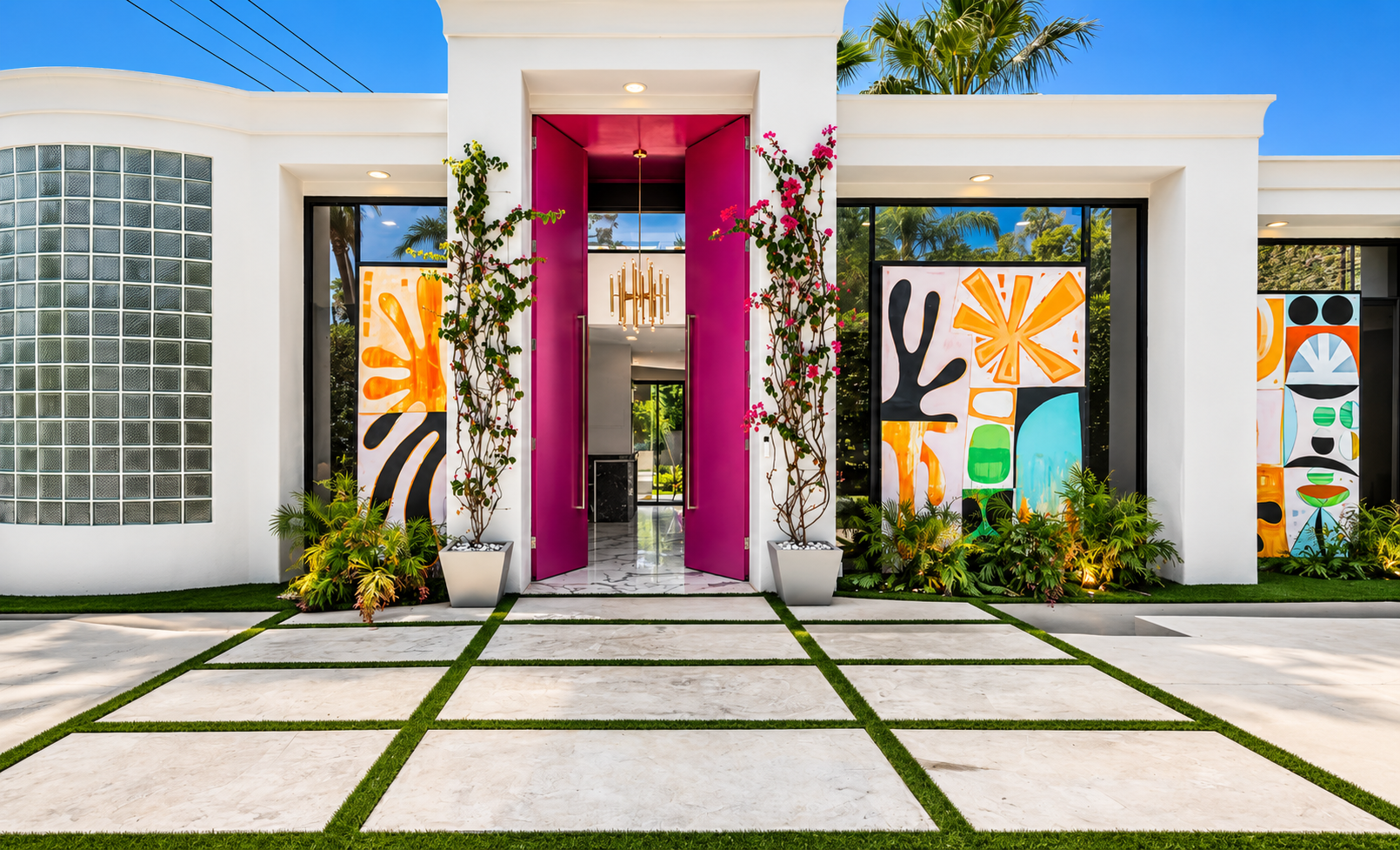
A vibrant 1954 Palm Springs home featuring eight colorful murals by late artist Shawn Savage is on the market for $2.295 million. The 2,237-square-foot property features bold hot-pink doors, three bedrooms, a pool, mountain views and playful interiors blending modern glamour with classic Palm Springs style.
By Chava Gourarie
Mon, Oct 5, 2026 3min
A bold 1950s home in Palm Springs, California, adorned with eight colorful murals by the late artist Shawn Savage, is coming to market ahead of the city’s annual Modernism Week.
The white stucco home on El Camino Way, built in 1954 and recently renovated, has an asking price of $2.295 million. Its staggered facade features three playfully abstract murals on either side of double-height hot pink doors.
The sellers are Los Angeles-based partners John Freeman and Mathieu Faure, who knew it was “the one” when they saw it after several months of searching in the winter of 2023. “It’s a happy house,” Freeman said. “We really liked the feel of the house: the uniqueness, the openness, the brightness—and the art.”
Located in the Mesa neighborhood of Palm Springs, which backs up to the San Jacinto Mountains, the 2,237-square-foot house features three bedrooms, an angled bonus room and a yard with a pool, desert mountain views and another colorful mural running alongside the pool.
“I never thought in my life I would have a house with pink doors,” said Faure, a producer at Apple TV who is originally from Paris. “It’s so colorful, it’s so different. And so Palm Springs.”
Abstract murals can be found on the facade.Patrick Ketchum
The layout of the home creates a smooth flow from the front doors through the open-plan common area—a foyer, bar, and living and dining room—into the kitchen around a fireplace wall and out to the yard. A corridor leads to a private bedroom wing, where the primary suite has floor-to-ceiling windows and the primary bath is only a tad smaller than the bedroom.
Faure has filled the home with Jonathan Adler furniture, rugs and accessories, riffing on the energetic California vibes of the house to create an aesthetic of “modern American glamour,” he said.
“It was enjoyable for me to play with different types of furniture and make this house ‘happy chic,’ as I describe it,” he said.
“He did a fantastic job,” said Freeman, who is an attorney and consultant. “It does kind of bring a smile to my face whenever I walk into the house.”
Since the furniture and decor were chosen for the particularities of the space, the couple is open to selling them with the home. Their West Hollywood house is already furnished; the collection doesn’t match the vibes of a Houston loft they bought near family; and Faure can’t imagine these pieces in New York—where he’s lived in the past—he said.
The duo bought the Palm Springs house for $1.925 million in 2024, according to property records, and will list the home Monday. They are represented by Stewart Smith, Patrick Jordan and Kevin Stanley of Bennion Deville Homes/Luxury Portfolio International.
The previous owners had purchased the home in 2021 for $975,000 and then spent more than two years and $700,000 on the renovation, according to Realtor.com. They commissioned Savage, a local Palm Springs artist and painter known for his joyful abstract work, to decorate the home.
Savage, who died in 2024, lived in the Coachella Valley from 2003, and his work can be found in various local institutions and is on exhibit at the Illumine Gallery in Palm Springs. “Some artists pass through a place. Shawn Savage became a part of it,” the gallery’s description states.
Unsurprisingly, the murals invite lots of friendly conversations, as well as guided tours and interested lookers, but never to a degree that it disturbed the peacefulness of their home or the neighborhood, the sellers said. “It felt like living in an art gallery, and you have the exterior that you would share with the world,” Faure explained.
The neighborhood also played a role in their decision to buy, because of its access to the hiking trails of the San Jacinto Mountains, the lack of through-roads and the neighborly environment.



 6 min
6 min


 Copyright 2020, Dow Jones & Company, Inc. All Rights Reserved Worldwide.