The Rise of Million-Dollar Companies With Just One Employee - Kanebridge News
Share Button

The Rise of Million-Dollar Companies With Just One Employee

Artificial intelligence is making it easier than ever to build a business without building a team. As AI takes over coding, customer support, marketing, administration, and other day-to-day tasks, a growing number of solo founders are scaling startups to millions in revenue with few—or even no—employees. While the trend is lowering barriers to entrepreneurship, it is also reshaping hiring, raising questions about the future of work and how businesses will grow in the AI era.

By
Thu, Jul 30, 2026 5:08pmGrey Clock 5 min

Ben Broca launched a company last December that offers AI tools to entrepreneurs. He’s already added 10,000 paying customers and is on track to bring in $10 million in revenue this year.

One thing he hasn’t added: any other employees.

The 40-year-old is part of a class of entrepreneurs who are launching, and then often running, new companies on their own. Artificial intelligence tools answer Broca’s emails, help write and debug code, field requests from customers, sign up new subscribers and grant refunds when issues arise.

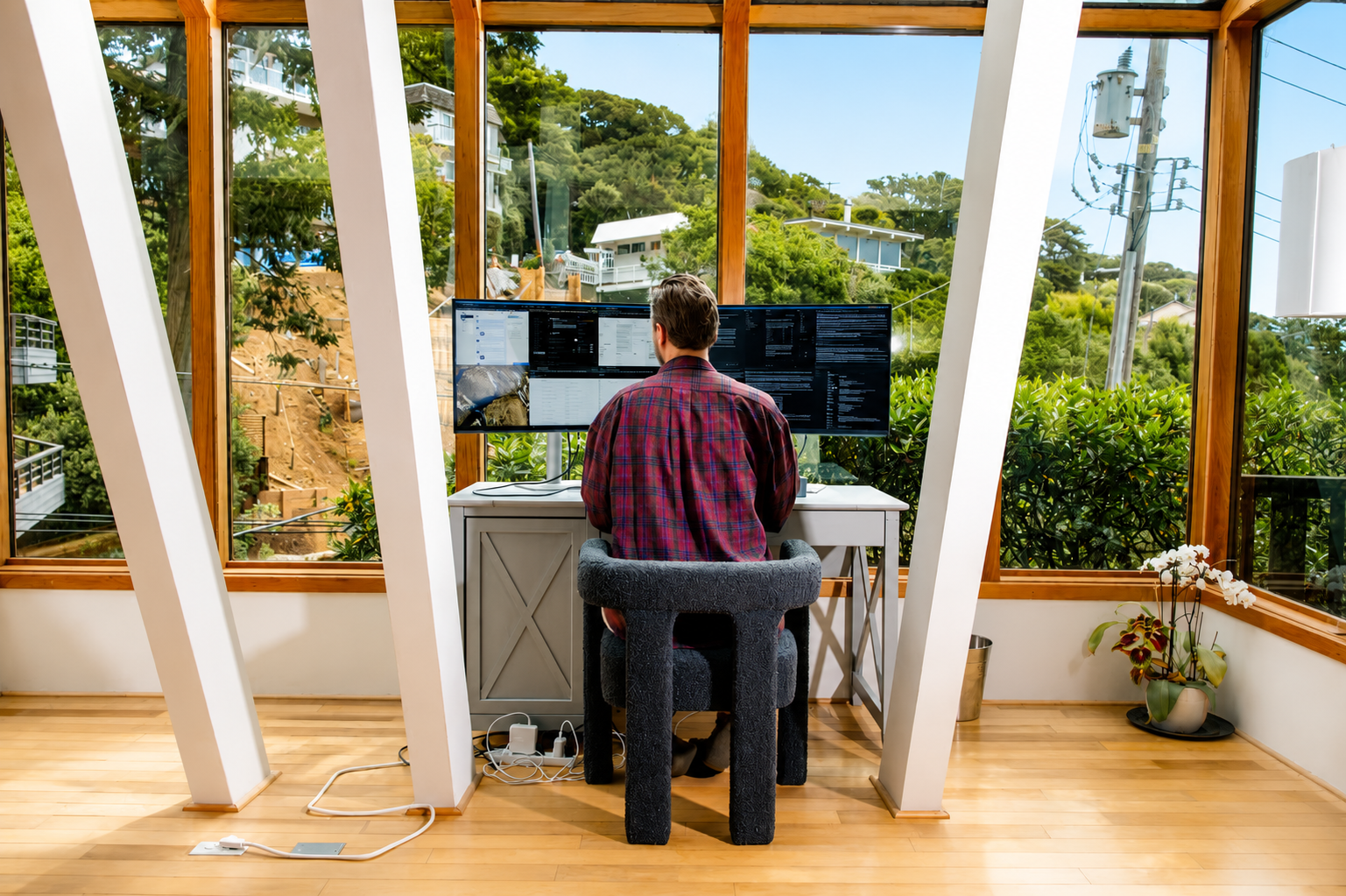
Broca relishes his ability to make whatever decisions he wants on his own, often from his sun-drenched Sausalito, Calif., living room. “I think compromises make lukewarm results,” he said.

Once upon a time, running a business of a certain size required a team. AI is turning that assumption upside down, and more aspiring entrepreneurs are going it alone.

Ben Broca sitting in his home office.
Tech has seen an explosion of solo founders in the past year. Broca said he likes being able to work at his own speed, unencumbered by a team. Jonah Reenders for WSJ

An analysis by the payments company Stripe shows there are thousands of solo operators on the company’s platform that are generating over $1 million in revenue, with their ranks doubling between 2023 and 2025. The number of solo operators crossing the $10 million threshold nearly tripled in that same span.

In the past, people without business contacts or particular savvy might not have known how to get their ideas off the ground, said Ernie Tedeschi, Stripe’s chief economist. “Now, AI can be a built-in business partner,” he said.

AI’s ability to handle various administrative tasks makes it potentially useful for launching solo businesses in many fields. But the technology’s ability to also handle key tasks in tech, like coding, make that field a particular hot spot.

Analyzing Census Bureau data, Bank of America Institute economist Taylor Bowley found that among all industries, new business applications in the information sector have seen the biggest percentage increase—nearly 45%—over the past year. At the same time, the rate of information-sector applicants saying they plan to hire workers has experienced the sharpest decline of any measured industry.

This Census dataset doesn’t track solo-operated businesses. But the numbers broadly show—in tech and beyond—that applications are flat among businesses likely to hire workers, but generally rising elsewhere. Economists say that’s a strong sign that solo operators are on the upswing.

“The bar for getting started has never been lower,” said Julian Weisser, who runs a San Francisco-based accelerator for solo founders working in tech. The accelerator—which offers founders seed money and mentorship in exchange for an equity stake—attracted 4,500 applicants for 10 slots made available in its most recent cycle, nearly five times the number it drew when it launched last May.

Going it alone with AI can still be surprisingly expensive. Broca said he was losing money on many customers’ accounts while paying to access Anthropic’s Claude to run his clients’ requests—that AI company, as well as others, charges based on usage. He has since switched to free open-source AI models from China.

Broca said he has raised $30 million from investors and, at the same time, has saved millions in salary since he hasn’t needed a team of software engineers.

Another risk: If it’s easy for one entrepreneur to launch an AI-assisted business, copying them can be easy, too. This creates anxiety for founders like Troy Johnston, who runs an AI-assisted business alone in Orlando, Fla.

“Everybody has the sword and we all have the ability to unsheathe Excalibur now,” said Johnston, 40, who used AI to code an app that helps people get the most out of credit card benefits. The company makes around $3,000 a month in profit, with no employees, and is continuing to grow.

Headshot of Troy Johnston.
Troy Johnston said AI’s power and ease of use is an incredible boon for entrepreneurs like him—and also a double-edged sword. Luann Koerper

What one-person businesses will mean for the labor market remains to be seen. Polling has shown Americans are worried that AI will replace jobs, and top economists are wrestling with that possibility, too. But AI is also creating lots of new jobs, and the go-it-alone entrepreneurs show how the technology can both open doors and limit employment opportunities.

“If everyone’s hiring less, but you get four times more firms, what does that do to head count?” said Rembrand Koning, an associate professor at Harvard Business School who studies entrepreneurship. He co-authored a recent study that found that among 50,000 startups the researchers examined, those focused on AI tended to operate with 25% fewer employees.

Koning also believes a soft hiring environment that’s left some people mired in long job searches has encouraged more to try their hand at launching businesses.

Some founders cite different motives. “It’s a perfect storm of post-pandemic burnout and a re-evaluation of one’s priorities, and also booming AI and a sense of what’s possible,” said Samir Ahmad, 39, who lives in Breinigsville, Pa.

Two years ago, Ahmad decided to leave the corporate job he had worked at Verizon for almost two decades to start a solo coaching and consulting business. He had been seeing social-media posts touting the ease and virtues of AI, which he used to chart a business plan and help with marketing. “It was like my chief of staff, a second in command,” he said.

The business ultimately petered out within months, though, and Ahmad is now back to a full-time corporate role with a utility company.

For Claire Vo, 41, AI helped her turn a passing impulse into a business. She was working full-time as a tech executive when she tapped AI in late 2023 to help code an app that would help her manage documentation and design for new products, with customers ranging from financial services to healthcare firms.

“I was copying and pasting from ChatGPT,” said Vo, who lives in San Francisco.

Claire Vo smiling into the camera while recording a podcast.
Claire Vo used AI to code an app that’s on track to make seven figures in profit this year. Claire Vo

She put the app online for $1 a month, and within weeks people downloaded it thousands of times. Nearly three years later, Vo’s company—which she ran solo for nine months before hiring an engineer—now has 100,000 users and is on track to make seven figures in profit this year. AI handles the company’s marketing, sales and customer support.

While AI is a shortcut, Vo said her network and credibility in the industry were key. “I think people over-index on how easy AI is and under-index on how much I did to get to this point,” she said.


MOST POPULAR

The Australian leather house has opened an immersive four-day pop-up in Manhattan, unveiling its Bloom Collection and redefining what a product launch can look like.

Following the successful launch of its Palais Collection, MAISON de SABRÉ has unveiled a new modular handbag system offering more than 720 styling combinations.

Related Stories
Lifestyle
How to Outsmart AI When It’s Tracking Your Workday
By Callum Borchers 20/08/2026
Lifestyle
Meta PR Goes Back to Playing Offense
By Adam Levine 13/08/2026
Lifestyle
Why Apple Stock Just Got Downgraded to Sell
By 11/08/2026

As AI productivity trackers reshape workplace evaluations, employees are learning how to manage calendars, activity levels and AI usage to ensure their contributions are recognized.

By Callum Borchers
Thu, Aug 20, 2026 4 min

What’s more important than being a good employee right now? Looking like a good employee in the eyes of AI productivity trackers that more managers are using to evaluate their teams.

Employee-monitoring systems are especially popular at tech companies and are also used by other white-collar firms that want to probe how people spend company time. The scary thing: You might not even know you’re being watched because many states don’t require disclosure.

Metrics can include performance data that is undoubtedly relevant, such as sales results. But it also can employ dubious proxies like keyboard strokes and how often your computer screen goes into sleep mode.

We generally accepted, or at least understood, heightened surveillance during the work-from-home era. Back then it seemed reasonable for bosses to keep tabs on employees they couldn’t see.

Yet the oversight has only escalated, and tensions are rising, too.

A group of former Meta Platforms employees alleges in a lawsuit that the company used a “constellation of internal artificial-intelligence systems” when it began laying off about 10% of its workforce in May. Meta says humans make termination calls.

However that case shakes out, a couple of things are clear. Companies eager to gauge which employees are locked in now have sophisticated AI monitoring systems at their disposal. And they believe they have leverage in a tepid labor market.

So while we may chafe at having our worth reduced to numbers on the boss’s productivity dashboard, we have to play the game as it’s being played. Here are some tips, based on conversations with people who make employee monitoring systems—and others who game the systems.

Be meticulous about your calendar

Calendar integration is one way that productivity trackers have gotten more advanced and, ostensibly, fairer.

Let’s say you make an old-fashioned phone call or attend an in-person meeting. Your Outlook or Slack status may switch to “away,” making you appear as inactive as if you were taking an extended coffee break.

Employee monitors like one made by a company called Insightful cross-check your online status with your calendar to see whether there is a valid reason for your apparent inactivity. If that call or meeting is on your schedule, then the system will recognize that you are busy offline. If nothing is on the books, it could look like you’re slacking off.

Hit the activity sweet spot, around 80%

Let’s not go any further without addressing the underlying question: How much downtime is permissible during the workday? After all, people have been scared to let managers see anything non-work-related on their screens since personal computers first arrived in offices.

No one knows this better than Roger Wagner, who is widely credited with creating the first “boss button” in the early 1980s. He designed a keyboard shortcut to instantly display a spreadsheet if the boss walked by your cubicle while you were playing a computer game. Boss buttons have been features of countless diversions since. (I confess to using one built into a March Madness streaming app.)

Wagner, the founder of computer-education company 1010 Technologies, says his original design was a joke—more of a commentary on overbearing managers than a cover for lazy employees. Good bosses understand workers need mental breaks throughout the day, he says.

This matches what I heard from Insightful Chief Executive Ivan Petrovic. He says customers that use his company’s workforce-management platform don’t expect employees to stay on task 100% of the time.

“On average companies are aiming for 60% to 80% of your time being utilized for work during the day,” he says.

Go ahead and exhale. It’s probably OK to watch an occasional YouTube video at your desk.

And if you’re going to artificially inflate your activity level, be careful. Hitting 90% could look suspicious.

Get physical

So don’t leave your mouse jiggler on all day. Choose the right one if you must resort to shenanigans.

There are lots of software applications that mimic the movements of a computer mouse, so you can appear to be working while away from your desk. There are also devices that plug into computer ports and do the same thing.

Corporate cybersecurity systems increasingly block these apps and devices, and productivity trackers claim to be able to detect them. But some workers swear by mouse docks, like one made by Tech8 USA, that keep cursors moving. The company originally made mouse-moving software but now focuses on physical jigglers.

“People are drawn to mechanical solutions because they’re so simple and don’t require software,” says Tech8 Marketing Director Sam Matthews. “As monitoring technology becomes more sophisticated, that distinction has become even more relevant.”

Use AI, but not too much

Another popular metric for employee-monitoring systems is AI usage. Companies want to know who is embracing new tools, and it can be tempting to think more is better.

“There’s a performative aspect where employees overblow their usage of AI so that they appear relevant in the organization,” says Andrea Derler, principal researcher at Visier, which helps companies track and analyze employee work habits.

In a recent Visier survey of 1,000 U.S. workers, 48% admitted to exaggerating their AI usage.

This is already an outdated strategy. Using AI for everything used to score points for experimentation. Now it can seem wasteful because many companies are watching AI token spending more carefully.

Look, productivity theater has always been part of work. Most of us aren’t trying to cheat the system, but expectations are changing so quickly that we need to be savvy about what the latest employee trackers are looking for.

Sometimes it takes a little gamesmanship to get full credit for our contributions.