Are Low Interest Rates A Risk to the Property Market and Economy?
As MSQ Capital’s Managing Director Paul Miron sees things, we’re pawns to a rather significant economic experiment.
It is to the astonishment of most economists, politicians and property experts that we are experiencing an extraordinary V shape recovery.
This week’s fundamental economic good news is that the unemployment rate has fallen to 5.8%, smashing expectations. The property market seems to be booming, job adverts are increasing and consumers are now freely going back to pre-Covid-19 spending levels. Millennials are once again ordering smashed avocados whilst leisurely completing their online home loan applications in order to begin the hunt for their first property purchase. That debut purchase, mind you, is now mostly sponsored by the government’s extraordinarily generous schemes, such as ‘home builder’ ($2billion worth) and other various grants (providing up to $50,000 per person).
This is a far cry from expectations a year ago, when Prime Minister Scott Morrison sternly prepared Australians for a 6-month hibernation, followed by a high unemployment rate and a long and hard economic recovery.
Despite current positive economic euphoria, there are some very respected and seasoned investors, politicians and economists who are extremely worried — of the view that the economic recovery, both locally and internationally, is founded on fragile thin ice.
There is a high risk that both our local economy and international economies may generate inflation past the prescribed target of the 2%-3% tolerance of central bankers around the world. This would place the RBA Governor, Philip Lowe, under significant pressure to increase interest rates, despite his assertions that rates will stay put for at least 3 years.
Lowe’s motivations would be to avoid the undesirable economic and social impacts of hyperinflation, akin to past historical experiences that lead to the Great Depression of the ‘30s, the late ’70s oil crisis and the ’80s, where many people can remember living through official interests of 18.5%.
During the past few weeks we’ve seen a number of global central bankers — notably as those from Russia, Brazil and Turkey, among others — increase their official interest rates as their economies simply do not have the financial capacity to continue printing money as freely as our economy.
Increase in interest rates would put downward pressure on asset classes such as property and shares, whilst undermining consumer confidence — resulting in lower spending and impeding a full economic recovery.
The current unemployment trend would very quickly change from positive to negative. The most alarming comment is that both monetary and fiscal policies have pretty much been exhausted during the pandemic. Worse still, if the Government was unable to support the market, it could lead to a market collapse like the crashes of 1987 and 2004 and the various property market corrections we have experienced in the past.
The rationale for such divergence of economic opinion is fundamentally based on the fact that we’re living through an economic experiment. The combination of monetary and fiscal policy employed by the Government and RBA has never before been tested — think zero interest rates, Quantitative Easing, Job Keeper, Job Seeker and mortgage payments deferrals to name but a few.
Another way to appreciate this is via the below graph prepared by AMP. It demonstrates the hypothetical green line if Covid-19 had not happened. The blue line depicts actual GDP figures.
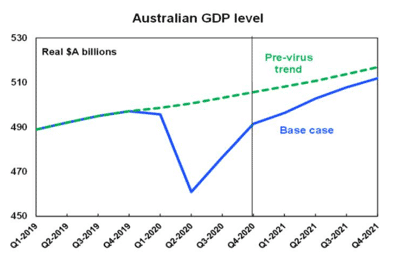
Despite Australia’s GDP being in excess of 3% for the past two quarters (for the first time ever), we remain 2.4% below than what we would have been if Covid-19 never arrived. Our unemployment was mid 4% pre-Covid, with wage growth peaking at a mere 1.4%p.a., whereas today unemployment sits 5.8%.
It is the RBA’s fundamental economic assumption that in order for inflation to shoot past 3% maximum traditional target, interest rates must be kept low and we require the unemployment rate to fall to 3%. This is because in the current economic situation, wage inflation is the key element to push overall inflation. According to many economists, it could take years for unemployment to reach a rate below 4% and which therefore supports the RBA’s expectation.
The estimated financial cost to future tax payers to ensure we have this V shape recovery is estimated to be circa $350b, roughly 17% of our GDP. This is 5 times larger than any stimulus that was provided during the GFC.
And so, despite the surging asset values, it is unlikely for the economy to suddenly overshoot the green line while a number of industries, such as tourism and international students, remain subdued (and let’s not forget those industries being targeted in our ongoing trade war).
The true economic recovery picture will be seen in the next two quarters of GDP figures, where either the fear of inflation will abate or crystallise into reality.
Paul Miron has more than 20 years experience in banking and commercial finance. After rising to senior positions for various Big Four banks, he started his own financial services business in 2004.

![]()
Rugged coastal drives and fireside drams define a slow, indulgent journey through Scotland’s far north.
A haven for hedge-fund titans and Hollywood grandees, Greenwich is one of the world’s most expensive residential enclaves, where eye-watering prices meet unapologetic grandeur.
Greenwich, Connecticut, is in New England (just barely), but that doesn’t mean it’s a quaint, sleepy small town with covered bridges and white churches on the green.
It’s leafy, certainly, but it’s also a luxury-minded power centre close to New York City, with many celebrity residents (director Ron Howard, singer Diana Ross, actor Meryl Streep and, at one time, Australia’s own Mel Gibson).
The main shopping street, Greenwich Avenue, is home to brand stores such as Hermès, Kate Spade, Saks Fifth Avenue, and Tiffany & Co.
And Greenwich, particularly in the “back country” north of the Merritt Parkway, is host to some of the most exclusive real estate in the world.
The average price for a single-family home in the second quarter of 2025 was USD $3.25 million (AUD $4.9 million). But that’s merely an entry point, buying a smaller home in one of the town’s less desirable neighbourhoods.
What does USD $43 million (AUD $66 million) buy in Greenwich?
Last autumn’s most expensive listing offered a 1,068-square-metre waterfront home with eight bedrooms and 11 bathrooms, plus “Gatsby-like lawns”, a gym, games room, party room, wine cellar, fruit orchard, pool and spa. The front and side porches have heated floors.
Prefer something more traditional and secluded? For USD $33 million (AUD $50 million), buyers could close on an 11,760-square-metre Georgian manor on 3.2 hectares, featuring eight fireplaces, an elevator, and a dumbwaiter.

The first floor features a three-storey cascading chandelier. For bibliophiles, there’s a two-storey mahogany library. If bocce is more your pace, a similar USD $25 million compound on 7.5 hectares, built for a liquor magnate in 2009, may appeal. Fourteen bathrooms should suffice.
The Greenwich market is strong, but not without challenges.
“The big problem is that there’s no inventory,” said Evangela Brock, an agent with Douglas Elliman. “It’s extremely low at all price points.”
In November, just 15 properties under USD $1 million (AUD $1.52 million) were listed without contracts, compared with 23 above USD $10 million (AUD $15.2 million). Of those, six had contracts pending. Greenwich has more than 17,000 single-family homes.
Kanebridge Quarterly toured two mid-priced houses in Greenwich. “You don’t lose money in Greenwich real estate,” said Beth MacGillivray, a realtor with the Higgins Group. “This is the hot spot.”
MacGillivray opened the door to a 733.9-square-metre Georgian colonial in the Sherwood Farms Association development her family built in 2005. The house was expected to sell for about USD $5 million (AUD $7,743,535).
The six-bedroom, four-level house is move-in ready, with staged furniture showing its potential and many of the amenities that buyers in this range expect.
Visitors enter through a two-storey foyer with a marble floor. A circular staircase leads to an airy living room with double-height ceilings.
There’s a main bedroom with his-and-hers bathrooms, a cherry-panelled library with cigar-smoke venting, five fireplaces, and a state-of-the-art kitchen with a breakfast nook by Greenwich-based designer Christopher Peacock.
Most rooms have huge walk-in wardrobes. Even the laundry room has granite countertops. Custom millwork, cabinetry and fixtures are evident throughout.
The drawbacks? A smaller yard and no pool. Still, refugees from the city would marvel at the abundant interior space.
Not far away, an entirely different house was on the market for USD $2.66 million.
The imposing 696.7-square-metre, nine-bedroom, seven-bath Georgian/Federal home on Shady Lane in the Glenville neighbourhood was built in 1900. Its good bones and inherent grandeur were apparent, as was a clear need for updating.
“It’s a good project for someone,” said realtor Kaori Higgins. “It needs the right buyer, someone who is looking to return it to its stately original condition.”
Given the hot market, some buyers may be tempted to tear it down and build anew.
But the house is filled with charming period details, including hand-built stone fireplaces, reading nooks, pocket doors, leaded windows and beautiful original millwork.
The second floor offers a vast veranda with views of Long Island Sound and a built-in swimming pool.
The drawbacks? Bathrooms that were awkwardly redesigned in the 1970s, unsightly flooring on the upper levels, and crumbling exterior elements.
Higgins noted that a nearby sister property, fully renovated, sold for USD $11 million (AUD $17 million). Any buyer of Shady Lane’s faded elegance would need both imagination and deep pockets.
For contrast, Kanebridge Quarterly left Greenwich for nearby Fairfield’s upscale Greenfield Hill neighbourhood to visit Lion’s Gate, a 595 square metre Tudor Revival home built as a modest dwelling in the 1920s but extensively expanded and remodelled in 2000.
With three acres of land, a guest cottage, an artist’s studio and a pool house, the asking price is USD $3.3 million (AUD $5 million). Like the Sherwood home, Lion’s Gate is flawlessly move-in ready, with designer touches throughout.
The entire second floor was added during the renovation and features parquet flooring, a massive main suite, arched doorways and 2.74-metre ceilings.
Many rooms include walk-in wardrobes, extensive carved millwork and built-ins. The wood-panelled library (on the site of the former stable) is warm and inviting.
The expansive kitchen includes a window seat with a hand-painted ceiling, a wine cooler and a butler’s pantry.
Realtor Lorelei Atwood said Fairfield faces the same inventory shortage as Greenwich.
“Demand is growing as more New York-based executives are being told they have to report to the office,” she said. “Fairfield has always been a commuter town.”
Why is this home USD $3.3 million (AUD $5 million), and the Sherwood property around USD $5 million (AUD $7,743,535)?
Location. Greenfield Hill is lovely, but Greenwich real estate occupies a rarefied class of its own.
Note: Thanks to realtor Sherri Steeneck for chaperoning.
This story appeared in the Autumn issue of Kanebridge Quarterly, which you can buy here.