Las Vegas Power Couple Lists Home in the Nevada Desert for $19.5 Million
Jenna and Michael Morton’s Summerlin home has a 60-foot outdoor slide, a DJ booth and a wine room that holds hundreds of bottles.
By E.B. SOLOMONT
Mon, Mar 16, 2026 3:40pm 3min
Jenna and Michael Morton have created some of the best-known nightclubs and restaurants in Las Vegas.
But when building a home in the area for their family, they veered away from the glitzy excess of the Strip in favour of a calming, desert retreat.
That’s not to say entertainment was an afterthought: The roughly 2-acre property in the Summerlin neighbourhood has a 60-foot outdoor slide and a DJ booth.
“We are in Las Vegas,” Jenna said. “It’s part of what we do in this town. We do fun.”
Now, after about 20 years of fun, the Mortons’ three children are out of the house, and they are listing the home for $19.5 million.
Michael is a son of Chicago restaurateur Arnie Morton, who founded Morton’s The Steakhouse, which has more than 50 locations nationwide.
His brother Peter Morton co-founded the Hard Rock Cafe, and Michael and Jenna operate restaurants including Crush at the MGM Grand and La Cave Wine and Food Hideaway at Wynn Resorts .
The couple paid $1.25 million for the vacant Summerlin site in 2003. At the time, they were living in Chicago but planning to move to Las Vegas to be closer to their work.
Located in the Ridges, a gated community about 15 minutes from the Strip, the property is at the end of a cul-de-sac abutting the Red Rock Canyon National Conservation Area.
“The first time we were there, there were wild burros behind us,” Michael said.
The single-story house spans about 9,400 square feet and curves toward the canyon for privacy and mountain views.
Photo: JPM Studios.
“The curve is an embrace of the mountains,” said Jenna during a video call as she walked outside, the vista framing her face.
In contrast to the over-the-top vibe of Las Vegas hotels and casinos, the couple’s aesthetic at home is what Jenna described as “Japan meets desert,” with clean lines and neutral colours.
The house has seven bedrooms; the primary bath has a soaking tub made out of a boulder.
A wine room has colour-changing Lucite pegs that hold hundreds of bottles. A separate, roughly 530-square-foot guesthouse has a roof deck.
The property is mostly flat, with the exception of a sloped section where the Mortons built the tiled slide, which drops into the pool.
“I looked at it and said, ‘There will be a slide on that hill,’” Michael recalled. It isn’t just children who have enjoyed it—he and Jenna and many of their friends have taken a turn. “A lot of adults hit that slide,” he said.
Photo: JPM Studios.
The Mortons said they entertained frequently, from fundraisers to a birthday party where their son filled an outdoor trampoline with bubbles.
For Jenna’s 40th birthday, the couple hosted a 1960s-themed party that began with a 200-person sit-down dinner, followed by toasts and karaoke.
Michael enlisted the rock band Cheap Trick to make a surprise appearance during karaoke.
As Jenna took the microphone and started belting out their song “I Want You to Want Me,” the band began playing behind her. “We took the rods out of the reactor that night,” he said. undefined
Although selling is bittersweet, the Mortons said they want something smaller now that their children are grown.
The couple—he is 61, she is 59—have a second home in Manhattan Beach, Calif., and they plan to build a smaller house in Las Vegas.
The luxury market in Las Vegas has exploded over the past few years, said listing agent Kristen Routh-Silberman of Douglas Elliman.
There were 76 sales in the Las Vegas area above $10 million in 2025, up from 59 a year prior, she said. The record is held by a home at the Summit Club that traded for $35 million in 2024.
A recent building boom means inventory is finally catching up to demand, according to Routh-Silberman.
The spring market has started early this year, and there seems to be more activity thanks to demand from California and Washington transplants seeking tax advantages, she said.
Copyright 2020, Dow Jones & Company, Inc. All Rights Reserved Worldwide. LEARN MORE
BNW Developments has established a Sydney presence, joining Arada and Sobha Realty among the growing number of UAE developers pursuing Australian buyers and development opportunities.
The Australian leather house has opened an immersive four-day pop-up in Manhattan, unveiling its Bloom Collection and redefining what a product launch can look like.
Related Stories
Property
Dopamine Design: A Couple Lists Their 1950s ‘Happy House’ in Palm Springs Ahead of Modernism Week
By Chava Gourarie 05/10/2026
Property
Dubai and Abu Dhabi’s Trophy-Home Developers Are Doubling Down on Waterfront Living
By Jake Emen 01/10/2026
Property
BNW joins growing wave of UAE developers targeting Australia
A vibrant 1954 Palm Springs home featuring eight colorful murals by late artist Shawn Savage is on the market for $2.295 million. The 2,237-square-foot property features bold hot-pink doors, three bedrooms, a pool, mountain views and playful interiors blending modern glamour with classic Palm Springs style.
By Chava Gourarie
Mon, Oct 5, 2026 3min
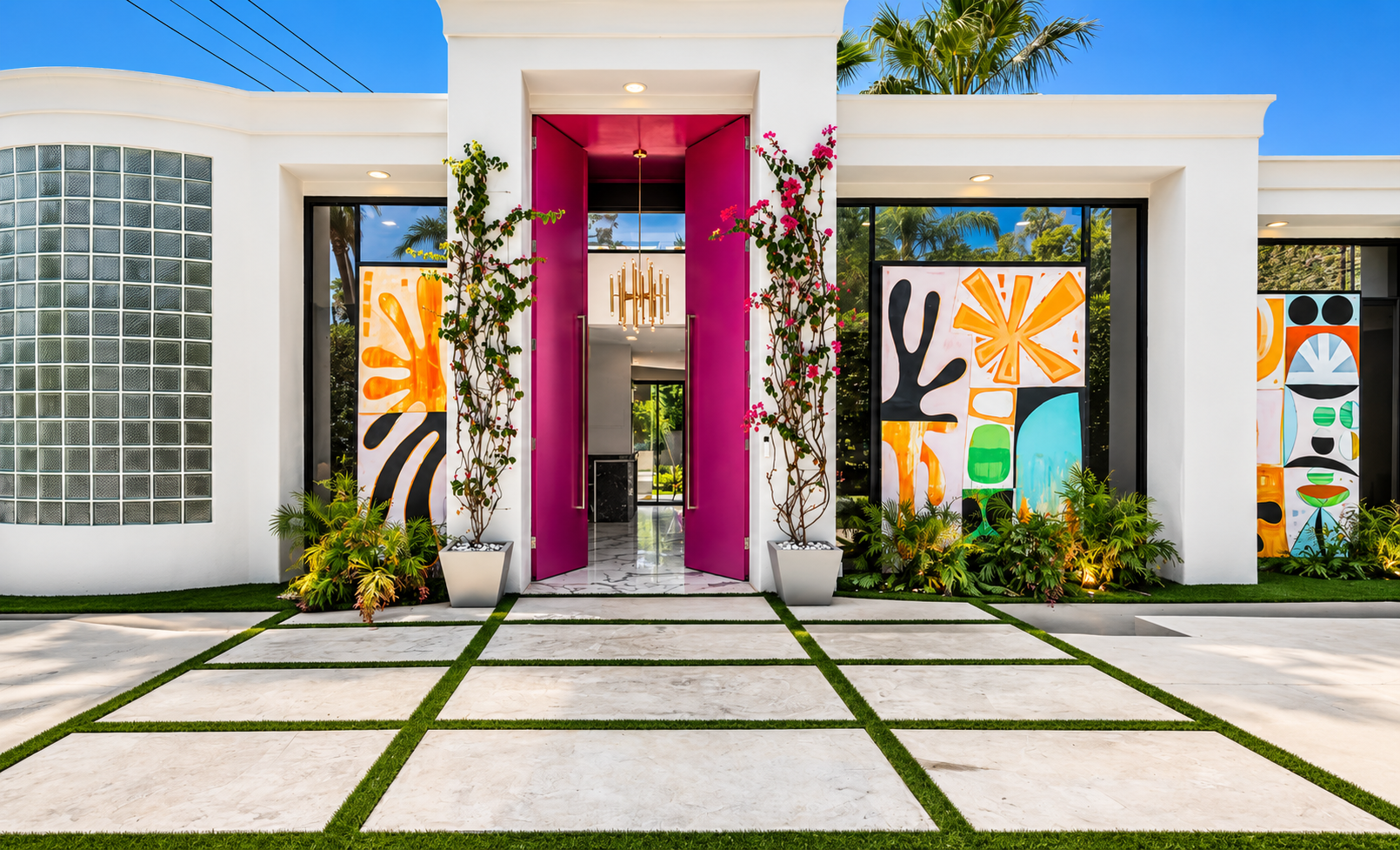
A bold 1950s home in Palm Springs, California, adorned with eight colorful murals by the late artist Shawn Savage, is coming to market ahead of the city’s annual Modernism Week.
The white stucco home on El Camino Way, built in 1954 and recently renovated, has an asking price of $2.295 million. Its staggered facade features three playfully abstract murals on either side of double-height hot pink doors.
The sellers are Los Angeles-based partners John Freeman and Mathieu Faure, who knew it was “the one” when they saw it after several months of searching in the winter of 2023. “It’s a happy house,” Freeman said. “We really liked the feel of the house: the uniqueness, the openness, the brightness—and the art.”
Located in the Mesa neighborhood of Palm Springs, which backs up to the San Jacinto Mountains, the 2,237-square-foot house features three bedrooms, an angled bonus room and a yard with a pool, desert mountain views and another colorful mural running alongside the pool.
“I never thought in my life I would have a house with pink doors,” said Faure, a producer at Apple TV who is originally from Paris. “It’s so colorful, it’s so different. And so Palm Springs.”
Abstract murals can be found on the facade.Patrick Ketchum
The layout of the home creates a smooth flow from the front doors through the open-plan common area—a foyer, bar, and living and dining room—into the kitchen around a fireplace wall and out to the yard. A corridor leads to a private bedroom wing, where the primary suite has floor-to-ceiling windows and the primary bath is only a tad smaller than the bedroom.
Faure has filled the home with Jonathan Adler furniture, rugs and accessories, riffing on the energetic California vibes of the house to create an aesthetic of “modern American glamour,” he said.
“It was enjoyable for me to play with different types of furniture and make this house ‘happy chic,’ as I describe it,” he said.
“He did a fantastic job,” said Freeman, who is an attorney and consultant. “It does kind of bring a smile to my face whenever I walk into the house.”
Since the furniture and decor were chosen for the particularities of the space, the couple is open to selling them with the home. Their West Hollywood house is already furnished; the collection doesn’t match the vibes of a Houston loft they bought near family; and Faure can’t imagine these pieces in New York—where he’s lived in the past—he said.
The duo bought the Palm Springs house for $1.925 million in 2024, according to property records, and will list the home Monday. They are represented by Stewart Smith, Patrick Jordan and Kevin Stanley of Bennion Deville Homes/Luxury Portfolio International.
The previous owners had purchased the home in 2021 for $975,000 and then spent more than two years and $700,000 on the renovation, according to Realtor.com. They commissioned Savage, a local Palm Springs artist and painter known for his joyful abstract work, to decorate the home.
Savage, who died in 2024, lived in the Coachella Valley from 2003, and his work can be found in various local institutions and is on exhibit at the Illumine Gallery in Palm Springs. “Some artists pass through a place. Shawn Savage became a part of it,” the gallery’s description states.
Unsurprisingly, the murals invite lots of friendly conversations, as well as guided tours and interested lookers, but never to a degree that it disturbed the peacefulness of their home or the neighborhood, the sellers said. “It felt like living in an art gallery, and you have the exterior that you would share with the world,” Faure explained.
The neighborhood also played a role in their decision to buy, because of its access to the hiking trails of the San Jacinto Mountains, the lack of through-roads and the neighborly environment.



 3 min
3 min


 Copyright 2020, Dow Jones & Company, Inc. All Rights Reserved Worldwide.