A Science of Buildings That Can Grow—and Melt Away
Share Button

A Science of Buildings That Can Grow—and Melt Away

Architect Neri Oxman, creator of ‘material ecology,’ explains how silkworms, shrimp shells and insect exoskeletons could help shape the city of the future.

By
Wed, Apr 13, 2022 11:02amGrey Clock 4 min

While the pandemic heightened speculation about what the city of the future will look like, architect Neri Oxman says she is sticking with a blueprint based on a core principle of her work: In years to come, buildings will be grown, not built.

At Massachusetts Institute of Technology’s Media Lab from 2010 to 2021, Ms. Oxman founded and directed the Mediated Matter group, a team researching in areas including computational design, digital fabrication, materials science and synthetic biology. There, she created a field she calls material ecology.

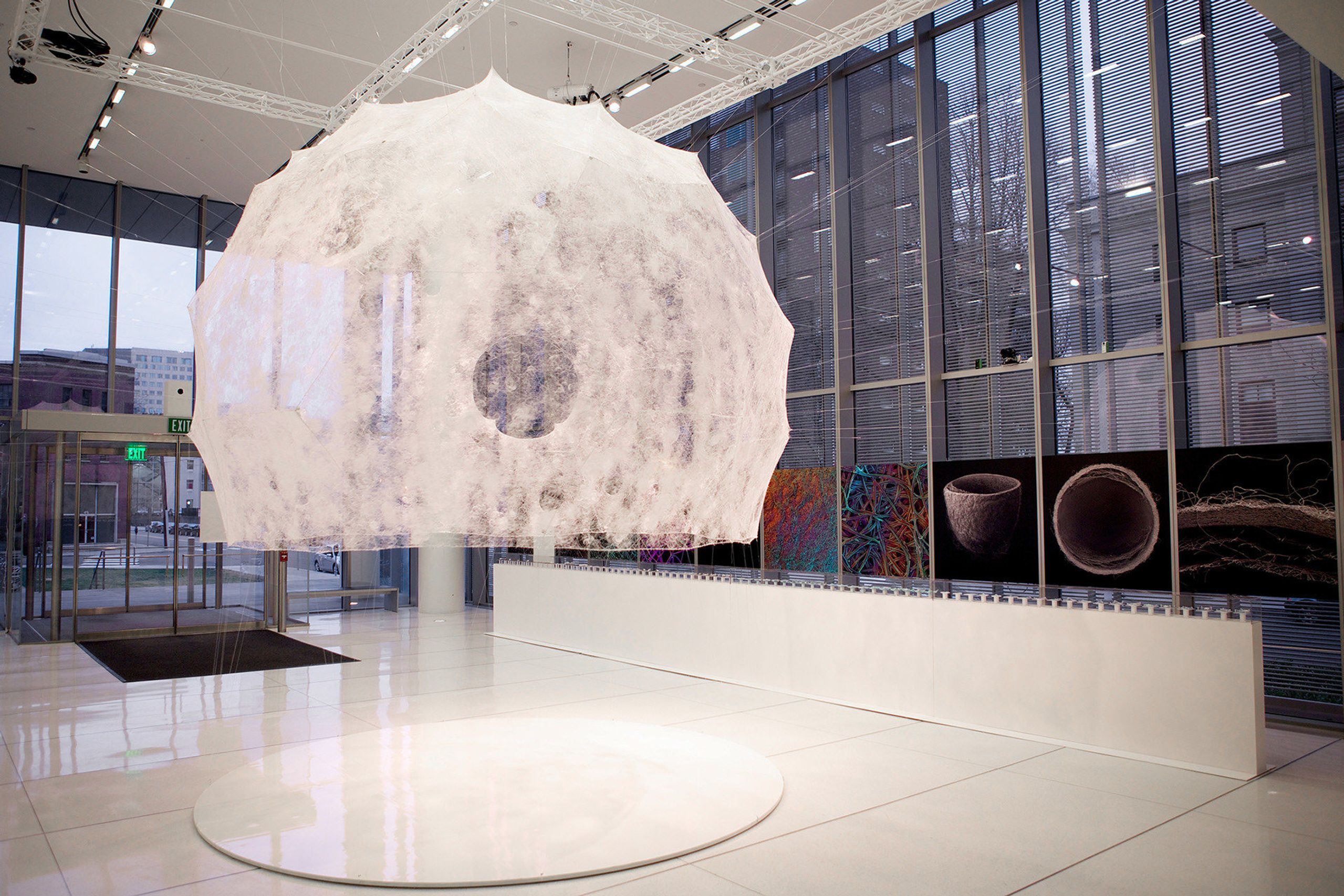
The result? A body of work that includes a pavilion spun by 6,500 silkworms (with the help of a robotic arm), a series of 3D-printed sculptures filled with liquid channels of the pigment melanin (which she envisions could be used in the façades of buildings to protect against ultraviolet rays), and a collection of artifacts constructed using materials derived from shrimp shells and insect exoskeletons.

Since leaving academia, Ms. Oxman, 46 years old, has focused on Oxman, the New York-based design and technology company that she founded in 2020 with the aim of applying her design philosophy to real-world projects. A retrospective of her work is on display at the San Francisco Museum of Modern Art. The Wall Street Journal spoke to Ms. Oxman about the future of urban architecture and how she thinks design can be used as a tool to fight climate change.

You created a new term to describe your approach to design: material ecology. What does it entail?

The idea behind material ecology is to enable total synergy between grown and built environments by deploying new digital technologies that allow us to augment bio-based materials for large-scale construction.

How do you decide which natural materials to use in your designs?

It comes down to ethics and availability. We work with the most abundant biopolymers on the planet which include cellulose, found in plant cell walls; pectin, found in apple and lemon skins; and chitin, found in the shells of crustaceans.

You’ve talked about wanting to create buildings that naturally decay when they are no longer needed. How would that work?

Using technology, we can program biomaterials to degrade in response to changing environmental conditions. At MIT, we built three biopolymer pavilions [the Aguahoja pavilions] which, instead of concrete, were built using shrimp shells, fallen leaves and apple skins. We programmed the pavilions to decay at a certain point when exposed to rainwater. This, in turn, nurtures soil microorganisms to fuel new growth.

It’s a circular economy of material that could be used to create biodegradable refugee camps, for example. Once the refugees find a safe haven, the camps would be programmed to melt away in the rain.

What does “programmed” mean in this context?

It’s complex. When we combine biopolymers including chitosan, pectin and cellulose, the material’s ability to absorb water varies based on its composition. Chitosan, for example, is naturally water-resistant and doesn’t readily dissociate when submerged, while pectin is hydrophilic and dissolves rapidly. By choosing how we blend these components, we can access a spectrum of hydrophilicity—otherwise known as a material’s affinity to water—and this lets us tune or program the speed at which a material breaks down. In essence, we are designing the architectural equivalent of metabolic rate.

How many years are we from grown buildings becoming a reality in cities across the world?

For grown buildings to appear in towns and cities, we need to rethink mass production, and this will take five to 10 years to happen in a meaningful way. However, the development of products made from biological materials—cars, for example—could begin within the next year.

What role will existing buildings made from concrete and plastics, for example, play in your vision for the city of the future?

The architect and professor Carl Elefante says that “the greenest building is one that is already built.” That’s because the carbon emitted during construction is vast compared to the operating emissions of a given building. We therefore need to find new ways to augment the pre-existing built environment rather than trying to completely rebuild our cities from the ground up.

How does one do this?

We need to look at a range of interventions. One is the creation of bioengineered façades for existing buildings. An example: in the U.S. alone, hundreds of billions of square feet of glass façade components are produced every year. As part of our research at MIT, we 3D-printed glass augmented with synthetically engineered microorganisms to produce energy [from the sun]. This allows us to develop solar-harnessing glass façades that can act as a skin for pre-existing buildings.

We must also think about whole-building recycling. A current example is Apple’s headquarters in Cupertino, Calif. The campus was built by Norman Foster using materials from old buildings that used to be on the same site. Rather than simply destroying structures when we no longer have use for them, we must look for ways to augment them using new technology and intelligence.

Which skills would you encourage future generations of architects to develop?

The architect of the future is interested in formation, as much as she is interested in form. She is a systems thinker, interested in building relationships between objects rather than seeing them as standalone. She invents new technologies with which to design, manufacture and build. She is a gardener, not a master planner

Reprinted by permission of The Wall Street Journal, Copyright 2021 Dow Jones & Company. Inc. All Rights Reserved Worldwide. Original date of publication: April 10, 2022.


MOST POPULAR

Rugged coastal drives and fireside drams define a slow, indulgent journey through Scotland’s far north.

A haven for hedge-fund titans and Hollywood grandees, Greenwich is one of the world’s most expensive residential enclaves, where eye-watering prices meet unapologetic grandeur.

Related Stories
Property
INSIDE ONE OF THE WORLD’S MOST EXCLUSIVE POSTCODES
By Jim Motavalli 07/04/2026
Property
Las Vegas Power Couple Lists Home in the Nevada Desert for $19.5 Million
By E.B. SOLOMONT 16/03/2026
Property
A 92nd-Floor Penthouse With 360-Degree City Views Is Brooklyn’s Highest Residence
By BILL CARY 02/02/2026

A haven for hedge-fund titans and Hollywood grandees, Greenwich is one of the world’s most expensive residential enclaves, where eye-watering prices meet unapologetic grandeur.

By Jim Motavalli
Tue, Apr 7, 2026 4 min

Greenwich, Connecticut, is in New England (just barely), but that doesn’t mean it’s a quaint, sleepy small town with covered bridges and white churches on the green. 

It’s leafy, certainly, but it’s also a luxury-minded power centre close to New York City, with many celebrity residents (director Ron Howard, singer Diana Ross, actor Meryl Streep and, at one time, Australia’s own Mel Gibson).  

The main shopping street, Greenwich Avenue, is home to brand stores such as Hermès, Kate Spade, Saks Fifth Avenue, and Tiffany & Co. 

And Greenwich, particularly in the “back country” north of the Merritt Parkway, is host to some of the most exclusive real estate in the world.  

The average price for a single-family home in the second quarter of 2025 was USD $3.25 million (AUD $4.9 million). But that’s merely an entry point, buying a smaller home in one of the town’s less desirable neighbourhoods. 

What does USD $43 million (AUD $66 million) buy in Greenwich?  

Last autumn’s most expensive listing offered a 1,068-square-metre waterfront home with eight bedrooms and 11 bathrooms, plus “Gatsby-like lawns”, a gym, games room, party room, wine cellar, fruit orchard, pool and spa. The front and side porches have heated floors. 

Prefer something more traditional and secluded? For USD $33 million (AUD $50 million), buyers could close on an 11,760-square-metre Georgian manor on 3.2 hectares, featuring eight fireplaces, an elevator, and a dumbwaiter.  

The first floor features a three-storey cascading chandelier. For bibliophiles, there’s a two-storey mahogany library. If bocce is more your pace, a similar USD $25 million compound on 7.5 hectares, built for a liquor magnate in 2009, may appeal. Fourteen bathrooms should suffice. 

The Greenwich market is strong, but not without challenges.  

“The big problem is that there’s no inventory,” said Evangela Brock, an agent with Douglas Elliman. “It’s extremely low at all price points.”  

In November, just 15 properties under USD $1 million (AUD $1.52 million) were listed without contracts, compared with 23 above USD $10 million (AUD $15.2 million). Of those, six had contracts pending. Greenwich has more than 17,000 single-family homes. 

Kanebridge Quarterly toured two mid-priced houses in Greenwich. “You don’t lose money in Greenwich real estate,” said Beth MacGillivray, a realtor with the Higgins Group. “This is the hot spot.”  

MacGillivray opened the door to a 733.9-square-metre Georgian colonial in the Sherwood Farms Association development her family built in 2005. The house was expected to sell for about USD $5 million (AUD $7,743,535). 

The six-bedroom, four-level house is move-in ready, with staged furniture showing its potential and many of the amenities that buyers in this range expect.  

Visitors enter through a two-storey foyer with a marble floor. A circular staircase leads to an airy living room with double-height ceilings.  

There’s a main bedroom with his-and-hers bathrooms, a cherry-panelled library with cigar-smoke venting, five fireplaces, and a state-of-the-art kitchen with a breakfast nook by Greenwich-based designer Christopher Peacock.  

Most rooms have huge walk-in wardrobes. Even the laundry room has granite countertops. Custom millwork, cabinetry and fixtures are evident throughout. 

The drawbacks? A smaller yard and no pool. Still, refugees from the city would marvel at the abundant interior space. 

Not far away, an entirely different house was on the market for USD $2.66 million.  

The imposing 696.7-square-metre, nine-bedroom, seven-bath Georgian/Federal home on Shady Lane in the Glenville neighbourhood was built in 1900. Its good bones and inherent grandeur were apparent, as was a clear need for updating. 

“It’s a good project for someone,” said realtor Kaori Higgins. “It needs the right buyer, someone who is looking to return it to its stately original condition.” 

Given the hot market, some buyers may be tempted to tear it down and build anew.  

But the house is filled with charming period details, including hand-built stone fireplaces, reading nooks, pocket doors, leaded windows and beautiful original millwork.  

The second floor offers a vast veranda with views of Long Island Sound and a built-in swimming pool. 

The drawbacks? Bathrooms that were awkwardly redesigned in the 1970s, unsightly flooring on the upper levels, and crumbling exterior elements.  

Higgins noted that a nearby sister property, fully renovated, sold for USD $11 million (AUD $17 million). Any buyer of Shady Lane’s faded elegance would need both imagination and deep pockets. 

For contrast, Kanebridge Quarterly left Greenwich for nearby Fairfield’s upscale Greenfield Hill neighbourhood to visit Lion’s Gate, a 595 square metre Tudor Revival home built as a modest dwelling in the 1920s but extensively expanded and remodelled in 2000.  

With three acres of land, a guest cottage, an artist’s studio and a pool house, the asking price is USD $3.3 million (AUD $5 million). Like the Sherwood home, Lion’s Gate is flawlessly move-in ready, with designer touches throughout. 

The entire second floor was added during the renovation and features parquet flooring, a massive main suite, arched doorways and 2.74-metre ceilings.  

Many rooms include walk-in wardrobes, extensive carved millwork and built-ins. The wood-panelled library (on the site of the former stable) is warm and inviting.  

The expansive kitchen includes a window seat with a hand-painted ceiling, a wine cooler and a butler’s pantry. 

Realtor Lorelei Atwood said Fairfield faces the same inventory shortage as Greenwich.  

“Demand is growing as more New York-based executives are being told they have to report to the office,” she said. “Fairfield has always been a commuter town.” 

Why is this home USD $3.3 million (AUD $5 million), and the Sherwood property around USD $5 million (AUD $7,743,535)?  

Location. Greenfield Hill is lovely, but Greenwich real estate occupies a rarefied class of its own. 

Note: Thanks to realtor Sherri Steeneck for chaperoning. 

This story appeared in the Autumn issue of Kanebridge Quarterly, which you can buy here.