‘SAD BEIGE’ HAS TAKEN OVER BABY GEAR, CLOTHING, DECOR
Parents are gravitating toward neutral hues that match their minimalist tastes; ‘I don’t think many kids’ favourite colour is beige’
Krissy Kyne, a 27-year-old makeup artist in San Antonio, is giving birth to a baby boy this week. The room waiting for him at home is neither blue nor pink, but beige.
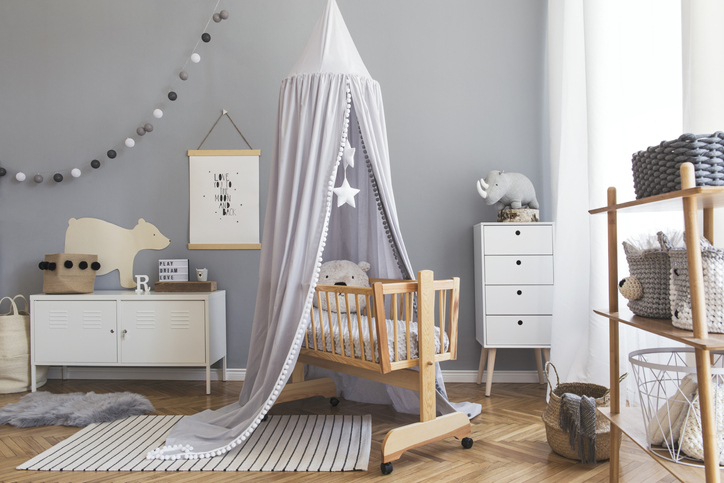
It has a light-coloured wood crib, a woven jute rug, a latte-hued changing pad and a cream ottoman, with oatmeal throw pillows and camel muslin blankets strewn about. Ms. Kyne said her mother-in-law told her her taste for neutrals looked “sterile,” but she has committed to the aesthetic, stocking drawers with beige onesies, beige sweatsuits and beige socks.
Ms. Kyne joins a wave of parents eschewing bright and stereotypically gendered colours for kid wares, and instead choosing earthy, neutral tones aligned with minimalism. It’s a look TikTok satirist Hayley DeRoche has termed “sad beige,” but some see it as a happy development: The ecru, blond and brown products fit right in with their stylishly muted décor in the rest of the house.
“Our whole house isn’t changing because we have kids,” said Jen Atkin, a celebrity hairstylist and entrepreneur in Los Angeles known for working with the Kardashians—although she conceded that the aesthetic can invite stains. Because she has two kids and three dogs, she bought easy-to-clean beige outdoor rugs and couches for her home.
Kylie Jenner showed off the beige furnishings in her son Wolf’s nursery in a video from March. Caitlin Covington, a content creator in North Carolina known online as “Christian Girl Autumn,” often dresses her daughter in brown and ecru ensembles for portraits.
“I’ve been influenced by influencers,” said Amina Kadyrova, a mother of three in New Jersey. “I’m a victim of the marketing system. But I genuinely like it.” Neutral colours are easier to mix and match on kids, she added.
Earlier this year, Baby Gap created a designated beige section inside some stores after researching market trends, according to the brand’s head designer, Carolyn Koziak. A new line from Walmart, Easy Peasy, includes a lot of beige, too. According to Etsy, searches for beige kids clothes jumped 67% in the past 12 months compared with the previous period.
“It seems to be marketing this fantasy that if I buy neutrals, my children will also be neutral, calm and quiet,” said Ms. DeRoche, the TikTok user, who lives in Petersburg, Va.
Most children’s companies still sell lots of toys and clothes in bright and inviting primary colours. “It’s important to expose kids to learning colours to help them with their visual perception,” said Ann-Louise Lockhart, a pediatric psychologist in San Antonio. “Having variety is important for brain development.”
Amanda Gummer, a neuropsychologist and children’s play expert in Britain, said there isn’t evidence that colourless toys stunt developmental milestones. Still, Dr. Gummer said, “the motivation of having an Instagrammable house and not letting kids explore and make a mess worries me. I don’t think many kids’ favourite colour is beige.”
Ms. Atkin said her children can get their colour fix elsewhere. “My son will go to indoor gymnasiums, play centres, museums, and he gets covered in slime and goo, and colour and glitter,” she said. “We do that outside of our house, and then we get to come home to a nice, calm, clean environment.”
Other parents noted the pacifying nature of neutrals. “Brown and beige make me feel calmer,” said Maddie Berna, a photographer and mother of two in central California. “I personally don’t like super bright colours, and they do wear that sometimes, but it’s annoying to see all the time.”
Ms. Berna’s mother, Ashley Durham, isn’t a fan.
“All of Ellie’s bows are the same kind of beige and I would like her to wear something that sticks out more,” she said, referring to her 15-month-old granddaughter. “I do try to buy them brighter color clothing. I just never see them in it.”
Naomi Coe, a California-based interior designer specialising in kid’s rooms, said she experienced an influx of beige requests during the pandemic, when many parents were spending more time at home.
“Neutral is going to give you calm, serene, homey, cozy,” she said. “I’ve noticed a shift where people are after that feeling more.”
Laura Roso Vidrequin, founder of secondhand kids-clothing marketplace Kids O’Clock in London, said beige products sell three times as fast as other colours on the site—perhaps because they are gender-neutral, she said, hence easy to pass down.
Elizabeth Robles Jimenez, a mother of four in Downey, Calif., said she bought plenty of pink and princessy products for her first three daughters before settling on beige décor and wooden toys for her 2-year-old, Ava.
“I think whites and creams give her an opportunity to discover her own self and not have the mentality that because she’s a girl, she needs all pink,” Ms. Robles Jimenez said.
Mushie, a startup that makes pacifiers, bibs and stacking cups in beige hues, has seen double-digit growth this year, according to its chief executive, Levi Feigenson. Moms cited the labels Oat, Soor Ploom, the Simple Folk, Tiny Cottons, Jamie Kay, Nora Lee, Rylee + Cru as others with an abundance of beige products.
“When I started my company [over 10] years ago, you couldn’t get a baby or child garment in a neutral colour unless you went to Europe,” said Marissa Buick, the Brooklyn founder of kidswear brand Soor Ploom. Her colour choices reflect ones “you won’t find in a shop, but are in nature,” she said.
Rugged coastal drives and fireside drams define a slow, indulgent journey through Scotland’s far north.
A haven for hedge-fund titans and Hollywood grandees, Greenwich is one of the world’s most expensive residential enclaves, where eye-watering prices meet unapologetic grandeur.
Their careers spanned the personal computing, internet and smartphone waves. But some older workers see AI’s arrival as the cue to exit.
Luke Michel has already lived through two technology overhauls in his career, first desktop publishing in the 1980s and online publishing later on. But AI? He’s had enough.
So when his employer, the Dana-Farber Cancer Institute, made an early-retirement offer to some staff last year, the 68-year-old content strategist decided to speed up his exit. Before, he had expected to work a couple more years.
“The time and energy you have to devote to learning a whole new vocabulary and a whole new skill set, it wasn’t worth it,” he said.
It isn’t that he’s shunning artificial intelligence—he is learning Spanish with the help of Anthropic’s Claude. But, at this point, he’s less than eager to endure all the ways the technology promises to upend work.
“I just want to use it for my own purposes and not someone else’s,” he said.
After rising for decades and then hovering around 40% in the 2010s, the share of Americans over 55 years old in the workforce has slipped to 37.2%, the lowest level in more than 20 years.
The financial cushion of rising home equity and stock-market returns is driving some of the decline, economists and retirement advisers say.
But for some older professionals, money is only part of the equation.
They say they don’t want to spend the last years of their career going through the tumult of AI adoption, which has brought new tools, new expectations and a lot of uncertainty.
Many people retire when key elements of their work lives are disrupted at once, said Robert Laura , co-founder of the Retirement Coaches Association and an expert on the psychology of retirement.
“Maybe their autonomy is being challenged or changed, their friends are leaving the workplace, or they disagree with the company’s direction,” he said.
“When two or three of these things show up, that’s when people start to opt out.”
“AI is a big one,” he adds. “It disrupts their autonomy, their professionalism.”
Michel, whose work required overseeing and strategizing on website content, has been here before.
When desktop publishing arrived in the 1980s, he was a graphic designer using triangles and rubber cement.
The internet’s arrival changed everything again. Both developments required new skills, and he was energized by the challenge of learning alongside colleagues and peers.
It felt different this time around. “Your battery doesn’t hold a charge as long as it used to,” he said.
He would rather spend his energy volunteering, making art, going to operas and chairing the Council on Aging in North Andover, Mass., where he lives.
In an AARP survey last summer of 5,000 people 50 and over, 25% of those who planned to retire sooner than expected counted work stress and burnout as factors.
About half of those retired said they had left work at least partly because they had the financial security to do so.
In general, older Americans are less likely than younger counterparts to use AI, research shows.
About 30% of people from ages 30 to 49 said they used ChatGPT on the job, nearly double the share of those 50 and older, according to a 2025 Pew Research Center survey of more than 5,000 adults.
Baby boomers and members of Generation X also experienced the sharpest declines in confidence using AI technology, according to a ManpowerGroup survey of more than 13,900 workers in 19 countries.
“We as employers aren’t doing a good enough job saying (to older workers), we value the skills that you already have, so much so that we want to invest in you to help you do your job better,” says Becky Frankiewicz , ManpowerGroup’s chief strategy officer.
Jennifer Kerns’s misgivings about AI contributed to her departure last month from GitHub, where the 60-year-old worked as a program manager.
Coming from a family of artists, she said, it offends her that AI models train on the creative work of people who aren’t compensated for their intellectual property. And she worries about AI’s effect on people’s critical-thinking skills.
So she was dismayed when GitHub, a Microsoft-owned hosting service for software projects, began investing heavily in AI products and expecting employees to incorporate AI into much of their work. In employee-engagement surveys, the company had begun asking them to rate their AI usage on a scale of 1 to 5.
When it came time to write reports and reviews, colleagues would suggest that she use ChatGPT.
“I’d be like, ‘I have no idea how to use that and I have no interest in using AI to write anything for me,’” she said.
It would have been more prudent to work until she was closer to Medicare eligibility, she said. But by waiting until her children were out of college and some of her stock grants had vested, the math worked.
Her first act as a nonworking person: a solo trip to Scotland, where she took a darning workshop and learned how to repair sweaters.
“The opposite of AI,” she said.
Employers already under pressure to cut workers—such as in the tech industry—may welcome some of these retirements, said Gad Levanon , chief economist at Burning Glass Institute, which studies labor-market data.
“The more people retire, the fewer they have to let go,” he said.
Some of the savviest tech users are also balking at sticking around for the AI upheaval. Terry Grimm, who worked in IT for 40 years, retired from his senior software consultant role at 65 last May.
His firm had just been acquired by a bigger firm, which meant learning and integrating the parent company’s AI and other tech tools into his work.
Until then, Grimm expected he might work a couple more years, though he felt that he probably had enough saved to retire.
“I just got to the point where I was spending 40 hours at work and then 20 hours training and studying,” said Grimm, who has since moved with his wife from the Dallas area to a housing development on a golf course in El Dorado, Ark.
“I’m like, ‘I’ll let the younger guys do this.’”