5:01 and Done: No One Wants to Schmooze After Work - Kanebridge News
Share Button

5:01 and Done: No One Wants to Schmooze After Work

Office happy hours, client dinners and other after-hours work gatherings lose their lustre as more people feel the pull of home

By ANNE MARIE CHAKER
Thu, Sep 14, 2023 9:16amGrey Clock 3 min

Patience for after-hours work socialising is wearing thin.

After an initial burst of post pandemic happy hours, rubber chicken dinners and mandatory office merriment, many employees are adopting a stricter 5:01-and-I’m-done attitude to their work schedules. More U.S. workers say they’re trying to draw thicker lines between work and the rest of life, and that often means clocking out and eschewing invites to socialize with co-workers. Corporate event planners say they’re already facing pushback for fall activities and any work-related functions that take place on weekends.

“The flake-out rate is so much higher at events now,” says Gretchen Goldman, a research director in Takoma Park, Md.

This summer Goldman sent an invite to 100 colleagues for casual after-work drinks at some picnic tables just outside the office as a goodbye party. She was taking a new job with the federal government. Fewer than 10 showed up.

“I guess people are just busy,” she says.

The pandemic altered eating and drinking habits, and pandemic puppies, now fully grown dogs, have to be walked on a schedule. With fewer people back in offices, there are fewer impromptu happy hours and a lack of interest in staying out late with colleagues, some bosses and workers say.

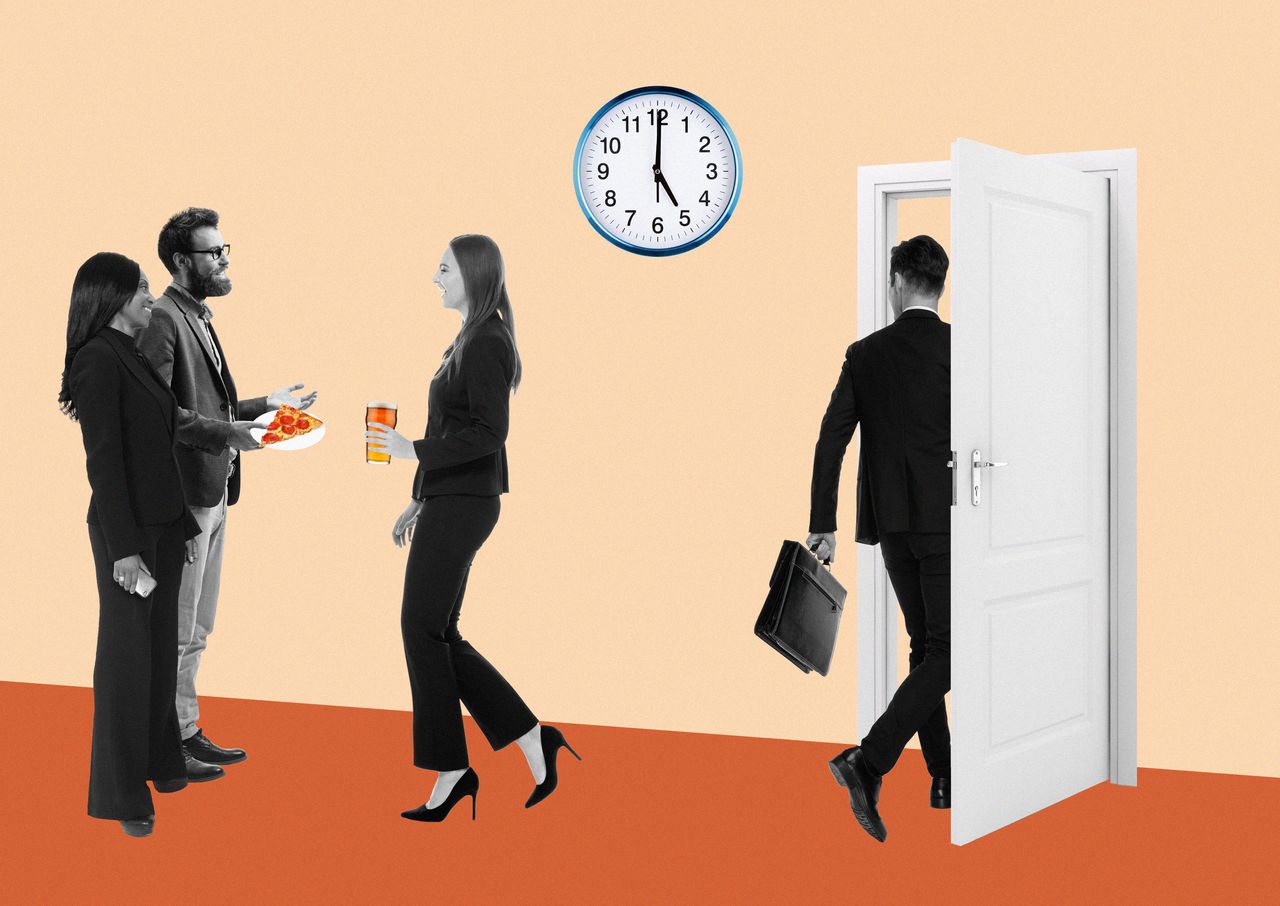
Andy Challenger oversees employees who participate in the fantasy football league at his outplacement firm, Challenger, Gray & Christmas. When some of them floated the same game plan as prior years—an in-office pizza party that goes past 11 p.m. as everybody drafts their favorite players—the pushback was swift. This season, the pizza arrived at 4:30 p.m. and everyone was finished and out of the office by 6 p.m.

“Normally that would have been the starting time,” he says.

For decades, an unspoken rule of office culture has been that much of work happens outside the 9-to-5 window. Getting ahead often requires being known outside the building and having organisational allies—the type of networking that’s helped by showing up for dinner with the boss and getting relaxed face time with co-workers at happy hours, says Jon Levy, a New York City-based consultant who advises organisations on connection and culture.

Now, even the go-getters are saying no to after-hours schmoozing opportunities.

The thinking is: “That 20th happy hour isn’t going to produce anything better for me,” Levy says.

People are less jazzed about eating out once they are home, and many got pretty good at making dinner during the pandemicsays David Portalatin, food industry adviser at Circana Group, a market research firm.

“When the consumer stretches and builds new muscles, they don’t abandon those behaviours completely,” he says.

In the past year, U.S. consumers had 264 million restaurant dinners after leaving work, which is down 43% from 2019 levels, according to Circana. And reservations are now earlier: In 2023, 26% of after-work restaurant dinners happened before 6 p.m., compared with 21% in 2019.

Barbara Martin hosts bimonthly evening soirees for clients of her marketing firm, Brand Guild. Traditionally, cocktails start flowing around 6:30 p.m. and the mingling could last until 9 o’clock—or beyond. But last Thursday she pulled the start time forward to 5:30 p.m. sharp.

“‘I’d love to come to these if you could do them earlier,’” Martin says she’s heard again and again this summer. “Nobody wants to overbook themselves until 10 p.m. on a weeknight anymore.”

Attitudes don’t appear to be changing as the summer vacation season ends. Kay Ciesla is helping organise an all-staff gathering for 80 people at the American Immigration Lawyers Association, the Washington, D.C., nonprofit where she works as a governance executive. She is considering an ax-throwing theme, and serving finger foods and cocktails.

“I’m already getting pushback,” she says of spending precious time that bleeds into personal hours on team building. Due to scheduling conflicts the group can’t gather until December. One employee voiced concern that the socialising could turn into a superspreader event ahead of Christmas travel.

Doug Quattrini, an event planner in the Philadelphia area, has already booked six Christmas parties. What’s different this year, he says, is that most are on weekdays, in the office—and end at 8 p.m.

“Nobody wants to take up people’s Fridays, Saturdays and Sundays,” says Fausto Pifferrer, co-owner of Blue Elephant Catering in Saco, Maine, near Portland, which has booked several office holiday parties for Monday through Thursday.

Younger Americans are drinking less. The share of people between 18 and 34 who said they “ever” drink alcohol has fallen to 62% from 72% two decades ago, according to Gallup data.

Caroline Wong, the chief strategy officer at Cobalt, a cybersecurity company in San Francisco, quit drinking in her early 30s and tries to plan social gatherings sans alcohol. A team off-site next month will be a tour of waterfalls near Portland, Ore. She’s noticed things wrap up earlier when there’s no drinking involved.

“It’s like, ‘You know what, we hung out for 90 minutes. We’re good and I’ll see you tomorrow,’” Wong says. “I think there’s something awesome about that.”


MOST POPULAR

Rugged coastal drives and fireside drams define a slow, indulgent journey through Scotland’s far north.

A haven for hedge-fund titans and Hollywood grandees, Greenwich is one of the world’s most expensive residential enclaves, where eye-watering prices meet unapologetic grandeur.

Related Stories
Lifestyle
The Workers Opting to Retire Instead of Taking on AI
By Lauren Weber & Ray A. Smith 07/04/2026
Lifestyle
ROLLS-ROYCE UNVEILS YACHT-INSPIRED CULLINAN SERIES FOR BESPOKE CLIENTS
By Staff Writer 30/03/2026
Lifestyle
BMW’s Electric i3 and iX3 Raise the EV Standard With a 400-Plus-Mile Range
By Jim Motavalli 26/03/2026

Their careers spanned the personal computing, internet and smartphone waves. But some older workers see AI’s arrival as the cue to exit. 

By Lauren Weber & Ray A. Smith
Tue, Apr 7, 2026 4 min

Luke Michel has already lived through two technology overhauls in his career, first desktop publishing in the 1980s and online publishing later on. But AI? He’s had enough. 

So when his employer, the Dana-Farber Cancer Institute, made an early-retirement offer to some staff last year, the 68-year-old content strategist decided to speed up his exit. Before, he had expected to work a couple more years. 

“The time and energy you have to devote to learning a whole new vocabulary and a whole new skill set, it wasn’t worth it,” he said. 

It isn’t that he’s shunning artificial intelligence—he is learning Spanish with the help of Anthropic’s Claude. But, at this point, he’s less than eager to endure all the ways the technology promises to upend work. 

“I just want to use it for my own purposes and not someone else’s,” he said. 

After rising for decades and then hovering around 40% in the 2010s, the share of Americans over 55 years old in the workforce has slipped to 37.2%, the lowest level in more than 20 years.  

The financial cushion of rising home equity and stock-market returns is driving some of the decline, economists and retirement advisers say. 

But for some older professionals, money is only part of the equation.  

They say they don’t want to spend the last years of their career going through the tumult of AI adoption, which has brought new tools, new expectations and a lot of uncertainty.  

Many people retire when key elements of their work lives are disrupted at once, said Robert Laura , co-founder of the Retirement Coaches Association and an expert on the psychology of retirement. 

“Maybe their autonomy is being challenged or changed, their friends are leaving the workplace, or they disagree with the company’s direction,” he said.  

“When two or three of these things show up, that’s when people start to opt out.”  

“AI is a big one,” he adds. “It disrupts their autonomy, their professionalism.” 

Michel, whose work required overseeing and strategizing on website content, has been here before.  

When desktop publishing arrived in the 1980s, he was a graphic designer using triangles and rubber cement.  

The internet’s arrival changed everything again. Both developments required new skills, and he was energized by the challenge of learning alongside colleagues and peers. 

It felt different this time around. “Your battery doesn’t hold a charge as long as it used to,” he said. 

He would rather spend his energy volunteering, making art, going to operas and chairing the Council on Aging in North Andover, Mass., where he lives. 

In an AARP survey last summer of 5,000 people 50 and over, 25% of those who planned to retire sooner than expected counted work stress and burnout as factors.  

About half of those retired said they had left work at least partly because they had the financial security to do so. 

In general, older Americans are less likely than younger counterparts to use AI, research shows.  

About 30% of people from ages 30 to 49 said they used ChatGPT on the job, nearly double the share of those 50 and older, according to a 2025 Pew Research Center survey of more than 5,000 adults. 

Baby boomers and members of Generation X also experienced the sharpest declines in confidence using AI technology, according to a ManpowerGroup survey of more than 13,900 workers in 19 countries. 

“We as employers aren’t doing a good enough job saying (to older workers), we value the skills that you already have, so much so that we want to invest in you to help you do your job better,” says Becky Frankiewicz , ManpowerGroup’s chief strategy officer. 

Jennifer Kerns’s misgivings about AI contributed to her departure last month from GitHub, where the 60-year-old worked as a program manager.  

Coming from a family of artists, she said, it offends her that AI models train on the creative work of people who aren’t compensated for their intellectual property. And she worries about AI’s effect on people’s critical-thinking skills. 

So she was dismayed when GitHub, a Microsoft-owned hosting service for software projects, began investing heavily in AI products and expecting employees to incorporate AI into much of their work. In employee-engagement surveys, the company had begun asking them to rate their AI usage on a scale of 1 to 5. 

When it came time to write reports and reviews, colleagues would suggest that she use ChatGPT.  

“I’d be like, ‘I have no idea how to use that and I have no interest in using AI to write anything for me,’” she said. 

It would have been more prudent to work until she was closer to Medicare eligibility, she said. But by waiting until her children were out of college and some of her stock grants had vested, the math worked. 

Her first act as a nonworking person: a solo trip to Scotland, where she took a darning workshop and learned how to repair sweaters.  

“The opposite of AI,” she said. 

Employers already under pressure to cut workers—such as in the tech industry—may welcome some of these retirements, said Gad Levanon , chief economist at Burning Glass Institute, which studies labor-market data. 

“The more people retire, the fewer they have to let go,” he said. 

Some of the savviest tech users are also balking at sticking around for the AI upheaval. Terry Grimm, who worked in IT for 40 years, retired from his senior software consultant role at 65 last May.  

His firm had just been acquired by a bigger firm, which meant learning and integrating the parent company’s AI and other tech tools into his work.   

Until then, Grimm expected he might work a couple more years, though he felt that he probably had enough saved to retire. 

“I just got to the point where I was spending 40 hours at work and then 20 hours training and studying,” said Grimm, who has since moved with his wife from the Dallas area to a housing development on a golf course in El Dorado, Ark.  

“I’m like, ‘I’ll let the younger guys do this.’”