
Book Recommendations From Business Leaders and Cultural Influencers

By Fang Block
Tue, Dec 15, 2020 4:41am 2 min
2 min
2 min

 2 min
2 min
Jenny Johnson
President and CEO, Franklin Templeton
A Woman of No Importance: The Untold Story of the American Spy Who Helped Win World War II, by Sonia Purnell
“This is a remarkable story of an American woman who served as a secret undercover agent in France during World War II—first as a spy for the British Intelligence agency SOE, because the U.S. state department refused to let her join, and then later for the U.S. She had unbelievable success in mobilizing the French resistance—fortunately, unconscious bias worked in her favor, as the Germans could not imagine that a woman with a disability could be so effective at undercover work—including bold prison breaks! Despite her success, the SOE refused to promote her, until finally it became abundantly clear that she was far more effective than her
superiors, and she was appointed to a leadership position.”
Greg Norman
World Golf Hall of Famer, Chairman and CEO, Greg Norman Co.
Rise and Kill First: The Secret History of Israel’s Targeted Assassinations, by Ronen Bergman
“The book was recommended by a few of my friends. I recently went on a trip to Israel and was fascinated by how such a small nation has had such a difficult history. This book really showcased how hard Israel has fought and continues to do so for its sovereign rights.”
David Hunt
President and CEO, PGIM
The Third Pillar: How Markets and the State Leave the Community Behind, by Raghuram Rajan
“While the globalization of capitalism has been responsible for lifting millions of people out of poverty, in an age of rising inequality, many are rightfully questioning the system as a whole. Rajan’s The Third Pillar offers an
excellent framework to understand the problems associated with market-based economic systems and help us think about solutions.”
Dana Canedy
Senior Vice President and Publisher, Simon & Schuster
White Ivy, by Susie Yang
“I absolutely love fiction with characters that are so richly realized and that defy stereotypes and show us new ways to see cultures and the people who make them so complex and vibrant. Yang does not disappoint, with this brilliant work of literature that offers a unique view of the immigrant experience and left me thinking about class and character in unexpected ways.”
Cristina Mariani-May
CEO, Banfi Vintners
Can’t Hurt Me: Master Your Mind and Defy the Odds, by David Goggins
“I was inspired by Goggins ’ perseverance and drive. As a working mom who recently reorganized her business after 100 years of being family owned and operated and who worked to reposition it for today and the next generation, I really loved the role model I found in Goggins. I am also an ultra-marathon runner, and David tells amazingly detailed stories of long-distance trail runs. If you want to feel empowered, read this book!”
 Copyright 2020, Dow Jones & Company, Inc. All Rights Reserved Worldwide. LEARN MORE




BNW Developments has established a Sydney presence, joining Arada and Sobha Realty among the growing number of UAE developers pursuing Australian buyers and development opportunities.
The Australian leather house has opened an immersive four-day pop-up in Manhattan, unveiling its Bloom Collection and redefining what a product launch can look like.
AI-powered travel agents are challenging online booking platforms, but Airbnb’s exclusive listings and direct customer relationships could give it an edge. Its next challenge: turning repeat guests into loyal customers through stronger rewards and innovation.
3 min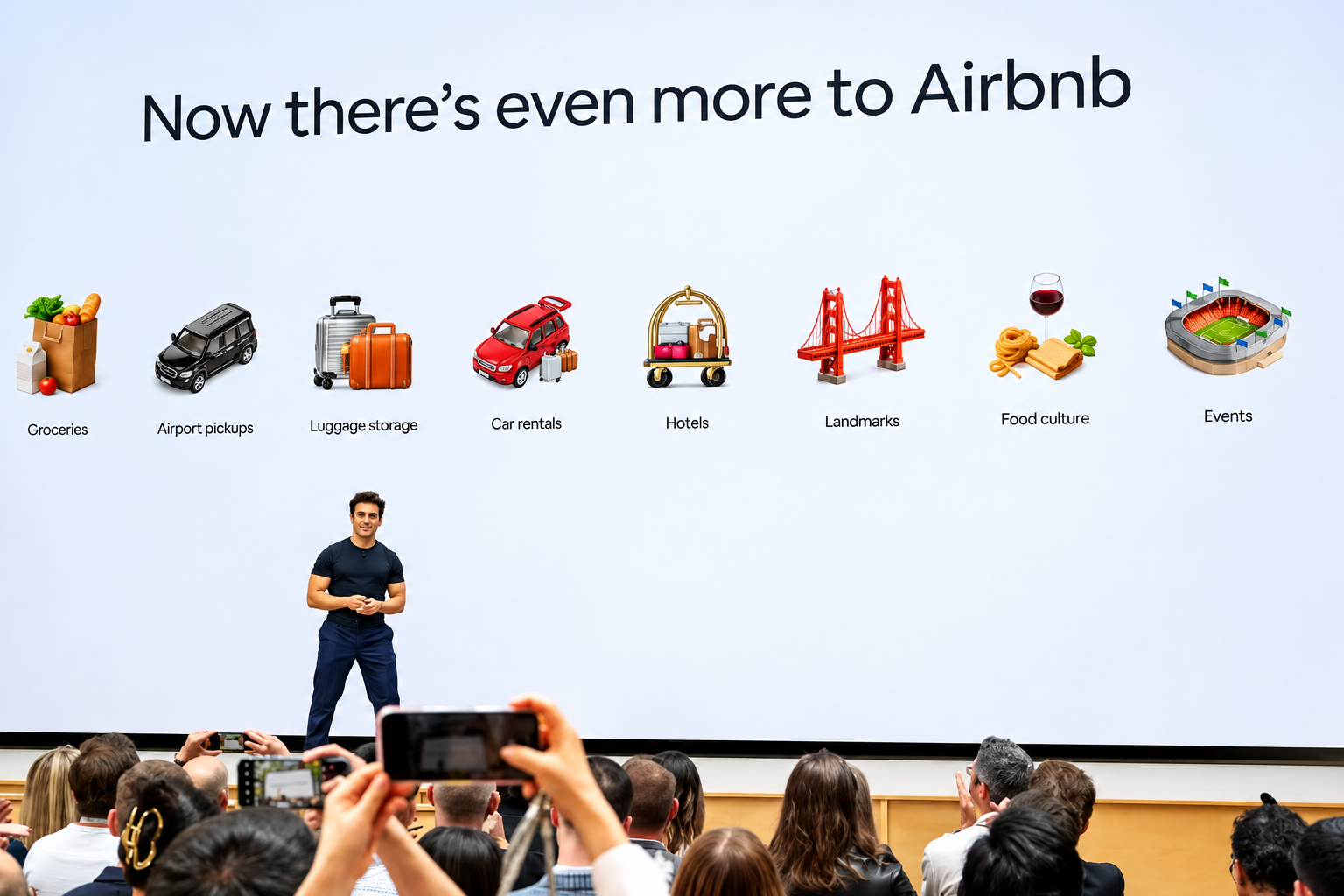
AI agents like Muse can already find you the cheapest hotel room in Paris. But they can’t locate a cheaper version of that Catskills cabin you’ve been eyeing, because it might only be available on Airbnb ABNB -1.43%decrease.
Investors should pay attention to that distinction. When Meta Platforms META 3.38%increase launched its Muse agent last month, travel stocks including Booking Holdings BKNG -1.19%decrease, Expedia and Airbnb all fell sharply.
Airbnb, though, has a real chance to emerge as a winner from the upheaval. The catch: Its stock already reflects above-industry growth. To justify its valuation, Airbnb will need to turn repeat customers into loyal ones.
Online travel companies make much of their money by simplifying search and collecting fees on bookings. AI agents threaten that model.
But not all travel marketplaces are equally exposed. Booking and Expedia largely sell hotel rooms that travelers can also book directly or through competing sites. If an agent can find the same room elsewhere, it has little reason to favor either Booking or Expedia.
Booking and Expedia also sell sponsored listings that steer travelers toward particular properties. Wells Fargo estimates those will account for about 8% of Expedia’s revenue and a much higher percentage of profit next year.
Airbnb has more ways to adapt. More than half its listings are available only on its platform, and more than 90% of its traffic comes directly to its app or website.
The customer relationship doesn’t end after booking, either. Bernstein analyst Richard Clarke notes that 90% of Airbnb guests go on to message their hosts about arrival times, keys or local taxes, giving Airbnb a connection to both sides of the transaction.
How the companies have responded to the possible agentic future is telling.
Expedia quickly signed on as a Muse partner. Airbnb hasn’t, and Chief Executive Brian Chesky says AI chatbots have so far been a boon, sending customers to Airbnb’s website.
Chatbots might work for buying paper towels, he quipped at a Skift conference last month, but people enjoy planning trips. He argued that browsing dozens of homes isn’t something a text-based chatbot is well suited for.
Still, the AI jitters arrived just as Airbnb was persuading investors it deserved its pricey multiple. For years after its 2020 initial public offering, the stock—which trades around 25 to 30 times forward earnings—went nowhere. Investors saw a mature operator trading at a growth premium.
This year, Airbnb growth seems to be accelerating. The stock jumped in August after the company raised its full-year revenue-growth guidance with its second-quarter results. Wells Fargo analyst Ken Gawrelski credits a run of product improvements under a revamped leadership team.
Among the changes: letting guests reserve now and pay later, adding hotels, and a redesigned home page and app. Investors were also betting on what comes next, including thousands more hotels, car rentals and, eventually, advertising.
The irony is that some of those growth drivers push Airbnb closer to the kind of business Booking and Expedia run—the kind of business AI agents could threaten. Even if AI agents capture a large share of travel planning and booking, Airbnb would capture the demand. But it and others would slowly lose control over how customers find and choose properties.
That would undermine the advertising opportunity investors are counting on. The bigger point for Airbnb and other marketplaces is that losing control of customer acquisition could mean surrendering some of their pricing power and margins.
To bulletproof itself, Airbnb might look to another e-commerce giant that has so far kept AI agents at arm’s length: Amazon.
Like Amazon, Airbnb has a loyal customer base and hard-to-match supply. But it has nothing like Prime membership to make customers think twice before taking their business elsewhere.
That is where loyalty comes in. Business travelers stick with Hilton or Marriott because enough nights earn them perks. Leisure travelers rarely accumulate stays with one chain. Airbnb has millions of listings and plenty of repeat customers, but no broad rewards program. It has begun experimenting with credits on hotel stays, but it should make loyalty a priority, not just a promotion.
Airbnb also plans to launch its own AI agent next year. But travelers using an agent might still want it to search Airbnb, Vrbo, Booking and hotel websites alike, rather than limit itself to one company’s inventory.
Eventually, Airbnb might have to strike deals with agent makers, using its unique homes as leverage to negotiate favorable terms, says Gawrelski. Such deals, along with rewards for loyal guests, could over the long term eat into the company’s roughly 13% take rate, he adds. But if they bring in enough additional bookings, the trade-off could be worthwhile.
History offers a reason not to panic. The shift from desktop to mobile unsettled investors in Alphabet and Amazon, but both emerged as major beneficiaries. Companies with valuable assets can come out of a platform shift stronger, if they adapt quickly enough.
Airbnb has homes the bots can’t easily replace. Now it needs to give guests a reason to insist on booking them there.
