
The Unexpected Ways a Big Raise Affects Your Happiness
Getting more money often leads to immediate satisfaction. The good feelings might not last.

By JOE PINSKER
Mon, Jan 15, 2024 9:50am 4 min
4 min
4 min


Getting more money often leads to immediate satisfaction. The good feelings might not last.
4 min
Up and down the income ladder, people say more money would make them happier. When they actually get it, that isn’t always the case.
Some people who have gotten big raises recently say the money hasn’t changed their day-to-day life or hasn’t provided them as much joy as the things in their life that have nothing to do with money. Others were hoping for a bigger raise or felt conflicted about making more money.
Jess Tapia, a 28-year-old accountant in Hoffman Estates, Ill., thought for years that $90,000 was a salary that would make her happy. When a raise of about $20,000 pushed her pay to that level last February, it did—at first.
To celebrate, Tapia booked a vacation to Germany the next month. The good vibes soon wore off.
“By the time I came back from that trip, it kind of fell flat for me because it was just back to normal, back to the routine,” she said.
The past few years have been good ones for workers seeking higher pay. Median year-over-year wage growth hit a recent peak of 6.7% in summer 2022, after mostly staying below 4% for more than a decade before 2021, according to the Atlanta Federal Reserve. Many of those who switched jobs, or threatened to, made substantial salary gains.
And people with higher incomes do tend to be happier, many studies show. Research looking at lotteries and random cash giveaways indicates that additional money can make people happier for months or even years.
But moving up the income scale, it takes more money to generate the same good feelings, said Jan-Emmanuel De Neve, an economics professor at Saïd Business School at the University of Oxford who studies well-being. The proportion of the increase matters.
“If an employer moves somebody from $15,000 to $30,000, that will have an impact on people’s life satisfaction that is the equivalent of them moving somebody from, say, $60,000 to $120,000,” De Neve said.
A pay increase that takes someone from financially stressed to financially stable often leads to more happiness. At the low end of the earnings spectrum, a higher income is associated more with squashing negative feelings than producing positive ones, according to a 2021 paper in the journal Proceedings of the National Academy of Sciences.
Randeep Chauhan, a 30-year-old nurse in Ferndale, Wash., went from making about $45,000 in 2021 to $90,000 in 2022 after completing a one-year nursing program.
“Doubling my income didn’t double my happiness, but it came close,” he said.
For Chauhan, much of the happiness boost came from being able to stop worrying about being able to cover his family’s monthly bills. He said his blood pressure dropped to a healthy level after his change in pay, which he attributes largely to the drop-off in financial stress.
If you get a raise, don’t just spend it, said Neela Hummel, a financial planner and the co-CEO of Abacus Wealth Partners.
“The worst thing that can happen with a raise is that that money gets immediately folded into cash flow and a client doesn’t even notice it,” she said.
Many people also jump ahead to how nice a car or how big a house they could afford with a new paycheck. Instead, Hummel advises, take the raise as an opportunity to up your savings or pay down debt.
Chauhan said he has avoided lifestyle creep, putting money toward retirement savings and student loans instead of buying a new computer or phone. “There’s a weird rush in making money and not spending it,” he said.
Austin Benacquisto’s pay has rocketed upward over the past few years. The 29-year-old commercial debt broker in Atlanta made roughly $60,000 in 2019, $110,000 in 2020, $180,000 in 2021 and $325,000 in 2022, including bonuses.
His steps up to $110,000 and $180,000 felt better than the one up to $325,000, he said.
“The last 50,000 I made in 2022 just was for stuff in my house that I wanted,” he said.
Benacquisto’s pay fell to about $200,000 last year as his industry slowed down. The drop felt worse than the recent increases felt good, he said.
“This being the first decrease, it definitely stings,” he said.
People’s happiness with their pay is strongly tied to how it compares with the pay of others around them, say researchers who study compensation. Sometimes, those comparisons rankle.
A 30% raise made Ryan Powell less happy at work.
Powell, a 38-year-old finance director for a manufacturer in western North Carolina, received that pay bump in 2022. He had been hoping for more based on the salary information he had heard from recruiters, peers in the industry and his M.B.A. cohort.
The initial thrill of the raise lasted about three months, he said.
“The further I got into it, the more I was realising that I was anchored to the higher number,” he said.
Executives are more likely to leave their companies if their pay is low compared with other top bosses, according to a 2017 study in the journal Human Resource Management.
Comparisons matter closer to home, too. Living in an area where people tend to make more money than you is linked to being less happy, according to a 2005 paper in The Quarterly Journal of Economics.
One reason that Tapia, the accountant in Illinois, isn’t happier after her raises is that she feels guilt about making more money than her parents ever did. Her dad works in construction and landscaping.
“I work from home mostly, I’m comfortable and I’m always indoors. During summertime, he’s sometimes outside working 10 hours in 100-degree weather,” she said.
Tapia recently got another raise of roughly $10,000. She again booked a vacation to Europe but is hoping to extend her joy further this time.
“I’m starting to feel like this is going to plateau, so let me try and make the feeling last a little longer with this trip,” she said.
 Copyright 2020, Dow Jones & Company, Inc. All Rights Reserved Worldwide. LEARN MORE




BNW Developments has established a Sydney presence, joining Arada and Sobha Realty among the growing number of UAE developers pursuing Australian buyers and development opportunities.
The Australian leather house has opened an immersive four-day pop-up in Manhattan, unveiling its Bloom Collection and redefining what a product launch can look like.
AI-powered travel agents are challenging online booking platforms, but Airbnb’s exclusive listings and direct customer relationships could give it an edge. Its next challenge: turning repeat guests into loyal customers through stronger rewards and innovation.
3 min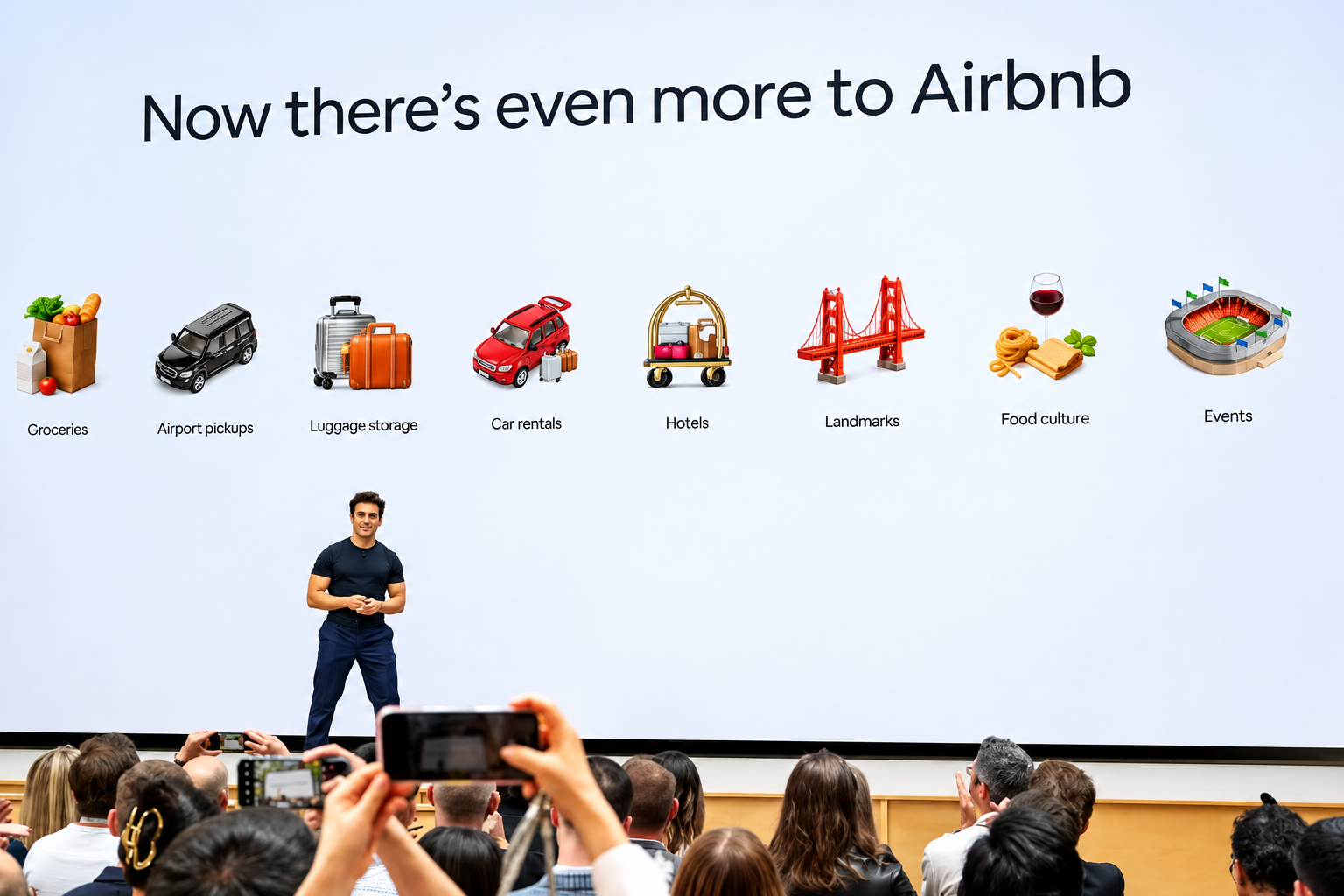
AI agents like Muse can already find you the cheapest hotel room in Paris. But they can’t locate a cheaper version of that Catskills cabin you’ve been eyeing, because it might only be available on Airbnb ABNB -1.43%decrease.
Investors should pay attention to that distinction. When Meta Platforms META 3.38%increase launched its Muse agent last month, travel stocks including Booking Holdings BKNG -1.19%decrease, Expedia and Airbnb all fell sharply.
Airbnb, though, has a real chance to emerge as a winner from the upheaval. The catch: Its stock already reflects above-industry growth. To justify its valuation, Airbnb will need to turn repeat customers into loyal ones.
Online travel companies make much of their money by simplifying search and collecting fees on bookings. AI agents threaten that model.
But not all travel marketplaces are equally exposed. Booking and Expedia largely sell hotel rooms that travelers can also book directly or through competing sites. If an agent can find the same room elsewhere, it has little reason to favor either Booking or Expedia.
Booking and Expedia also sell sponsored listings that steer travelers toward particular properties. Wells Fargo estimates those will account for about 8% of Expedia’s revenue and a much higher percentage of profit next year.
Airbnb has more ways to adapt. More than half its listings are available only on its platform, and more than 90% of its traffic comes directly to its app or website.
The customer relationship doesn’t end after booking, either. Bernstein analyst Richard Clarke notes that 90% of Airbnb guests go on to message their hosts about arrival times, keys or local taxes, giving Airbnb a connection to both sides of the transaction.
How the companies have responded to the possible agentic future is telling.
Expedia quickly signed on as a Muse partner. Airbnb hasn’t, and Chief Executive Brian Chesky says AI chatbots have so far been a boon, sending customers to Airbnb’s website.
Chatbots might work for buying paper towels, he quipped at a Skift conference last month, but people enjoy planning trips. He argued that browsing dozens of homes isn’t something a text-based chatbot is well suited for.
Still, the AI jitters arrived just as Airbnb was persuading investors it deserved its pricey multiple. For years after its 2020 initial public offering, the stock—which trades around 25 to 30 times forward earnings—went nowhere. Investors saw a mature operator trading at a growth premium.
This year, Airbnb growth seems to be accelerating. The stock jumped in August after the company raised its full-year revenue-growth guidance with its second-quarter results. Wells Fargo analyst Ken Gawrelski credits a run of product improvements under a revamped leadership team.
Among the changes: letting guests reserve now and pay later, adding hotels, and a redesigned home page and app. Investors were also betting on what comes next, including thousands more hotels, car rentals and, eventually, advertising.
The irony is that some of those growth drivers push Airbnb closer to the kind of business Booking and Expedia run—the kind of business AI agents could threaten. Even if AI agents capture a large share of travel planning and booking, Airbnb would capture the demand. But it and others would slowly lose control over how customers find and choose properties.
That would undermine the advertising opportunity investors are counting on. The bigger point for Airbnb and other marketplaces is that losing control of customer acquisition could mean surrendering some of their pricing power and margins.
To bulletproof itself, Airbnb might look to another e-commerce giant that has so far kept AI agents at arm’s length: Amazon.
Like Amazon, Airbnb has a loyal customer base and hard-to-match supply. But it has nothing like Prime membership to make customers think twice before taking their business elsewhere.
That is where loyalty comes in. Business travelers stick with Hilton or Marriott because enough nights earn them perks. Leisure travelers rarely accumulate stays with one chain. Airbnb has millions of listings and plenty of repeat customers, but no broad rewards program. It has begun experimenting with credits on hotel stays, but it should make loyalty a priority, not just a promotion.
Airbnb also plans to launch its own AI agent next year. But travelers using an agent might still want it to search Airbnb, Vrbo, Booking and hotel websites alike, rather than limit itself to one company’s inventory.
Eventually, Airbnb might have to strike deals with agent makers, using its unique homes as leverage to negotiate favorable terms, says Gawrelski. Such deals, along with rewards for loyal guests, could over the long term eat into the company’s roughly 13% take rate, he adds. But if they bring in enough additional bookings, the trade-off could be worthwhile.
History offers a reason not to panic. The shift from desktop to mobile unsettled investors in Alphabet and Amazon, but both emerged as major beneficiaries. Companies with valuable assets can come out of a platform shift stronger, if they adapt quickly enough.
Airbnb has homes the bots can’t easily replace. Now it needs to give guests a reason to insist on booking them there.
