
The Highest Paid CEOs of 2023

By THEO FRANCIS
Wed, May 22, 2024 9:48am 6 min
6 min
6 min

 6 min
6 min
The chiefs of America’s biggest companies reached new pay heights in 2023 as stock awards swelled the value of compensation packages.
Half of the executives in a Wall Street Journal analysis made at least $15.7 million, a record for median CEO pay in the annual survey, with several making more than $50 million . Median pay for the same companies a year earlier was about $14.5 million .
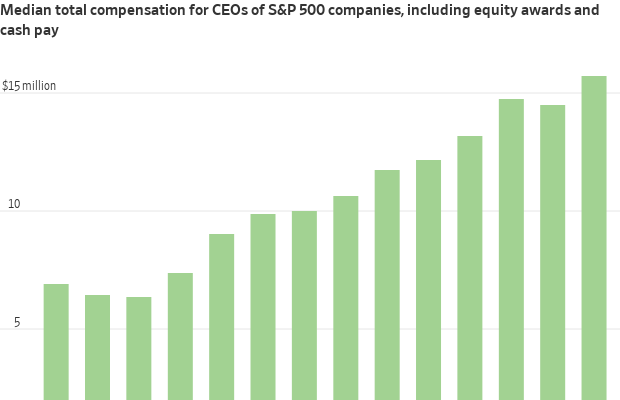
Most of the executives received year-over-year raises of at least 9%—one in four got 25% or more—and most companies recorded annual shareholder returns of at least 13%, the Journal found in an analysis of data on more than 400 companies from MyLogIQ , a provider of public-company data and analysis. (See the full ranking below.)
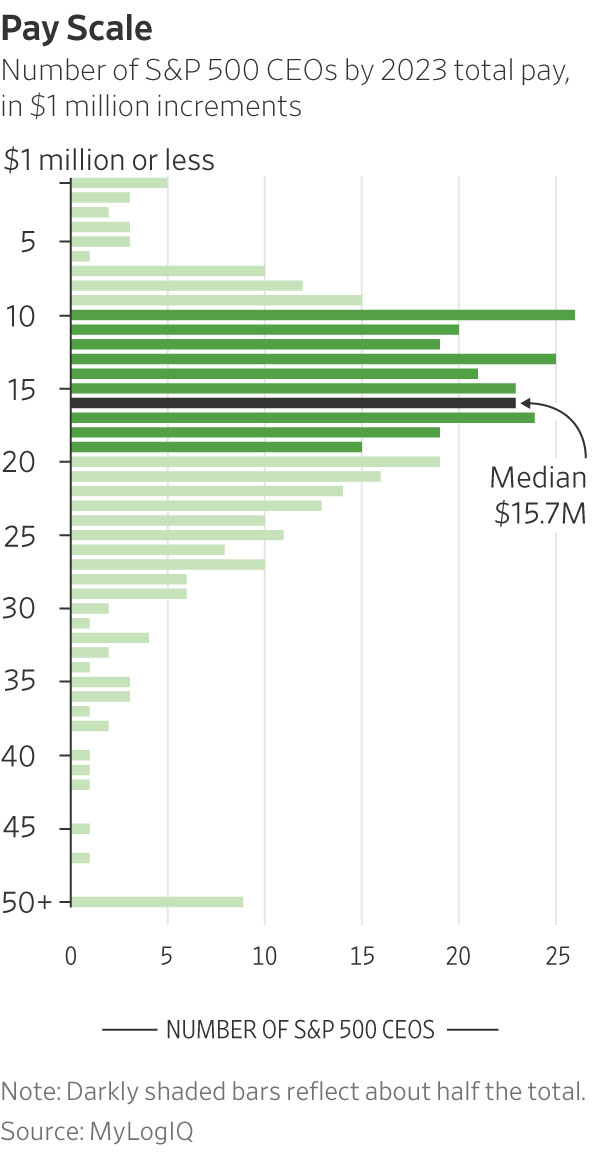
Eight tech executives ranked among the 25 top earners, as did five each heading financial companies and media or entertainment companies.
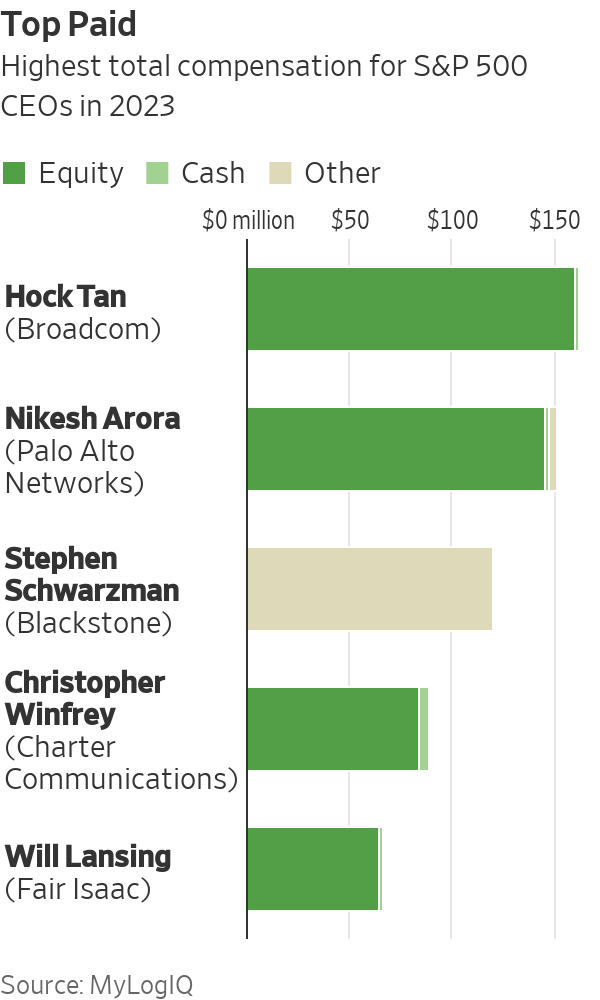
Hock Tan , the highest-paid CEO in the Journal’s analysis at $162 million, has to stay on the job for five years and Broadcom ’s share price must reach certain targets after October 2025 to get the full value of most of his pay. Broadcom said the company has outperformed competitors under Tan, its CEO since 2006, and he won’t get more equity or cash bonuses for five years.
Pay for Nikesh Arora at Palo Alto Networks totalled $151 million, mostly in equity awards that included shares granted over three years.
Blackstone , where Steven Schwarzman made $120 million, said the company’s 83% total return surpassed U.S. asset managers last year and described its pay structure as aligning executive incentives with those of investors.
Christopher Winfrey of Charter Communications , the cable operator, received total pay valued at $89.1 million, largely in options and stock vesting over five years, and much of it only if the company’s shares rise 28% to 152% from when the grants were made.
A $30 million one-time retention and leadership award that vests over five years helped boost total pay for Fair Isaac ’s Will Lansing to $66 million. The company said its shareholder returns ranked among the top 1% of companies in the S&P 500 over the past decade.
Equity awards continued to make up the bulk of most executives’ pay, much of it structured to deliver more stock or options if the company meets financial or share-price performance over several years. That means the pay can lose considerable value if the company’s share price falls or operating targets are missed—or soar in value amid market and operating success.
Restricted stock awarded in early March last year to Jensen Huang , CEO of graphics-chip maker Nvidia , quadrupled in value through late January, to $107.5 million. Huang’s pay, originally reported at $34.2 million , included $26.7 million of restricted stock as valued at grant.
Under the terms of the award, Huang could receive 50% to 100% more shares than originally targeted if the company meets performance criteria, according to Nvidia’s proxy.
Nvidia’s share price tripled during the year.
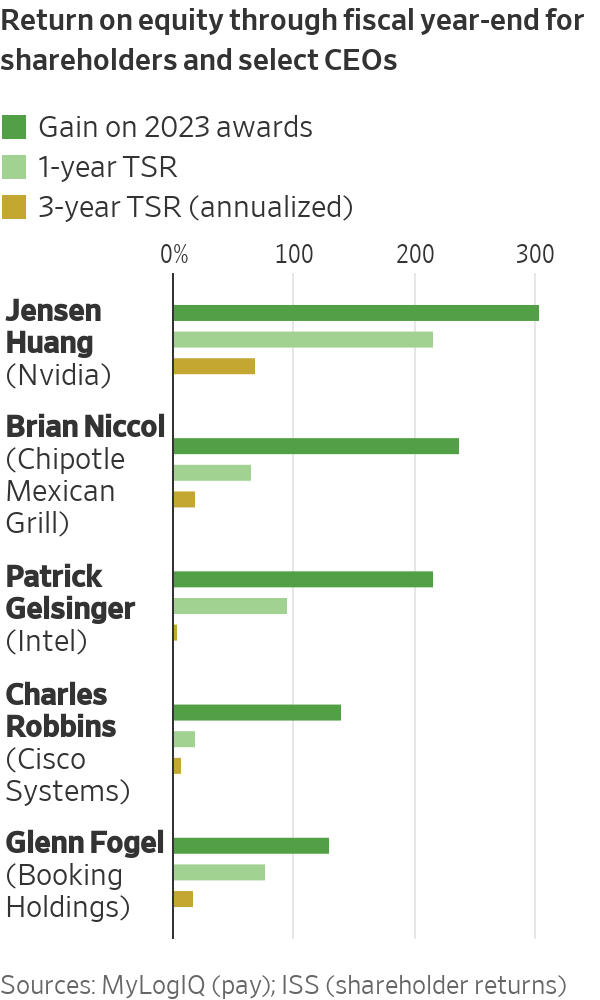
Brian Niccol , CEO of restaurateur Chipotle Mexican Grill , received stock and options valued at $15.5 million when they were granted in February 2023 as part of a $22.5 million pay package. By the end of the year, that equity had more than tripled in value, to $52.2 million, the company said. Chipotle shares returned about 65% during 2023, and 18% a year over three years.
A Chipotle spokeswoman said the growth in Niccol’s equity-award value reflects the company’s strong share-price performance during the year. The company said the value Niccol ultimately realises depends on continued financial, operating and stock-market performance by the company.
Intel CEO Patrick Gelsinger ’s equity awards last year also more than tripled in value by year-end, to $39.3 million. The company said in its securities filings that austerity measures last year reduced Gelsinger’s salary by about 15% to $1.1 million, which in turn reduced his cash bonus target by about 15%, to $2.9 million.
Overall, median cash pay for CEOs, including salary and annual bonuses, remained flat at about $3.8 million.
Pay for CEOs running the best- and worst-performing companies didn’t vary dramatically. Median total pay was $14.6 million for the 20% of CEOs whose companies recorded the worst returns compared with other companies in the same sector, and $15.7 million for CEOs at the best-performing companies.
Chip and computer hardware makers accounted for six of the 25 best-performing companies—including Nvidia, the top performer—while four were in the travel or transportation industries. Several of the top performers bounced back from one or more years of poor returns, often tied to the pandemic.
Royal Caribbean Group reported paying Jason Liberty $17.2 million and recorded a total return of 162% last year, after posting minus 36% in 2022 and minus 43% in 2020, when the cruise industry was battered by illness and travel bans. (The company posted a 3% return in 2021.) Ride-sharing giant Uber Technologies recorded a 149% return after posting returns of minus 41% in 2022 and minus 18% in 2021.
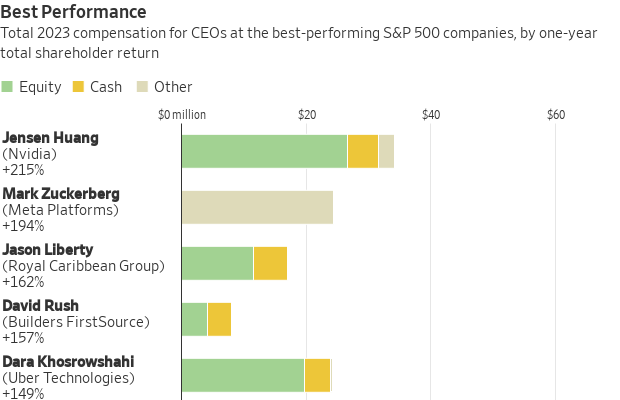
Chip maker Advanced Micro Devices , ranked seventh by one-year performance, was headed by Lisa Su , the second-highest-paid woman in the analysis, at just over $30 million, including nearly $28 million in restricted stock and options. The highest-paid woman, at $31.55 million, was Julie Sweet of consultant Accenture , which posted a one-year total return of about 14%.
Thirty-one women ran S&P 500 companies for the full year of 2023, up from around two dozen at the beginning of the decade. None ranked among the top 25 by pay. One other woman ran one of the 25 best performers: Jayshree Ullal at networking company Arista Networks , which posted a 94% return. Ullal’s pay totalled $15.56 million.
Among the 25 worst-performing companies in the Journal analysis, nearly a third operated in the healthcare sector, including six pharmaceutical or biotech companies. They were joined by four utilities.
Pfizer said it didn’t pay bonuses to top executives last year after weak demand for Covid-related products led the company to miss financial targets. The $17.5 million equity award that made up most of CEO Albert Bourla ’s total pay last year is meant to recognize his leadership and give him an incentive to focus on long-term strategy, the company said.
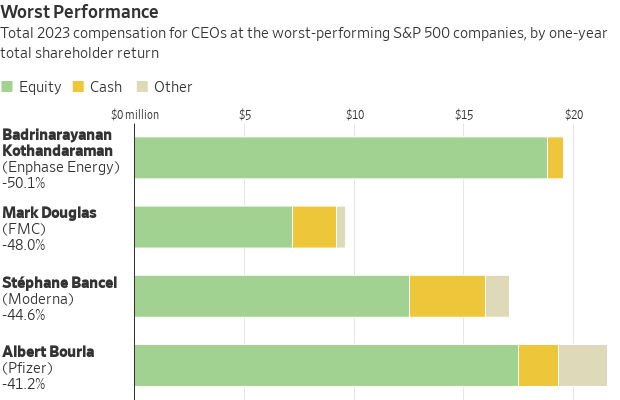
Poor performance can slash the value of CEO equity awards. Covid-vaccine maker Moderna reported total pay of $17.1 million for CEO Stéphane Bancel last year, including $12.5 million in stock and option awards.
The value of those awards fell 42% to $7.3 million at year-end, the company’s proxy shows, as Moderna’s stock price tumbled about the same amount for the year. In addition, equity awards made to Bancel in prior years fell in value by about $167 million during 2023.
Those losses offset a net $945 million in new equity awards and increases in value reported for Bancel during the prior three years.
Moderna declined to comment.
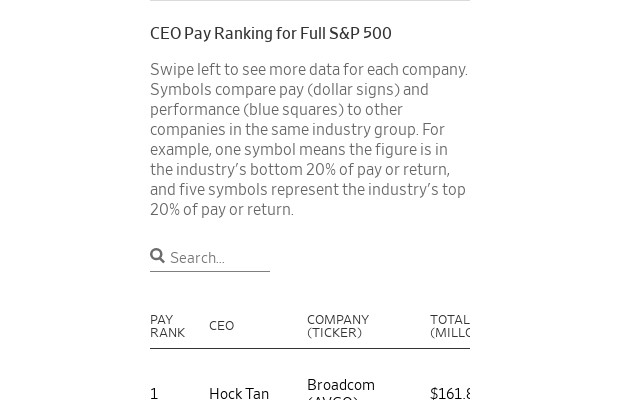
The Wall Street Journal used data from corporate proxy statements filed through May 16 by companies in the S&P 500 index with fiscal years ended after June 30, 2023. The data was collected by MyLogIQ, a provider of public-company data and analysis.
Aggregate pay and shareholder-return figures exclude companies that changed CEOs or fiscal-year-end dates during the year.
Pay reflects the value of equity awards at grant, as reported by companies. Total returns reflect stock-price change and dividends, in most cases calculated from the month end closest to the company’s fiscal-year end.
Sources: MyLogIQ (compensation); Institutional Shareholder Services, FactSet (shareholder return); Standard & Poor’s (industry groups); company filings (pay for select companies)
 Copyright 2020, Dow Jones & Company, Inc. All Rights Reserved Worldwide. LEARN MORE




BNW Developments has established a Sydney presence, joining Arada and Sobha Realty among the growing number of UAE developers pursuing Australian buyers and development opportunities.
The Australian leather house has opened an immersive four-day pop-up in Manhattan, unveiling its Bloom Collection and redefining what a product launch can look like.
AI-powered travel agents are challenging online booking platforms, but Airbnb’s exclusive listings and direct customer relationships could give it an edge. Its next challenge: turning repeat guests into loyal customers through stronger rewards and innovation.
3 min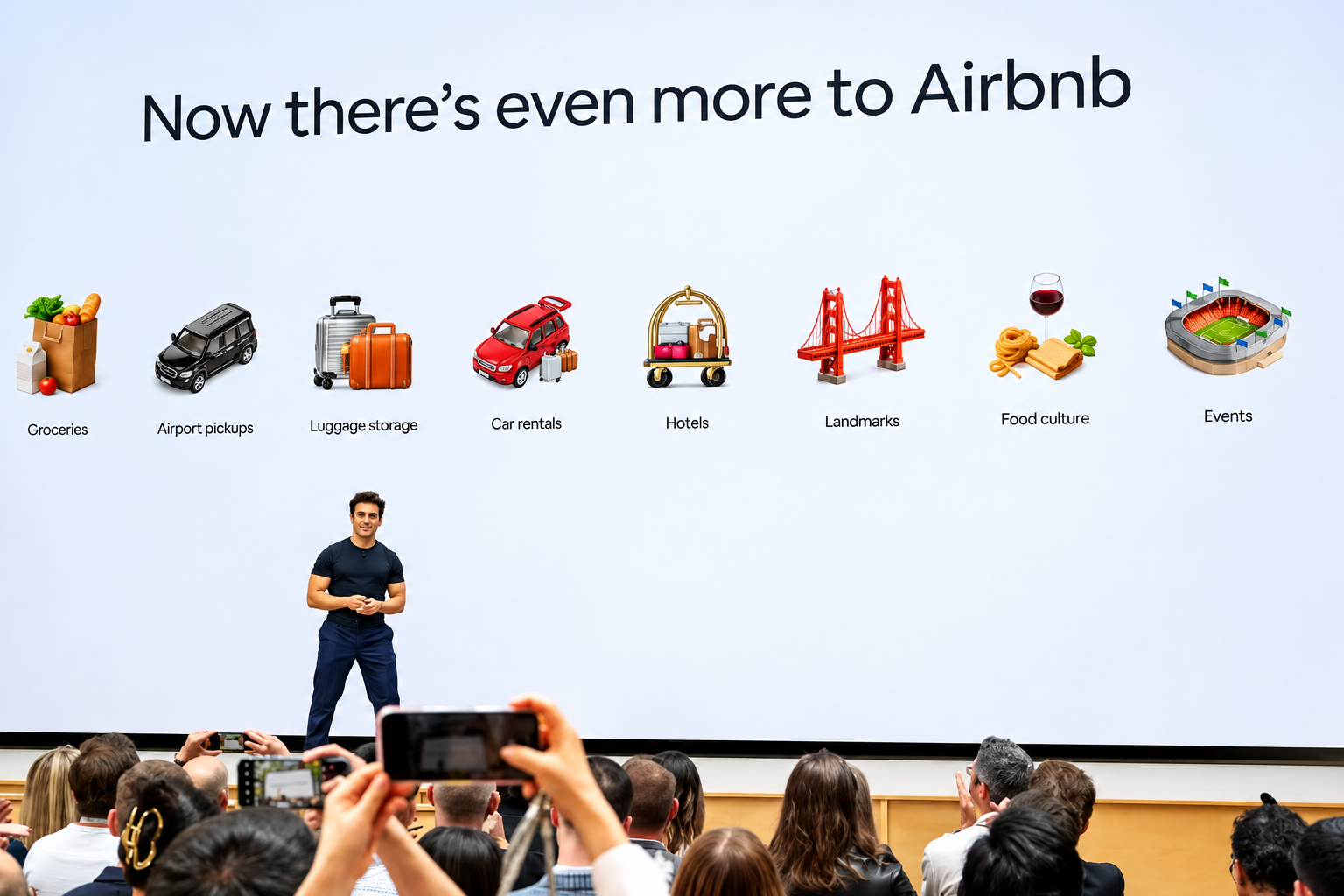
AI agents like Muse can already find you the cheapest hotel room in Paris. But they can’t locate a cheaper version of that Catskills cabin you’ve been eyeing, because it might only be available on Airbnb ABNB -1.43%decrease.
Investors should pay attention to that distinction. When Meta Platforms META 3.38%increase launched its Muse agent last month, travel stocks including Booking Holdings BKNG -1.19%decrease, Expedia and Airbnb all fell sharply.
Airbnb, though, has a real chance to emerge as a winner from the upheaval. The catch: Its stock already reflects above-industry growth. To justify its valuation, Airbnb will need to turn repeat customers into loyal ones.
Online travel companies make much of their money by simplifying search and collecting fees on bookings. AI agents threaten that model.
But not all travel marketplaces are equally exposed. Booking and Expedia largely sell hotel rooms that travelers can also book directly or through competing sites. If an agent can find the same room elsewhere, it has little reason to favor either Booking or Expedia.
Booking and Expedia also sell sponsored listings that steer travelers toward particular properties. Wells Fargo estimates those will account for about 8% of Expedia’s revenue and a much higher percentage of profit next year.
Airbnb has more ways to adapt. More than half its listings are available only on its platform, and more than 90% of its traffic comes directly to its app or website.
The customer relationship doesn’t end after booking, either. Bernstein analyst Richard Clarke notes that 90% of Airbnb guests go on to message their hosts about arrival times, keys or local taxes, giving Airbnb a connection to both sides of the transaction.
How the companies have responded to the possible agentic future is telling.
Expedia quickly signed on as a Muse partner. Airbnb hasn’t, and Chief Executive Brian Chesky says AI chatbots have so far been a boon, sending customers to Airbnb’s website.
Chatbots might work for buying paper towels, he quipped at a Skift conference last month, but people enjoy planning trips. He argued that browsing dozens of homes isn’t something a text-based chatbot is well suited for.
Still, the AI jitters arrived just as Airbnb was persuading investors it deserved its pricey multiple. For years after its 2020 initial public offering, the stock—which trades around 25 to 30 times forward earnings—went nowhere. Investors saw a mature operator trading at a growth premium.
This year, Airbnb growth seems to be accelerating. The stock jumped in August after the company raised its full-year revenue-growth guidance with its second-quarter results. Wells Fargo analyst Ken Gawrelski credits a run of product improvements under a revamped leadership team.
Among the changes: letting guests reserve now and pay later, adding hotels, and a redesigned home page and app. Investors were also betting on what comes next, including thousands more hotels, car rentals and, eventually, advertising.
The irony is that some of those growth drivers push Airbnb closer to the kind of business Booking and Expedia run—the kind of business AI agents could threaten. Even if AI agents capture a large share of travel planning and booking, Airbnb would capture the demand. But it and others would slowly lose control over how customers find and choose properties.
That would undermine the advertising opportunity investors are counting on. The bigger point for Airbnb and other marketplaces is that losing control of customer acquisition could mean surrendering some of their pricing power and margins.
To bulletproof itself, Airbnb might look to another e-commerce giant that has so far kept AI agents at arm’s length: Amazon.
Like Amazon, Airbnb has a loyal customer base and hard-to-match supply. But it has nothing like Prime membership to make customers think twice before taking their business elsewhere.
That is where loyalty comes in. Business travelers stick with Hilton or Marriott because enough nights earn them perks. Leisure travelers rarely accumulate stays with one chain. Airbnb has millions of listings and plenty of repeat customers, but no broad rewards program. It has begun experimenting with credits on hotel stays, but it should make loyalty a priority, not just a promotion.
Airbnb also plans to launch its own AI agent next year. But travelers using an agent might still want it to search Airbnb, Vrbo, Booking and hotel websites alike, rather than limit itself to one company’s inventory.
Eventually, Airbnb might have to strike deals with agent makers, using its unique homes as leverage to negotiate favorable terms, says Gawrelski. Such deals, along with rewards for loyal guests, could over the long term eat into the company’s roughly 13% take rate, he adds. But if they bring in enough additional bookings, the trade-off could be worthwhile.
History offers a reason not to panic. The shift from desktop to mobile unsettled investors in Alphabet and Amazon, but both emerged as major beneficiaries. Companies with valuable assets can come out of a platform shift stronger, if they adapt quickly enough.
Airbnb has homes the bots can’t easily replace. Now it needs to give guests a reason to insist on booking them there.
