
AI Will Revolutionise How You Travel, Priceline CEO Says

By MICHAEL KAMINER
Tue, Jul 9, 2024 9:35am 4 min
4 min
4 min

 4 min
4 min
With its 1997 launch as a name-your-own-price site, Priceline helped usher in the era of online travel booking―and the growth of a trillion-dollar category. Priceline itself has mushroomed into a global business with 1,500 full-time employees; along with global airline bookings, the site claims to offer 1.2 million accommodations in 116 countries.
Now, the Connecticut-based company is focusing on generative AI, and CEO Brett Keller is behind the leap. It’s just the latest technology push from Keller, a 25-year veteran of the company who has also served as CMO and COO. Under Keller, Priceline launched the travel industry’s first full-service mobile app in 2009; he also helped conceive the hugely popular William Shatner-fronted “Negotiator” ad campaign.
Keller, 56, talked to Penta about how AI is changing travel planning, what luxury travellers do to save money, and why Japan blows his mind.
Penta: Much of Priceline’s marketing is about value. Do you see luxury travellers in your customer mix along with budget-conscious travellers?
Brett Keller: High-net-worth consumers take a significantly higher number of trips than the average leisure traveller. For a high-end vacation like a safari in Tanzania, they’ll work with experts. But for the other 30 trips they book that year, either for themselves or family members, they don’t always reach for the stars. They want to manage money effectively. And as they’re moving around the country and the world, they need a fast, easy way to book travel that accommodates their needs. Priceline is a great platform for that kind of trip. And if you’re taking a quick weekend trip to Miami, and want to stay in the Four Seasons, we’ve negotiated with them. Even high-net-worth individuals seek value.
Priceline made headlines last year for partnering with both Google and OpenAI on Penny, your AI assistant. How has Penny evolved?
She’s gone from, “I can answer questions about the hotel you’re looking at” to actually servicing the customer through more complicated scenarios. If you need to cancel a hotel that’s fully refundable, you can do it with one click. But if there are issues, like a reservation that’s not fully cancelable, Penny can walk through those steps for you.
Penny’s also helping people find, search, and book properties. For example, if the customer tells her, “I’m looking for a great resort with these features, anywhere warm”—she’ll present recommended properties that meet those requirements. You can continue with Penny on the site, or go with the traditional experience.
Has there been any pushback from consumers about Penny and generative AI?
There has been none. Customers still have access to phone agents. Anyway, the younger generation doesn’t want to talk to anyone. And with traditional chat agents, live agents, or even messaging apps, there’s typically a delay. Penny answers immediately and in real time.
What’s the future of generative AI and online travel booking?
The future is a highly personalised shopping experience. It’s hard to achieve, because we don’t know about the consumer when they come in. But generative AI lets us dramatically improve personalisation. As you work with Penny, and tell us your preferences, the way you interact lets us find and book the best products and services every time you return. The ability to customise and personalise increases exponentially.
Is the travel experience even more bifurcated between elite, ultra-high-net-worth travellers and everyone else?
Consumers seem to be a little less sensitive in some areas. On planes, first-class and comfort-plus seats are the first to go, most of the time, and people are burning through points to sit in the front because they’re tired of not having legroom. But seats are packed in economy, too, so people are flying.
Hotel bookings are more economically driven in the U.S. Higher-income people are not as affected by interest rates or the cost of living, so they spend more freely than economy-minded consumers. There is a bit of bifurcation there. The low end is not filling, but the high end is.
It’s been reported Europe’s going to get even more crowded this summer. Does Priceline ever suggest alternatives to over-touristed or overpriced destinations?
We’re not in the business of telling you where you shouldn’t travel. We market popular destinations because that’s where people want to go. As much as we could tell people, “Las Vegas is overcrowded, don’t go,” people will want to go.
Social media is highlighting some overpopulated destinations and suggesting alternatives, so that comes back to us. But price is the No. 1 motivator. Vegas is a great value. There are so many hotel rooms available that you can go in a non-peak period and get a room in a four-star hotel for US$120. Try doing that in New York City.
What destinations are going to pop over the next year or two?
Asia will continue to be exciting and interesting to people. Bangkok is a great place to move in, then travel throughout Southeast Asia. As the region gets more popular, people will keep trying to find more remote and more unique destinations. People love Europe, but it was the hot spot in 2022 and ’23. Some travellers are saying, “I’ve had enough, and I’m moving on.” Japan is also amazing, for so many reasons. It’s easy to navigate. English is not a challenge. It’s safe. It feels like a different world, but completely first-world. The strength of the dollar is also driving some of that―again, price plays a role.
Beyond that, Mexico and the Caribbean took a real hit in 2022 and ’23 after a boom in 2021. They’re coming back now. A lot of people don’t want to travel far—“I just want to go to a beach and not think of anything.” And because not everyone wants to travel overseas, unique and relaxing cities like Nashville, Tennessee; Houston; and Austin, Texas, will be popular, especially into the fall.
Every day brings more headlines about airline woes. Who gets blamed if a Priceline customer has a bad flying experience, you or the airline?
When you have a bad experience traveling, you want to blame everybody. No matter what happened, the online travel agency takes blame and the airline takes the blame. It could be your seat, the person sitting next to you, whatever. We get the complaint, and we take on that responsibility and that role. We have leverage because of the amount of business we drive to partners. They want to work with us to make sure the customer has the best experience. Something goes wrong almost every time you take a trip. That’s just the reality.
What are your favourite places to travel?
My favourite destination, and a place where I spend a lot of time every summer, is [resort town] McCall, Idaho, one of the most beautiful towns in the West, with hiking, trails, and mountain biking. Outside of the country, it’s Japan, absolutely. Tokyo is the most exciting city in the world. It’s mind-blowing.
This interview has been edited for length and clarity.
 Copyright 2020, Dow Jones & Company, Inc. All Rights Reserved Worldwide. LEARN MORE




BNW Developments has established a Sydney presence, joining Arada and Sobha Realty among the growing number of UAE developers pursuing Australian buyers and development opportunities.
The Australian leather house has opened an immersive four-day pop-up in Manhattan, unveiling its Bloom Collection and redefining what a product launch can look like.
AI-powered travel agents are challenging online booking platforms, but Airbnb’s exclusive listings and direct customer relationships could give it an edge. Its next challenge: turning repeat guests into loyal customers through stronger rewards and innovation.
3 min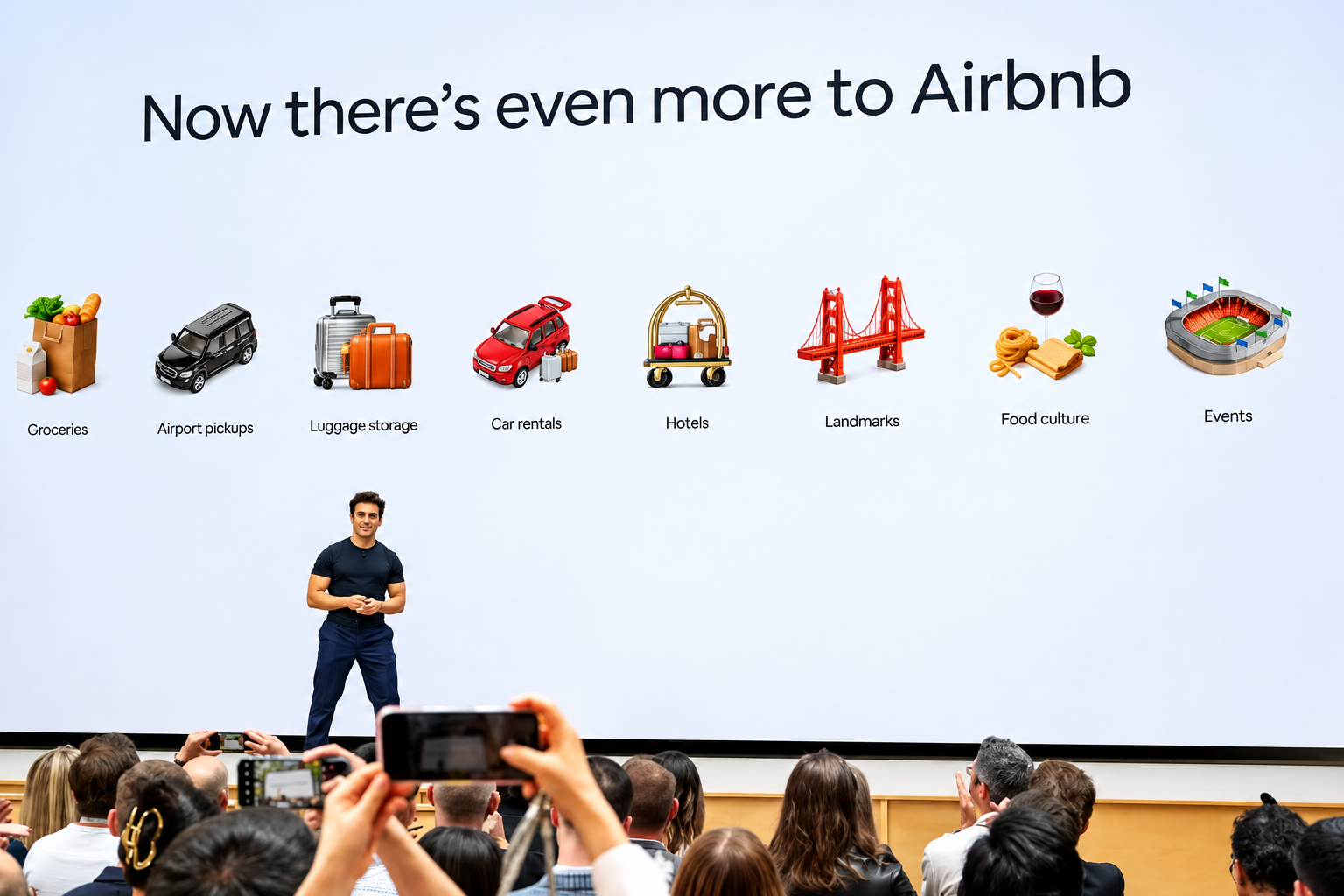
AI agents like Muse can already find you the cheapest hotel room in Paris. But they can’t locate a cheaper version of that Catskills cabin you’ve been eyeing, because it might only be available on Airbnb ABNB -1.43%decrease.
Investors should pay attention to that distinction. When Meta Platforms META 3.38%increase launched its Muse agent last month, travel stocks including Booking Holdings BKNG -1.19%decrease, Expedia and Airbnb all fell sharply.
Airbnb, though, has a real chance to emerge as a winner from the upheaval. The catch: Its stock already reflects above-industry growth. To justify its valuation, Airbnb will need to turn repeat customers into loyal ones.
Online travel companies make much of their money by simplifying search and collecting fees on bookings. AI agents threaten that model.
But not all travel marketplaces are equally exposed. Booking and Expedia largely sell hotel rooms that travelers can also book directly or through competing sites. If an agent can find the same room elsewhere, it has little reason to favor either Booking or Expedia.
Booking and Expedia also sell sponsored listings that steer travelers toward particular properties. Wells Fargo estimates those will account for about 8% of Expedia’s revenue and a much higher percentage of profit next year.
Airbnb has more ways to adapt. More than half its listings are available only on its platform, and more than 90% of its traffic comes directly to its app or website.
The customer relationship doesn’t end after booking, either. Bernstein analyst Richard Clarke notes that 90% of Airbnb guests go on to message their hosts about arrival times, keys or local taxes, giving Airbnb a connection to both sides of the transaction.
How the companies have responded to the possible agentic future is telling.
Expedia quickly signed on as a Muse partner. Airbnb hasn’t, and Chief Executive Brian Chesky says AI chatbots have so far been a boon, sending customers to Airbnb’s website.
Chatbots might work for buying paper towels, he quipped at a Skift conference last month, but people enjoy planning trips. He argued that browsing dozens of homes isn’t something a text-based chatbot is well suited for.
Still, the AI jitters arrived just as Airbnb was persuading investors it deserved its pricey multiple. For years after its 2020 initial public offering, the stock—which trades around 25 to 30 times forward earnings—went nowhere. Investors saw a mature operator trading at a growth premium.
This year, Airbnb growth seems to be accelerating. The stock jumped in August after the company raised its full-year revenue-growth guidance with its second-quarter results. Wells Fargo analyst Ken Gawrelski credits a run of product improvements under a revamped leadership team.
Among the changes: letting guests reserve now and pay later, adding hotels, and a redesigned home page and app. Investors were also betting on what comes next, including thousands more hotels, car rentals and, eventually, advertising.
The irony is that some of those growth drivers push Airbnb closer to the kind of business Booking and Expedia run—the kind of business AI agents could threaten. Even if AI agents capture a large share of travel planning and booking, Airbnb would capture the demand. But it and others would slowly lose control over how customers find and choose properties.
That would undermine the advertising opportunity investors are counting on. The bigger point for Airbnb and other marketplaces is that losing control of customer acquisition could mean surrendering some of their pricing power and margins.
To bulletproof itself, Airbnb might look to another e-commerce giant that has so far kept AI agents at arm’s length: Amazon.
Like Amazon, Airbnb has a loyal customer base and hard-to-match supply. But it has nothing like Prime membership to make customers think twice before taking their business elsewhere.
That is where loyalty comes in. Business travelers stick with Hilton or Marriott because enough nights earn them perks. Leisure travelers rarely accumulate stays with one chain. Airbnb has millions of listings and plenty of repeat customers, but no broad rewards program. It has begun experimenting with credits on hotel stays, but it should make loyalty a priority, not just a promotion.
Airbnb also plans to launch its own AI agent next year. But travelers using an agent might still want it to search Airbnb, Vrbo, Booking and hotel websites alike, rather than limit itself to one company’s inventory.
Eventually, Airbnb might have to strike deals with agent makers, using its unique homes as leverage to negotiate favorable terms, says Gawrelski. Such deals, along with rewards for loyal guests, could over the long term eat into the company’s roughly 13% take rate, he adds. But if they bring in enough additional bookings, the trade-off could be worthwhile.
History offers a reason not to panic. The shift from desktop to mobile unsettled investors in Alphabet and Amazon, but both emerged as major beneficiaries. Companies with valuable assets can come out of a platform shift stronger, if they adapt quickly enough.
Airbnb has homes the bots can’t easily replace. Now it needs to give guests a reason to insist on booking them there.
