
Perth’s Long Road To A Real Estate Boom
After a lacklustre 2020, the Western Australian capital is poised to break out this year.

By Kristen Craze
Mon, Feb 15, 2021 3:10am 5 min
5 min
5 min


After a lacklustre 2020, the Western Australian capital is poised to break out this year.
5 min
They both boast golden beaches, 28-degree-celsius summer days and glamorous waterfront real estate, but when it comes to comparing property prices there is a great divide between Perth and Sydney.
In addition to the 4000km separating the two Australian cities, there is a cavernous $700,000 gulf in average house prices. But that looks set to change.
Despite Perth being 2020’s second worst-performing Australian capital city in terms of price growth, Louis Christopher, managing director of SQM Research, a residential property data firm, said recent numbers show all the hallmarks of a boom.
“Our forecast is that dwelling prices for Perth will rise by 8% to 12% this year,” he said. “We have another scenario where everything goes right with the vaccine, and everything gets back to some kind of normal in the world, then prices will rise by 10% to 15%.”
“If we are correct about that forecast, it will be the first meaningful rise Perth housing has had since 2007, or briefly between 2013 and 2014,” he added. “It’s taken a long time for the market to experience strong rises. Indeed, the median house price for Perth is actually still lower than it was in 2008, but it’s fair to say it’s offering really good value relative to other cities and relative to its recent history as well,” he said.
According to SQM Research figures, the current median asking price for detached houses in Perth is $672,000, while apartments are $385,000. Meanwhile, Sydney’s median sits at $1.38 million (for houses) and $670,000 (for apartments).
Full Speed Ahead
Data compiled by the Real Estate Institute of Western Australia showed that Perth’s home value index lifted 1.6% in January, and was up 3.8% compared with three months ago, currently making it the fastest-growing major residential market in Australia.
Damian Collins, REIWA president and local broker with Momentum Wealth Residential Property, said the city’s property prices looked set to soar.
“The improvement experienced in the latter half of 2020 has continued into 2021, which is pleasing to see. With the pandemic continuing to impact travel and our local economy bouncing back after a challenging year, more and more West Australians are recognizing that now is the time to buy,” he said.
“Properties continue to sell at a faster rate than they did last year, with the median days to sell sitting at just 21 days, down from 43 days in January 2020. There is little doubt now that the Perth market has swung into the seller’s favour and buyers are needing to act a lot faster to secure a property,” he said.
Confidence Has Returned
Perth’s luxury real estate market is also currently experiencing a renaissance, according to realtor Mark Anderson of Hub Residential, a brokerage based in the West Australian capital city.
“We had a drop in confidence around May and June of 2020 at the height of Covid uncertainty in Australia, but that’s changed,” he said.
“In the $5 million to $30 million price brackets, I’d have to say that buyers at that level have a pretty good handle on where the economy is going. They’re looking at it from the point of view that this is a good time to trade, a good time to buy,” he added, attributing the positive sentiment to Australia’s record-low mortgage interest rates (the official cash rate is sitting at 0.10%) and Western Australia’s comparatively low coronavirus infection rate. (The state has recorded 907 cases and nine deaths since the state’s first reported case on Feb. 21, 2020.)
Mr Anderson said waterfront suburbs would be the ones to watch as home buyers and investors, including a wave of international ex-pats, seek out lifestyle properties in the wake of the pandemic.
“Towards the end of last year, for example, Cottesloe turbocharged itself in about 10 weeks and in some cases, the increases were anywhere between 15% and 25% year on year,” Mr Anderson said of the beachfront suburb where the median house price is now $1.95 million.
Located approximately seven miles from the city centre, Cottesloe is known for its more than half a mile stretch of white sand and waterfront restaurants.
“Some of these buyers see Cottesloe as a blue-chip investment, but ultimately I think people are asking themselves ‘Where do I want to end up?’ and the answer is the beach. I guess it’s a great example of FOMO,” he added.
Comparing the Markets
“Perth is just one of those really unique places in the world. I ask people when they’re buying a house here, ‘Why did you come?’ and they often say, ‘We love how it’s so spacious, it’s like a big country town!’” Mr Anderson said.
Perth’s population according to the 2016 Census was just under 2 million, while Sydney’s was approaching 5 million.
He said when international, and interstate, buyers stack Perth up against its more famous cousin, they often see more bang for their buck in Sydney.
“Our prices are really inexpensive given the fact that we’re so close to the beach, or the river. Our beaches are as good as Sydney, but the cost of living isn’t as high—and it’s relatively safe. We don’t even have as much rain, or the damaging storms that Sydney has,” Mr Anderson said.
On paper, the comparison also works in Perth’s favour. For Sydney’s median house price of $1.38 million, buyers in blue chip waterfront suburbs would get a modest attached two-bedroom home. In Perth, the same money could secure a spacious four- to five-bedroom family property on a grand block close to the beach or riverfront.
Often referred to as the most isolated city in the world, Perth is more than 2000km from the nearest city. Its property market is also unique in that global commodity prices play their part due to the significant role mining has in the state of Western Australia.
“What makes us think this time around we’re definitely going to see a pick up in Perth is what’s happening in the local rental market. Rents there absolutely plummeted in 2019 and 2020, but right now the vacancy rate at the end of December was just 0.9%. At its worst, when Perth rentals were majorly oversupplied back in 2016 and 2017, the rate was 5.5%,” Mr Christopher said.
As a result, rents are surging. SQM Research analysis shows house rents in Perth rose 12.7% in a year to $499 a week while apartments increased by 10.4% to $375 a week.
Mr Collins added that Perth’s residential vacancy rate has hit the lowest level recorded by the REIWA in 40 years.
“With the rental stock levels remaining low and expected to do so in the coming months, combined with low interest rates and expected gross yield growth, we will expect investor numbers to increase in the latter end of the year, particularly when the moratorium ends in March,” he explained, referring to the conclusion of a state-wide freeze prohibiting residential rental increases.
A City on the Rebound
Mr Christopher said that the Perth rental market has generally been the lead indicator for the residential sale market.
“You don’t always get that with other cities. In Sydney and Melbourne, you can have a weak rental market, but the [sales] market can still stay strong, and vice versa,” he said.
Mr Christopher explained that by 2019 there was no new construction in Perth, however employment levels began to increase due to a pick-up in local mining projects. Although projects paused briefly in 2020 due to Covid, it is now all systems go.
“Perth has been creating jobs, and still is creating jobs, but there’s been no new accommodation for the additional people coming to Perth,” he said.
Conversely, Australia’s other capitals have experienced a rise in vacancies and plummeting asking rents due to stalled immigration and international student numbers since the onset of the pandemic.
This, according to Mr Christopher, makes Perth more or less “coronavirus-proof” in the future.
“Perth traditionally doesn’t get a large share of international migration. Everyone tends to go to Sydney and Melbourne, so when Australia’s borders closed, Perth wasn’t hit as hard as the larger cities were,” he said.
 Copyright 2020, Dow Jones & Company, Inc. All Rights Reserved Worldwide. LEARN MORE




BNW Developments has established a Sydney presence, joining Arada and Sobha Realty among the growing number of UAE developers pursuing Australian buyers and development opportunities.
The Australian leather house has opened an immersive four-day pop-up in Manhattan, unveiling its Bloom Collection and redefining what a product launch can look like.
A vibrant 1954 Palm Springs home featuring eight colorful murals by late artist Shawn Savage is on the market for $2.295 million. The 2,237-square-foot property features bold hot-pink doors, three bedrooms, a pool, mountain views and playful interiors blending modern glamour with classic Palm Springs style.
3 min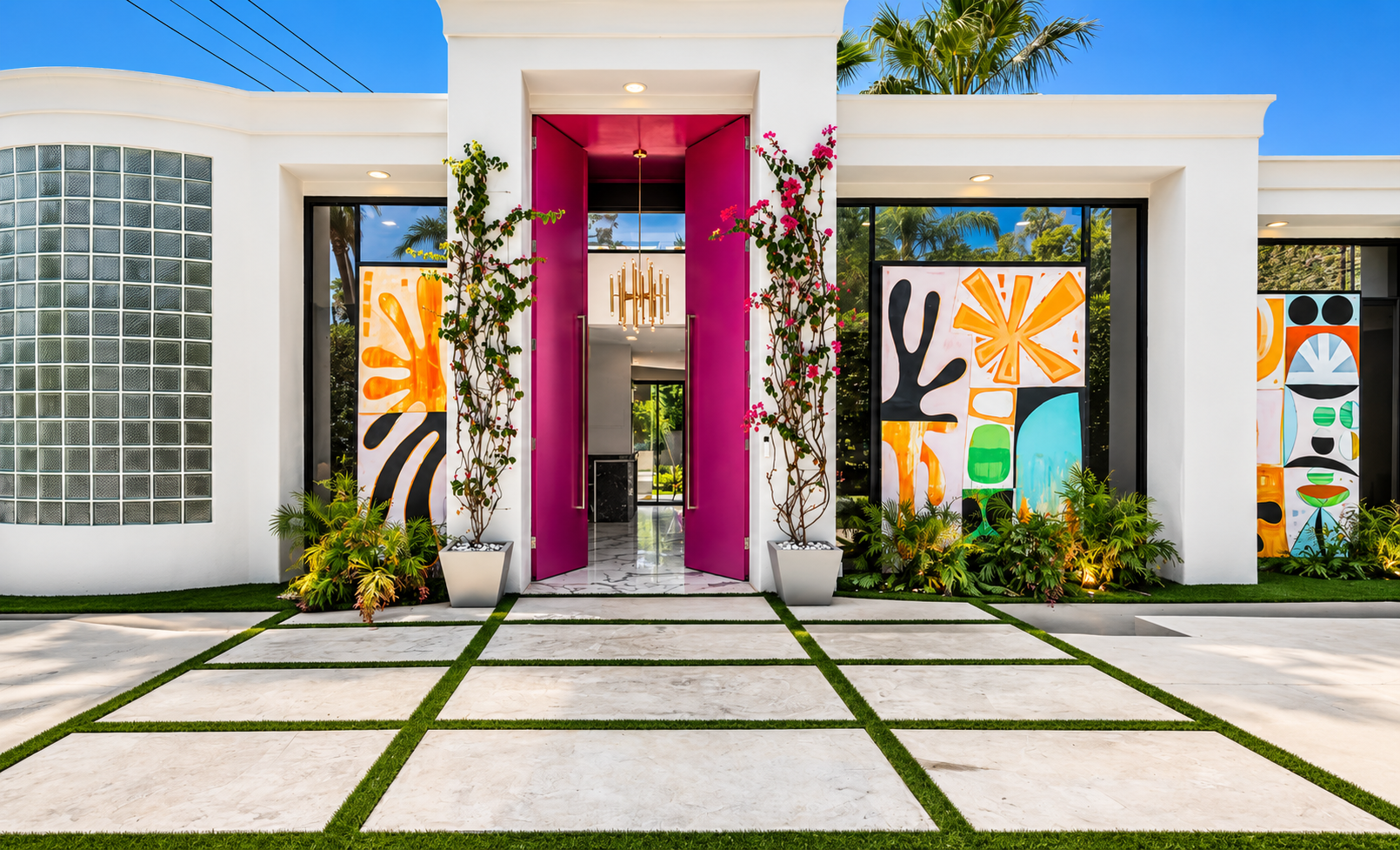
A bold 1950s home in Palm Springs, California, adorned with eight colorful murals by the late artist Shawn Savage, is coming to market ahead of the city’s annual Modernism Week.
The white stucco home on El Camino Way, built in 1954 and recently renovated, has an asking price of $2.295 million. Its staggered facade features three playfully abstract murals on either side of double-height hot pink doors.
MORE: Megamansion Outside Princeton, N.J., With a Pub and Two-Story Library Heads to Auction
The sellers are Los Angeles-based partners John Freeman and Mathieu Faure, who knew it was “the one” when they saw it after several months of searching in the winter of 2023. “It’s a happy house,” Freeman said. “We really liked the feel of the house: the uniqueness, the openness, the brightness—and the art.”
Located in the Mesa neighborhood of Palm Springs, which backs up to the San Jacinto Mountains, the 2,237-square-foot house features three bedrooms, an angled bonus room and a yard with a pool, desert mountain views and another colorful mural running alongside the pool.
“I never thought in my life I would have a house with pink doors,” said Faure, a producer at Apple TV who is originally from Paris. “It’s so colorful, it’s so different. And so Palm Springs.”
The layout of the home creates a smooth flow from the front doors through the open-plan common area—a foyer, bar, and living and dining room—into the kitchen around a fireplace wall and out to the yard. A corridor leads to a private bedroom wing, where the primary suite has floor-to-ceiling windows and the primary bath is only a tad smaller than the bedroom.
Faure has filled the home with Jonathan Adler furniture, rugs and accessories, riffing on the energetic California vibes of the house to create an aesthetic of “modern American glamour,” he said.
“It was enjoyable for me to play with different types of furniture and make this house ‘happy chic,’ as I describe it,” he said.
MORE: Beverly Hills Villa of Late Philanthropist Glorya Kaufman Sells for $19.25 Million
“He did a fantastic job,” said Freeman, who is an attorney and consultant. “It does kind of bring a smile to my face whenever I walk into the house.”
Since the furniture and decor were chosen for the particularities of the space, the couple is open to selling them with the home. Their West Hollywood house is already furnished; the collection doesn’t match the vibes of a Houston loft they bought near family; and Faure can’t imagine these pieces in New York—where he’s lived in the past—he said.
The duo bought the Palm Springs house for $1.925 million in 2024, according to property records, and will list the home Monday. They are represented by Stewart Smith, Patrick Jordan and Kevin Stanley of Bennion Deville Homes/Luxury Portfolio International.
The previous owners had purchased the home in 2021 for $975,000 and then spent more than two years and $700,000 on the renovation, according to Realtor.com. They commissioned Savage, a local Palm Springs artist and painter known for his joyful abstract work, to decorate the home.
MORE: Alpine Villa From Lady Gaga Movie ‘House of Gucci’ Lists for €2.9 Million
Savage, who died in 2024, lived in the Coachella Valley from 2003, and his work can be found in various local institutions and is on exhibit at the Illumine Gallery in Palm Springs. “Some artists pass through a place. Shawn Savage became a part of it,” the gallery’s description states.
Unsurprisingly, the murals invite lots of friendly conversations, as well as guided tours and interested lookers, but never to a degree that it disturbed the peacefulness of their home or the neighborhood, the sellers said. “It felt like living in an art gallery, and you have the exterior that you would share with the world,” Faure explained.
The neighborhood also played a role in their decision to buy, because of its access to the hiking trails of the San Jacinto Mountains, the lack of through-roads and the neighborly environment.
“It’s a very friendly place,” Faure said.

