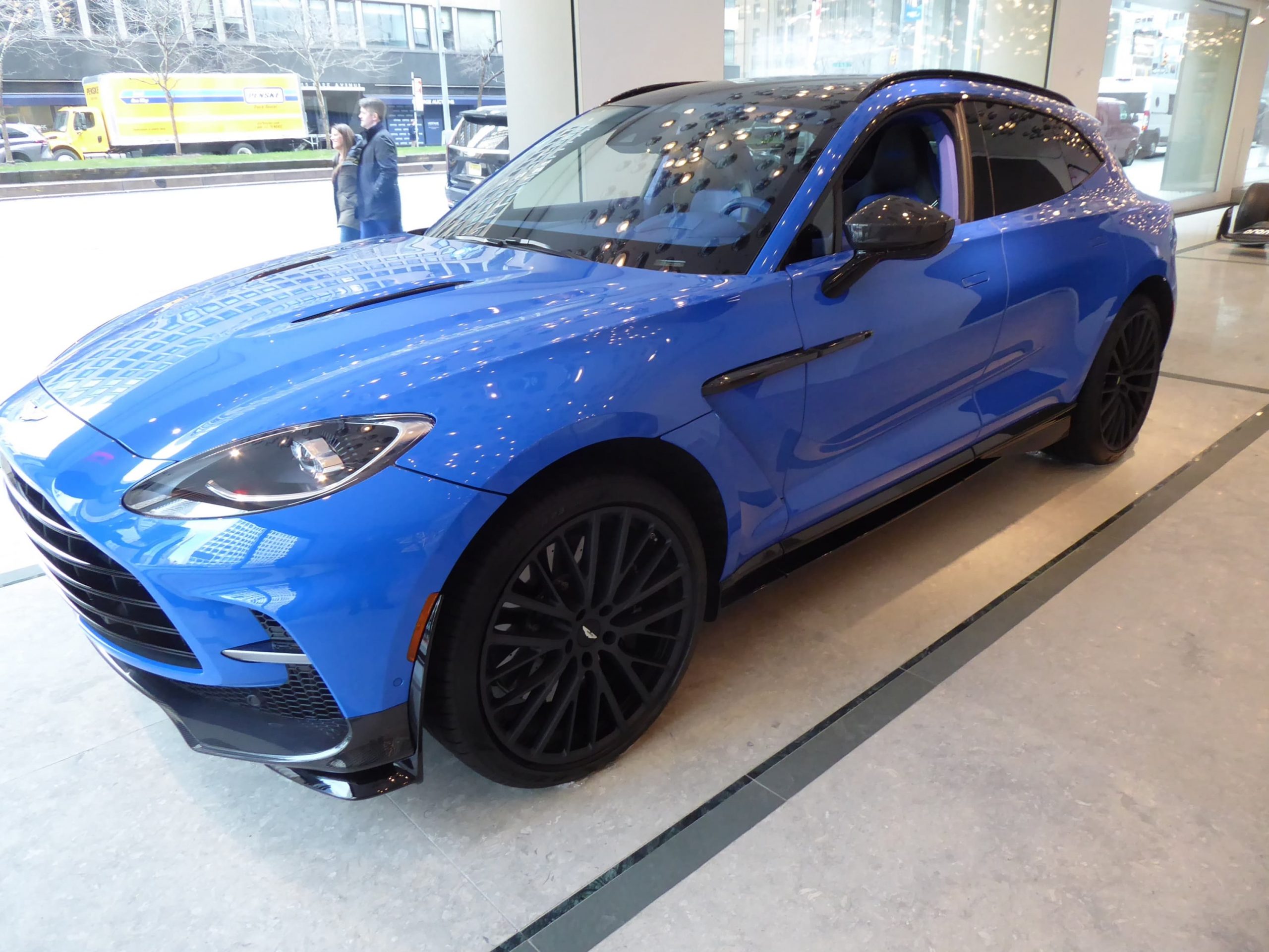
Gaze Upon the Quirkiest Electric Vehicle You’ve Ever Seen

Richard Rieger II, 25, a nurse living in Brandon, Miss., on his electric 1969 Subaru 360, as told to A.J. Baime.

When I was in college, I worked at a place that bought, sold and consigned classic cars. I was a shop mechanic, and a Subaru 360 passed through. I fell in love with it, and, about a year later, one popped up for sale on Facebook. I paid $1,200 for it.

The 360 was the first Subaru imported into the U.S., in 1968. A guy named Malcolm Bricklin imported them. He later started his own car company that failed. [According to Subaru’s website, the 360 sold for $1,297, got 66.3 mpg and was marketed as “cheap and ugly.”] The car did not sell very well. My 360 was not in good shape at all. The motor was disassembled and missing pieces. The cylinders were rusted. The bottom half of the car was mostly rotted out.

At the time, I had just started working as a nurse. Covid was a rough time if you were a hospital worker. I did a lot of ICU work. This car became my Covid project, to get my mind off of work. A lot of it was done when I’d get home, between midnight and 3 a.m. In the summer heat of Mississippi, it’s a good time to work in the garage. It became a “can-I-do-it” project.

I spent about two years just on rust repair. I took the transmission apart. I was able to flush it out and clean it. The brakes were a project. They don’t make parts for this car, so all the parts had to be sourced from different cars and different model years.

For power, I took the electric motor and mounting plate out of a Taylor-Dunn truck. (If you don’t know what this is, you might remember one from the scene in “Austin Powers: International Man of Mystery” when he is riding this little truck and gets stuck in a hallway.) I used the control box out of an E-Z-GO golf cart. So now the 360 runs on electric power.

The goal was never about making an electric car, specifically. I was just trying to get it going with whatever I had lying around and stuff that people gave me. I had to get two sprockets custom made, by a company here in Jackson, Miss., called Motion Industries.

A lot of people in the Subaru community were helpful, through the 360 Facebook page. These cars are so rare these days, and the parts are so hard to find, people are just happy to see them not end up in the crusher. Especially one as bad off as this car was when I started out.

A lot of people also helped me right in my garage. My dad was an electrical engineer for many years, and he helped with the wiring and other stuff. My grandfather, a neighbour, my uncle all helped, too.

Along the way, we took the 360 to car shows, a lot of them locally around Jackson, and one as far off as Ardmore, Tenn. The first time we took it to a show, it had no brakes and we had to roll it up to the judging station with our feet hanging out the doors to make sure we could stop it. Every show we took it to, it had reached another stage, and some people really enjoyed seeing the progress.

I think the car could be street legal, but right now it’s not. Where I live, a lot of the roads are minimum 55 mph. This car has a top speed of about 30 mph. But I have invested so much time in it, and with the help of my friends and family, it means a lot to all of us.

Nowadays, you see Subarus everywhere. But you won’t see many 360s, and you won’t see any other Subaru like this one.

These Teenagers Know More About Investing Than You Do

Seventeen-year-old Sophia Castiblanco doesn’t just drive a Tesla . She also owns shares of the company .

Sophia, a high school junior in the Chicago suburbs, invests in stocks such as Tesla, Apple and Amazon.com. When she started making money as a social-media content creator three years ago, her parents encouraged her to put some of her earnings in investments likely to grow over time, rather than parking all her cash in a savings account .

She now has several thousand dollars invested in accounts set up by her father at Charles Schwab, Edward Jones and Robinhood . Last year, she saved up money to buy a new Tesla Model 3, which starts at around $40,000, through a payment plan she is splitting with her parents. On TikTok, Instagram and YouTube, she makes videos teaching her thousands of followers about investing basics.

“I’ve always had a business mindset of wanting to make money, and I’m very OK with taking risk,” Sophia said. “There’s really no minimum age to start.”

Sophia is one of many teenagers jumping into the U.S. stock market. Teens generally can’t open their own brokerage accounts until they turn 18, but adults can set up custodial accounts for minors. The accounts are turned over to the children when they reach legal age.

Custodial accounts for teens at Schwab totalled nearly 200,000 in 2022, up from about 120,000 in 2019, according to the company. They jumped above 300,000 in 2023, thanks in part to Schwab’s integration of TD Ameritrade. Other brokerages, including Vanguard, Fidelity and Morgan Stanley’s E*Trade, also reported a surge in custodial accounts in recent years.

Some teens ask their parents to open accounts—and share the login information—at brokerages such as Robinhood that don’t offer custodial accounts. At smaller financial apps such as Greenlight, teenagers are investing more money than ever before. They invested $20 million in 2023 using the Greenlight app, up from around $10 million in 2021.

A Fidelity study on teens and money recently estimated that about a quarter of teenagers in the U.S. have started investing, based on an online survey of 2,081 respondents ages 13 to 17. Trades placed using Fidelity’s Youth app, an account opened by parents but owned by teens, jumped in the fourth quarter.

Many teenagers opened up their accounts during winter break while off from school, said Kelly Lannan, a senior vice president at Fidelity.

The boom in teen trading is part of a wider rush to financial markets among Americans since the start of the Covid-19 pandemic. Stocks rocketed higher , drawing hordes of newbie investors trying to profit from the big gains.

Many of those new investors have since ditched the meme stocks that soared during that era but have remained invested, sending the share of Americans who own stocks to an all-time high.

Stocks are back at record levels, with the Dow Jones Industrial Average recently topping 38000 and the S&P 500 eclipsing 5000 for the first time. Since the start of 2020, when an unprecedented trading boom among rookie investors kicked off, the S&P 500 has soared around 55%.

“There’s just more and more awareness that the sooner you start, the better things are,” said James Martielli, head of investment and trading services at Vanguard.

Martielli said he opened custodial accounts for his three children more than a decade ago when they were toddlers. At Vanguard, there has been a jump in custodial IRAs, a type of retirement account.

The biggest advantage is time. Setting aside $10 a week for a child at birth would leave an 18-year-old with a roughly $20,000 nest egg, assuming an 8% annual return, according to the investing app Stash, which offers custodial accounts. Left until the investor turned 70, and assuming annual growth of 8%, that sum would mushroom to about $1 million.

Of course, these returns can be shaped by many factors, including when an investor buys in and how stocks end up doing. The S&P 500 has recorded a 10% annualised total return over the past three decades, according to Dow Jones Market Data through the end of 2023. Buying an S&P 500 index fund at the peak of the dot-com bubble in 2000 would generate an annualised total return of around 7%, while buying at the low of the financial crisis in 2009 would lead to a roughly 16% annualised total return.

Hot tech stocks

Brokerage executives say that technology behemoths that are ubiquitous in the lives of teens are often some of the most widely held shares. At Vanguard, U.S. stock index funds are particularly popular in custodial accounts.

Mahanth Komuravelli, 16, has a small chunk of his roughly $7,000 portfolio in an S&P 500 index fund, while most of his positions are in big companies such as Amazon and Advanced Micro Devices. He is exploring buying some small-cap stocks such as education company Chegg . Mahanth uses a Fidelity Youth Account that his father helped him open. The two often discuss investment ideas.

“Sometimes he asks me for advice,” said Mahanth, a high school junior in Edison, N.J.

Kaida Benes, a 13-year-old from the suburbs of Minneapolis, has been stashing money—earned from household chores such as doing the dishes or cleaning the bathroom—in an investment account on Greenlight that now has about $1,000 in it.

She’s also been drawn to bigger companies and has invested in tech stocks such as Apple, Alphabet and streaming companies Disney and Netflix . At times, she has been on edge about potential losses. She says her mother has helped her stomach the volatility.

“Stocks go up and down. It’s fine, it just happens,” Kaida said she’s learned.

She has been hunting for other opportunities to make money to pour into savings or investments. She recently found a recliner chair at a yard sale and enlisted her parents to help fix it up and flip it for a profit on Facebook marketplace, she and her mother, Renee Benes, said.

“I like having money,” Kaida said.

Renee Benes said she was frustrated that she didn’t learn about investing until a year or two ago, when she was well into her 30s. Benes, who’s an online influencer, wanted her daughter and son to be more financially savvy.

Lessons learned

Many young investors are starting to invest earlier than previous generations did. Almost two-thirds of Gen Z investors said they first started learning about investing in high school or middle school, compared with about 38% of millennials in a 2023 Bank of America survey of affluent individuals. Some are introduced to stocks through family members or teachers, while others have turned to social media.

Felix Peng, a 17-year-old in the Los Angeles area, said he has learned a lot about investing from YouTube and Instagram—but that some social-media stars promote riskier trading strategies that seem more like gambling. He said it is a red flag when influencers try to sell expensive trading courses that promise investors they will make a lot of money quickly.

Still, Felix believes it is beneficial for young people to learn from their mistakes when they have less money to lose. His investments in Apple, Meta Platforms and Alphabet have performed well. But when he bought shares of Teladoc around their peak and watched them tumble, he saw how tough it is to time the market. He has about $1,000 in a custodial account on Stockpile, an investing app geared toward parents and children.

“It’s a great lesson and I’m glad I learned,” Felix said.

Seventeen-year-old Rachael Kim in Orange County, Calif., traded shares of AMC Entertainment Holdings during the meme-stock era and said she made a roughly 300% profit.

“For a little while, I got addicted to that adrenaline,” Rachael said of day trading. “But as I began researching more, I realized it was highly unlikely to continue that aggressive profit.”

Rachael said she started studying investing to help her parents, who are immigrants, prepare for retirement. Now she regularly invests about half of the money she makes—from creating social-media content, working as a cashier and teaching at her church—in index funds tracking the S&P 500 and tech-heavy Nasdaq-100. She has about $10,000 in her custodial Roth IRA at Fidelity.

“Since we’re young, we have the privilege of seeing our investment compound,” Rachael said. “The biggest lesson would be to start early.”

World’s Major Economies Fall Behind U.S.

Economies in the U.K. and Japan shrank at the end of last year, underlining the widening gulf between robust growth in the U.S. and more anaemic conditions in the rest of the world.

The decline in activity in Japan came as a surprise to economists and meant that it has slipped in the global rankings of the world’s largest economies behind Germany and into fourth place.

In the U.K., the economy shrank for the second consecutive quarter, the shorthand definition of a recession. The U.K.’s statistics agency Thursday said gross domestic product fell at an annualized rate of 1.4% in the final three months of 2023, compared with a 3.3% increase in the U.S. over the same period.

U.K. consumer spending, the main driver of the U.K. economy, fell over the second half of 2023 even as wage growth outpaced inflation for the first time in two years, boosting consumers’ purchasing power. Japanese consumers, who are still seeing prices rise faster than wages, also cut their spending in the final quarter.

The growth numbers from the U.K. and Japan mirror similarly weak conditions in much of continental Europe and China .

The divergence between the U.S. and the rest of the rich world is in large part a story of surprising U.S. strength . The U.S. grew much faster than economists had expected it would at the start of 2023, while Europe was badly hit by high energy prices from the Ukraine war and rising interest rates. Economists forecast the growth gap will narrow somewhat over the course of the year, but remain wide.

U.S. consumer spending has been more resilient in the face of rising interest rates than in other parts of the world. Government spending in the U.S. has also remained at historically high levels for periods outside of recessions, giving the economy an added boost.

The Organization for Economic Cooperation and Development earlier this month said it expects the U.S. economy to grow by 2.1% this year, while it sees the U.K.’s economy growing by 0.7% and Germany’s economy by 0.3%.

To be sure, the declines in activity in Europe and Japan have been relatively modest and are a reflection of slow-growing economies that by nature fall into contraction more often than those that have a higher sustained level of growth.

And while economic output declined in a number of rich countries as 2023 drew to a close, job markets in Europe and Japan remained tight, as they were in the U.S. As a result, many economists hesitate to describe the U.K. and Japanese downturns as full-blown recessions.

Policymakers expect economies to pick up as inflation ebbs in the months ahead.

“We’re seeing some signs of a pickup,” Bank of England Gov. Andrew Bailey told lawmakers Wednesday.

Japan’s unemployment rate fell to an 11-month low in December, and the Bank of Japan ’s Tankan survey “showed that business conditions across all industries and firm sizes were the strongest they’ve been since 2018.”

Many economists expect the Bank of Japan to end its policy of negative short-term interest rates in either March or April, although the bank hasn’t confirmed that.

“We doubt that today’s GDP figures will prevent the Bank [of Japan] from ending negative interest rates in April,” said Marcel Thieliant , head of Asia-Pacific at Capital Economics.

The decline in its GDP during the second half of the year, and the yen’s weakness relative to the euro, meant that Japan dropped from third place in the global rankings of economic heft when measured in U.S. dollars.

Germany takes over the third-place spot behind the U.S. and China, despite Europe’s largest economy contracting during 2023.  Japan lost its second-place spot to China in 2010 .

Meet the Woman Taking the ‘Blood Sport’ out of Buying a Coveted Hermès Birkin Bag

The impetus for Judy Taylor to start her luxury handbag and jewellery resale company Madison Avenue Couture dates back to her career in investment banking more than two decades ago. At the time, she was an avid shopper for high-end clothing and had built a sizeable collection of corporate wear from designer labels.

Taylor eventually took an extended break from banking to travel the world and decided to sell the clothing on eBay.

“I was surprised at the money I netted by selling these used items and realized the potential of the online resale market,” Taylor says. “Not being someone to let an opportunity pass, I began to buy and sell new and almost new luxury clothing, shoes and handbags and saw how much they were in demand.”

Hermès Birkin 25 Himalaya Niloticus Crocodile Diamond Encrusted Hardware, priced at $US500,000.
Courtesy of Madison Avenue Couture

Her homespun venture quickly grew into a full-fledged profitable business, and in 2010, she established Madison Avenue Couture. Today, the brand bills itself to be the largest online independent reseller of new and never-worn Hermès holy grail bags, primarily Birkins and Kellys that are nearly impossible to find. It also sells a selection of pre-owned collectible and vintage Hermès, Chanel, Goyard, and Louis Vuitton bags, Hermès and Chanel jewellery, and accessories and sought-after fine jewellery.

Taylor says that her company enables any consumer with the means to buy highly in-demand goods.

“You can’t just go into Hermès and buy a Birkin because there usually aren’t any available, and if they are, customers are limited to buying two bags a year,” she says. “Chanel has also limited purchases since Covid, and other brands have imposed restrictions.”

According to Taylor, these tactics have increased market demand and have enabled luxury labels to increase their prices. However, since supply cannot meet demand, consumers are increasingly reaching out to the resale market, including her company, for these items.

“Our business continues to grow, and we have an extensive network to source handbags and jewellery,” Taylor says. “Unlike much of the traditional resale market, our items are primarily new and never used and carry a premium over [the] retail price.”

Taylor, 59, speaks with Penta about her company and the luxury resale market overall.

Can you talk about how the luxury resale market for handbags and jewelry has evolved in recent years, especially since the pandemic?

About three weeks into the pandemic, we started getting orders. They were slow at first but then accelerated.

With retail stores closed and travel restricted, people turned online to shop. The only place to purchase new Hermès and Chanel handbags was online and from dealers on the secondary market. They became comfortable with buying these brands online. Sales increased by 60% in 2020 and doubled in 2021, compared to the prior years. Even after the brand boutiques opened and travel resumed, online sales continued their momentum. Our sales quadrupled from 2019 to 2023.23.

Who are your customers, and have they changed over the years?

Our clients are primarily those who have disposable income and love to spend it on beautiful things. Partners of hedge funds, investment bankers and law firms, self-made entrepreneurs, physicians and dentists, celebrities and socialites represent the bulk.  But we always have the aspiring—those for whom buying a Birkin or Kelly is a bit of a financial stretch.

What are the advantages of buying a resale bag or piece of jewellery?

Hermès and Chanel do not offer their handbags online. While Hermès.com may offer one or a few small bags on occasion, they are sold out in seconds. The same goes for branded jewellery, notably Van Cleef & Arpels. Try purchasing a popular VC&A Alhambra piece online or in one of their stores to take home immediately—it is almost impossible.

Hermès Sac Faubourg Birkin 20 White Matte Alligator Palladium Hardware, priced at $US225,000
Madison Avenue Couture

The second is ease of purchase. Hermès has made getting a holy grail bag almost a “blood sport.” The machinations that someone goes through to get a Birkin or Kelly are anxiety-producing for most. First, you need to find a friendly sales associate. Then, a profile must be built, which involves spending on Hermès goods that are not leather handbags. The more the spend, the greater the chance of getting a handbag. Expensive furniture, fine jewelry, and watches have the greatest sway. Scarves or a pair of shoes won’t bat an eyelash. The amount needed to be spent is unknown, but we’ve heard it could be significantly more than the price of the bag. Plus, there is no guarantee that it will result in getting the bag of your dreams.

In the secondary market, you can pick the bag of your dreams without the hassle and stress of building a profile.

How do you source your items, and how are you able to guarantee their authenticity?

We purchase from individuals and other handbag dealers primarily. We usually get the original store receipt or a copy of it for most bags we purchase, which establishes provenance. Regardless of having the receipt or not, every bag goes through in-house and third-party authentication. We chose who we believe to be the best independent authenticators of Hermès and Chanel, which is where we find the most counterfeits.

What are some of the most in-demand brands and items for buyers who can afford them?

Hermès and Chanel handbags are generally in demand by professional and affluent women and men who give them as gifts. Goyard is popular because it evokes quiet luxury. In jewelry, we see the greatest demand is for Van Cleef & Arpels pieces, particularly the Alhambra series.

What advice do you have for people who want to find a specific piece from a source outside of the brand itself?

We recommend that people purchase only from dealers who guarantee authenticity and have a history of selling only authentic bags.

Furthermore, rely on a reseller that has its inventory on hand like us.  We have already checked the condition, verified authenticity, and confirmed availability. Marketplaces, which aggregate different vendors, cannot know for certain if an item is available, in the stated condition or authentic. (Some authenticate after the item is sold, which delays getting the item.) Resellers that do not have an item in stock will source it, which can take weeks and may not be in the condition described.

This interview has been edited for length and clarity. 

The Six Months That Short-Circuited the Electric-Vehicle Revolution

The Michigan plant where the F-150 Lightning electric truck is built used to vibrate with excitement.

President Biden visited in 2021 and test drove the blazing-fast pickup. Before the first ones even started rolling off the assembly line in the spring of 2022, Ford said it would expand the factory to quadruple the number it could build.

That energy is rapidly fading. Ford is cutting the plant’s output by half, and workers are relocating to other facilities, mostly those making gas-powered pickups and SUVs.

The sudden change “was a little bit of a shocker,” said Matthew Schulte, who inspects trucks at the factory in suburban Detroit. “Reality has set in.”

As recently as a year ago, automakers were struggling to meet the hot demand for electric vehicles. In a span of months, though, the dynamic flipped, leaving them hitting the brakes on what for many had been an all-out push toward an electric transformation.

A confluence of factors had led many auto executives to see the potential for a dramatic societal shift to electric cars: government regulations, corporate climate goals, the rise of Chinese EV makers , and Tesla ’s stock valuation , which, at roughly $600 billion, still towers over the legacy car companies.

But the push overlooked an important constituency: the consumer.

Last summer, dealers began warning of unsold electric vehicles clogging their lots. Ford, General Motors , Volkswagen and others shifted from frenetic spending on EVs to delaying or downsizing some projects. Dealers who had been begging automakers to ship more EVs faster are now turning them down .

Even Tesla Chief Executive Elon Musk warned of “notably lower” growth in vehicle deliveries for the company in 2024.

“This has been a seismic change in the last six months of last year that will rapidly sort out winners and losers in our industry,” said Ford Chief Executive Jim Farley on an earnings call in early February.

EV sales continue to grow, and auto executives say they remain committed to the technology. But many are recalibrating their plans.

Ford has pulled back on EV investment and could delay some vehicle launches, while increasing production of hybrids , which run on both gasoline and electricity. It lost a staggering $4.7 billion last year on its battery-powered car business and projects an even bigger loss this year, in the range of $5 billion to $5.5 billion.

Some auto executives acknowledge they got ahead of the market with overzealous demand projections. Pandemic-era supply-chain shocks and a resulting car shortage created long waiting lists and early buzz for EVs, making the industry overly optimistic.

Only later, as a barrage of new EVs hit the market, did executives realize that car buyers were more discerning than they expected. Many were hesitant to pay a premium for a vehicle that came with compromises.

Farley and other industry CEOs are still confident that EVs will eventually take off, albeit at a slower pace than initially envisioned. But for now, the massive miscalculation has left the industry in a bind, facing a potential glut of EVs and half-empty factories while still having to meet stricter environmental regulations globally.

“Ultimately, we will follow the customer,” GM Chief Executive Mary Barra told analysts this month.

In 2020, as the car market unexpectedly heated up during pandemic lockdowns, traditional automakers shifted from dabbling in electric cars to launching an all-out blitz. They outlined plans to build dozens of battery factories, EV assembly plants and vehicle models, pledging more than a half-trillion dollars of investment in the technology through 2026, according to consulting firm AlixPartners.

The rapid rise of Elon Musk’s Tesla added to the urgency. Over just a few years, its market value rocketed past those of legacy car companies. Wall Street cheered strategic moves toward electrics and bid up shares of EV startups.

Tougher auto-emissions restrictions in Europe and China gave car companies little choice but to add more EVs or risk penalties. The Biden administration steered the industry toward more environmentally friendly cars, earmarking hundreds of billions in subsidies for battery production, consumer tax breaks and EV chargers.

At the start of 2023, car executives were expecting to cash in on their EV bets.

GM’s Barra had been among the earliest and most vocal industry advocates of shifting to EVs. The Detroit automaker set a goal of phasing out nearly all gas-engine vehicles by 2035.

“This is a breakout year,” Barra said on GM’s January 2023 earnings call . GM was finally making its own batteries and said it was ready to start cranking out EVs to satisfy pent-up demand for a new electric Cadillac SUV and Hummer pickup truck.

Ford, emboldened by swelling orders for the F-150 Lightning, increased prices for the pickups by as much as $20,000 over the original sticker. Elsewhere, car executives were talking up their plans to accelerate EV factory work.

Trouble ahead

Then warning signs began to appear. In mid-January of last year, Tesla slashed prices on some models by more than 20%, triggering a chain reaction.

Used-car dealers who had Tesla Model 3s and Model Ys in stock saw their values plummet by thousands of dollars. Customers who had bought Teslas at higher prices were furious.

“Why cut EV prices when demand is greater than supply?” Bank of America analyst John Murphy wondered.

Musk insisted that there was no demand problem. The company was trying to broaden appeal by making its cars more affordable, he told analysts.

Inside Ford, staffers analysed what Tesla’s cuts might mean for its own EV sales. About two weeks later , Ford reduced prices on some versions of its Mustang Mach-E SUVs by nearly 9%.

Speaking to analysts in May, Farley largely shrugged off the pricing pressures, saying they weren’t reflective of broader interest in EVs. He remained upbeat about Ford’s outlook, reiterating plans to expand Lightning output.

Around that time, car dealer Mickey Anderson began noticing that EVs were accumulating on his lots in Kansas, Nebraska and Colorado.

At first, Anderson and other retailers thought the slower sales were a fluke. At meetings with manufacturers in the late spring and summer, the dealers compared notes.

“We were worried,” Anderson recalled. “We went from wait lists to six months of supply, seemingly in a matter of weeks.”

As car companies entered the summer-selling season, there were other worrying signs. U.S. EV sales for the first half of 2023 rose 50% from a year earlier, down from a 71% increase in the first half of 2022.

The wave of early EV adopters willing to splurge had receded, and the next round of potential customers was proving more hesitant. They had more questions about how far a car could go on a single charge , and the life expectancy of batteries. They worried about charging times, repair costs, and not having enough places to plug in, according to dealers and surveys.

Interest rates were rising, pushing up monthly payments on EVs, which already were selling, on average, for about $14,000 more per vehicle than gas-engine models, according to research firm J.D. Power.

Lyndsey Grover, a Dallas-based paediatric anaesthesiologist, said her husband was pushing her last year to replace her hybrid Volvo with an all-electric version, for environmental reasons.

She looked at a Rivian SUV, Tesla Model Y and an electric Mercedes, but ended up with another Volvo—a plug-in hybrid that could travel some distance on battery power before switching to traditional hybrid mode.

Her husband already had a Tesla Model S. She said it often requires a full night of charging at home, and even then, its range on a single charge often fell below estimates displayed by the vehicle. She felt the family needed at least one gas-powered vehicle.

GM was having trouble processing battery cells , a bottleneck that was preventing it from getting EVs to showrooms. Manufacturing delays left buyers waiting for delivery of models such as the Cadillac SUV and Hummer pickup truck.

Late last July, GM’s Barra told analysts plenty of consumers still wanted the company’s EVs. “These vehicles are getting to the dealers’ lots, and if they’re not already sold, they’ve got a list of people who are waiting for them,” she said.

Two days later, Ford’s Farley struck a different tone . “The paradigm has shifted,” he told analysts. Although consumers were still buying EVs, Ford’s pricing power was deteriorating compared with gas-engine models, he said, and the market for EVs would remain volatile.

Jefferies analyst Philippe Houchois asked Farley what had changed. “A few weeks ago when we saw you in Detroit…it’s like you had religion” on EVs, he told the CEO.

Farley replied that Ford was responding to market realities.

A Ford spokesman said that producing significant numbers of electric pickups before its rivals enabled the company to become an EV truck leader and to attract customers from other brands. Learning about the habits of EV buyers, he said, would benefit future vehicle development.

Late last summer, Ford dealer Ed Jolliffe saw on his store’s computer system that the factory planned to ship him about a dozen Lightnings. That worried him.

Earlier, his Detroit-area dealership had been receiving one or two Lightnings at a time, and his salespeople had had no trouble finding buyers. More recently, prospective customers seemed more hung up on the monthly payment of nearly $1,000.

Jolliffe had spent a half-million dollars installing EV fast chargers. He was getting ready to rent a billboard along the nearby interstate declaring: “Fastest Chargers Downriver!”

“We were all-in,” he said. So he swallowed hard and agreed to take the trucks.

Changing plans

The unraveling came swiftly. In a single month last fall, the average interest rate on an electric-car purchase jumped from 4.9% to 7%, making monthly payments even less affordable for some shoppers, said Tyson Jominy, vice president of data and analytics for J.D. Power.

Suddenly, once-long waiting lists for EVs shrank and buyers dropped reservations.

Over a 10-day span in October, the tone of automakers in Detroit and beyond turned gloomier. GM said it would delay by one year a $4 billion overhaul of a suburban Detroit factory to build new electric pickup trucks, citing “evolving EV demand.”

The next day, Elon Musk said that not as many people could afford a Tesla given higher interest rates and tougher economic conditions. Affordability was keeping a lid on demand, he said during a call to discuss third-quarter results.

A week later, on GM’s quarterly call , Barra described the transition to EVs as “bumpy,” and said the company wouldn’t meet a self-imposed goal of producing 400,000 EVs over a two-year period through mid-2024.

Two days later, Ford said it would defer $12 billion in electric-vehicle investments and focus on increasing hybrid production, citing the need to better match demand.

By late last year, it was becoming clear that sales of hybrids—once dismissed by some automakers as an unnecessary half-measure—were taking off and would outsell EVs in 2023.

“People are finally seeing reality,” said Toyota Motor   Chairman Akio Toyoda . For years, Toyota and other EV-cautious carmakers had been touting hybrids as a consumer-friendly way to reduce carbon emissions.

In November, thousands of U.S. dealers signed a letter urging Biden to ease proposed regulations that would push the industry to sell more battery-powered cars. “Last year, there was a lot of hope and hype about EVs,” the dealers wrote. “But that enthusiasm has stalled.”

Some auto retailers say that they are now selling EVs at a loss to clear unwanted inventory.

Jolliffe, whose car dealership is a 25-minute drive from the Lightning plant, is struggling to understand what happened. On a recent weekday, he peeked out his window at eight Lightnings and four Mach-Es.

“Nobody’s opening the door” to check them out, he said. “There just seems to be this hesitancy that is hitting hard.”

Men Used to Have Wives. Now They Have Stylists.

Jay Buys’s wife changed his life with 10 words: “You know, you don’t have to just wear band T-shirts.”

Shirts from Nine Inch Nails and Thrice—for years, this was the bulk of Buys’s wardrobe. Were they awesome ? Yes. Did they make him look like the CEO of a successful web design firm? Not quite. “If I looked better, I would’ve felt better,” said Buys, 44, of San Diego. So he hired someone to teach him to look better.

For most, the term “stylist” brings to mind a celebrity dresser putting Timothée Chalamet in a bombastic red carpet outfit. But there is also an industry of white-collar stylists helping hapless corporate types find the right shirts and trousers for their daily lives.

For Buys, that guy was Patrick Kenger.

Kenger runs Pivot, a personal styling service, charging as much as $5,000 to remake your wardrobe. Kenger’s job is part Marie Kondo, part therapist and large part a personal shopper. He helped Buys retire the band tees at work, subbing them with Suitsupply blazers and Bonobos trousers.

The switch had a Superman-bursting-out-of-the-phone-booth effect on Buys. “​​I look like I know what I’m doing.” Strangers seem to think so, too. He was startled when a random 20-something at the grocery store saw his leather John Varvatos jacket and chirped, “I like your drip, bro!”

Today, strivers in tech, law and finance are wealthier than ever, but corporate dress codes have collapsed. The hoodie-clad billionaire has become a cliché. In the C-suite, Loro Piana sneakers have trounced dress shoes. Fleece vests have vanquished ties. At the same time, we’re in a new era of boardroom boasting.

Executives crow about their pay packages, their workout routines (looking at you Mark Zuckerberg!) and the rarity of their sneakers. To look like you haven’t bought new clothes since we all clutched BlackBerrys is to risk being lapped on the corporate ladder.

So, if you’re sitting there confidently dressed and accepting compliments on how well your pants fit, congrats! But there are many men who lack the skills to piece an outfit together. Stylists say their work has ballooned in the past decade as the range of options on what’s office “appropriate” has waylaid even confident corporate leaders.

“Men are very confused right now with the dress codes that have blurred the lines of formality,” said Jacci Jaye, a white-collar stylist in New York City for two decades, whose services start at $3,800 plus expenses. Jaye, who works solely with executives, said that many of her roughly 50 clients knew what they liked in terms of style, but had no idea how to achieve that look.

“I looked sloppy and I didn’t want to look sloppy,” said Raj Nangunoori, 36, a neurosurgeon in Austin. He spent working hours in scrubs, but out of them, he was adrift. “Even shorts, like I was never great at picking out shorts,” Nangunoori said.

Around a year ago, he googled in search of a stylist and hired Peter Nguyen, a former menswear designer turned $10,000 stylist. Nguyen’s entrepreneur- and tech-type clients are long on money, short on time and scant on clothing knowledge.

Nguyen’s first step is a lengthy questionnaire: What music do you listen to, what are your hobbies, where do you vacation? “I view my clients like they’re characters in a movie,” he said. They give him their background and Nguyen’s job is to outfit that character.

The pair landed on a neat framework for Nangunoori’s new look: What would Ryan Reynolds wear? Prosaic tees were swapped for polo-neck sweaters and James Perse chinos were tailored to fit properly. Nguyen got Nangunoori into a pair of Common Projects minimalist $500-ish sneakers. Most importantly, he convinced him to ditch his shopping mistake paint-splattered jeans.

“I can’t pull off what Travis Scott’s wearing,” said Nangunoori, relaying all his hard-bought wisdom.

Like working with a trainer, some clients are wary of admitting they enlisted a fashion guru. One CEO I spoke with who hired a stylist told his business partner he had done so, only to be mocked. After that, he decided “I’m not talking to anyone.”

“I never had my own confidence in going shopping and buying suits or dress clothes or even my weekend stuff,” said Nate Dudek, 42, an executive at a software company living in East Hampton, Conn. A “technology nerd,” Dudek wasn’t born with a strong visual sense. “That goes from everything from picking a wall color in my house to the way I dress.” His tees-and-jeans wardrobe was as spicy as a glass of milk.

In 2022, about one year before co-founding his own company, Dudek “set out to invest in myself” by hiring Cassandra Sethi, a New York stylist behind the company Next Level Wardrobe whose services currently start at $5,500. Dudek’s wife, who has “killer style” and occasionally shopped for him, took some warming up to the idea. “She was like, ‘Why? I’m so good at buying you clothes!’”

But Dudek wanted an objective outside advisor—someone who didn’t know him as intimately as his wife—to overhaul his closet. (His wife has come around, and is relieved to not be his unpaid personal shopper.)

He never even had to meet her in person. Sethi shipped him boxes of clothes and over a three-hour Zoom session they deduced what suited him best. The transformation, Dudek said, “was fairly obvious.” Colleagues commented that he was carrying himself differently in his new grey Ted Baker blazer, and Save Khaki United’s trim tees. “I felt it too,” he said.

It is a cliché—but a factual one—that in many relationships, the wife or better-dressed husband is the begrudging fashion consultant. Supreet Chahal, a personal stylist in Oakland specializing in tech guys, says many clients come in saying “my girlfriend tried to help me, my wife tried out on me, but she keeps dressing me the way she wants me to look.”

Marco Rodriguez’s former girlfriend didn’t shop for him, but did steer him towards Nguyen a few years ago. “She was like, ‘Hey listen, I know you hate shopping,” said the 39-year-old musician and entrepreneur in Austin.

And oh, he did. Rodriguez could never find pants that fit his “interesting physique.” When he needed new clothes, he had to force himself to buy them. His style was directionless.  I knew what I wanted but I just didn’t know how to get there.”

With Nguyen’s assistance, Rodriguez landed on a sort of “Soho boho, I hate to say rockstar” look of low-key Justin Theroux-style leather jackets, Chelsea boots and pieces from Parisian label Officine Générale. The experience “got me out of my comfort zone,” Rodriguez said.

The mindlessness that comes from working with a stylist is enticing to efficiency-obsessed tech workers. “I don’t want to spend a lot of time thinking in the morning,” said Michael Peter, 53, a principal architect at Google in cloud technology. Previously, he dressed like your standard tech worker—jeans, tennis shoes, the odd Batman tee—but a lightbulb went off during one meeting when he watched a better-dressed colleague take charge.

“He walked in the room, he had gravitas,” said Peter. Striving for that same effect, he hired Sethi of Next Level Wardrobe. She directed him toward a “refined elevated casual look” of slender-but-stretchy Vuori pants (which accommodate his gym-rat legs) and James Perse polos. Rather than his girlfriend telling him what to buy, he says, she’s stealing his clothes “all the time.”

To be sure, all of this comes at a cost. Businessmen I spoke with view the hefty fees as an investment, like renting a well-appointed office.

“The cost didn’t faze me a bit,” said Aaron Preman, 48, who owns a roofing company in San Diego, and hired Kenger at around $3,500.

“He taught me a lot in a short amount of time,” Preman said. He discovered that wintery colours suit his olive complexion and that he really likes Theory suits and Zegna ’s $990 triple-stitch sneakers—he now owns several pairs. The cost of everything—the guidance, the clothes—has been worth it to Preman. “He could’ve told me $10,000 and I would’ve said, ‘Okay, when are you coming over?’”

Hotter-Than-Expected Inflation Clouds Rate-Cut Outlook

US: Inflation eased again in January but came in above Wall Street’s expectations, clouding the Federal Reserve’s path to rate cuts and potentially giving the central bank breathing space to wait until the middle of the year.

The Labor Department reported Tuesday that consumer prices rose 3.1% in January from a year earlier, versus a December gain of 3.4%. That marked the lowest reading since June.

Still, the consumer-price index was higher than the predicted 2.9%, a disappointment for investors who hope the Fed will cut rates sooner rather than later. Rate cuts tend to help stock prices by boosting economic activity and reducing competition from bonds for investor dollars.

The release gave a nasty jolt to markets. Stocks fell sharply and bond yields rose. The Dow Jones Industrial Average slid more than 500 points, or about 1.4%, its worst one-day decline since March. For all three major U.S. stock indexes, it was their worst performance on a CPI release day since September 2022 , according to Dow Jones Market Data.

The yield on the 10-year Treasury note rose to 4.315%, bringing it to its highest level since the end of November.

Interest-rate futures, which before Tuesday’s report implied the central bank would probably begin cutting rates by its May meeting, now suggest a June start date is more likely.

Where the Fed could go from here

Investors’ belief that Fed cuts were imminent has helped fuel the rally in stocks. The Dow on Monday had hit its 12th record close of 2024.

But Tuesday’s inflation report underscores why Fed officials have been dismissive of such expectations. Some Fed officials have suggested that the pace of improvement over the past six months might overstate underlying progress in containing price pressures.

Officials have said they aren’t ready to entertain rate cuts at their next meeting, March 19-20, because they want to see more evidence that inflation is returning to their 2% target.

Fed Chair Jerome Powell has said officials want to see more evidence that inflation is returning to its 2% goal, which is measured against a separate gauge to be released later this month by the Commerce Department.

“It’s not that the data aren’t good enough. It’s that there’s really six months of data,” Powell said in an interview on “60 Minutes” earlier this month. “It doesn’t need to be better than what we’ve seen, or even as good. It just needs to be good.”

Core prices, which exclude food and energy items in an effort to better track inflation’s underlying trend, were up 3.9% in January. That was equal to December’s gain, which was the lowest since mid-2021.

From a month earlier, overall prices were up a seasonally adjusted 0.3%, and core prices were up 0.4%—larger gains than economists expected.

Two measures of inflation

The Fed’s preferred measure of inflation has been running cooler than the Labor Department’s, and analysts said that could continue in January. The figures released Tuesday calculate medical care and airfares differently, and those categories were especially strong in January. The Labor Department’s measure also puts a much higher weight on shelter costs, which for both owners and renters are derived from rents. Shelter costs accounted for 0.23 percentage point of the monthly gain in overall prices in January. Shelter costs were up 0.6% month over month.

Some Fed officials have said they are looking for evidence that a slowdown in price pressures is broadening beyond goods such as used cars, which have seen prices decline over the past year. Tuesday’s figure showed the opposite: Price declines accelerated for goods while price increases accelerated for services.

And prices are still far above where they were before the pandemic—especially for items   that most Americans buy often, like groceries.

The sting of those past price increases might be part of why so many Americans remain down on the economy . An analysis conducted by Goldman Sachs economists suggests that frustration with high price levels might have contributed to low confidence readings that persisted in the early 1980s even after inflation had slipped sharply.

“It does seem like it takes a while for confidence to recover, in part because people are focused on levels rather than changes,” said Goldman chief economist Jan Hatzius .

The Labor Department’s measure of overall consumer prices was up 19.6% this January from four years earlier, just before the pandemic hit. In contrast, prices were up 8.9% in the four years ended January 2020.

Economists generally expect inflation to cool this year, though they caution the process could be bumpy. Cooling prices for newly signed leases, for example, should eventually translate into lower shelter costs.

“I can tell inflation has gotten better,” said Mike Poore, of Henderson, Ky. “That’s definitely a good thing. It’s a shame it’s not happening quicker.”

The high cost of groceries

A Bank of America Institute analysis of customer data found households tended to make far more transactions a month for food and drinks at restaurants and bars, for groceries and for gasoline than they do for other items. Labor Department figures show that prices in all three of those frequent-transaction categories are higher, relative to before the pandemic, than prices overall.

Research from University of California, Berkeley economist Ulrike Malmendier and three co-authors found that prices for items that people buy more often play an outsize role in framing their inflation expectations. “In terms of what gets ingrained in people’s brains, it’s stuff that they purchase frequently,” she said.

Other research Malmendier has conducted examines the scarring effects of inflation episodes , which can have persistent, and potentially costly, effects on people’s financial decisions. She is heartened by the fact that inflation has retreated relatively quickly from the 9.1% it hit in June 2022 —a contrast to the experience of the late 1970s and early 1980s, when inflation remained elevated for years.

“I’m a little less worried about long-lasting effects than I was in 2022,” she said.

Wrigley Gum Heir’s Porsche and a Pristine Ferrari Spyder to Highlight Miami Car Auction

An exceptionally rare 1967 Ferrari 365 California Spyder by Pininfarina, the ninth of just 14 built, will highlight an auction of classic cars and other vehicles in Miami next month.

RM Sotheby’s will conduct a two-day auction from March 1-2 with 119 motor vehicle lots at the first ModaMiami extravaganza. On offer will be boats, motorcycles, and a plane, too.

The Spyder is in exceptionally original condition, with certification from Ferrari Classiche that it retains its matching-numbers chassis, engine, transmission, rear axle, and body. The car is chassis number 9935, completed in May 1967 and in the hands of two long-term owners (four owners total). It was specified with China Red paint and a white-leather interior that matched the Los Angeles-based first owner Nancy Tewksbury’s 275 GTS. The coachbuilt car was bought by Donald Grove, a Princeton physicist, in 1971. Grove restored the car and kept it for 27 years. The Spyder is estimated to achieve between US$4 million and US$4.5 million.

A 1929 Duesenberg with LeBaron coachwork was originally owned by the man who ran both the Wrigley’s gum company and the Chicago Cubs.x
RM Sotheby’s

Another notable car at the auction will be a 1929 Duesenberg Model J “Sweep Panel” dual-cowl phaeton with coachwork by LeBaron. The car’s original owner was Phillip K. Wrigley, who took over the famous chewing gum company (and the Chicago Cubs) from his father, William Wrigley, Jr. The younger Wrigley traveled to the Duesenberg factory in Indiana to see his car being built. It is chassis 2177 with engine J-121, originally with a Murphy body.

After a year and 10,400 miles, Wrigley decided he preferred the dual-cowl LeBaron phaeton body on a friend’s car better, and so he retained his original chassis but swapped on the LeBaron body. It was the kind of thing that was possible on cars with body-on-frame construction. The Duesenberg is estimated to achieve between US$2.65 million and US$2.85 million.

This 1966 Porsche 906 Carrera S achieved more class wins than any other 906.
RM Sotheby’s

From the racing side of things comes a 1966 Porsche 906 Carrera S with competition history, initially driven by first owner Josef “Sepp” Greger. The car ran to victory in the two-litre class at the European Hillclimb Championship in 1966 and the European Mountain Championship in 1968. Under new owners, it competed in other German races in 1971 and 1972, then went to Macau, where it also raced but did not finish. It took part in some 80 races (achieving more class wins than any other 906) and was even used briefly as a road car. Under New York owner Jean Goutal, who bought the car in 2003, it was finally fully restored by Porsche racing specialist Kevin Jeanette’s Gunnar Racing. After three years of work, the Carrera is now virtually as-delivered, with many period details. The estimate is between US$1.8 million and US$2.8 million.

Fancy a very original Cobra? This 1964 289 example has never been crashed or extensively modified.
RM Sotheby’s

Other special cars in the RM Sotheby’s Miami auction include:

— The 1964 289-powered Mark II AC Cobra is a late production model with rack-and-pinion steering and a pair of dual-barrel carburetors from the factory. The car retains its original engine, which offers 271 horsepower. Originally sold in Illinois and then Ohio, the car was on the cover of the first Cobra World Registry in 1974. The Cobra was repainted in the 1980s in its current classic blue with white stripes. After extensive service in 2022 by Cobra specialist Rare Drive in New Hampshire (including a rebuild of the brakes and suspension) it is ready for the road. The car has never been in an accident or had extensive modifications. It’s estimated at US$1.1 million to US$1.3 million.

— The 1929 De Havilland DH60GM Gipsy Moth is a restored airplane from the early days of aviation that was used in the making of the 1985 hit film Out of Africa. In keeping with that history, the plane’s sale benefits a rhinoceros sanctuary in Kenya. This all-metal Gipsy Moth was built under a De Havilland license in the U.S. in 1929. It was then shipped to the UK, where it was eventually registered G-AAMY to celebrate the career of British aviatrix Amy Johnson, the first woman to fly solo from England to Australia in her own Gipsy Moth. In 1985, the plane was dismantled and shipped in two crates to Nairobi by way of Germany. It subsequently appeared in numerous scenes in Out of Africa , which starred Meryl Streep and Robert Redford and is based on the 1937 autobiography of that name by Isak Dinesen (a pseudonym for Karen Blixen). The plane has been regularly maintained and now has an uprated De Havilland Gypsy II engine that makes 135 horsepower, and is said to be eminently air-worthy. The plane is projected to bring US$140,000 to US$220,000.

Very few of these 27-foot 1941 Chris-Craft Model 115 Custom Runabouts were built, and “Runaway Jane” is the only survivor from that year. RM Sotheby’s
RM Sotheby’s

— The 27-foot 1941 Chris-Craft Model 115 Custom Runabout “Runaway Jane” is the only survivor of three of these triple-cockpit wooden boats built that year. It was restored by Michigan experts in 2002 and has been sympathetically maintained since then. Power now comes from an 8.2-liter Mercruiser V8 with more than 300 horsepower, considerably enlivening the original performance. Only 62 examples of this 27-foot craft were built over a 10-year period.The low estimate is US$175,000 and the high US$225,000.

A star of the hit film Out of Africa was this 1929 De Havilland DH60GM Gipsy Moth airplane
RM Sotheby’s

There are, of course, many other vehicles being sold, including a series of BMW M cars, and classic Mercedes, including examples of the 540K, the 770K, and the 300SL.

How China Miscalculated Its Way to a Baby Bust

China’s baby bust is happening faster than many expected, raising fears of a demographic collapse. And coping with the fallout may now be complicated by miscalculations made more than 40 years ago.

The rapid shift under way today wasn’t projected by the architects of China’s one-child policy—one of the biggest social experiments in history, instituted in 1980. At the time, governments around the world feared overpopulation would hold back economic growth. A Moscow-trained missile scientist led the push for China’s policy, based on tables of calculations that applied mathematical models used to calculate rocket trajectories to population growth.

Four decades later, China is aging much earlier in its development than other major economies did. The shift to fewer births and more elderly citizens threatens to hold back economic growth. In a generation that grew up without siblings, young women are increasingly reluctant to have children —and there are fewer of them every year. Beijing is at a loss to change the mindset brought about by the policy.

Births in China fell by more than 500,000 last year, according to recent government data, accelerating a population drop that started in 2022 . Officials cited a quickly shrinking number of women of childbearing age—more than three million fewer than a year earlier—and acknowledged “changes in people’s thinking about births, postponement of marriage and childbirth.”

Some researchers argue the government underestimates the problem, and the population began to shrink even earlier.

Following the data release, researchers from Victoria University in Australia and the Shanghai Academy of Social Sciences predicted that China will have just 525 million people by the end of the century. That’s down from their previous forecast of 597 million and a precipitous drop from 1.4 billion now.

“Our forecasts for 2022 and 2023 were already low but the real situation has turned out to be worse,” said Xiujian Peng, a senior research fellow at Victoria University who leads the population research in Melbourne.

China’s fertility rate is approaching one birth for every woman , less than half the 2.1 replacement rate that keeps a population stable. In the late 1970s, the fertility rate hovered around 3.

At the time, China was coming out of the chaos of the Cultural Revolution and about to embark on economic reforms. The country’s leader, Deng Xiaoping, and other officials became alarmed when a group of scientists told them that unless they started restricting births, China would have more than four billion mouths to feed in a hundred years.

An essay by some of the scientists published by the official People’s Daily in early 1980 suggested China’s search for a response to overpopulation “points to bringing the fertility rate down to 1…each couple having only one child.”

That fall, China started enforcing the one-child policy nationwide—but the calculations had missed some crucial factors.

Population fears

China wasn’t the only country worried about overpopulation at the time. The rapid rise in the global population in the 1960s and ‘70s prompted fears that humanity would reproduce faster than food production could rise, an idea argued nearly two centuries earlier by economist Thomas Malthus.

Chinese officials were increasingly reviving scientific research after the Cultural Revolution. While social scientists had been persecuted by Mao’s Red Guards, others doing work related to the military had been partly shielded.

The group included Song Jian, a protégé of the father of China’s atomic-bomb program and one of China’s top scientists working on satellites and rockets. Song had studied in Moscow, where he got advanced degrees in a branch of mathematics known as control theory and in military science. Military officials sent him to a launch site for rockets and satellites in the Gobi Desert to escape the chaos of the Cultural Revolution.

Song, who eventually became China’s senior cabinet member heading science and technology, is now 92. He didn’t respond to requests for comment sent to the State Council and the Chinese Academy of Engineering.

In 1975, Song had been part of a Chinese academic delegation visiting the University of Twente in the Netherlands, where he got to know a Dutch mathematician, Geert Jan Olsder. Three years later, the two met a second time, at a conference in Finland.

Olsder, now in his 80s, said he talked about how his research with other mathematicians had been inspired by the warnings about finite global resources and how mathematical models could be applied to birthrates.

Song spoke with the others in fluent English and showed a clear interest in mathematical modelling, Olsder wrote in an email. If the two hadn’t met, he said, he’s sure that some kind of population policy would have started in China, but perhaps a little later. “I feel like a domino stone in a long series of such stones,” he wrote.

Song refined his modelling over the next few years, and with a team of scientists began calculating how different fertility rates could affect China’s population size. In late 1979 he began to present officials with reports based on their modelling. He calculated that, at a constant fertility rate of three babies for every woman, China’s population would hit 4.26 billion by 2080.

With his computer-assisted mathematical models and political connections, Song caught the attention of top leaders. He argued that rapid population growth would prevent China from becoming a rich, modern country, said Susan Greenhalgh, an anthropologist at Harvard University who has written books about the one-child policy.

“He used a frightening narrative of a coming demographic-economic-ecological crisis to persuade people,” she said.

To ward off skepticism, officials said China could switch gears if births dropped too much. “In 30 years, the current problem of especially dreadful population growth may be alleviated and then [we can] adopt different population policies,” the Communist Party said in an open letter in 1980.

Within a little more than a decade, the fertility rate had dipped below the replacement rate. The cohort of young women was still massive, which kept the population growing. But the number of newborn girls was quickly dwindling.

Impact

As the decades passed, a growing number of demographers and economists called out the policy as outdated and flawed. China’s fertility rate would have gone down on its own as life expectancies rose and economic conditions improved, they say.

One factor missing from Song’s population math was human behaviour. The government’s sometimes brutal enforcement, including forced abortions and sterilisations, as well as decades-long propaganda about the benefits of having a small family , left a lasting one-child mindset. The modelling also failed to take into account the traditional preference for sons. If couples could only have one child, they would prefer to have a boy.

Young women are now at the core of China’s demographic dilemma. They are increasingly reluctant to have children—and there are fewer of them every year.

Greenhalgh, the Harvard anthropologist, said that the women growing up under the one-child policy were raised in line with Beijing’s goals of a smaller but what it called “higher-quality” population: well-educated, savvy and independent. “These women are not going to accept going back to the family to be housewives,” she said.

Apart from cultural and social changes, Song’s model hadn’t taken into account economic forces, such as the enormous migration flows to cities unleashed by Deng’s reforms, which played a bigger role than anyone had imagined in pushing down fertility rates, researchers have said.

Zuo Xuejin, a retired demographer who is leading the research team at the Shanghai Academy of Social Sciences, sounded alarms about demographic implosion more than a decade ago, saying the conditions that may have warranted birth-restriction measures had all faded away.

“For many years overpopulation was China’s major concern. It was difficult to convince the government and the public that China will have the problem of fast decline and aging of the population,” Zuo wrote in an email.

Song has said he believed it had been a good call. China had successfully defused the bomb that could have led to a “population explosion,” he wrote in a 2010 essay published by the University of Jinan, his alma mater. “Zero growth [in population] is the destiny of modern mankind and an urgent task for contemporary China,” Song wrote. He estimated China’s population wouldn’t start shrinking until after 2035. He was off by more than a decade, with official data showing the drop starting in 2022.

Beijing has said the policy prevented 400 million births, a claim it has often put forth as a kind of Chinese gift to the world, including at the 2009 climate summit in Copenhagen. Demographers have disputed the figure, saying China’s fertility rate would have gone down on its own as economic conditions improved.

Demographer scramble

Even when Beijing dropped the one-child policy in 2015, leaders didn’t abolish birth restrictions altogether. Instead, it just pivoted to a two-child policy. Now, Beijing is urging people to have three, trumpeting the need to return to a “birth-friendly culture.”

Entrepreneurs, economists and demographers have tried to convey the idea that China needs more babies .

James Liang , co-founder and chairman of travel service provider Trip.com Group and a research professor of economics at Peking University, co-founded YuWa Population Research Institute, a private think tank focused on demographic and public policy analysis.

Liang estimated that China needs to devote 5% of its gross domestic product—roughly equivalent to its education spending—on direct subsidies to promote births and lower the costs of raising children in order for the fertility rate to recover to 1.4, the average rate of advanced economies. His company gives its long-term employees an annual cash bonus of 10,000 yuan ($1,406) for each of their children until they are 5 years old.

Demographers are trying to catch up on the rapidly falling births. The United Nations’ population predictions for China, which were based on the country’s 2020 census and assumed a fertility rate of 1.19, are already out of step with reality.

Patrick Gerland, head of the U.N.’s population estimates and projection section, said their computing tries to capture long-term trends and isn’t made for rapid changes. He agrees with other researchers that put China’s fertility rate closer to 1.0.

“In the case of a country like China where the fertility from one year to the next year has been changing so fast, we’ll have smaller population [projections] than what we had expected two years ago,” he said. The U.N. plans to update its forecasts in July.

Yi Fuxian, a senior scientist in obstetrics and gynaecology at the University of Wisconsin-Madison and a critic of China’s birth restrictions, has long argued the situation is even worse than official data suggests. Yi believes China’s population actually started shrinking years ago, based on birth estimates pieced together from other available data, such as school enrolment and the number of vaccines for newborns.

“All of China’s population policies for decades have been based on erroneous projections,” Yi said. “China’s demographic crisis is beyond the imagination of Chinese officials and the international community.”

Once a generation of young people has made up their minds, it’s hard to change them, said Cai Yong, a sociologist at the University of North Carolina at Chapel Hill.

It’s possible fertility rates could now increase with official messages and policies promoting bigger families to a newer generation, said Cai, but “if it’s going to happen, it’s not going to happen in the short term.”

These Families Are Shutting Down the Bank of Mum and Dad

The parents have been paying the monthly phone bill and covering rent for far longer than in prior generations. Some are helping their children with down payments to buy homes. Others are putting a roof over their kids’ heads well into their 20s and 30s to help them save because they can’t cover rising costs of living.

That comes with a price tag. More than a quarter of parents who are helping their children financially said it caused them to postpone retirement, according to a recent Credit Karma survey . More than half had to cut back on living expenses and about a third took on debt.

Feeling stretched, they are negotiating the terms of separation.

Nancy Clark and her then-28-year-old son, Reid Clark, had just sat down to dinner in June 2022 when the conversation turned to when he would move out. The topic had come up before, but this time they decided to set a date one year later.

Nancy, now 60, said she remembers thinking: “I know that becoming financially independent needs to feel a little painful.”

Reid set off on his own last June. He ditched a job managing his family’s three ice cream shops in New Hampshire for a gig as the assistant to a professional ice hockey team’s mascot in St. Paul, Minn. He also works at an M&M’s store.

Nancy bought him groceries when he moved in and occasionally gives $50. By this June, Reid will no longer get any financial help if he’s short. He hasn’t needed to hit up his mum for rent money in the past few months. “I want to chart my own path in life,” he said.

Taking such a gradual approach and framing the conversation around gaining financial independence give it a positive spin, said Rocky Fittizzi , a wealth strategies adviser at Bank of America Private Bank. Telling your children you’re cutting them off suggests it is a punishment.

An emotional decision

Many adult children are living at home, or moving back in, to save money. The cost of food and rent have jumped, and more college graduates are saddled with student debt. The share of 25-to-29 year-olds with student loans rose to 43% in 2022 from 28% in 1992. The rise was even bigger for those between 30 and 34, according to a recent report by the Pew Research Center.

Some 20% of men and 12% of women between 25 and 34 years old lived at home last year, far higher than two decades ago, according to Census Bureau data.

During the pandemic, layoffs and money strains forced some adult children and their parents to live together and share finances, said Arne Boudewyn at Insights Squared Consulting Group, a family wealth consulting company.

Worries over losing the close bonds forged during those years may add to the stress of ending monetary help, financial advisers said.

“Letting go is often harder for parents these days because we need to feel needed as much as we want to feel wanted,” said Bobbi Rebell , the founder of Financial Wellness Strategies, which gives workshops for parents about how to teach their children to be financially responsible.

Tough love, but not too tough

Pam Lucina still remembers the day about 30 years ago when her father told her she was off the payroll. She was in her first year of law school. Her parents had paid for her undergraduate education. Because she assumed they would pay for law school too, she had chosen a pricey school.

She graduated with $40,000 in student debt and couldn’t afford to contribute to her 401(k) for about five years.

“I know that my parents sacrificed to give me what they did and I’m grateful for all of their past support but I wish I had been more prepared,” said Lucina, 52, now an executive vice president at Northern Trust .

Lucina said the experience was a main reason she became a financial adviser. She has three daughters, and recently asked the oldest to complete her own college financial-aid form.

She tells clients that even if they have good intentions when cutting off their kids, it can feel to the children as if their parents are withholding money to punish them.

“Assure them that love is not contingent on finances,” she said.

Create an exit strategy

There are times when financial help is necessary. With a health issue or addiction, parents often use a special needs trust, where funds typically go directly to the child’s treatment and recovery. Others may opt to help children temporarily after a layoff.

But financial advisers said parents need to set boundaries.

Ashley Kaufman ’s parents told her she would need to move out of their Manhattan apartment, where she was living rent-free, once she saved $100,000 for a down payment on her own place.

The cybersecurity consultant hit her goal by the time she was 25, but she wasn’t sure she was ready to move out right then. She enjoyed seeing her younger siblings regularly and playing with her family’s dog named Waffles, she said. Her parents encouraged her to go to some open houses anyway.

Kaufman, who is the stepdaughter of Rebell from Financial Wellness Strategies, is now 27. She bought her apartment around two years ago.   She’s happy to be building equity in her place.

“I’m glad my parents gave me a little nudge,” she said.

—Julia Carpenter contributed to this article .